Museum Friend Rick Domas looks at the county’s major landowners in the 19th Century, including a local vicar!
I was leafing recently through my copy of The Parks and Forests of Sussex by William Smith Ellis, Esq, published in Lewes by H. Wolff in 1885, and came upon a table titled, ‘List of Landowners in Sussex of Over 1,000 Acres’, drawn from the Parliamentary Return of
1875.
The Parliamentary Return of 1875 was an official survey recording all English and Welsh landowners with estates over 1,000 acres or with annual property rental above £1,000.
Its purpose was to document the distribution of land and wealth, providing insight into the concentration of rural estates and social hierarchy during the Victorian era.
As to be expected – this is England, after all – the Return reveals that the largest holdings were dominated by titled aristocracy.
At the top was Lord Leconfield of Petworth, with 30,221 acres, followed by the Duke of Norfolk (19,217 acres), the Duke of Richmond (17,117 acres), the Earl of Chichester (16,232 acres), and the Earl of Abergavenny (15,364 acres).
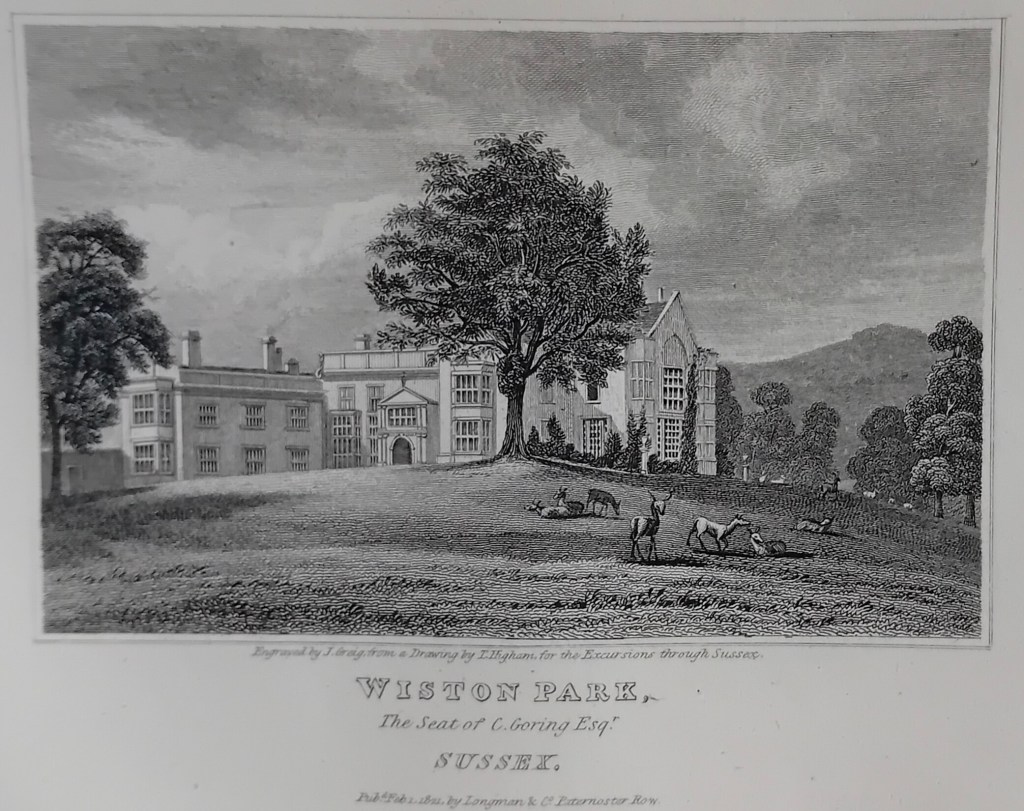
Other major landowners included the Rev John Goring of Wiston, the Earl of Ashburnham, the Earl of Egmont, Viscount Gage, the Earl De la Warr (Knole, Sevenoaks), and several additional peers and gentry, with these holdings exceeding 10,000 acres per property owner.
Notably, the Rev Goring appears as a vicar, yet controlled a vast estate inherited through the Goring family, illustrating the intersection of clerical office and hereditary landownership.
Rev John Goring of Wiston stands out in 19th century Sussex as both a parish vicar and one of the county’s largest landowners. Unlike his contemporaries on the 1875 Parliamentary Return—most of whom were titled aristocrats—Goring’s wealth came not from his clerical office but through generational inheritance.
The Goring family acquired Wiston Manor in the 17th century via marriage to Elizabeth Fagg, heiress of the Fagg family of Wiston. Over time, the estate expanded and consolidated, passing through successive generations until John Goring inherited it in the mid-1800s. By 1875, he ranked among the top landowners in Sussex, controlling extensive acreage across Wiston and neighboring areas.
Although his income as vicar was modest, Goring oversaw a substantial estate, including Wiston House, its parkland, and surrounding farmland. Contemporary sources describe the house as a stately seat with ornamental grounds and a deer park, emphasizing that Goring’s social and economic standing derived from landholding rather than ecclesiastical position and stipend.
The estate encompassed 14,139 acres and generated a ‘gross rental’ of £13,705, approx £2.25 million in today’s pounds. Not bad for a vicar!
A search of online sources indicates no documented genealogical link between the long-established Goring family of Wiston and the family that founded The Goring hotel in London.
The evidence points to two separate origins: an old English landed Goring dynasty in Sussex, and a hotel-founder (Otto R. Goring) who appears to have been born in Germany and emigrated to Britain.
Much of the estate endures today. Wiston House, Grade I listed, retains its 16th-century core and historic façade, and now functions as Wilton Park, a conference center hosting
international meetings under the UK Foreign, Commonwealth & Development Office.
The broader Wiston Estate spans approximately 6,000 acres within the South Downs National Park, encompassing farmland, woodland, and vineyards, while the former deer park has largely been replaced by agricultural land.
St Mary’s Church, adjacent to the house, remains a Grade II* listed building with medieval origins and 19th-century restoration. The Goring family continues to manage the estate,
balancing heritage preservation with modern enterprise.
Rev John Goring’s life illustrates a rare intersection of clerical service and substantial inherited wealth, leaving a legacy evident in both the built and natural landscape of Wiston.
Part II of this blog will examine the ‘List of Landowners in Sussex of Over 1,000 Acres’ in greater detail.
Discover more from Friends of Horsham Museum & Art Gallery
Subscribe to get the latest posts sent to your email.
 Friends of Horsham Museum & Art Gallery
You must be logged in to post a comment.