On this day (September 27) in 1825, George Stephenson’s steam-powered Locomotion No. 1 travelled 26 miles between Shildon, Darlington and Stockton, carrying hundreds of passengers to great fanfare, writes Museum Friend and volunteer Rick Domas.
It set in motion a ‘train’ of events that changed the UK forever.
There were several firsts in the commercial/industrial use of railroads prior to September 1825, however.
In 1804, the Penydarren Tramroad in South Wales carried iron and people powered by an early high-pressure steam engine designed by Richard Trevithick, showing steam could work on rails.
By 1812, the Middleton Railway (Leeds) was operating a steam locomotive in commercial coal traffic.
The First Inter-city Railway
The next great leap came with the opening of the Liverpool and Manchester Railway in 1830. This was the first line to operate entirely with steam locomotives, on double track, with a fixed timetable and signaling.
It was, in essence, the first modern inter-city railway. The Liverpool and Manchester became a model for future development and a symbol of the possibilities of rail.
During the 1830s and 1840s the country was swept by “railway mania”, a speculative and practical boom in railway construction.
Investors clamoured to back new lines, and Parliament was inundated with VBills for railway schemes. This was a period of intense experimentation: there were competing ideas about the right track gauge, about the best kind of locomotives, about how to finance and regulate the new technology.
Rail Comes to Horsham
The first Horsham railway station opened on 14 February 1848 as the terminus of a single-track branch line from Three Bridges, built by the London, Brighton & South Coast Railway.
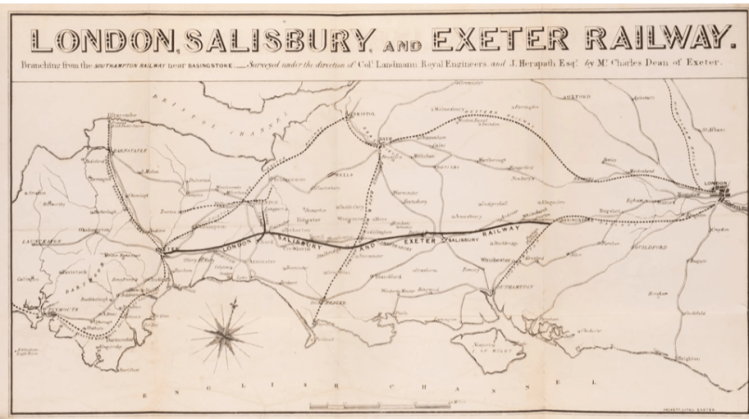
This early connection to the London–Brighton main line immediately linked Horsham with the capital and the wider region, enabling faster transport of people and goods than the traditional turnpike roads had ever allowed.
The decades that followed saw Horsham’s rail network expand significantly. The branch line was soon doubled to cope with growing traffic, and by the early 1860s Horsham had become a small but important junction.
The opening of the Steyning Line in 1861 created a direct route to the south coast via Steyning and Shoreham-by-Sea, while the Horsham-Guildford line, opened in 1865, linked the town to Surrey through a rural route that included Rudgwick, Baynards, and Cranleigh.
Together these lines made Horsham a gateway for travelers and commerce moving between London, the South Downs, and the coastal ports.

The railway infrastructure also grew to reflect Horsham’s rising importance. Christ’s Hospital station, opened in 1902 to serve the newly established school, became a major junction where several lines converged. Locomotive servicing facilities, sidings, and a goods yard made Horsham a busy railway centre.
The network carried both passengers and freight, bringing agricultural produce to market, carrying bricks and timber to building sites, and ferrying London day-trippers to the countryside.
The interwar period brought further change. In 1938, the Southern Railway rebuilt Horsham station in a bold modern style, with architect James Robb Scott designing a functional, clean-lined building that still stands today.
That same year saw the completion of electrification from Three Bridges through Horsham, marking the town’s full integration into the growing suburban commuter network. The first electric trains heralded faster, cleaner, and more reliable services, which in turn encouraged further residential growth.
Yet the mid-20th century also brought decline. The Beeching cuts of the 1960s led to the closure of many rural branch lines across Britain, and Horsham was no exception.
The Guildford line was closed in 1965, followed by the Steyning Line in 1966, ending direct rail connections to those communities.
Several small stations in the area were also lost. These closures shifted more local travel onto the roads, but they also left behind trackbeds that today have been repurposed as footpaths and cycle routes, most notably the Downs Link trail.
Today, Horsham remains a key station on the Arun Valley and Sutton & Mole Valley lines, with regular Southern and Thameslink services to London, the south coast, and Gatwick Airport.
Its handsome 1938 station building, sympathetically refurbished in recent years and now Grade II listed, continues to serve as the town’s gateway.
Though much of the surrounding branch network has vanished, the railway still plays a central role in Horsham’s identity, linking the town’s historic past with its role as a thriving commuter centre in 21st century Sussex.
The State of Rail Today in the UK
The state of today’s British rail system is debatable. The infamous Beeching Report of 1963 closed many unprofitable, mainly rural lines, and forcibly introduced a reduced, less redundant rail system.
Delays on all lines are almost inevitable, and labour unrest in the recent last years of Conservative Government made train travel unreliable and disruptive for many. It is this system that seemingly struggles to function efficiently on a daily basis.
The HS2 project, the UK’s major high-speed rail scheme now under construction, was originally intended to link London with the Midlands and then further north to Manchester, Leeds and beyond. As of mid-2025, only Phase 1, from London to the West Midlands, is proceeding; the planned extensions beyond this (notably Phase 2b eastwards toward Leeds, and northern legs) have been cancelled.
High-speed rail doesn’t come cheap these days. When first announced (in 2012-2013), estimates were roughly £20.5 billion (in 2019 prices) for Phase 1.
Projections now are in the range of £49-£56.6 billion (in 2019 prices), almost triple the initial estimate.
HS2 timeline? Lengthening. When first announced in a 2010 White Paper, Phase 1 was intended to begin construction around 2013 and to open for service by 2026. Since then, delays have pushed the opening window for Phase 1 to between 2029 and 2033, with some governmental reports listing 2030 for initial runs. 2030 seems a bit optimistic, given the project’s history to date.
Legacy
Britain can justly claim to be the birthplace of the modern railway. While wooden wagonways and horse-drawn tramroads existed elsewhere, it was in the UK that these early experiments were transformed into a fully-fledged transport system, combining iron rails, steam locomotion, scheduled passenger services, and a rapidly expanding national network.
The opening of the Stockton & Darlington Railway in 1825 and the Liverpool & Manchester Railway in 1830 created the template for rail transport worldwide, and British engineers, locomotives, and expertise soon spread across Europe, North America, and the colonies.
By mid-century, with over 6,000 miles of railway open linking most major towns and industrial centres, Britain possessed the most extensive and technologically advanced railway network on earth, setting a model that would be emulated and adapted around the globe.
The arrival of the railway in 1848 transformed Horsham from a modest market town into a growing transport hub, and rail service today links Horsham to London, the south coast, and beyond.
The UK train system continues to carry millions of passengers daily, and the ambitious but troubled HS2 project promises a bright future. At the same time, preserved steam lines, restored stations, and railway museums keep the memory of the pioneering era alive.
Britain’s railways thus stand as both a working legacy and a cultural treasure—proof that the country which gave the world the railway continues to adapt and innovate, even as it honours the achievement that helped launch the modern age of transport.
Discover more from Friends of Horsham Museum & Art Gallery
Subscribe to get the latest posts sent to your email.
 Friends of Horsham Museum & Art Gallery
You must be logged in to post a comment.