1880 to 1913
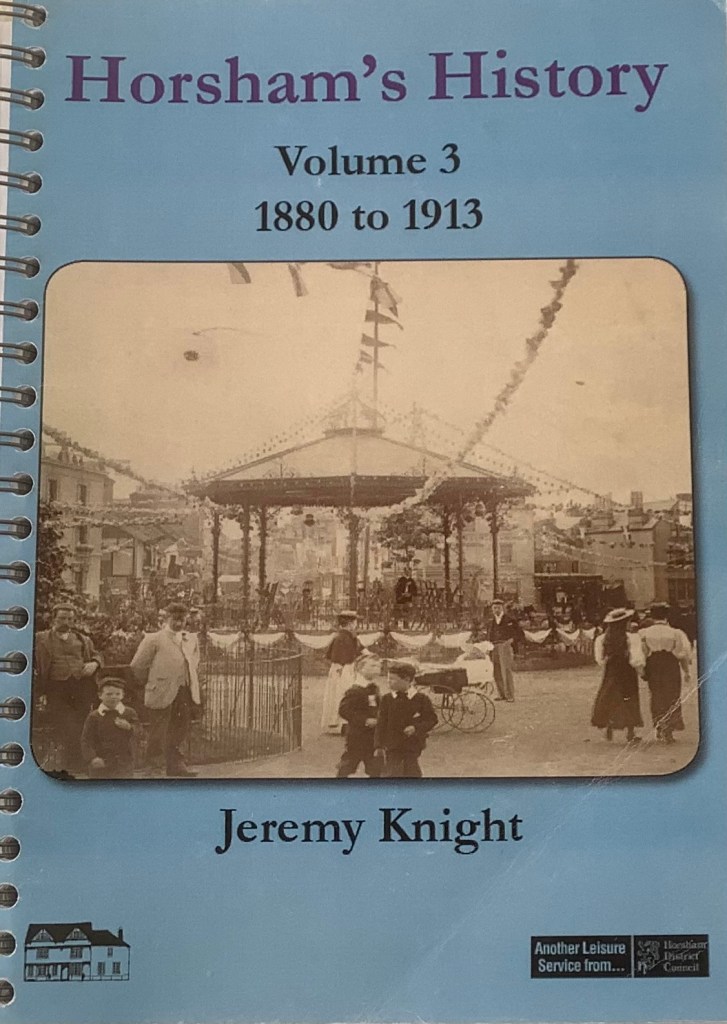
© Copyright: J Knight & Horsham District Council 2006
Cover and format designed by Horsham Museum and Horsham District Council
J Knight has asserted his right under the Copyright,
Designs and Patents Act 1988 to be identified as the author
of this work
British ISBN 978-190248441-9
A CIP catalogue record for this book is available from the British Library
PREFACE
An apology from the author – “It is impossible to write ancient history because we do not have enough sources, and impossible to write modern history because we have far too many”. So wrote Charles Peguy in Clio (1909-12), whilst the length of time taken to get out volume three: two years covering thirty, compared with two years covering the span of Horsham’s history up to 1880, can also be answered in a quote by Thomas Jefferson in 1817 when he wrote to a Dr Smart: “To write history requires a whole life of observation, of inquiry, of labour and correction. Its materials are not to be found among the ruins of a decayed memory”[1].
I could leave it at that and let you, the reader, come to your own conclusions. However, one of the great frustrations faced by any historian has is having to second guess. So, to save the frustration, please read this introduction which explains why volume three took two years, why I have altered what I proposed to do in volume 1 and where I plan to take the work forward from here.
I started this book in December 2006, a month after finishing the first two volumes. I had intended that book to complete the Horsham story up to 2000. However, within a month it became very clear that, whilst entirely possible, the amount of material available and the story that the untapped resources revealed made it a great lost opportunity. Lytton Strachey argued that “Ignorance is the first requisite of the historian – ignorance, which simplifies and clarifies, which selects and omits…” I could so easily have deliberately remained ignorant of the material housed in Horsham Museum archives, on the microfilms of the local newspaper, of the accounts in the Parish Magazine, so that these thirty years would have been covered in one chapter. I could have just written about the rebuilding of the Town Hall in 1888, the building of the bandstand in 1892, the Cottage Hospital in the same year and the creation of Collyer’s new home in 1893, whilst the decade leading up to the First World War was the lull before the storm.
Yet I chose to explore the period in greater detail. Why? The period isn’t my preferred area of research: that is, the 18th century, so before tackling the period I read, not cover to cover, but in some depth, New Oxford History of England; A New England?: Peace and war 1886-1918 by G. R. Searle. It was an eye-opener, for whenever I picked up a document, or read a newspaper account, I could see parallels in Horsham. I read in January 2007 with great amusement the great controversy over caning children, a Horsham controversy that led to editorials in The Teacher. I would not have known this if the museum hadn’t been given a scrapbook by a descendent of one of the Local School Board members. Yet what put the debate in perspective was that the controversy occurred at the same time the National Society for Prevention of Cruelty to Children was formed. What was in reality a minor debate had echoes on the national stage and opened up a view of how some in Horsham regarded children and their status, as well as their legal rights. This so obviously could be a stepping-stone to a far greater study, yet I had to draw the line and not pursue it any further. It was, however, a realization that so much of what I looked at could have echoes elsewhere that led me to develop the chapters more fully.
All previous historians of Horsham have to a large extent ignored Horsham post-1880, a point made in the previous volumes. However, there is a wealth of material out there that can be explored. To encourage this I also decided to cover things in greater detail as well as offer longer extracts from original sources. For example, I was looking at a Directory of 1906 when the phone rang. It occurred to me that telephones must have come into use around this time, and the advert for a trader had a one-digit phone number, but another trader had another type of number, so after spending a couple of hours looking at the directories and then the internet I had a narrative that explained how telecommunications came to Horsham; a story that hadn’t been told before. No doubt future historians will create a different narrative, but at least there is now an “in the beginning” phase. And so it goes on.
So you will see how one month soon ran in to two; then six, and finally twelve. In November 2007 I started working on Horsham during World War One. I wanted to get the research done so I could mount an exhibition in January 2008. In February I went to Hong Kong, using the first few days there to recover from jet lag and to read through what I had written. I soon realized that whilst I could get 1914-18 into the third volume, it would have made the book too thick and would have taken a lot of time to fine-tune the story. I had re- read the chapters for 1880-1913 and decided that although they are long, the story they told was interesting to me. So on my return I decided to use volume three to cover 1880-1913, and would aim to get the book out by June.
Then by chance I picked up two weighty tomes in Colin Pages in Brighton; two seriously academic works whose titles would or could put most people to sleep: one on the history of taxation, the other on estates and marriage. But browsing through them in the shop basement I could see echoes of Horsham’s story – a whole new chapter on local government finance was opening up – Horsham’s arguments were mirroring national debates. So, a delay and a re-think and new additions.
In the meantime Julie Mitchell had kindly proofread the text and tidied it up etc.; however, she strongly recommended, after comments made by the editor of Horsham Society Newsletter that the text should be proofread by someone else. Fortunately for me, Jason Semmens, the Assistant Curator, agreed to do so, again in his spare time, which was fully-stretched with his own research and publications on Cornish witchcraft/folklore. This rightly caused more delay in the publication of the work, but the time enabled me to undertake fine-tuning of the research and it was now that I made probably the most significant discovery of this volume. I had taken as “gospel” the comments made by Dorothea Hurst about the Town Hall and never checked them (neither had previous historians), but I decided to read the newspaper accounts, the original documents held by Horsham District Council and the letters file held at West Sussex Record Office concerning the rebuilding of Horsham Town Hall. It was one of the iconic events of the Victorian period: Horsham Town Hall was rebuilt in 1888; Dorothea Hurst, who lived through the period and published her history only a year later, says the Town Hall was pulled down and rebuilt. But the actual records show that it wasn’t; it was refurbished and some structural work carried out, but not a rebuild. This would tie in with other evidence – no plaque marking the rebuild (one was put on the fountain only 10 years later), and no photographs of the civic opening of the Town Hall, for there wasn’t one. A Town Hall, the monument to civic pride, would have had a grand ceremony; look at the bandstand four years later; but the Town Hall had nothing.
So the delay in publication enabled further revelatory research to be undertaken. I hope and trust other people will explore the period further and agree or disagree with the account given here. I have tried to give the sources of the material used, so you will have a guide. This is the first stage in reclaiming Horsham’s forgotten history, in creating a narrative different from decayed memories.
And just to point out how it will be possible for future historians to add to this account, the week before writing this Preface, Sue Djabri emailed me the following note:
Dear Jeremy,
I have now got to the part of the Denne Road Cemetery burial records dealing with the period of the measles epidemic in 1886 and have produced a few facts and figures which you might care to add to your text, maybe as footnotes, as they really point up the severity of the outbreak. Pam said that you were away all week, so I am sending this to both your e-mail addresses, in case you are doing final work on Volume 3 at home!
63 children were buried in Denne Road cemetery in the first quarter of 1886 (out of a total of 88 burials during that period). This was a huge increase compared with the previous quarter, when there were nine child burials out of a total of 33, and the following quarter when there were 13 child burials out of a total of 31 – these figures were normally much the same throughout the year. Seven children and four adults died at the Horsham Union workhouse in Crawley Road during the first quarter of 1886, as opposed to a total of four and two deaths in the previous and following quarters.
The most tragic case was when three children from one family were buried on one day – 19 February 1886 – when the epidemic was at its height: Robert J. Oakes of Queen Street lost his two daughters, aged 5 months and 4, and his son aged 2. The youngest child, Nellie Oakes, was privately baptised on 11 February, as were several other children during the epidemic, presumably because they were so ill that it was not possible to take them to church. Two of the other children privately baptised, Emma Palmer and Annie Reynolds, also died a few days later.
The children were mainly buried in section E of the cemetery – possibly in mass graves as there are clusters of consecutive grave numbers – with a few individual burials in sections C, D and L. From the Horsham Parish burial records (as transcribed by the Parish Register Transcription Society), which give the place of some of these deaths, it would seem that Queen Street, New Street, Horace Street and Park Terrace, on the east side of the town, were the streets worst affected by the epidemic. This is in line with the record of aid given, in the Parish Magazine, which was concentrated on the eastern part of the town.
Hope that this may be useful,
And for those that want to know, the next volume will cover The War Years 1914-1945; volume 5 – Post War Horsham – up to 2000. There will be a detailed index for this volume published later.
Acknowledgments
This is probably the one area that gives people the most pleasure writing, but often gives little evidence to the reader of the actual level of contribution to the work in hand. Owing to the vagaries of technology, and after having many people try the Word program which continues to produce American English, which is fine if I were producing a history of Horsham USA for the American market, therefore I would like to thank Julie Mitchell for the first proofreading of the text and Jason Semmens for a second proofreading. Both of them have performed a task beyond the call, and those in the know, know all too well why it is more than just ‘different English’. I would like to thank Bill Mathews for scanning the images. Brenda Brewer for transferring and sorting out the document and images so it can be published. Horsham District Council’s Reprographic Department for producing the book. Sue Djabri and Jason for being an ear to some of the debates aired here. Sue also helped out with some supplementary information based on her research into family history and for her book Images of England Horsham.
I would also like to thank museum staff for the encouragement to continue this work, as well as members of the public who, in asking when the next volume would be out, gave unknowing support.
In the 17th century cats were referred to as “an idle mans play thing” – both Parker and Coco; particularly Parker, tried their best to stop this book coming out, but they failed, though only just – cats, I have discovered, cannot see why a laptop should compete for the lap. And when not working on a lap I had the opportunity to work on and I would like to thank Adrian for providing a large table and floor space which gave me the opportunity to spread out when not working on my lap.
A brief note about money
Throughout the book sums of money are identified. Those born before 1976 will be familiar with, though by now may have forgotten, pre-decimalised money. The following note is by way of explanation:
Before 1971 money in Britain was based on pounds, shillings and pence, which itself had its origins in the Anglo-Saxon period. There were 20 shillings to the pound, 12 pennies to a shilling. The coins were a crown (5 shillings), half crown (2.5 shillings), shilling, sixpence (.5 shilling), threepence (three pennies), penny, halfpenny and a farthing, (one quarter of a penny).
Napoleon in the 1790s/1800 instituted monetary reform in Europe based on a hundred rather than twelve, but it would be another 170/180 years before Britain followed suit!
At the time of the changeover in 1971, one old penny was equivalent to just less than half a new penny; a shilling was equivalent to 5p.
Some coins ceased to be legal tender before the changeover, so the farthing (a quarter of a penny), which was introduced in 1613, ceased to be legal tender in 1960. The old halfpenny was removed in 1969 and a new halfpenny was introduced to replace the old penny, though that now has ceased to exist. As things became more expensive the need for very small units of money died out. (It could be argued that rather than things becoming more expensive the actual value of the money was debased so it could buy less – either way the effect was the same: you could no longer buy items for the smaller denominations of money.
NOTE: I have not produced contemporary values for the sums identified, as:
- they will date
- the Bank of England produces current conversion tables regularly updated to convert values into modern-day equivalents
- by giving a modern-day equivalent it gives it a value that is out of context.
If you do want to know the current-day value there are a number of websites that tell you, including one run by the Bank of England.
CHAPTER EIGHTEEN
THE NAKED CHRONOLOGY
| 1880 | A writer considers the town with its trees, wide streets and numerous open spaces as having a continental look. A nonconformist Sunday school room built of red brick and seating 300 opened this year. Later, it would become Albion Hall in Albion Road. In Roffey a working men’s club is opened under the management of the vicar, which has a hall, a library and a reading room. A roller-skating rink opened around this time in Brighton Road, which by 1912 had become the Olympia skating rink. |
| 1881 | Horsham’s population reaches 9,556 according to the census. |
| 1882 | The Horsham Liberal Club in Albion Terrace opened with reading, smoking, recreation and refreshment rooms. The Horsham Times and West Sussex Courier with its independent views of politics and church, published first in Crawley and then Lewes, flourishes till 1941. The poultry market moved to the Swan Inn and then to the Black Horse. The following year the local board of health acquired the markets, leasing the tolls in 1884 for £5. |
| 1885 | Henry Padwick, who bought Stammerham from the Shelleys in the 1870s, sold it to the Aylesbury Dairy Co. In 1892 the Company went broke and sold the 1,300 acres to Christ’s Hospital School. |
| 1886 | Hawthorne House, which stood adjacent to the Manor House, was demolished. The following year, Tanbridge House, built in a Jacobean style for the railway contractor Thomas Oliver, who included two 16th century fireplaces from its predecessors that stood nearby. The Horsham Club in Carfax opened; within two years it had around 170 members. |
| 1887 | Monday and Wednesday markets for poultry and corn were held respectively, with cattle being sold on alternate Wednesdays. Later, selling by auction was introduced. The local board abolished the July Fair. It had its offices in the Town Hall. |
| 1888 | The Parish Room was built with a library in Causeway. The Horsham Advertiser, first published in 1871, changed its name to West Sussex Times, boasting that it was the paper of the new county. It was pro-Tory and Church. Five years later, after two further title changes, it became The West Sussex County Times. Springfield Park House had become a school, Horsham College, in 1904; Gerald Blunt opened its successor. Local board of health bought the Town Hall and repaired it. |
| 1889 | The July Fair was reinstated in Bishopric under the local board. Then held in Jew’s Meadow |
Horsham 1880-1890
HORSHAM CHANGES
On 4 November 1880 Horsham’s last burgage-holder, Pilfold Medwin,[1]died. Pilfold was the youngest son of Thomas Charles Medwin, and brother of Thomas Medwin, the biographer of Byron and Shelley. Only months before, he cast his vote as a burgess, insisting on his right to do so, even though he could have voted through the increase in franchise caused by electoral reform that saw 1109 votes cast at that election. That election had been between James Clifton Brown and Sir Henry Fletcher.[2] (The Liberals were still carrying the blue colour; the Conservatives, pink.) Meetings were held at different public venues including the newly-built skating rink[3], just east of the iron bridge, as the electorate was so large and the party management system too weak to fund individual door to door canvassing en masse. However, problems could arise at such meetings (unlike hustings where both candidates were present), for rumours would spread, and there was no control of the message. For example, it was rumoured that Brown said “The working-man was nowadays too extravagant in his tastes; he wanted ham and eggs for breakfast”. A damning comment if genuinely made by the Liberal candidate. Polling took place on 1 April 1880 and Sir Henry won the seat from Brown. Even though there was a great deal of drinking going on and Mr Bull, the Under Sheriff, had arrived in the town to make arrangements for a petition for corruption, no petition was forthcoming, for Brown was, according to Albery, too radical even for his own party and Sir Henry too popular[4]. This was a rare uncontested election. The nation as a whole, though, voted in a Liberal Government and so the writing was on the wall for Horsham to remain as a Parliamentary seat.
The death of the last burgage holder (who because of his status retained the right to vote in elections, a remnant of the pre-1832 Reform Act), was also a portent for the coming decade, for the next ten years or so would see the last vestiges of medieval and Georgian Horsham broken and the emergence of a new Horsham, a Horsham for the modern age, though ironically it was a modern age that wished for the veneer of its past.
In this decade the old political certainties of Whig and Tory would be changed into the two-party politics of Liberal and Conservative; the old Market Hall would be pulled down and rebuilt as a Town Hall, the fairs would be stopped by an Act of the Home Secretary only to be re-established with new rules and regulations; the management of the county services through Quarter Sessions would be transformed through the creation of a County Council; Horsham itself would lose its own MP as Horsham became absorbed into a larger political area. As for Collyer’s, its days were numbered, both physically and constitutionally, and it would re-emerge phoenix-like in the early years of the next decade as a Grammar School worthy of its origins, after a century of slumber. The next decade was momentous for Horsham.
With the formation of a Local Board in the previous decade, Horsham had a group of people who saw the virtue of Local Government. But what was Horsham like at this time? G. F. Chambers, in Tourists’ Guide to Sussex, described Horsham as having a continental aspect, with its trees and wide streets, with the Carfax being singled out as an “oasis in the business quarter of the town”[5]. Following on from the Franco-Prussian war and the resultant turmoil in Paris mentioned in the previous chapter (see Vol. 2), Paris underwent major redevelopment with the creation of wide boulevards which would, it was thought, stop the erection of barricades. These wide streets were obviously in the mind of the writer though Horsham, even with its rebuilding, could never really be described as Continental[6].
It does, however, show that the Local Board’s investment in paving was paying off in terms of creating a modern image of Horsham. The Local Board was primarily set up to deal with sewage and clean water, but in 1878 it had also taken over the interests of the parish highways board which included lighting and paving. In 1879 the sewage works had been completed at a cost overrun of nearly £6,000 (est £7,590, actual £13,560), they had bought out the Waterworks at £7,000 and now, on 9 July1880, they had an estimate to pave the District[7]. The report produced by the Surveyor on behalf of the Horsham Local Board Works and Drainage Committee sets out the recommendations and the cost to carry them out:
1. “That with accord to the question of paving. Asphalt be the material used in the outlying parts of the District
2. That New Street, Barrington Road, Station Road, Bedford Road, Arthur Road, Rushams Road, Percy Road, Trafalgar Road, and Saint Leonards Road be paved on one side with asphalt and kerbed
3. That a 4 feet 6 inch pavement be laid from the Skating Rink to corner of New Street, and a 3 feet 6 inch pavement in Park Street
4 That the money required to carry out the proposed works of paving be borrowed and that the Surveyor be instructed to prepare Estimates of the possible amount required”
This he did, and itemised, identifying that the paving wasn’t to be in Horsham stone as one might have thought, but Victoria stone. The estimate also shows that New Street and Trafalgar Road would have five feet wide asphalt paving; the others as specified, 5 feet 6inches. The total estimated cost was £1209.8.9d.[8]
Unfortunately, we don’t know if the plan went ahead, but as the Local Board was not averse to borrowing money and saw it as imperative to make up for lost time, it probably did.
The apparent willingness of the Local Board to borrow may seem at odds with the perceived notion of Victorian prudence of living within one’s means; and the stigma of debt was genuine, for debt could, and did, mean the workhouse. However, in reality such sermons were preached to the poor rather than the middle or landed classes, who were able, as the ledgers of William Albery’s saddlers business show, to have credit for one or two years with no interest charged. The people who ran Horsham’s Local Board were the same people receiving credit in the trader’s shop. In addition they could argue, as did the Labour Government in the late 1990s, that they were borrowing to invest in the future, not to cover running costs – investing in infrastructure; not wages. As such it was a well-judged policy, for the town needed major structural investment if it was to become comparable with other leading towns of Sussex, the towns of the coast; not the countryside. Economic power had moved in the Victorian period to the coast away from the countryside as agriculture declined in importance on the national scene, but Horsham had the ability through its superb rail network to become the capital of Sussex, the county town.
This forward-thinking and, one might argue, dynamic approach: no longer being passive receptors of events taking place around them, but physically shaping the future of Horsham, can also be seen in the mental culture of the town. As will be seen below, Horsham was indulging in some serious debates and working through issues for itself, which may be seen as surprising.
The surprise comes from perceived ideas about Victorian Horsham; ideas encouraged by two key elements: the idealisation in the late Victorian times of the countryside as played out in the literature, which for convenience will be termed “Back to the Land”[9], that will be explored below, and the Reminiscences of Henry Burstow. The latter book, which has been quoted from in the previous chapters, is the semi-autobiography of a cobbler. It was used by William Albery and others as the authentic voice of Horsham but, as will be shown later, it very much fitted in with the notions of a Back to the Land movement. If Burstow knew of the discussions taking place within the town, he filtered them out; thus providing Albery with the self-confirming narrative he wanted to hear. The other option, and probably just as likely, was that Burstow, although he could have been, wasn’t concerned over the issues. Either way, the narrative that has come down about Horsham in the late Victorian period is one of a country market town ticking over, rather than, as is shown below, a town where cutting-edge debates took place. Debates that have echoes today.
MARKING A CENTURY
Some two weeks later, after agreeing to the paving, Horsham, along with the nation, celebrated the centenary of the Sunday School movement. On Sunday the 25th at 3pm, there was a religious service held in the Congregational School Room, Albion Road. Then two days later, on the Tuesday, “A DEMONSTRATION will be held in Horsham Park, (by the kind permission of R H Hurst., esq. And Mr Prewett)” as the poster, printed by R. Laker Snr, Horsham, boldly declared before announcing that the children would congregate at the school room at 2pm and then march through the Town to the park “Headed by the BAND” with games and a free Tea for the children at 4, with Teachers and Friends having theirs at 5.30 at 9d. The Band was probably the Fire Brigade Band which on previous occasions had doubled-up as the Town Band.
The Congregational School Room at Albion Road saw this year the formation of the Horsham Mutual Improvement Association. Dorothea Hurst records its existence in her revised history, published in 1889; not under the aegis of the Association but as a user of Albion Hall, noting that it “is a large plain building, situated in the Albion Road, capable of containing about 300 persons, erected by subscription, through the efforts of the Nonconformists, and used by them for a Sunday School; but also very frequently hired for different public meetings, especially temperance Meetings and those of the Mutual Improvement Society ”[10]. That is the only mention in her book of this group. This would tie in with the national picture as noted by Jonathan Rose: “these institutions are scarcely mentioned in studies of labour history. Richard Altick and E.P.Thompson appreciated the critical role they played in adult education, but could locate very little information about them. Though they were ubiquitous in Victorian and Edwardian Britain, they left few surviving records. In most cases, they can only be reconstructed through the memories of their members”.[11]
Fortunately for Horsham, the minute book of Horsham’s Association has survived and it provides a rich vein that hasn’t been mined before. In addition to the minute book the Parish Magazine, which started in 1884 and is discussed below, also contains brief accounts of the Association meetings, as does the local press. What is clear is that the Association conforms very much to the picture outlined by Rose, whose study can provide a national context; thus making the Horsham story both less and more relevant: less in that the Association was following national trends, and more because it shows that Horsham was increasingly absorbing, and being absorbed into, the national scene; Horsham was not an isolated part of late Victorian Britain, but a fully paid up member.
The minute book reveals that a preliminary meeting of the Association was held on 2 December 18?? in the Old School Room Springfield Road, with a formal meeting held the following day. At this meeting the key purpose of the Association was decided upon: “That the object of the association be the mental and moral culture of its members. That for the attainment of this meetings be held for readings, Discussions, for reading of essays and such other pursuits as may be deemed desirable”. This can be seen as the classic model. “The mutual improvement society was a venture in cooperative education. In its classic form, it consisted of a half dozen to a hundred men from both the working and lower- middle classes who met periodically…Typically at each meeting one member would deliver a paper on any imaginable subject-politics, literature, religion, ethics, “useful knowledge”- and then the topic would be thrown open to general discussion.. The aim was to develop the verbal and intellectual skills of people who had never been encouraged to speak or think”[12]. As we shall see, Horsham’s branch covered most of those themes.
So less than two years before, the Horsham Literary and Scientific Institution had closed its doors and now the self-improving drive of the Victorian mind saw to it that a new institution be formed[13]. This shouldn’t be that surprising, for the chief protagonist of self-improvement was Samuel Smiles, whose worldwide best seller Self Help, published in the same year as Darwin’s Origin of the Species, 1859, was based on lectures he gave to the Leeds Mutual Improvement society in 1845.[14] A week later, 9 December, the first public meeting was held; an entertainment consisting of readings and “recitations vocal and instrumental music”. At the next committee meeting a piano was hired for the season for £2.10/-. At the same meeting it was decided that there should be weekly public meetings. At the final public meeting of the year “a novelty was introduced into the entertainments of the Horsham mutual improvements Society”, according to the newspaper account pasted into the minute book of the Association from where the information comes, “in the shape of a discussion as to the merits and demerits of smoking”. The public meeting decided smoking was not beneficial.
SMOKING: THE DEBATE
At the time of writing this, 4 January 2007, the Government had just proposed increasing the age at which it was legal to buy tobacco, from 16 to 18. It is interesting, therefore, to read of a debate in Horsham on the effects of smoking, a debate that must have been taking place elsewhere, but which has largely been ignored. As the newspaper reports, “Mr Alfred Scrase undertook to defend, and Mr. Jury Cramp to oppose the use of tobacco, – In the course of an ably written paper, Mr. Scrase contended that many reasons might be adduced in favour of moderate smoking. He quoted a number of medical testimonies in favour of smoking and also cited no less an authority than the Lancet, and the well known “Family Doctor”, of Cassell’s Magazine to show that smoking might be indulged in without very injurious effects. The women, and even the children, of Burmah all smoke, and are still of average health. Our soldiers and sailors smoke, and none are, as a rule, more healthy, stronger, or capable of more endurances…(and smoking) “when moderately indulged in, neither injurious to health, to morals, or to society, but had been and was still, the comfort and consolation of many millions in all parts of the world (cheers). – Mr Cramp followed with an equally able and argumentative essay on the negative side of the question. He based his objections chiefly on the physical bearings of the subject, and contended that the whole body of man was very seriously affected by the poisons of nicotine in the tobacco. After detailing many diseases to which smokers are known to be subject, Mr Cramp urged that morals were not improved, but otherwise, by smoking, as smoking often gave a keen thirst for strong drink. “Mr Cramp then argued that the £15,000,000 spent yearly on tobacco and cigars could, if saved would benefit Society. “At considerable length the reader combated the medical evidence in favour of smoking, and also contrasted the rival opinions of eminent medical men. The discussion was then continued by Mr Harrington, Mr Baxter, and others, and the interesting and instructive debate closed”. (The minute book of the Temperance Society given to Horsham Museum by Cecil Cramp has a large number of medical accounts published in the press concerning the issue of smoking. It was surprisingly a “hot” topic of debate – leading to the question: why did it take over 100 years for the debate to become as active again?)
Although there were many other societies around or recently formed in Horsham; for example, the Chess Club in 1879[15], The Mutual Improvement Association is one of the most interesting because it tells us what issues people in Horsham thought about. There are obviously a raft of caveats: for example, we don’t know how many or who attended the lectures, whether it was just a “politicised” minority, if there was a genuine interest or was just something to do. But, and an important but, it does indicate that there was a level of political consciousness in Horsham, Horsham wasn’t merely a receptive, passive place ignoring the issues of the day, but was engaging in the debate, and unlike some of the groups the Association was not part of a larger formal structured organisation, but did draw on what other Associations and Societies were doing, though this wasn’t identified in the minutes. That being said, the Horsham Association was created and developed within Horsham to meet the needs of Horsham folk. For that reason, the minute book will be looked at in more detail.
The Association ran a full programme of lectures, readings and musical evenings; the latter being the most popular; each season, running from September to May. The minute book refers to a lending library with it being open every Thursday from 7.30 to 7.45. The fine for an overdue book was 1d per seven days or part thereof. The books were to be selected by the committee. At the same meeting, on 11 January 1881, it was decided to hold classes “for the mutual improvement of members in elocution and for criticism – at such times as it should deem expedient”.
The first meeting was held on 4 February, but the audience was small. The secretary was also “instructed to make inquiries at South Kensington in reference to the formation of science & art classes”[16]. This was the beginning of art teaching in Horsham, as will be shown later. Two days later, on 13 February, a lecture was held by Rev S. Evershed “On the formation of a habit of scientific inquiry”, with a small audience. A week later an evening devoted to “local and instrumental music – readings and recitations” was held but the “weather being most unpropitious”, the audience was “fair”. Interestingly, each evening’s entertainment had its own programme printed identifying the piece and the performer.
On 3 March J. H. Freeman F.R.A.S gave a lecture on Some of the wonders of the Heavens, which was “listened to by a large and enthusiastic audience”. On 5 May 1881 the Committee decided to hold a public meeting in the Town Hall on 11 May to see what response there would be to forming classes linked to the South Kensington scheme. Unfortunately, on the day, the audience was small so they decided to commence with art. Horsham would now have a formal art class that would see many notable artists emerge and provide Horsham Museum with a wealth of local topographical views.
To help the class on its way, on 8 February 1882 a “Grand Evening Concert in aid of the Art Class… by the Horsham Glee Club” was held at the Albion Assembly Room, raising £10 –14 –6d. The second annual report would record with pride the following: “The Art Classes which have been established in Horsham, though not ostensibly connected with the association are in reality one of the good fruits of a desire for Mutual Improvement and ? culture which is the object of our association. It may be remembered that they were first suggested by our President at one of our meetings and they have been established, on, we hope, a permanent footing by the ? and great personal assistance by one of our vice presidents Mr Alex Wood.”
The next season started with a musical entertainment. Membership was a shilling, with admission to the Entertainments being 1/-, 6d and 2d, members free, paying half price for the 1/- seats. Public meetings would be fortnightly, with meetings for reading English literature held every alternate week. The first entertainment of the season was a great success, as was the reading. The table below sets out the lectures identified in the minute book for the1881/2 session along with any comments made about them:
| DATE | SPEAKER | SUBJECT | COMMENT |
| Wednesday Oct. 12th 1881 | J H Freeman F.R.A.S., F.C.S. | The Marvels of Chemistry | Illustrated with numerous experiments. A large audience £2. 9/- taken at door |
| Nov.10th 1881 | Rev. Robert Wilson | Life on the Nile | “very interesting was listened to with marked attention by an intelligent and large audience, £2-7-8 taken on door |
| Nov 17th | Alex Wood M.A. F.S.A. | Shakespeare’s Merchant of Venice- its plot-his characters and its teaching | “The lecture displayed a large amount of thought and research…audience small 5/4 taken at door |
| Dec 8th | Sir Henry Fletcher Bart. M.P | An account of Sir Henry’s Visit to Ireland | Highly interesting. “The audience was a large and fashionable one – £5-6-9 taken at door” |
| Thursday Jan. 26th 1882 | W E Hubbard Jun. | Fair Trade; Free Trade; and the General Principles of Business. | “This lecture was well attended- it was followed by discussion in which the following gentlemen took part- Free Trade- W Lintott, J G Brown, J Harrington and W E Hubbard Esquires. Fair Trade R Ramsden Esq £1 16 2 ½ “ This lecture was promoted with a flyer |
| Thursday Feb 16th 1882 | Rev. C F Overton M.A (Vicar of Warnham) | South Africa | “Large and fashionable audience – Highly interesting lecture.” £2-13-6 The lecture illustrated by diagrams |
| Feb 27th , March 6th & 13th | Dr E L Bostock | St Johns Ambulance Association | “the audiences were not large which is much to be regretted – the lectures being highly interesting. |
| March 30th | Sir John Bennett | The Natal | “Illustrated by diagrams and models” £1-1 |
According to the second annual report the Association had nearly 300 members. “The lectures without an exception have been of a highly instructive as well as interesting character – and it is believed they have conduced greatly to the mental improvement of the audiences”.
The lecture programme itself shows how certain long-term issues of the day were played out in Horsham: namely, the Irish Question and South Africa. Although the lecture was an account of Sir Henry’s visit to Ireland it would have been set against the background of the discussions taking place over how Ireland was to be governed; a debate that was ripped apart by Gladstone’s insistence in 1885/6 that the Liberal Party would back the establishment of an Assembly, a subordinate Irish Parliament. This was the Liberals’ “Corn Law”; the issue that helped to reformulate Liberal and Conservative ideology and allegiances in the last decades of the 19th century.[17]
The South Africa debate in Horsham followed almost a year from the shattering defeat of the British by the Dutch Boers. South Africa was hot news following the defeat at Majuba Hill on 27 February 1881.[18]
Not only was Southern Africa of interest, but so was North Africa and, in particular, Egypt; and Egypt meant the Nile. Egypt had for various reasons become an economic basket-case leading to its bankruptcy in 1875-6. Britain and France intervened along with other European countries to stabilise the situation. Their efforts led to a revolt in September 1881 by four Egyptian colonels who under the slogan “Egypt for the Egyptians” garnered much local support. This frightened the British and French, who thought the Egyptians might default on their debt repayments that had been formulated to resolve the country’s bankruptcy. This led to further engagement in Egyptian affairs, eventually leading to the British invasion of Egypt, at the behest of the Khedive, on the 16 August and the defeat of the Egyptian nationalist forces on 13 September 1882; after this Britain began its occupation of Egypt. It must also not be forgotten that there was a religious angle, with the story of Moses, a story that was told in the schools and Sunday schools of Britain. This particular story may have had more resonance in Horsham, as the medieval wall paintings recently refurbished in the parish church portrayed Niletic plants and animals. In addition there was the ongoing romance of the Nile itself, the search for its source capturing the imagination, with Stanley having concluded his search in 1877. As the Vicar of Warnham was giving the lecture it is likely that the biblical element came to the fore, but the contemporary geo-political nature of the lecture must not be overlooked. In addition to the lecture a husband and wife team who had links with Horsham was also involved with Egypt, Wilfrid and Anne Scawen Blunt,
SCAWEN BLUNTS AND EGYPT
Wilfrid Scawen Blunt was born in 1840 at Petworth House, the second son of Francis Scawen Blunt of Crabbet Park, Poundhill and Newbuildings Place, Southwater. His ancestor had owned Springfield House where they had entertained John Baker (see vol.1). At the age of 18 he joined the diplomatic service, serving 11 years in Europe and South America. He was blessed with good looks, so actively enjoyed the pleasures of female company, becoming, amongst other things, the young lover of Catherine Walters, the celebrated or notorious, depending on whose view one takes, courtesan Skittles. In 1875 John Murray, Byron’s publisher, published Blunt’s first book of poetry Sonnets and Songs by Proteus, where Skittles became Esther. According to the critic John Murray, the poetry was “truly of the grape, not of the gooseberry”. In 1869 he married Byron’s granddaughter Lady Anne Isabella Noel King, heir to the Milbanke fortune. Now wealthy, Scawen left the Foreign Service.
With the death of his brother and his sister of tuberculosis in 1872, he became owner of Crabbet Park and Newbuildings. He and his wife then departed on their travels in the Near East and Arabia where they would make their name for courage and expertise. Their accounts would be, and still remain today, classics of travel writing, with his wife’s accounts of Bedouin life being almost anthropological in its detail.
In 1878, and mainly through Lady Anne’s money and interests, they decided to form a stud in England at Crabbet Park. They met with the sheikhs famed for horse breeding and over the next decade they actively acquired breeding stock including the remnants of the Abbas Pasha collection in Egypt. It all started when they purchased a pure-bred Arab stallion, Kars, for £69 and founded their celebrated Crabbet Arabian stud. There is one local story that relates to the Blunts’ interest in Arabian horses. In the same year they bought a stallion called Pharaoh for “£192 6s, a 14.3 dark bay with black points, celebrated among the tribes as “the handsomest colt bred by the Sebaa for twenty years…The carriage of his tail was magnificent and he had ‘eyes like the human eye, oval and showing the white’.”[19] On 29 May 1882 the Blunts would show Pharaoh off in Horsham. Lady Anne had painted Wilfrid “bushy – bearded and in a Bedouin head-dress and robes, seated with casual grace upon the rearing stallion Pharaoh, finishing it in November 1881” Obviously both took great pride in the horse, yet, as Anne wrote, the horse was passed over for a “mongrel”. Anne believed it was down to either the mongrel’s owner being related to the judge, or because bondholders, those that held bonds covering Egypt’s debt, flocked to the show and they “loathe the name of Blunt”[20]
In 1882 the Blunts purchased a 37-acre walled garden outside Cairo named Shaeykh ‘Ubayd: this was to be their winter home and where they created a second stud. By now Lady Anne had made a name for herself having published two travel books, The Bedouin Tribes of the Euphrates (1879) and Pilgrimage to Njed (1881). Although Lady Anne is credited as the author, they were based on her journals but rewritten by Scawen. Lady Anne did however become fluent in Arabic and developed an encyclopaedic knowledge of Arab horses, writing two books which her daughter would eventually incorporate in her books on the subject. Anne would also translate original Arab texts which Scawen would put into verse and have printed.
Back in England Scawen Blunt, now forty, entered the political arena trying to make England a liberal place and to regenerate Islam. (In today’s 2007 climate of “islamaphobia” this may seem strange.) Whilst rewriting his wife’s journals he thought about the political dimension, producing a number of articles which would be republished in 1882 in the book The Future of Islam. The book The Future of Islam sets out his early ideas; ideas which nearly changed the face of British imperial interest. As he writes in his Preface:
“These essays, written for the Fortnightly Review in the summer and autumn of 1881, were intended as first sketches only of a maturer work…Events however, have marched faster than he at all anticipated…the French, by their invasion of Tunis, have precipitated the Mohammedan’s movement in North Africa; Egypt has roused herself for a great effort of national and religious reform; and on all sides Islam is seen to be convulsed by political portents of ever-growing intensity. He believes that his countrymen will in a very few months have to make their final choice in India, whether they will lead or be led by the wave of religious energy which is sweeping eastwards….To shut their eyes to the great facts of contemporary history, because that history has no immediate connection with their daily life, is a course unworthy of a great nation; and in England, where the opinion of the people guides the conduct of affairs, can hardly fail to bring disaster. It should be remembered that the modern British Empire, an agglomeration of races ruled by public opinion in a remote island, is an experiment new in the history of the world, and needs justification in exceptional enlightenment; and it must be remembered, too, that no empire ever yet was governed without a living policy. The author, therefore, has resolved to publish his work, crude as it is, without more delay”[21].
Blunt then informs the reader that he has revisited the country setting out the current situation, before apologising to the Mohammedans for any error that he may have introduced because of his ignorance. He then goes on to say “he has a supreme confidence in Islam, not only as a spiritual, but as a temporal system the heritage and gift of the Arabian race, and capable of satisfying their most civilised wants; and he believes in the hour of their political resurgence.”[22]
Blunt’s position was simple: an Islam led by, and based around, Egypt was preferable to that based around the Ottoman Empire. The Ottoman Empire had grown rapidly from its Turkish heartlands in the 15th and 16th centuries, creating a powerful entity that separated Britain, France and the Dutch countries from their far eastern colonies. However, their power was declining in the face of growing western expansion, which led to a jockeying for positions, a feature exacerbated by the Suez Canal. Britain and France had a choice: do they let Egypt grow and become independent of the Ottoman rule, or do they allow it to be subsumed within the weakened Ottoman Empire? Blunt through his contacts had met Gladstone, and initially had great success persuading him to pursue the goal of Egypt for the Egyptians. But by May 1882 Gladstone had changed his mind and Alexandria was bombed. Blunt was banned from Egypt. Blunt, the anti-imperialist, had nearly succeeded in stopping imperial aggression. In retaliation Blunt wrote and published The Wind and the Whirlwind in 1883, which predicted the fall of the Empire as the weak would eventually strike back. [23]
Blunt now involved himself in other nationalist issues; not just Egypt but India and Ireland. His wife would concentrate her efforts in the Arab stud.
In some respects it is possible to see these lectures as part of the hunger for news. In 2006 the BBC celebrated 40 years of “From our Own Correspondent”, a radio broadcast giving the personal approach to a topical subject, or story that interested the reporter in the region of the world they were based. In 1880 there was no such system in place; the major newspapers had journalists in the field[24] but the accounts were reporting on events rather than the context, though part-time Southwater resident Scawen Blunt had written some perceptive articles that had been published in Fortnightly Review and republished in book form in The Future of Islam, in 1882, but for the majority such accounts would have been little-read.
It should not be forgotten that the Mutual Improvement Society gave public readings. A nationwide movement started in the 1850s where extracts were read from books at a penny a time which lasted up to the end of the 1890s, and in one survey of working class interviewees reading aloud had been practised in half of their homes[25], so listening to a talk was the preferred method of finding out. Horsham was able to tap into the network of personal contact to find out the context; to have a first-hand account. As was shown with the Horsham Journal published by Albery, foreign press stories were reprinted; for example, the praise of Sir Fitzgerald in India; there were letters going between Horsham people and Horsham émigrés which were probably being circulated, but these lectures gave a very public account of the world outside Horsham, a window on the world. The lecture on Free Trade, Fair Trade would have no doubt covered some of the prevailing economic arguments over the Empire, arguments that by the end of the century had led to questions of Tariffs to protect home industry and Imperial concessions[26].
The following committee meeting after the AGM, on 23 June, saw the proposal by Mr Frost “to hold a loan exhibition of objects of art during the month of October next…for the benefit of the art class and the association”. Unfortunately little survives concerning this exhibition but it would be unsurprising if George Bax Holmes and Thomas Honywood didn’t lend material from their own collections to the exhibition, for they had done the same some eight years earlier in 1874.
THE LOAN EXHIBITION AND PROTO-MUSEUM
A reference in 1882 Kelly’s Directory of Sussex[27] suggests that the idea of a museum was in the air at Horsham. The Directory was probably referring to the Loan Exhibition, or as the idea is tied directly to the Volunteer Fire Brigade, it is more than likely that it was the curios and antiques owned by Captain Honywood (see below). However, Horsham had two individuals who referred to their own collections as museums: George Bax Holmes and Thomas Honywood. Bax Holmes, Horsham’s dinosaur hunter and the senior of the two, had clearly allowed people in the town to view his finds, as noted by Dudley as early as 1836. If they could not, then Dudley[28] would have been more guarded. Equally, the concept of the museum wasn’t alien to the world of Horsham. For example, Sarah Hurst, some six years after the foundation of the British Museum in 1753, tried to visit it on one of her stays in London.[29] In Brighton Gideon Mantell had created his own Museum in the 1830s which was open to view, so to Bax Holmes the idea of showing his specimens within a museum setting would have been natural.
But it was the Great Exhibition of 1851 that caught the public imagination, for here objects were exhibited to glorify the work of British industry and the Empire, as well as to marvel in man’s ingenuity. The tone was wonder and awe rather than pure education. It wasn’t the Great Museum, but the Great Exhibition, and it was to that event that Henry Michell took the schoolchildren of Horsham. Henry visited the Great International Exhibition in 1862, which he viewed with less enthusiasm.
“Exhibitions” had become part of Victorian life, and so the while the great and good of Horsham didn’t discus the creation of a “Museum”, they did discus the idea of an “Exhibition”. And so in 1874 Horsham mounted the Horsham Loan Exhibition to which Holmes lent some of his specimens. The Horsham Advertiser described it thus: “a grand exhibition of ancient and modern articles”; which were on view to the public for two weeks in January.[30] Although the local press referred only loosely to beautiful specimens of natural history, a better description of Holmes’ contribution appeared in Nature of the same month, via a letter written by a Thomas Cowan who had clearly been well-briefed by Holmes.[31] George’s fossil remains may have caused some local comment, but by now the discoveries on the Continent and, particularly, Belgium would have diminished their scientific importance, though not local interest.
The other lender would probably have been Thomas Honywood, the noted and fêted Captain of the Fire Brigade, photographer and inventor of “nature printing”, as well as amateur archaeologist, who has previously been mentioned for his Mesolithic finds. He probably lent some of his flints, and possibly the Horsham Hoard of medieval pottery.
Horsham was developing a culture of exhibitions based around core collections built up by local people, who viewed the objects as a means of understanding the past and world around them as well as providing an artistic background, for the exhibition was put on in order to raise funds for the Art class.[32]
Perhaps it was the strong link between South Kensington and the art class’s formation that encouraged the idea of another loan exhibition. Equally, Horsham folk were avid attendees of exhibitions, especially as now it was only a maximum of two hours away by train. So in 1884 there were at least two outings by Horsham folk to see the Healthy Exhibition, followed by a visit in 1886 to see the Colonies Exhibition; and Thomas Honywood exhibited at the Inventions Exhibition in 1885[33]. The Exhibition was an important part of the controlling influences of Victorian society, for you saw works created by others and were thus (generally) struck by your own inability and/or awe; and, more importantly, you were seen by others and you saw others – thus reinforcing codes of behaviour.
There is one other remarkable feature about Horsham that needs to be raised, but doesn’t sit comfortably within the narrative: that of prehistoric life. Today we sit easily with the concept of prehistory, of a human past stretching back thousands of years. The opening pages of this history explored Horsham’s past without any theoretical or conceptual context. We know of it and accept it as fact. Yet that is only recent; somehow, in Horsham, a town of around 5,000 people, two men would co-exist within the same timeframe who would be willing to think ‘outside the box’ about the past. George Bax Holmes would actively search out fossils from the pre-‘Adamatic’ period, and take onboard revolutionary ideas.[34] Whilst it might be easier to think of dinosaurs roaming the planet before the emergence of man, the notion that Britain was populated by humans with a past that disproved the Biblical teachings was even more far-fetched. Today we assume that Darwinian evolution is the accepted way of thinking about the past, yet Origin of the Species was published in 1859 and the follow-up The Descent of Man, which put it within a human context, was only published in 1871 and there was no mass conversion to evolutionary acceptance.[35]
Whether these ideas had widespread acceptance within Horsham is questionable: interestingly, none of the Horsham Mutual Improvement Society lectures covered such issues. Therefore, the reason why the exhibition was an exhibition rather than a temporary museum was because such issues were not faced: it was a display rather than an education. In fact, it wasn’t until 1893, some six years after Bax Holmes’ death, that Horsham had a ‘public’, rather than private, Museum, with the foundation by the Free Christian Church of a Museum Society.
The Mutual Improvement Society continued to flourish with an active lecture programme, though with the replacement of the secretary, the minutes are not so enlightening. In 1885 the Committee decided that “ladies and minors under the age of 18 be not allowed to vote in any of the debates”. (Nationally this was often the case, with women excluded from debates, only opening up towards the end of the century[36]). The same year, debates were proposed on “Free education”, “Novel reading; is it injurious or beneficial to the general public” and “Compulsory National Insurance”; however, National Insurance was removed from the list and replaced by a debate on “Radicalism” and a new subject of debate: “The Liqueur Question”.
The following year 1886 Mr R. H. Hurst was appointed president of the Debates; such was the Association’s growing status. A letter was received from a Mr Turner, of the Crown Inn, with suggestions for debates:
“Subject No 1.,
That the “Unprecedented” increase of “Infant and Children” “Mortality”, during the months of Janry, Febry, Mar, and April, in the present year, was due to the “Unsanitary, defective Town Sewage” of Horsham.(the issue of infant mortality will be covered below)
Subject No.2.
That “Trades Unionisms” is a Financial and Social Evil”, to the British Empire.
Subject 3
That the “? Men” members of Parliament hitherto returned have not “Financially nor Socially” benefited their class, but shown themselves “obstructive to Legislation” by their Ignorance and waste of valuable legislative time”.
Obviously written with some passion, the Committee’s response was that Mr Turner was asked to “formulate his resolutions more in accordance with the etiquette of Parliamentary usage”.
The same year it was decided to move from Albion Road to the Kings Head Assembly Room. In November 1886 the Rev. H. B. Ottley proposed the Association provide “Penny Entertainments on Saturday Evenings”; the Committee felt that it “couldn’t undertake it at present”.
In 1888 the Association printed a programme or, as they called it, ‘Syllabus”, for the first session, from October to December. The highlight undoubtedly was on 6 November when “Mr Charles Dickens. Reading from his Father’s Works: “David Coperfield” and “Bob Sawyer’s Party,” from “Pickwick”, at the Kings Head Assembly Rooms. Apart from entertainments, the programme consisted of two papers with debates, one of which was on Some Social Reformers, and two lectures. Mr Ash’s lecture on 29 October was with “dissolving views”, “My visit to Russia, how I went and what I saw” Illustrated by means of a Triple Lime-light Apparatus.” Professor Hulme’s lecture on 10 December was “The Pleasure of a Country Lane”; neither of which seem as relevant as those at the start of the decade, but both were, in their way; especially the country lane, as will be shown later.
Before leaving the Association, one comment needs to be made concerning the meetings; one that stands out because it is unexpected. At the bottom of some of the musical programmes is the comment “The Audience are requested not to leave their places until AFTER the National Anthem has been sung”. The image or perception of a highly patriotic and deeply royalist people in Horsham may not be the case at all; perhaps some of the audience had republican sympathies; after all, the Queen withdrawing herself from the public was a concern to the Government, particularly in the 1870s, though by 1887 as we shall see, in Horsham and elsewhere, Victoria had been “rehabilitated”[37].
The perception that Horsham was a quiet backwater during this period is also countered by a scrapbook made by James Harrington of 11 Albion Terrace in 1879/80. In the pages of an 18th century Latin maths book Harrington pasted in cuttings from various newspapers relating to the School Board, to which he was elected in 1879. The newspaper cuttings provide an interesting picture of education in Horsham, starting with a notice culled from The Horsham Advertiser 14 February 1880.
The cutting includes a letter sent by the school board to the authorities requesting that the fees be reduced in the outlying areas of the town from 2d to 1d., with St Mark’s and St Mary’s remaining at 2d, the reason being:
“Broadbridge heath, a purely agricultural district; Roffey, a most destitute district, certainly the poorest locality in Horsham; Trafalgar-Road in which the principle number of the inhabitants are mechanics and labourers, with small wages and some large families; east parade is situated in a district similar to Trafalgar- road with a fair proportion of labourers. We urge our requests upon the grounds that as compulsion is used, advantages ought to be given as far as possible to the poorer ratepayers…We also feel that as children are debarred up to the age of 13 years from earning anything for the household, advantages should be afforded as far as consistent with prudence”.
The cutting goes into a great deal of detail which is fascinating, but out of place in a Horsham history; e.g. the hanging of a picture of the crucifix in Roffey School or the provision of a lavatory in the same school; that the Union children, those who were at the workhouse, attended this school and the fact they had to attend religious instruction, thus reducing the attendances at the school; the amount of coal required, the classrooms being too hot.
The above cutting reveals that Horsham had, and was seen to have, a zoned town with distinct areas of poverty, including those where agriculture was prominent. Schooling was compulsory, in Horsham at least, for the Daily News of 1880 reported that local authorities will be encouraged to pass by-laws to enforce attendance. The fact that children couldn’t work till they were 13 was seen as a definite hardship and a modern introduction. Later it would be noted that the School Attendance Officer reported two boys hadn’t been to school and the Board had resolved to have a magisterial order to send them to an Industrial school. In addition, at that meeting they agreed that the number of times of non-attendance constituting neglect should be reduced from ten a fortnight to five; thus in effect increasing school attendance.
The minutes of the meetings as reported in the local press raised three issues which are very modern in approach and debate, within Horsham; namely: corporal punishment, the contract between state and parent, and religious involvement within education. Two of the issues caught the attention of the national press. In October 1880 The Teacher, a national newspaper reported in heavily sarcastic tones the policy the school board had adopted regarding corporal punishment; namely, that no child should receive corporal punishment by a teacher without permission of the Board. As The Teacher commented:
“The grotesque, thick-witted insolence implied by the regulation goes beyond the limits of caricature; but, after all, a good many Boards such as that presided over by Mr. Frost are really caricatures of the worst London vestries, so anything in their proceedings that seems unfamiliar to metropolitan individuals need not be reckoned incomprehensible…The Reverend being whom we have just proved to be a teller of falsehoods encouraged the staff by the following statement:- “if,” said the Reverend being, “a teacher struck me, I should give him one back….Now, in the catechism which Mr Frost and his species love to impart to the infant mind, children are enjoined to order themselves lowly and reverently before their pastors. Mr Frost is a pastor, so any child who does not strike at a teacher when punished is disobeying his pastor, and thereby imperilling his soul’s health. Therefore all loyal children in Horsham are justified in refusing to brook chastisement tamely…Mr Frost is an interesting specimen of his species…”
Later in the correspondence the Reverend Frost gives his reason for what today would be seen as an enlightened attitude:
“The Chairman said that his view of corporal punishment was that the position of the Board in the town was different from what it would be if the schools were voluntary. In the latter case a parent could take his child away at any time if he were dissatisfied, but as matters really were every parent was obliged to send his child to school whatever treatment it received, and there was no court of appeal but the magistrates’ Bench” He went on to say when the parents had given permission to the teachers he “felt no difficulty in supporting the resolution. He was opposed to the teachers having unbounded liberty to punish the children”.
Further discussion took place within the committee concerning the level of punishment and where, if the child was to receive corporal punishment, the blow or blows should take place; even asking for medical advice. A suggestion was put forward that a maximum of two blows and on the back (Dr Bostock said “the back was made on purpose for the cane (laughter)”.
The debate itself may surprise readers, because of the assumption that “in boys’ school every sum wrong, every spelling mistake, every blot, every question which could not be answered as the fateful day of examination drew near, was liable to be visited by a stoke of the cane”[38]. Or that “Caning in school was ubiquitous”[39]. Yet, in a survey of 444 children who were born between 1870 and 1908, “at least a quarter of working-class children, a third of other children, and 42 percent of all girls suffered little or no such punishment.” Whilst a number of other respondents stated that the punishment was often strict but just, suggesting to Rose that “the resentful were outnumbered by those who reported that corporal punishment was invariably fair, or infrequent, or simply not done”[40]. Having said that, Collyer’s school between 1869 and 1883 was ruled with the cane of Richard Cragg, the Headmaster, and the Usher John Williams, both remembered as “floggers”[41].
The issues raised in the debate are also revealing, and the fact that Horsham appeared in the national press probably indicates a wider discussion going on, rather than a localised one, for often it is easier to discuss local specifics than grand generalities, so the comments were not relegated to the “and finally”, but to the main editorial. What is apparent is that children were being seen in a different light. Instead of society needing protection from children, children needed protection from society. In fact, two years later after the debate in Horsham, the National Society for the Prevention of Cruelty to Children, NSPCC, was founded.
CHANGING CHILDHOOD[42]
The late Victorian/early Edwardian period saw society’s involvement with and about children change. This is not the place to discus the changes in any great depth, but the following will give an indication of the changes taking place and thus put into context the Horsham story.
In 1868 Louisa May Alcott could write her popular novel Little Women; children were seen in some regards as little adults. By the end of the century Barrie could write Peter Pan, about a child that doesn’t want to become an adult, but also about the magic of childhood. In addition the school leaving age rose: in 1880 it was set at 10, 1893, 11 and 1899, 12 with the ability for local authorities to raise it to 14 in 1900, though few did before 1918. In addition, the number of children being born was declining.
1860s 6.16 children
1870s 5.8
1880s 5.3
1890s 4.13
1915 2.43
In marriages which lasted 20 years or more the family size declined, which might make each child more valued, a view which advertisers picked up on with their sentimentalised view of the older child being seen as a rascal; cheeky, rather than a wild, abusive criminal. An example of this can be seen in the Parish Magazine when the vicar in 1884 appeals for funds for the East London Children’s Holiday Fund. Here the sick children were sent into the country for two, and on occasion, three weeks to have the benefits of “pure air and country pleasures”. The report of the visit is couched in sentimentality: ” The children have benefited in every way, and many thanks are due to the cottagers for the kindness and care with which they have been treated…The majority of these little Londoners have never spent more than a few hours in the country before, and were half-astonished to find that “buttercups” did not grow on hedges, nor strawberries onraspberry canes”.[4] The idealisation of the countryside over urban life will be explored further in this history, but the view of the East End child as innocent of nature rather than a “Fagin gang member” is clearly expressed. Some two years later, 150 children came to Horsham and the six children who misbehaved was put down to exuberance of youth rather than criminality.
This change manifested itself in the political sphere with changes in public policy. Prison was no longer seen as the right place to send children, and hospitals created children’s wards or even specific hospitals rather than within the women’s wards. In 1885 the age of consent for girls rose from 14 to 16, whilst incest, a taboo subject, was given a public airing with mothers given advice on how to deal with the subject[44]. Four years later in 1889 the Prevention of Cruelty to Children Act was passed which carried a fine or prison sentence for neglect, abandonment or ill-treatment of children. In the same year the Poor Law Act gave the Guardians the authority to terminate parents’ rights over abused children. It was further tightened in 1894 and 1899.
There was also a growing awareness of adolescence throughout this period. Some of the ideas were fanciful but all were concerned with the changes that took place in children between childhood and adulthood; a period known as youth. There were also concerns expressed about the lack of deference to adults and the growth of gangs, of “loafers“, hanging around on street corners cigarette-smoking and gambling, while girls would be getting “a dangerous craving for excitement” through reading “mawkish novelettes“. There was also a growing attempt to organise children’s leisure time. In the early 20th century 80% of 5 to 14 year olds attended Sunday school. There was the Anglican Girls Friendly Society of which Horsham had a branch, as recounted in the parish Newsletter. Other groups were soon established: the Band of Hope, Boys Brigade, Church Lads Brigade and in 1907 the Scouts, which interestingly asked Scouts to show obedience to King, Country and even employers but not parents. At the other end of the age range the age at which children could be taken by schools rose. When compulsory education was first introduced it was used by working class mothers as a nursery, but between 1901 and 1911, under-3s were taken out of the system and the number of places for 3-5s drastically cut back.
By the First World War there was a structure to childhood, which was mimicked or followed in the commercial world with, for example, publications aimed at age-related markets. Infants, juniors and adolescents had arrived.
BIRTH CONTROL
The figures in the table above show a marked decline in birth which was not down to rising infant mortality: simply stated, people were practising birth control. The reasons why this happened are too complex to go into here. However, in 1908 the Registrar-General calculated that 79% of the population decline was due to “deliberate restriction of child-bearing“. In 1879 The Malthusian League was formed to promote smaller families, offering advice on how this could be achieved. Chemists were promoting various remedies, but birth control clinics didn’t appear in working class areas until after the Great War, suggesting that abstinence was one of the main methods. In middle class homes respectable opinion frowned on artificial interference, linking it to the grubby world of prostitution, and just above abortion. Doctors would give lurid warnings about contraceptives claiming they led to cancer and, in the case of women, hysteria and galloping nymphomania. One Doctor was struck off in 1886 because he published his birth-control manual – The Wife’s Handbook – in a cheap edition[45]. But what is clear is that control was taking place, and on a grand scale, which reflected changes in society; a society trying to cope with, incorporate, and advance, issues about gender[46], family policy, adulthood, childhood and images of self [47], amongst many others.
Unfortunately we don’t know the date of the lecture, but we have in the Museum’s poster collection one for men only. As the poster proclaims: “Meeting for Men Only (15 years and upwards) Dr Fairlie Clarke will lecture on Purity at the Town Hall, Horsham at 8.15 pm Monday November 6th The Vicar of Horsham in the Chair. Come and Hear your old friend”; as the notice was for public display, the subject matter was kept discreet, but as it was for men only and concerned purity it was probably about sexual matters, as far as such matters could be discussed. The poster itself seems to date from the 1880s to around 1920. At such a time there was a great deal of discussion about racial purity, feeding out of the works by Darwin, but feeding into, in its extreme form, the ideology of the Nazi party. Was the poster publicising such a talk? Unfortunately, the title is too elusive.
The exchanges which were recorded in the press concerning the views of the Horsham School Board on caning are revealing, and not just in respect of the view of the nature of discipline and childhood.
The Teacher newspaper was arguing that the teacher had a certain level of responsibility and what we would understand today as professionalism; an ethical code of conduct that marked them out as being above the rest of society with regard to imparting and controlling children. The Teacher viewed any limitation of their power as an attack on their status; hence the virulence in its comments on the Chairman of the Horsham Board. The Chairman, Mr Frost, on the other hand was taking a more societal view arguing in effect that as the parents could not withdraw the children from a school, the school board had to look after the parents’ interests, in effect be a check on the behaviour of the teacher, their employee. It is a remarkably mature and sophisticated level of debate, which is still being played out today. In effect, whilst the issue, or to give a medical analogy, the symptom, was the use of corporal punishment, the real issue, or illness, was the degree to which the school board or state should protect the child and act as the child’s guardian when out of parental responsibility.
The next major debate took place in early 1881. It revolved round the question of religion. Unfortunately, religion and education had become linked because of the way that society at the time divided. Just as Gilbert and Sullivan would declare that you could be born a liberal or conservative, so equally you could be born church or chapel and, as a generality, if you were church your aspirations were marked out in one way, and chapel in another. Looking back to his Norwich childhood the journalist Massingham would write: “society was divided into two compartments: Church and Chapel…the Established Church founded itself on the old established industries of banking, brewing, wine-selling….” The Dissenters on the other hand “had a hold on the shop-keeping class, and in return for being slightly looked down on in this world, cherished rather confident opinions of its prospects in the next, coupled with serious doubts as to the Anglican position there”[48]. Although tongue in cheek it neatly sums up the difference.
By now the church was defining its position clearly along status of work rather than just creed alone; not that you didn’t have a choice, but somehow few chose to express it. Therefore, education which opened up or closed down opportunities became even more important within this heady mix. So, for example, a son of a shoemaker who was Chapel would be more likely to go to a board school than the Church of England school; and the reverse was true. While the divisions were clear and understood, it could be accepted. But what if, as at Horsham, the Board of Education became dominated by the Chapel? It is easy to see why, although looking back it seems like a minor concern, the debate was so important.
The story starts in 1840 as recounted by the chairman, Rev Frost: “This school of St Mark’s was the oldest Church school in the parish, and had seen many changes. In the year 1840 its present building had been given by his own brother-in-law, The Rev. J Kenrick – a fact which naturally gave him (the Vicar) a more than usual interest in its welfare. In the year 1875 it was leased to the Board, according to the Act…in fact, the school was leased to the Board for the secular purposes only, in a full confidence that it would always receive a friendly “consideration” at the hands of the Boards, and it was reasonably supposed that in this parish, where the majority of ratepayers are members of the Church, that majority would be represented by a corresponding majority on the School Board, and such majority was regarded as a sort of guarantee for this ‘friendly consideration’”. He went on to say that at the last election five Nonconformists were elected to the school board, “who were commonly credited with being under great temptation, when they had the opportunity to utilize the provisions of the Education Act, for purposes beyond that of simply and solely “securing an intelligent population”.When the school board appointed a new headmaster to St Mark’s it appointed someone who“was a leading Nonconformist, and one, consequently, to whom the religious teaching of Church children during the Church hour could not be confided”. (This was elaborated on in a letter to The Teacher paper by a Horsham Ratepayer: “The Horsham School Board, until the last election, has been entirely in the hands of the Church party, which means practically the clergy. Soon after the Board was first formed it took over all the church schools for secular teaching, i.e. from 10’ o’clock in the morning till 4.30 p.m. the Board paying all the expenses, and the Church Schools Committee taking their sectarian teaching between 9 and 10 a.m. The Committee then employed, at small salaries, some as low as 1d per hour, the Board teachers, who were of course all Church teachers to conduct this teaching. All the while the Board had a majority of Churchmen this worked smoothly; now, however, there is a majority of Nonconformists, so that this Board does not feel itself bound to elect Church teachers, and as a mater of fact it has elected a dissenter as master of St Mark’s school”. The letter went on to say that at Roffey there were similar problems because the Vicar wasn’t elected a visitor to the school.
This led to a spat that to the outsider looked like tantrums in the corner. The Church Committee decided that it would cancel the lease of schools; the School Board responded by saying that would save it money, and to go ahead, which led the Church Committee to argue that it would take back all the Church Schools and shut two down: St Mary’s and Broadbridge Heath, which would mean that the School Board would have to raise funds to pay for the replacement schools. Further discussions highlighted the costs, setting out that “the four church schools had cost the Board teaching staff only £727 16s 2d, and, deducting the Government grant averaging £323, leaving a net cost of £404 16s 2d. The children’s pence on the one side, and books, firing (heating), management, and sundry expenses on the other, may be presumed to be equal.” The report then goes into the cost side, noting the sum above as a saving. The first expense would be the erection of a new school at Broadbridge Heath, for “the present school room is very small, quite destitute of classrooms, and having insufficient playground, a point upon which the education Department are very particular. Mr Pannells estimated that a new school would cost at the very outside, £500 ; the interest and repayment of a loan would be £30 per year. The teaching staff, less the grant, would cost about £50, making a total of £80, and when the repayments were completed reducing it to £50”, The next consideration is the accommodation of the girls attending St Mary’s. It was suggested that 80 to 90 would go to East Parade and the rest to Trafalgar Road, “which it has already been decided to enlarge”. This, they worked out, would in extra staffing cost £30, making a total of £110 against £404, thus saving £294.
Later the School Board would enter into an argument with the Horsham Advertiser which led to the Advertiser revealing that “the total paid to the School Board since its formation in November 1873, to the present time has been £7,135 19s 1d”; the paper then went on to complain that “Considering the space which the newspapers devote to the lengthy and tedious proceedings of the School Board, it is only natural that they should look for an occasional prerequisite in the shape of an advertisement, when such a thing is necessary”. The School Board had issued a handbill requesting tenders to undertake building work.
As for the dispute that caused the major rift with the Church, the School Board in the end decided to remove the head teacher to Trafalgar School rather than keep him at St Marks. Thus ended Mr Harrington’s scrapbook. The religious debate is interesting because it was obviously unusual enough to appear in the national press.
Just as the issue of corporal punishment involved negotiation of responsibilities and setting of boundaries within a new framework, so the religious dispute played out similar actions. There was in effect a jockeying of power, with a realisation by the Church that it didn’t have the all-powerful position it used to have within Horsham. The state had entered into the equation and thus diminished the Church’s power; no longer would it have children’s minds to mould. (At the time of writing this there was a degree of public debate about Muslim schools being set up and teaching an Islamic (i.e. non-western) education, yet in Horsham, at this time, 120 years earlier, we have a real debate over religious teaching.)
The dispute also raises other issues; namely, the apparent degree of hostility between Christian groups the Nonconformists and the Church of England; a hostility that the late 20th century would see patched up and therefore read of it with some surprise. The other is the amount of money spent within Horsham on education. The brave new world of education would see some battles in Horsham and, as will be shown in later pages, this was the first skirmish. There would be battles over Collyer’s, Grammar schools and Comprehensives as well as the expansion of private schools over the next century.
As mentioned before, the ideas expressed in the debates and discussions seem out of kilter with what one would expect from the narrative which has come down to us from Burstow and others. Yet should they? A town that had adult education classes from as early as 1828 (Mechanics Institute) had a Literary and Scientific Society; a Library society/club might not seem so strange. Also, and just as importantly, politics had been conducted on the street for decades. The vast majority of Horsham’s population could not vote, but the proliferation of political squibs and posters pasted up around the town would have led to a culture of debate, of discussion, of proposition and opposition. Although not provable, it is easy to see how the very neutering of a physical political action: the vote, led to a virtual action: the discussion; especially when politics was “in your face and on the streets”. So the idea of having two sides to the argument would have been prevalent and this, mixed with an educated artisan/middle class, the jockeying and negotiating, of working out, of making new networks, shouldn’t really be that surprising. But it is. [49] While the debates were raging in the press in 1881, a young William Albery decided to keep a bicycling record, setting out in detail the distance cycled, amount spent and any incidents on the route such as falling off the bicycle. One comment that today seems strange is the way that William describes the roads for every journey; some being fair, good, others – for example, to Pulborough – being “stony and bad”, or the road to Strood and back being “very bad”. Today we think of roads being covered with tar, but that only came in with the motor car. The road surface was what became known as water-bound macadam. “The feature that made the road so firm, though McAdam did not know it, was the surface tension of water surrounding each particle of dust within it between the stones. This cemented them together, just as wet sand at the edge of the sea is firmer underfoot than dry sand further up the beach. The dust in the road was produced by the traffic itself, by the grinding action of iron-tyred vehicles drawn along it; they also compacted the surface…Tar was eventually needed when pneumatic tyres started to suck the dust out.” [50] In effect this meant every journey had different road conditions. Tar was first used on roads in West Sussex in 1904, after being tested in 1902; until then the watering of roads the most common method of controlling the dust and maintaining the surface. The County Surveyor, in 1889, one year after the formation of the County Council (see below) was authorised to employ 18 roadmen with picks and shovels to repair the roads[51]. Albery’s diary also recounts one incident, the burning to the ground of Holmbush mansion “on account of gasoline explosion damage £5,000 to £10,000. The Gentleman & butler & coachman severely hurt best part of furniture saved.” Albery had apparently cycled to the fire at 8.20pm overtaking the second fire engine, returning home at 11pm.
THE PENTACYCLE (a.k.a. Hen and chickens) -1883
The five-wheeled cycle (pentacycle) was invented and patented by Edward Burstow, architect, of Horsham, Sussex. Postal officials at Horsham tried out these cycles for both postal and telegraph delivery work. Although the centre-cycle did not prove popular elsewhere, the Horsham postal workers wrote a letter of appreciation to Mr Burstow: November 1883 ‘We ? wish to express our great satisfaction with the machines which we have now tested for more than a year through all conditions of roads and weather, for letter, parcel and telegram deliveries. We have no hesitation in saying the Centre-Cycle is vastly superior in every respect to any other wheel machine, running exceedingly easy when heavily loaded, and the best yet invented, having most successfully answered all the requirements for our purposes.’
The example on display in Horsham museum is a replica.
The area that Albery cycled over would have included land that backed onto the St Leonard’s Forest Estate which was sold at the King’s Head Hotel, Horsham, on 13 July 1881. This sale was one of the largest land transactions carried out in Horsham’s history in the modern period involving 3,200 acres, as the large Sale Particulars informed prospective purchasers: “comprising an area of over 3,200 acres, including Residential, Sporting and building properties, richly timbered, an ornamental Lake of sixteen acres known as Hammer Pond, Langhurst & Rapelands, with Holme, Seamans, Church, Plumers Plain, and numerous Farms, Having good Farm Houses, Cottages and appropriate Buildings; The Limes, Hollywood, Woodlands & other Residences., Together with the greater Part of Colgate”[52], the notes to the sale highlight that “The greater part of the pretty Village of Colgate is included in the Sale, and is divided into numerous Lots suitable for the erection of Small Residences, thus offering to smaller Capitalists an opportunity of securing a Building Site in this favourite Village”, whilst the rest of the text highlights the hunting and shooting aspect. This includes that comment that the “Horsham and Crawley Hounds hunt the district; two packs of Stag Hounds, and Lord Leconfield’s popular hunt is also within easy reach” as well as the fishing and fowl available in the Hammer Pond.
The County Times of 16 July 1881 gave a short report on the sale noting that “One of the largest and most important sales of land that has taken place in Sussex for some yearstook place at the King’s Head Hotel when…St Leonard’s was put up for public competition…The lots were 56 in number, and purchasers could buy a lordly domain, or the more humble cottage or homestead. Altogether the sale was most satisfactory, and realised about £35,000”. Although this might suggest that the land was selling for £100 an acre this is far from the case, as a great deal of the sale had properties attached. The newspaper then gives the prices of individual lots, but not all of them, as they list sales totalling £28,422. The table below summarises the sale.
| LOT | PROPERTY (a- acres, r – rod, p-perch) | PRICE |
| 2 | Freehold building land known as Common Field Nuthurst Parish 3a 0r 8p, bought for Mr Bigge Swallowfield | £270 |
| 3 | Cottage & Garden Monk’s Gate Mr Bigge | £90 |
| 4 | Strip of enclosed land with 4 cottages on in Monk’s Gate | £150 |
| 5 | Two closes of accommodation land and orchard, Monk’s Gate 13a | £450 |
| 8 | Freehold property-Church Farm, Lower Beeding 45a | £1350 |
| 9 | Detached cottage, garden & land originally part of Church Farm 22a | £570 |
| 10 | Three closes of Freehold accommodation land, village of Lower Beeding with Cottage and Garden 11a 1r 29p | £350 |
| 14 | Plummer’s Plain House Farm, Willis Farm, Cook’s Farm, several cottages with good gardens, containing about 173 a | £2450 |
| 16 | Freehold property Hammer Hill incld Hammer Pond | £4,000 |
| 18 | Residential property Woodlands, with Lower Grouse Farm, Beech cottage and numerous small tenements in and near Barnsnap | £6,500 |
| 24 | Freehold property Springfield Farm 87a | £2,500 |
| 25 | The dragon Public House, Colgate | £120 |
| 30-34 | Small plots of ground in Colgate | £50,£50,£77 10/-, £100, £70 |
| 35 | 4 New cottages with gardens – Colgate | £145 |
| 37 | Colgate Brickyard | £530 |
| 39 | Faygate Forest about 180a | £5,500 |
| 41 | Little Clovers Farm | £750 |
| 43 | Forest Croft | £230 |
| 44 | Clover Farm | £400 |
| 45 | Freehold Cottages, Garden and Two Enclosures of Meadowland called Moorhead | £350 |
| 46 | Freehold plot of Garden and Pasture, part of Roffey Park | £260 |
| 54 | Four enclosures of Arable & Pasture about 13a | £400 |
| 56 | Freehold Enclosures of Meadow Land adjoining Warnham Station about 14 a | £780 |
In many respects this signifies the start of a major development in Horsham’s late Victorian and Edwardian history, the breaking-up of larger landholdings and the creation of shooting estates (See the chapter Back to the Land for a fuller account.)
A more physical view of Horsham can be seen in the photographs that have survived from this period and a street directory published in 1881. The directory consists of local advertisements, a directory, a calendar of key dates and illustrated stories. It is, however, the advertisements and the street directory that reveal most about Horsham, both in content and look.
Although it is dangerous to argue from incomplete information, as we don’t know how the display advertisements were designed, it is unlikely that the Horsham businessman or woman wouldn’t have had a say in the display fonts used in the advertising; if not the actual fonts, then the impression they were intended to convey. For example, W. Vinall & Co. a company of upholsterers, blindmakers and paper hangers, used capital letters with unsophisticated serif fonts with no degree of ornamentation, compared to nine different fonts, four of which were ornamental, in the advert for S. Tobit, a Fancy & General Drapery Warehouse. The advertisements display a confidence in Horsham (shown through the number of them); a self-awareness of the business (the confidence of display types used) and a certain self-pride, with the names of the owners of the businesses taking precedence over the service provided. Horsham was portraying all the virtues that have become associated with Victorian self-improvement and respectability promoted by Samuel Smiles.
The actual directory is equally interesting, with certain areas having numbered property. For example, Barrington Road was numbered, but Crawley Road wasn’t; Denne Road was numbered, but Denne Parade wasn’t. What this provides is a snapshot of a developer’s town; those un-numbered were new builds, the first householder being known; the numbered had a changing population where other people had once lived. Equally, some people have un-numbered residences, such was the persons prestige, for example, North Parade starts at No. 2, No. 1 being Hon. Mrs Pelham. Some are notable properties, schools, or tradesmen, but in essence the table reveals below those streets recently laid out and not yet fixed with a definite location, given by being numbered.
| Numbered Streets | Albion Terrace, Arthur Road, Barrington Road, Bedford Road, Bishopric, Brighton Road, Carfax, Causeway, Denne Road, Depot Road, East Parade, East Street, Horace Street, London Road, Manor Place, Market Square, Middle Street, Moth’s gardens, Nelson Road, New Street, Norfolk Road, Normandy, North Parade, North Street, Park Street, Park Terrace East, Park Terrace West, Park Terrace Gardens, Percy Road, Piries Place, Queen Street, Shelley Road, South Street, Spencers Road, Springfield Road, St. Leonard’s Road, Station Road, Trafalgar Road, Victory Road, West Street, Worthing Road. |
| Un-numbered Streets | Albion Road, Chichester Road, Crawley Road, Denne Parade, Hurst Road, Kerves lane, Pond-tail road, Rusham’s Road., Station Gate |
The Directory reveals that every single property in West Street, Horsham’s main shopping street, was now a business address. It didn’t mean that no-one lived above the shop, but all buildings were shops or solicitors etc. The Carfax was the next densely-retail or trade area with, for example, number 17 being the Sussex Social Club, and it still had space for a dairy – C. Kimber’s Carfax Dairy. Albion Road had Harrington’s pipe factory, and Chichester Road only had a T. Kent in residence in an un-numbered property.
A more detailed directory was published by Kelly’s in 1882. The introductory essay and allied information reveals a lot about Horsham, some of which is not mentioned in other readily-available resources. These are set out below in point fashion:
KELLY’S ANECDOTES
- The Horsham Water Works Company purchased by the Local Board is “about to” construct “a large reservoir…in the high lying ground near the union house, for the constant supply of the district”.
- St Mary’s Church: “The spire which is of timber with a covering of oak shingle, has lately (1882) undergone extensive repairs at a cost of £300, raised by the inhabitants.”
- “The General Baptist chapel…many years ago converted into a free Christian church; attached is a congregational library, containing upwards of 15,000 volumes, which is also available to the public on payment of a small subscription”.
- The Grammar School:- “The Endowed School Commissioners are about to issue a scheme for this school, so framed as to furnish an efficient course of education to the children of the middle classes.”
- “The police consist of a superintendent, sergeant and 16 constables”.
- “The Corn Exchange, in West Street…The spacious market room is well ventilated, and lighted with large lantern in the ceiling. There is a suite of rooms over the front part, communicating with the Black Horse Hotel, and a large assembly room at the end, adapted for concerts and public entertainments: extensive corn stores, with stabling underneath, communicate by separate entrances with the market room.”
- “A Rose association was also established in 1877 and several exhibitions have been held”.
- The Horsham Volunteer Fire Brigade: “The Engineers number 1 captain, 8 superintendents and 51 firemen; the Salvage Corps consists of 1 superintendent and 11 men; and the Escape Corps numbers 20 men, under a superintendent: the fire escape stands at the Town Hall…the members pay all their personal expenses: premises in North Street were acquired in 1882, at a cost of £485, where the two engines, appliances, and a van for the conveyance of the Salvage Corps are now kept. A reading room, library and museum are about to be added.”
- “There is a Masonic lodge at the King’s Head Hotel where also the Odd Fellows hold their meetings. The Ancient Order of Foresters meets at the “Crown”. The Horsham Friendly Society holds its meetings at the “Dog and Bacon” and the Mutual Benefit Society meets at the “Star Inn”.
- “There are two banks and a savings bank, and a post office savings bank was established in 1861. Gas works were erected in 1835, enlarged in 1865, extended in 1868, and still further enlarged in 1881”.
- “The Seventh Sussex Rifle Volunteer Club in Park street, was erected by Capt. Hubbard in 1873, and contains a large drill shed, gymnasium, reading room and library, as well as billiard and refreshment rooms and lavatories.”
- “The Horsham Liberal Club, situated in Albion Terrace and opened in 1882, contains reading, smoking, recreation and refreshment rooms”
- “In the town and its vicinity are several corn mills…three ale and porter breweries, an extensive and old-established tanyard and two iron and brass foundries and coach factories”
- “The King’s Head, situated in the centre of the town, an old-established house, has recently been considerably enlarged; attached is a spacious music hall and assembly rooms, capable of seating over 500 persons; there are also good billiard rooms and stabling. The Station Hotel, near the railway station, has delightful pleasure gardens, covering about an acre and is about to be greatly enlarged. The ‘Hurst Arms’…an old established house, with a spacious assembly-room attached, for holding concerts and meetings, capable of seating over 200 person” (it also mentions Crown and Bedford Inns).
The Directory also revealed, or rather makes clear, that Horsham had no industrial base. 1901 would see Britain with its largest manufacturing industry, yet 20 years earlier there was in Horsham, and, it has to be said, elsewhere in rural Britain, little sign of it. Industrialization, which saw craft trades being mechanised, that saw machine-made tools of standard interchangeable parts, had rarely kicked in, and wouldn’t do so for a decade or more. Those places that did have workshops would be based around the family, with the family partnership being the basic business model. A corollary of this is that there was little chance of creating a united working class movement, as there was no one employer to become dissatisfied with; no class enemy,[53] so the Church and clubs and societies continued to be a means of creating and selecting the individual’s identity as well as political leaning.
In March 1882 a major political event took place, mirroring in some respects the great assembly that occurred some 140 years earlier at Hills Place. On a Tuesday afternoon at the Kings Head the West Sussex Liberal Registration Association met. The air was expectant with various notions of structural changes within the political world. It was expected that changes would occur to the franchise, to County MPs, and to Town and Borough MPs, though nothing was certain. The meeting was formally to agree the 11 rules and to establish a county-wide organisation: the West Sussex Liberal Association, “its object being to secure the return of Liberal Members to parliament for the division”[54]. The chairman noted that nine years earlier, in 1873, a start was made with registrations in the polling districts of Birdham, Chichester, and Stoughton, whilst “On Friday last at Horsham they formed a Central Association for the district. They knew very well that in a short time they would have the county franchise, and what they were now doing was their plain duty”. The reporter laid out various speeches which showed the depth of Liberal desire for change. The speakers noted that for 47 years the Liberals had been “asleep”, allowing Conservatives to send County MPs, without contest: “that at the present moment the county sent the satellites of peers to parliament rather than representatives”, and that Mr. J C. Brown (the late Liberal MP for Horsham) be elected President of the Association.
That evening the Chairman, Mr. R. H. Hurst, set the scene of the meeting held in the Kings Head Assembly Room; the first meeting of the Amalgamated Liberal Societies of the Rape of Bramber and Horsham United Liberal Associations. He argued that there were a number of reasons for the amalgamation: the uniting of all Liberals, having “one common platform for all the great questions that arise. There is another reason…that is on account of the strong probability that exists that it cannot be a very great time before the country franchise is assimilated with that of the borough, and it is equally certain that a redistribution of seats will soon take place”. That it was “very desirable, therefore, that we should become acquainted throughout a larger district with all those persons who have the good of the cause which we advocate at heart.”
In November 1883 Mr. G. Faudel Phillips, who at that time lived at Horsham Park, declared himself as the Liberal candidate for Horsham. The issues they had foreseen in 1882 finally arrived in 1884 and 5, when three Acts were passed; the last being the Redistribution of Seats Act which saw an extension of the franchise and the abolition of Horsham as a separate political entity; it would now be merged, and as this had been expected for some time, both parties were ready for it. The renewed local vigour typified by this meeting of 1882 led to the opening that year in Albion Terrace of a Liberal club with a library and reading room.[55] In 1885 the election was held for the newly-constituted Horsham division and Sir Walter Barttelot was elected as Conservative member, a seat he held till his death in 1893[56], having been a County MP from 1860 to 1885. Today he is primarily remembered for the road named after him. His contemporaries were equally less forthcoming in their opinions of him, with H. W. Lucy saying of him “is perhaps, one of the most impressive speakers in the House of Commons, and it is a pity he has so little to say that is worth hearing” [57] He even opposed the creation by his own party of County Councils in 1889.
FRANKLIN – A FORGOTTEN MILITARY ORGANISER
In 1882 Lillian Annie Margareta Franklin was born, the only daughter of William Franklin of Horsham, a wholesale merchant. In 1909 she joined the First Aid Nursing Yeomanry corps or FANY, which had been founded two years earlier. The women, aged from 18 to 30, provided their own horses and uniform, paid 10s enrolment fee, and 6s a month subscription. By 1910 the organisation had fragmented with only six people left in FANY, and it was mainly down to Franklin that it survived. Survive it did, and at the outbreak of World War One offered its services to the War Office, which wasn’t interested; but the French and Belgians were, and soon it ran their hospitals and casualty stations, and drove ambulances and supply cars for the next four years along the front for both armies.
By January 1916 the British eventually gave in, and gave command of a convoy formed at Calais with Lillian being the first woman to officially drive for the British Army. The women were originally housed in tents on the beach, taking the dead and wounded to the hospitals or hospital ships. In 1917 she was mentioned in dispatches and would be later described as the bravest women that a Royal Artillery Officer had met. In 1918 she received an OBE and a Belgian gallantry award. After the war FANY continued, but on reduced lines, with Lillian becoming the first corps commandant in 1924. She retired in 1932, having never married. She lived at 94 Rushams Road, Horsham till her death in 1955. [58]
Collyer’s school had continued to provide minimum education with the regime of Pirie continuing through Richard Cragg, headmaster (though not officially elected to the post), followed by the usher John Williams. However, with the creation of the Board Schools the standard of education, which had been debated within the town as early as 1869, raised its head again. The simple question was: what was the purpose of the school? If the Board schools provided basic education, surely the endowed school should aim to provide a higher level. Rather than face the issue, the question was allowed to lie dormant. As identified in Kelly’s directory, by 1882 this had resurfaced and with the publication in 1883 of a sixpenny leaflet setting out the proposal by the Charity Commission and the Mercer’s Company, it came to a head.[59] All they had to do was get the town to agree.
The scheme the Charity Commissioners came up with was a new management structure and, crucially, a day and boarding school for fee-payers between the age of 7 and 17 with 20 free places and ten scholarships.
As the only corporate body in the town was the Local Board, the plan was deposited at the Town Hall in August 1883 with details published in The Horsham Advertiser on the 18th. By October, when a meeting was held at the Town Hall, enough people were interested to fill the room to capacity. A heated discussion took place with concern over clause 51, the establishment of 20 free places and 10 scholarships rather than the 60 free places set out in the original will. This move was seen as an attack on working people, who viewed Richard Collyer’s will as containing “rights and privileges” for the people of Horsham. (It should be remembered that even Kelly’s noted that the school changes were intended for the middle classes.)
The following week George Tanner expressed concerns through a letter to the editor of the Horsham Advertiser for 20 October 1883 that:
“Previous to the meeting had heard that scheme was approved (with trifling exceptions) by many tradesmen, and I expected to hear these gentlemen expound their reasons for the scheme and to point out the improvements and benefits the town would receive by adopting the said scheme. But I suppose their hearts failed them after they heard the very strong reasons given by the movers and supporters of the resolutions passed at the meeting…. It may appear very strange, but I call it a mean, selfish action on the part of those tradesmen whose fathers and themselves and their sons have received the full benefits of a free education at this same school to uphold and put their names to this scheme, which will shut out the labouring classes from receiving the same benefits (for if this scheme is adopted, in less than five years there will not be a single working man’s child in the school – see sec.51). But its the way of the world; the poor get poorer and the rich richer. Why? The rich and powerful, with a few noble exceptions, are never backward in putting their foot upon all the privileges of the poor man, and never too mean to secure his free rights from him, and eventually elbow him out, especially as regards his educational gifts. A few staunch and true working men have taken up this cause and mean to fight for their rights, and are not going to give in without a hard struggle; but as they cannot make their blows felt without powder, they look to their fellow working men for support.”
This was a rallying call and one that was picked up at a meeting in the Assembly Room, Albion Road. The meeting was promoted by large posters announcing that Richard Harris Esq., barrister-at-law, would attend the meeting and explain the clauses of the scheme and the rights of the poor under the several Acts relating to endowed schools. The three-hour meeting closed with two resolutions and a re-vitalised community who protested with a 1,100 signature petition and numerous well-argued and detailed letters in the press.
The reality of the situation was that Collyer’s had never been the town’s school, but a school gifted to the town and managed and funded by the Mercers Company and, as such, the power was in their hands. The fact that in the end they were unsuccessful should not disguise the fact that Horsham’s poor were sufficiently radicalised to protest. The poor may not have had the vote, though with the Reform Act going through, that might change; but they had a presence and they also had a history, a history they saw stretching back to 1540. Having said, that as one of the letters pointed out, the poor that Richard Collyer was originally referring to in his will were not the absolute poor, for the families had to be wealthy enough not to miss a child’s earnings, and had to be Church of England not Dissenters (which was suitably forgotten.) The strength and complexity of argument expressed in the papers suggests that what would in the future be called the “barrack room lawyer” approach was adopted, which raises the question: was it a middle class group advising and leading the arguments, or genuinely working poor?
The debates would continue on and off for five years, finally being resolved as described later in the history. Suffice to say that the poor didn’t get what they wanted, and for that Horsham could be grateful, for it would get a school aimed at higher education, and the town would have the status as a centre of learning. They played their hand well and Horsham gained a technical school partly paid for by the Mercers Company at the back of the new school.
In 1883 Horsham saw work start on building a new Congregational Church. This was the last in a number of churches that had been built since 1802.[60] By 1877 demand for a new church had grown, partly due to the leadership of Mr Frost, who arrived in October 1869 and continued as a pastor in Horsham until April 1902.[61]
A fund was established for “enlarging the chapel, and also building new school rooms”. By 1880 they had changed their mind and decided to build a new chapel and a separate schoolroom, in Albion Road, which opened on 6 May 1880. The large hall was extended in 1890 with three rooms at the back. By 1884 the new building was completed, with the local press describing it at “A spacious and elegant structure of red brick”. Two years later Mr Sendall decorated the wall at the back of the pulpit with scrolls and ornamentation.[62] Whilst the building of any new church is important within the townscape, as it tends to provide permanence and fixing, it wasn’t the most important religious building going up in the Horsham area, for in 1883 St Hughes Parkminster, near Cowfold, was officially opened. And as we have seen with the Hendersons of Sedgwick Park, the monastery became a local attraction.
According to The Parish Magazine, 1883 saw 11 October as a “red letter day in the history of Church work in Horsham”. That, though, was a view expressed in 1884, but the significance of the day should not be forgotten for, in effect, the church decided to look at itself not from a moral and spiritual position, but from a financial one. The newly-appointed churchwardens wanted to see the financial position of the Church and what it could expect to receive. According to the secretary’s report of 1884, the Free Christian Church in Horsham had been experiencing “recurring deficits and the difficulty of meeting the Church expenses”[63], which suggests that something was occurring in Horsham in 1883 that encouraged some of the churches to look at their finances.
Unlike the Free Christian Church, the Church of England couldn’t look forward to an unexpected legacy of nearly £12,000 from John and James Angus, so they looked at the way forward. Interestingly, they were in effect producing an audit and a business plan, knowing full well that the medieval structure of finance would no longer hold for a late Victorian society.
The wardens noted that “the Church income is derived from three sources:-
1. the vicarial tithes
2. the voluntary offerings of the people
3. the demands on the Vicar’s liberality”
They also noted that “the holder of vicarial tithes is not bound by law, and ought not to be expected, to defray expenses beyond the ministrations of St Mary”, and “that these facts not having been brought under the notice of the church people were not understood by them and that as the expenses of the services are incurred for the laity, they would wish to do their part by paying for those services so much appreciated by them.”
They went on to say that these facts should be presented before the public. So, on 11 October, a meeting was held of all those interested in Church affairs. “It was agreed that the system by which Mr Hodgson (then Vicar) was permitted to pay nearly all the Church expenses was hard on him, most enervating to the congregation, and certainly unfair to his successor”.[64] Interestingly, they adopted a policy that most charity organisations today follow; namely, seeking further donations from those who had already given and making sure that they could maximise the full potential of the congregation by setting up a system of sidesmen to collect the offertory, and they adopted a subtle approach, within the framework of giving, with the use of sidesmen; three appointed by the Vicar and three by the Churchwardens, thus giving the congregation the “opportunity of contributing to the necessary expenses of conducting Church services.” It was agreed that the system would not be put in place till 1884.
In February 1884, the decision was made to create a Church Council. This body would in effect provide over-arching administration of the church and all its services and duties, in effect attempting to provide “joined up” governance. Interestingly, it can also be seen in the light of what was happening within local government.
The Local Board had since its creation taken on, and over, many of the minor duties of various bodies, providing centralised administration as it was most cost effective; now the Church was going through the same process. The Council’s main duty was to assist the vicar in centralising and consolidating the work of the Church in Horsham.
It would do this through the following means: “to examine the present condition of the Church Finances”, which is explored in detail below, “to receive and centralise the reports and accounts of all the various charitable and religious agencies of the parish, to suggest means for promoting the economical management of all church offices; to encourage the maintenance of day and Sunday schools; to advise upon such questions as may from time to time arise in connection with the church’s responsibilities, as for instance, the legal subdivision of the parish; the successful management and use of a church or parish magazine; the effective lighting and heating of the church; the careful and reverent charge of the fabric, the vestries, the belfry, and Burial ground of the Church; to communicate to the clergy any considerations which might assist them in the arrangement of the services, the employment of Lay Helpers, the administration of Relief, the establishment of a Church institute for purposes of mutual improvement and recreation; and to take action in any direction which may tend to promote the interest and welfare of the Church in Horsham, and to commend it to the sympathies and support of the Parishioners generally”.
This would be a real shake-up, and the first thing it looked at was church finances, for all of the above would be hollow words if it didn’t have the wherewithal to carry it out.
In 1884 the Church Finance Committee not only published an estimated account of expenditure, but followed that by a detailed study of what was required, the latter being a wake-up call. This can be seen as a growing professional management of the church, reflecting the professionalisation entering other professions at this time. The Church might be a charity but it cannot run on charitable lines. When it published the detailed revenue and expenditure, the true picture of the church finances became more alarming as the extract published in the parish Magazine from which the following is taken
Expenditure – four heads, viz.-
“1. The Maintenance of the Staff of Clergy :-
The population of Horsham Parish (exclusive of Roffey and Southwater) may now be estimated at between 8,000 and 9,000. There are three Churches each with a full complement of Week-day and Sunday services (footnote There are now, regularly, four (sometimes five or six) Sunday services at St Mary’s- and an average of six between the other two churches – and all are well attended. there are also from 14 to 16 Week-day Services at the three Churches) a mission Room, eight Sunday schools, two or (including Collyer’s School) three Day Schools, besides the ordinary but arduous duties of pastoral visitation, class instruction &c…estimating the number of Clergy…at the lowest, four- i.e one assistant Curate to each 2,000 of the population…the stipends…of £150…amount to £600.” This figure was reduced to £500 because of various reasons, though a note was added that “adequate visitation and pastoral supervision” should see the number of clergy rise, not fall.
2. Church expenses
This was given in tabular form with explanatory notes, but in total:
St Mary’s was estimated at £350
St Marks £100
Holy Trinity £50
This was then further amended and identified that an additional £100 should be included for “Maintenance and Repair”; thus £400 for “Church Expenses and £200 for Church maintenance.”
3. Charities, Missions, etc.
This, as they pointed out, varied and was expended on funds given for such a purpose so nothing was put against the figure.
4. Education
“the late Vicar estimates £200” for the two day schools, St Mary’s and St Mark’s.
making in total £1,350.
The report then compared this figure to the approximate income for the year 1883. In that year:
£225 was given in offertories
£110 to the guarantee fund
£100 to the Day and Sunday schools
£60 paid to the Vicar for occasional duty at Coolhurst, (Though this will be stopped unless a new curate can be appointed)
£70 pew rents from St Marks (Which legally had belonged to the vicar but had not been taken by him nor will they in the future)
“Thus the total expenditure (about £1,350) has exceeded the total income (about £560) by no less a sum than £790. This heavy Deficit has hitherto been met by private bounty, – and chiefly, if not altogether, by the late Vicar; and amounting as it does to more than the Gross Endowerment of the Living, represents expenses which, in the opinion of the Council, ought to be defrayed, not by the Vicar, but by the Parishioners themselves in whose behalf they are incurred”[65] It was also noted that the Vicarage of Horsham was charged with Taxes and other expenses amounting to £250 in 1883 alone.
The report then put forward two recommendations:
- That the Offertory system “the true source of income of the church of England” be adopted in all churches at all services and everyone who attends “should contribute” however small.
- That this year a special “house to house” collection with the money given to the funds, in brackets, at the wish of the donors.
| Fund area | Amount required | Amount given to those areas At the wish of the donor |
| Horsham Clergy fund | £500 | £20 |
| Church Expenses | £400 | £5 |
| Alms houses | £0 | |
| Day & Sunday sch. | £200 & £50 recpt. | £5 towards day schools |
| Church Fabric Maintenance | £200 | £3 |
| General Fund | £0 | £20 |
| Guarantee Fund 1883 deficit | £113. 1s 1d | £2 |
They also recommended that proper accounts be kept, including orderly collection, systematic assignment and public exhibition of the Offertories, going on to note that comprehensive and similar principles had been provided for each of the three churches. Clearly the lax bookkeeping maintained by the previous vicar, who had obviously subsidised his and the churches work out of his own pocket, would no longer be acceptable – a new vicar and a new regulatory system. The report goes on to argue that if this is introduced the financial problems will be resolved, but only if the Laity of the Parish decide to support the church.[66]
It must have been galling for the Church to see the Roman Catholic brethren spending vast sums on St Hughes only seven miles away, but it is doubtful if they would have wanted the revenue from spirits to pay for the church, for St Hughes was only possible because of Chartreuse liqueur; a drink that took Europe by storm and led to money flowing into the coffers of the Carthusian brotherhood.
ST HUGHES MONASTERY
Although not in Horsham; in fact, lying seven miles from Horsham, the building and opening of St Hughes Monastery was given extensive coverage in the local press, with the Horsham Advertiser running two full columns on 12 May 1883, giving background information, from where the following extracts are taken.
“On Thursday the solemn rite of consecration of this fine church, which forms part of the Monastery, at Parkminster, Cowfold was celebrated …The monastery at Cowfold is the largest establishment of the kind in England, and has about seven hundred acres of farm land attached to it. The house and grounds stand in a beautiful piece of park like land, known as Parkminster, were purchased from Mr Percival Boxall for £50,000 and altogether the property and its adaptation to its present purpose has cost very nearly £300,000. The original contract for building the monastery had caused an expenditure of £116,000, when the Monks themselves took the work in hand, and spent an additional £100,000 upon it. As many workmen as six hundred have been employed upon it at one time in the buildings operations, and after so many years of toil and labour the place is still not completed in some of its surroundings…Some idea of the magnitude of the premises may be gathered from the fact, the cloisters extend to a total length of a mile and a half. The architects, Messrs. Normand and Sons, prepared no less than 160 plans. …The buildings are of Bath Stone, and some sand stone quarried at Slinfold. The cloisters and staircases have a solid concrete flooring. The church and chapels have oak flooring and panel, and seats of the same wood. The windows are mostly fitted with stained glass. The sculpture is the work of Mr Noyall; the ornamental woodwork was done by Mr Buisine, of Nice; and the many beautiful paintings are from the hand of M.Ant. Sublet, of Paris…it should be added that the parquetry flooring and the cupboards, &c., are the work of Mr. W.T. Benison and that M Cordier has latterly had the control of the workmen”.
The sense of re-ordering and re-focusing of the budgets, of tightening-up administration brought about by the strictures of financial management fed through, via the Church Council, into other areas of church administration. In 1884 the Church formed the Church Document Committee on 7 August. The Committee made an inventory of the records held in the Muniment Chamber and Vestry of the Parish Church. One of the glories of Horsham Parish records is the continuous run from 1540 of the Parish Registers, including the original paper copy; over 30 volumes in all. In addition to this they found recent documents relating to the churches, as well as such things as a list of inhabitants of the parish in 1776, “Passes into Horsham (should this be in quotation marks, papers relating to maintenance of wives and families of Militia settlements in parish, an “old book with note of goods delivered to the Church wardens 1611”.
The recommendations were simple and straightforward:
- The parish registers should be put in a fire-proof safe and kept at the church.
- The register of 1540 be covered and the Parish book of 1734.
- The Colliers school and the Almshouse’s papers and deeds and other legal documents placed in a deed box and deposited with the solicitor to the church.
- The Churchwardens Account books, Rate books and other papers re-boxed and stored in the church.
- The 1765 large Bible kept in the Vestry.
Although not provable, it cannot be a coincidence that Dorothea Hurst, in the revised edition of her History of Horsham published five years later in 1889, contained extracts from the church records, especially as the Parish Magazine in 1884 promoted her historical researches by republishing extracts from her book. So the desire to see order and care of the documents paid immediate dividends to the wider community by enabling further research to be undertaken.
In 1884 the Parish Magazine reported on a remarkable discussion that had occurred in the Church. It concerned the perennial problem of London and Trade, an issue that had been debated in Horsham since at least the 15th century and had, as shown above, resulted in “positive” action in the 16th and 18th centuries. This time the debate was over Church and local trade.
The Chairman raised the issue because several tradesmen argued that they could not support the church as much as they might wish “owing to the severe depression caused to local trade by the co-operative store system in London and elsewhere; and he had also found that from this cause alone much mutual misunderstanding had arisen on the part of both customers and the tradesmen.” He went on to argue that as the Church was neutral in such arguments he made no apology for causing the debate. “He proceeded to show that the customers, as a rule, had no idea of the great hardship produced upon individual tradesmen by their patronage of London stores; and while strongly feeling, as a customer, that local prices were occasionally (in places other than Horsham) quite prohibitive…that sooner or later the cheapest market win the day, he yet admitted the customers themselves were often to blame by not treating their tradesmen to the same ready money advantages which they were always ready to render to the stores.”
Mr. Churchmen pointed out that the tradesmen were also to blame “for charging excessive prices” and suggesting that although it would “sooner or later work out its own solution he suggested the desirability of tradesmen competing with stores on their own terms, by offering the public a double scale of charges – one for cash payment (or within three months), the other for deferred accounts. (Applause)” The discussion then opened up with comments by Mr. Boaler, Mr. Weller and others, Mr. Bostock thought that the debate was good humoured and fair before commenting “that in his desire to make ready-money payments, he often found a difficulty where it might least be expected, namely, in the unwillingness of tradesmen to send in their accounts. “[67]
The level of understanding of economics is clear here as the basic argument is that “you can’t buck the markets”, and it is pointless for some sort of regulatory control to be introduced. It hadn’t worked in the past and wouldn’t work now. Equally the cosy paternalistic relationship between local trader and local consumer, one that had survived for years, could not continue in the face of competition. London stores got sales because they only took cash and accepted no credit, or if they did it had to be paid for; in effect the Horsham trader was hiding the credit the customer had to pay by charging more, but that wasn’t being made explicit; it should be and could be done by charging less for a cash payment. The comment by Mr Bostock was a plea for tradesmen themselves to become more business-like by drawing up accounts and invoices sooner rather than later.
Horsham, a town of small traders, was now feeling the wind of a changing retail market and one that was more cash-based than credit. In some respects it equalised the playing field between rich and poor, for the poor always had to pay upfront; cash, not credit, whilst gentlemen expected long-term credit and a year or two before settling the accounts was not unknown. (William Albery’s ledgers show this, as do the earlier accounts of the Medwin family.) Now, irrespective of class, the London store and Horsham stores, following suit, had to adopt the same approach.
The Times of 12 March 1884 carried the news of the death of Helen Cordelia Angell “one of the most exquisite artists of our time”. It had first sung her praises, along with The Spectator in 1865 when she was compared to the recently-deceased William Henry Hunt, who himself had named her as his only successor. This was a far cry from January 1847 when she was born the fifth daughter of William Thomas Coleman, physician, and Henrietta Dendy (daughter of another known surgeon whose family would also have artistic talents).
Her older brother William Stephen Coleman would make a name in the art world as would her older sister Rebecca. She was mainly self-taught during the ages of 12 to 16 and then her brother provided her with encouragement; she would later step out of his shadow, earning praise for her originality, something for which her brother would be criticised as lacking. In 1871-3 Stephen became artistic director of Minton’s Art Pottery Studio, South Kensington, employing her to design and paint on pottery, which she and her sister Rebecca continued to do after the closure of the studio in 1875. In 1874 she married amateur artist and postmaster Thomas William Angell, continuing to paint and exhibit the pictures for which she earned her fame: exceptionally detailed watercolours of birds and nests and flora images.
In 1879 she was appointed flower painter in ordinary to Queen Victoria. Her work now changed direction with scenes of tropical birds and hothouse flowers, enabling her to widen her palette with more rich and diverse colours.
The minute detail of the earlier paintings was replaced with more loose and free-flowing brushwork. Contemporaries commented on her “force and largeness not often noticeable in a lady’s work”, whilst the Art Journal commented on her “crisp and masculine style of work which stamped out the effeminate and delicate method which until lately was in vogue in every school and drawing room in the land”. Angell died of uterine cancer at her home in Kensington on 8 March, and remains a forgotten Horsham painter, like her brother Stephen. [68]
Her death was not reported in the Parish Magazine, a journal that had been established that year to report on the activities of the various local Church of England churches.
The magazine, as well as giving information about the various services, provides a window onto a network of fundraising and social work within the framework of the Church of England, a church that had been renewed, both physically and with the retirement of the vicar, a new reverend at the helm who was almost evangelical in his approach. It also provides another view on the events in Horsham’s history. Interestingly, the first three to four years are recorded in the most detail, and this might reflect the repositioning of the local press, for as the local paper became the journal of record, so the need for the Parish Magazine to record such incidents diminished: in fact, after 1887, the Magazine generally only published stories that didn’t appear in the mainstream press.
For example, in the Easter pages, there was an account of The Maternal Society, “the oldest Charitable Society in Horsham”, established about 70 years ago, last year “91 respectable married women were benefited with assistance”, but because it was such a large number, the fund was running at a deficit of £6; the paper appealed for new subscriptions. Another club was reported on: The “Pioneer” Coffee Tavern, set up for many “men who formerly spent their leisure hours in the beershops” and spent their time here during the Easter holidays, and on Easter Monday “the garden was full of holiday-keepers, playing quoits or swinging, and enjoying lemonade or ginger beer in the open air.” In the evening they had a “Sing-Song”, whilst on 17 April the wives of the Club Members were invited to a substantial tea.[69]
HORSHAM WINTER FUND – an update
Later on, the Magazine would give a full account of The Horsham Winter Fund, whose origin is recounted earlier in this history. The fund operated by collecting donations “in the cold frost…Thus some £80 or even £90 used to be gathered; but the distribution was attended with every kind of evil. The poor were generally assembled at an early hour, and many had to wait at the doors of the Town Hall, often perishing with cold…it degenerated into a promiscuous and miserable dole.” The new Vicar, who came from Croydon, introduced a new system based on the one operated there, namely:
“1. To encourage the poor to lay by during the rest of the year for their own relief in the winter, by undertaking to add from a relief fund, the amount of a quarter of their own payments which, however, were not allowed to exceed 10s.
2. To discourage promiscuous almsgiving, and the needless creation of pauperism.
…The number of persons who have availed themselves of it have averaged 500, and their payments have frequently exceeded £200. The working expenses are about £6.10s, which includes £5 to the weekly Collector, who being a Volunteer engages to bestow the sum on some needed charity.” To prevent indiscriminate giving they confined temporary distribution, especially during a long-continued frost, to “members already on the Fund” and that those people should be recommended by three subscribers to the fund. Thus, again, a further managerial and professional approach was being recommended. The payment of a volunteer collector, who would give the money to a charity, put the work at a professional level, forming a contract rather than an ad-hoc charitable ethic, whilst the fund itself became a model of Victorian work ethic, helping those who helped themselves and took responsibility for their life.
The Parish Magazine also played a part, probably without consciously thinking about it in these terms, of defining gender during a time of social upheaval. In 1884, for example, there are articles about the Coffee tavern, where the men played quoits in the garden on Easter Monday rather than drinking down the inn, and, as Searle notes, this nationwide movement would lead the coffee house owner to provide a wide range of entertainments.[70] This is obviously linked to the temperance movement and within that context is perfectly rational, but it can also be seen as an attack on the definition of a stereotypical male – playing quoits in a garden rather than drinking in a pub with your mates.[71]
The Magazine also promoted the charitable work of the women, The Harvest Tea and Parochial entertainment, East London Children’s Holiday fund, Matrimonial Society, Girls Friendly Society and so on. What was the Church providing for the men? One of the fears of the late Victorian society was the fear of male effeminacy. In the mid-Victorian period the “ideal” of the man at home with his dutiful wife, an image portrayed by the greatest of British male role models, Prince Albert, was prevalent. Reading the “autobiographical diary” of Henry Michell, with all its faults as a true record, the image comes across of a domestic husband, one who enjoyed the pleasures of family life.
The temperance movement and other moral organisations promoted family life, what has been termed “masculine domesticity”[72]. This led to a rising anxiety that the sons of such men might not be manly. To compensate for this a number of parents sent their sons away to boarding schools, out of the domestic setting, but for most in Horsham that simply wasn’t an option; the other option was to provide and project images of manly pursuits. Here the Parish Magazine played probably an unknowing part, for in the May issue 1884 there is a full-page account under Warnham on “rhinoceros shooting”, followed in June by an account of the Second Sussex Rifle Volunteers. Both accounts are interesting for what they say about Victorian society. The rhinoceros shooting took place in India and shows close ties with the ruling elite in the country. It also gloried in the masculinity of the account, Morton Lucas was riding an elephant, the hunted beast was ugly (not handsome, but ugly, therefore deserving to die), he killed the Rhino on his own, whereas normally it takes a lot of shots to kill it, and in fact he mentions that the rest of the party had killed a female rhino before promoting his achievements. Also on that shoot they killed eight rhinos. He then whets the appetite by saying that the next account will be on buffalo shooting.
The account of the Second Sussex Rifle Volunteers[73] is interesting in that it is the only occurrence in the magazine, and it is included because the men and non-commissioned officers paid for a memorial stone to their late Comrade, Corporal Frederick Seagrave. The stone read: “In affectionate remembrance of Frederick Seagrave, who died after a very short illness, September 6th 1883, aged 28 years. “thy will be done”. Erected as a token of affection for their sleeping comrade, by the non-commissioned officers and men of the E Company 2nd Sussex Rifle Volunteer Regiment”. For a society concerned about male effeminacy this may seem in today’s society as a very public show of affection and could be misconstrued. BUT, and an important but, this was the period of male sociability, when strong bonds of male friendship were encouraged as a way of not being effeminate, of being outside the home and domestic life; what has been referred to as “homosociality”, where male friendship could be stronger than any bond with women. This type of relationship spread through all social groups and classes.
The upper class had bonded during school, university and then army or the Bar or Imperial service and then the clubs. (As will be shown later, membership of clubs was all-important in creating a “one of us” network of definition.) A classic of this type of person was Neville Henderson, public school, university, Foreign Office (see history of Sedgwick Park above), who never married but had a number of lady friends. As Richard Hannay, the fictional character of John Buchan, would say, “Women had never come much my way, and I knew about as much of their ways as I knew about the Chinese language. All my life I had lived with men only, and rather a rough crowd at that.”[74]
As for the Second Rifle Volunteers, just in case people thought it odd, the account does say that the headstone was set up with the permission of Frederick Seagrave’s wife. Another example of this growing “clubbiness” was the Horsham Club, which opened in 1884 and within two years had 170 members. The club, which is still going strong today, was a space where men could relax in each other’s company and probably network. It was not a space for formal learning, nor creating a voluntary network of doing good; it had no function other than being a space for men.
Both accounts could be read within the context of the literature of the day, literature that could be summed up by the author G. A. Henty who wrote 103 books between 1868 and 1902; boys adventure stories, some with an historical Imperial theme, and often given as Sunday School prizes [75]. In 1907 a study was made of Henty’s books which showed that he “wanted his boys to be bold, straightforward and ready to play a young man’s part, not to be ‘milksops’, and had ‘a horror of a lad who displayed any weak emotion and shrank from shedding blood, or winced at any encounter’”[76]. In light of this, the account of Rhino hunting has a different hue.
RHINOCEROS SHOOTING BY Mr Morton Lucas
“During my previous visit to India in 1877, I became acquainted with a young Hindoo Maharajah, named Kuch Bedar, and when I went out to India the second time in 1882, I met the maharajah again, and he recognised me at once, and told me he was going to have a big shoot soon in his state, and he invited me to join him. Never having had any big game shooting, I gladly accepted the invitation. Accordingly, we started on our journey after due preparation, and when we had ridden a little over 20 miles; we came to our first beat.
The high grass had all been burnt round, so that we could see if anything came out. All the guns being in their places, the Maharajah gave the order for the beating elephants to go right round and beat towards us. We all stood up in our howdahs, with a rifle in hand, ready for the game to break. I could hear the beaters ploughing their way through the jungle, when all of a sudden I saw the jungle being broken down like grass by some huge beast that was coming straight towards me. I stood as quiet as I could. My mahout pointed to the jungle with ominous signs, when, in a second, there appeared a great big Rhinoceros straight in front of me. I had never seen a rhino wild before, and, instead of instantly putting up my riffle and shooting, I stood and looked at the huge ugly beast in amazement. He, when he saw my elephant, stood quite still, and then, having recovered from my astonishment, I fired both barrels into him at about 35 yards. He fell on his knees and made a terrific noise, got up and bolted back into the jungle where the beaters were, and by the way they flew in all directions I could see that my friend the rhino had gone clear through them.
I followed him up as fast as I could with a beating elephant, and although we tracked him for a long way by the blood-marks, we did not come up with him, and had to return to where we left the rest of the party. They were more fortunate, as between them they had killed a fine female rhino, which was being bereft of her trophies by our shikarries. The natives eat the flesh of the rhino and say it is very good, but I have tried it and cannot say I agree with them. Two days after some natives came into our camp and told us they had found the body of a large rhino with two bullet marks on it, so we went out and found it was no doubt, the one I hit. He had a very good horn and teeth, and measured 73 1/2 inches high at the shoulder. I was very proud of having killed him myself, as they very often take a great many shots to kill them. One of my bullets had hit him in the neck, and that had caused him to bleed to death. We killed in all eight rhinos during one shoot. I will give you my experience of buffalo shooting in my next.”[77]
Before leaving the question of the male gender there is one surprising addition in the Parish Magazine: the constant reporting of cricket matches. If, as mentioned earlier, Horsham’s first football club had been created by the Church, then one would have expected the reporting of football. Having said that, the football club itself today views their starting date or re-formation date as 1881[78], suggesting that the club had devolved itself from the church. However, the only sport mentioned is cricket and the Victorian fascination with statistics is played out to the full with detailed accounts of runs and wickets taken by each player. Even stoolball, a game often played by ladies and one that was portrayed in the Illustrated London News as being played in front of Park House, wasn’t reported on. None of the new sports, such as athletics, running, or cycling only cricket, perhaps because cricket was a game born out of the villages, rather than urban areas, a truly local sport, one that united church, parish and community together.
Although Horsham had a local board of health and a number of doctors, the town didn’t have a hospital. The workhouse had one, as mentioned above, but not Horsham. Therefore, the sick had to be tended in their own homes. If the patient couldn’t go to the hospital, let the hospital go to the patient, and so in 1878 Horsham Nursing Association was formed; as the Parish Magazine of 1884 notes, though, it “is hardly known or appreciated sufficiently”. It was felt by a few ladies of the town that the poor of the town needed the “skilled and competent” services of a nurse. They raised funds to pay for one, who lasted a year, followed by Mrs Chatfield who was still in post in 1884. In 1882 she nursed 14 patients; in 1883, 24, some of whom she had looked after in 1883. The setup was simple: application was made for the nurse to the committee member; the nurse cost 1s a week, though daily visits could be made at 3d a day. The nurse then boarded with the family and “always does all in her power to make their homes and families comfortable.” The Association in 1883 bought, through donations, an invalid Bath-chair. However, in 1883 they spent £42 13s 10d but received £39.0s 9d, thus running at a loss of £3.13s 1d, so were appealing through the Parish Magazine for financial support. The success of the scheme meant that by 1886 they could have two nurses, as in 1885 Mrs Chatfield nursed 25 patients. The new nurse, Mrs Willoughby, would be for monthly nursing only at a cost of 5s a week, up from 1s in 1883, and 7s 6d for 10 days; all paid for in advance.[79]
The employment, albeit by a charity, of a nurse that lived in with the patient is interesting in what it says about people’s view of illness.
The 1850s and 60s in Horsham saw a great deal of discussion on the need for sewage works and water improvement (as they would do in the 1880s and 90s). There may have been an expectation that such work would cure all; a panacea, and whilst Horsham’s health did improve, it didn’t eradicate disease. It has been argued that towards the end of the century, particularly from the 1890s, emphasis “switched away from the Victorian’s concern with large-scale sanitary engineering – a project now largely, though not entirely, completed – to the promotion of the health of the individuals and to the control of common infections spread by social contact through personalised medical services.”[80]
In effect the individuals and their own health needs came to the fore, rather than mass health care. As such, the provision of a nurse to an individual home rather than a hospital fits in with such an idea. (In Horsham’s case it could be argued that the town was so backward in looking forward that it hadn’t fully developed the notion of responsibility for corporate health care). It doesn’t mean that a hospital wasn’t needed but, in effect, awareness that corporate health care didn’t cure all: individuals had to take responsibility.
A reflection of this change (though I am not sure to what extent there was a change in Horsham as there had been a weakness in corporate ethic in the town) can be seen in a number of health-related events recorded in the Parish Magazine. Before exploring that, though, it should be remembered that the church and health had a strong symbiotic relationship: the church members were encouraged to pray for the sick; that in death the church dealt with the arrangements, and the most obvious one, “cleanliness is next to godliness”; purity of mind and body was seen as a virtue, a moral right and the church was the guardian of morality. Therefore, the Parish Magazine and the church may have been promoting the health issues not from a purely medical perspective but also a moral one. Be that as it may, if the church didn’t, who would? Doctors didn’t have a duty of preventative care, there was no medical organisation, whilst the Board of Health was more corporate and saw its responses in large-scale provision; it was created to sort out sewers and drinking water, not individual illness.
In August 1884 an excursion to the Health Exhibition took place. The author of the article in the Parish Magazine, identified as XYZ, has an amusing turn of phrase, and so it intended to recount the excursion from his or her account. It is given fuller detail than a usual visit because it gives a strong flavour of the time and place and culture. Although the outing was predominantly for the choirboys, adults also attended.
HORSHAM VISITS THE HEALTH EXHIBITION
“On Monday August 18th, was held….a united Excursion for the three Church Choirs, the Men’s Bible Classes, and the Guild of Bellringers. The Excursion was originally projected for the Members of the Vicar’s Sunday Afternoon Bible Class, and it was thought that Portsmouth would be a suitable scene for the day’s outing; but the plan having become more comprehensive, the idea of Portsmouth was abandoned as impracticable”. A committee was formed “and the Health Exhibition at South Kensington was unanimously decided upon.
After much arrangement by correspondence and by two personal visits to the Exhibition, the day’s Programme was drawn up; and aided by numerous “skirmishes” for funds in advance, the Committee were able to carry the day’s arrangements to a completely successful issue.
The whole party assembled on the Saturday evening previous to the Excursion, in St Mary’s School when Tickets of Membership were distributed, together with a MS copy of the “Programme”, and a sketch plan of the “Healtherires” (both stencilled by Gestetner’s “Cyclo-style” process), by which means every member of the Expedition could at once inform himself upon the various times and place of rendezvous, under circumstances which, as the event proved, might well have bewildered even a more accustomed head than is usually to be found between the shoulders of a ten-year old choirboy.
The Excursionists met for the start early on Monday, the 18th, and, after distribution of the Railway Tickets and dinner and tea admissions to the Committee, the whole party divided themselves into 19 railway carriage compartments under the pilotage of…committee men.” (Interestingly Mr Cecil Hurst was recorded at the Vicar’s “aide-de-camp).
“Besides the regular party (numbering about 185) a horde of “irregulars” in the shape of the Horsham public, to the number of nearly 200, availed themselves of the “special” privileges of the railway arrangements; and the ordinary 9.4 am started with probably not far short of 900 passengers all told…and Victoria was reached (25 minutes late) at 10.55″
The party then attended a Church service at St Peters Eaton Square “by which the whole character of the day was sealed”. The author then describes the route taken so that “shortly before noon; and the party were as if by magic, absorbed into the ocean of the fife-and-twenty thousand (more or less) who crowded the galleries, corridors, courts, and gardens of that “labyrinthe” maze of wonders. Neither time nor space nor power will permit any attempt at describing the marvels and attractions of this palace of enterprise and industry…At two o’clock a general rendezvous was made at one of the rooms of the National Training School for Cookery, where a crowd of weary Sussex wanderers found, it is to be hoped, a plentiful supply of “coal for the engine” of their physical powers…After sundry earnest injunctions from the Tourist Agent-General not to forget the final rendezvous at 9 p.m., the party dispersed at 3 p.m., and again spent their strength in perambulating the Exhibition. At 6 p.m. they betook them, with lean and hungry souls, to “Lockhart’s Cocoa Rooms” behind “Old London”, regaling their fancy upon the anticipated “tea” which they, no doubt, expected to be awaiting them in calm peaceful solitude.
But alas! all London seemed to have become aware of their arrival; and the “Tourist Agent” was at his wit’s end lest he should be torn to pieces by his hungry and disappointed clients. But by dint of superhuman efforts on part of the caterer (Mr Horn.), and by means of imperturbable good humour and forbearance on behalf of the starveling Sussex Wanderers, all ended well. huge cups of cocoa, tea, or coffee, with colossal rolls and melting pats of butter, with mysterious three-cornered “scones” and cakes, were wrestled for across the “cocoa-bar”, extricated by triumphant choirboys, settled down upon distant tables, devoured, and (it is hoped) duly digested….However, at 9 p.m., after the surpassing beauties of the illuminated gardens and fountains had been appreciated, the party met in the Octagon Pavilion of the London Water companies; and a general move towards Victoria was made at 9.10 p.m.
The “struggle” at the barrier of the platform be veiled in silence; suffice it to say that by the timely aid of a deus ex machina in the shape of Mr Sewell, the Horsham Station Master, all difficulties of homeward progress were surmounted; and the London, Brighton and South Coast Railway having actually provided a Horsham “special” an hour and a half’s run brought home, at a little before midnight, wiser and happier men – “all that were left of them, weary four hundred”- X.Y.Z.”[81] And if you were wondering how the schoolboys could attend in July the Magazine carried a note saying “The holidays will commence on July 25th and school work will be resumed on August 25th “[82]
This was not the only visit to the exhibition by the people of Horsham, for to celebrate Harvest Home the workmen from Warnham Court Estate visited the exhibition “through their kindness of their employer Mr Lucas”. The account given in the Warnham pages of the Parish Magazine clearly shows due deference to the employer as well as the reciprocation that employers, if they were good, would provide. Fifty-seven men left Horsham station at 9.26am, arriving at London Bridge shortly before 11. “Here there were three omnibuses in waiting to convey the men to their destination in South Kensington. A most interesting route had been arranged for the party by Mr. Alfred Lucas, who, by his thoughtful kindness, did so much to render the excursion a success. After a visit to St Paul’s Cathedral and a ride through some of the crowded areas of the city, the men were taken along the embankment to Westminster Abbey…it is hardly necessary to say that all were deeply impressed and interested by all that they saw in the noble Church…After having seen all that could be seen in the time, the men took to the omnibus again, and reached the exhibition just before 1 o’clock, in time for the dinner which had been laid out for them by Betram and Roberts in one of the public rooms….it was an excellent repast – the party was waited upon by three gentlemen whom Sir Phillip Owen had, with great kindness, deputed to take the men to see the wonders of the Exhibition….At six the men sat down to a sumptuous tea, which had been provided for them by the kindness of Sir Philip Owen….Much of the afternoon, and the whole of the evening, were spent in listening to the fine bands of the royal marines and the grenadier guards; and it would be difficult to say which was appreciated more, the glorious music of the bands or the sight of the brilliantly-illuminated gardens. Both together formed a feast for eye and ear, which will not easily be forgotten.
A visit was also made to the Albert Hall, and some time was spent here in listening to the magnificent organ. Shortly before nine a start was made for Victoria, to catch the 10.05 train for Horsham. Mr and Mrs Alfred Lucas came to the station to see the party off, and just as the train was moving out the heartiest cheers were given again and again to Mr and Mrs Alfred for the kind attention which they showed to the comfort of the men during the day”[83].
What is interesting about the exhibition and the accounts is that whilst the exhibitions were informative, they were seen by both groups as a treat; an entertainment rather than a chore. The exhibition, by mixing entertainment and health, could also be viewed as promoting a “lifestyle”, an aspirational exhibition; being healthy was a choice, not always one of fate. In order to achieve that the individual had to take responsibility, which in turn meant decisions, and these could only take place with knowledge, unless they were going to be irrational and down to chance. For that you needed education.
The obvious corollary of a growing population is that more people die. The Church had closed the churchyard and opened a new one in Denne Road in 1852. Now, according to Dorothea Hurst, “it was found necessary to enlarge the Cemetery, and a piece of ground was bought for this purpose by the parish, adjoining the existing one, and a house erected as a lodge, in which a gardener, who also acts as a sexton resides. The larger part of this new ground was consecrated in 1885, a portion being left un-consecrated for the burial of those Dissenters or others who object to the ceremony”[84]. In addition, in November 1884 it was reported that “the churchyard has been completely transformed by the planting of the trees and shrubs so liberally supplied by the kind owner of Leonard’s Lee, Mr. W. Egerton Hubbard”. The account also thanked “Mr Sidney Ford, the Head Gardener, for his assistance and advice as to the disposal of the shrubs”[85].
One of the remarkable things about Horsham at this time was the explosion in library provision. In an era of cheap print, newspaper, magazine and book publications, the demand for a library would have diminished as people could afford to buy print. Yet it didn’t. These were not “public” libraries, but libraries connected to various institutions that could be accessed by members and, on occasion, by payment of a fee, the general public. The question to ask is, why? The simple answer is that we won’t know for certain, and more than likely there will be more than one answer or cause. However, we can surmise the following factors; for example:
- Those who founded the societies and clubs thought that reading was a valued pastime.
- Reading would stop idle hands and minds; thus reduce the temptation to drink, and other behaviour.
- It could bond members through discussion and debate.[86] Now, in club-based libraries, club members would read the same literature.
- It gave out a self-improvement message.
- It provided a culture or common beliefs.
- It was viewed as a “good thing”.
So, who had libraries and or reading rooms? The following is a provisional list; I suspect more will turn up as more research into the societies of Horsham is made more public.
Church/Chapel:
The Free Christian Church was the largest one; according to Kelly’s directory, “attached is a congregational library, containing upwards of 15,000 volumes, which is also available to the public on payment of a small subscription”.
Trafalgar Road Library “One of the most satisfactory, because entirely self-supporting, institutions in the parish, is the little unpretending Library in the Trafalgar Road District. £5 having been collected, it was started nine years ago and now numbers upwards of 400 volumes. The subscription is 1d per month for small books and 2d for the large ones, and the number of subscribers, of all ages from 6 to 70, averages 45. New books are constantly being added. They can be changed every Sunday afternoon at 4pm”[87]. In March 1886 the parish magazine carried the following notice: “The Vicar has received the following memorandum, intimating that a very handsome gift has been made to the Church by the Misses Pelham whose departure from Horsham was notified in our April number: The Trafalgar Road Library is given by the Miss Pelhams to the Vicar of Horsham, for the time being, in trust for the Holy Trinity district, with the request that it may not be removed from that District, nor incorporated with any other library in the town.-Springfield March 25th 1886.” Obviously the Pelhams didn’t want their library absorbed into the new parish library
Parish Library It was announced in 1885, when thanks to the “generosity of Miss Ewart, who has undertaken to be responsible for all outgoings for the first year, a Parish library has been founded, and in a short time will be opened. This will supply a want long felt, and sorely needed in Horsham. Who can estimate, in these days, the value of the circulation of pure and sound literature. [88]
Societies
In addition to these libraries:
The Rifle Regiment had a library, possibly as early as 1873, though definitely by 1882.
The Volunteer Fire Brigade had a library.
The Liberal Club had a reading room.
The Mutual Improvement Association had proposed, and presumably opened, a library.
And in 1888 the Parish room opened with space for a Library. Paid for by subscribers, it was built on land given by H. Padwick Esq., designed in a style known as “Ancient Domestic”, from plans by Mr Buck. According to the Caen stone tablet it was dedicated to the memory of the ministry of Rev. H B Ottley, Vicar of Horsham 1884-87. It opened on 19 April 1888 as a “Parish Room for Church purposes and for a Library”, the total cost being £852 with £793 raised through subscriptions with the deficit being met by E. Allcard, Esq. out of respect for the Rev. and as a memorial to Colonel Aldridge “to whose efforts the building was principally due.” [89]
It also begs the question of what happened to the library opened in the porch of the church for which the Boys school was removed in 1840, and the Horsham Literary and Scientific Society Library. It would seem that libraries sprang up and died on a regular basis, though possibly some books were transferred from library to library. This changeover in library institutions helps to explain why, when the audit of documents was carried out for the church, only one old book was found and that was only 100 years old. It also has an advantage, with the rapid change in library provision, that many of the books would be up to date, though obviously the classics would be constantly supplied; i.e. Bunyan, Milton, Shakespeare. What would be interesting to know is whether the books in the libraries associated with the clubs and organisations such as the Fire Brigade and Rifle Association technical, or literature for enjoyment; i.e. books on fire prevention.
LIBRARY PROVISION IN HORSHAM 50 YEARS AGO
How does this compare with previous years in Horsham? Until recently that has been impossible to answer: except for the Vyse survey carried out in 1670s[90] there has been no survey produced of book ownership or subscribing/lending bodies in the town. However, The quarterly Journal of Education published in the 1830/1, probably in the early 1830, did carry out and publish the results of a nationwide survey and, thanks to D. Stonestreet who kindly sent the Museum the Horsham extract, we can show that some 40 years before the Directory was published Horsham had a very rich literate culture: far richer than one would have supposed from reading Burstow, who probably wasn’t an avid reader.
It should be pointed out that the survey was interested in the educational attainment and institutions in the town, using the idea of subscription libraries as a means of assessing the educational strength of the community, something that Rose did so well in his monumental study of working class reading.
The survey notes that the “following communication from a resident at Horsham is truly valuable, as it shows how much has been done in one small place by the people for their own improvement.”
The Survey first of all notes what formal educational provision there is in the town[91], before going on to note that the town and parish of Horsham has about 5,200 people, and that there is no college or seminary, before going through the schools and noting the number of pupils:
Richard Collyer: 60 boys.
British Schools: 200 boys and 100 girls, started in 1825, 2 1/2d per week. (This was later corrected to 140 boys, 54 girls).
A National Girls school: c.70 free (Later corrected to 92 girls).
A National Boys: c.70 free (Later corrected to 108 boys).
A Sunday school at the Independent Dissenting chapel, began in 1815, c. 270.
A Sunday school at the Wesleyan chapel of about 20 scholars.
An Infant school, started in 1828, but since 29 joined the British Schools, enlarged to take 100, but currently 60, 2d per week. (This was later corrected to 60 infants).
A National Infant school, started in 1831, 80 free. (Later corrected to 120 infants).
Mechanics Institute formed in 1829, about 60 members, 2s per quarter with under 18s paying 1s6d.
However, it is the survey of the libraries either associated with the institutions above or separate from them that is most interesting.
As mentioned in volume one, Collyer’s didn’t have a library till the 20th century, and this survey doesn’t refute that earlier statement.
The British schools “are provided with lending libraries on subjects of biography, history, travels, &c, in addition to which the scholars have latterly entered into a subscription of the purchase of books on science, &c. for their own use.
The Sunday school run at the Independent dissenting chapel has “a gratuitous lending library of religious publications for the use of the scholars, and another library for the separate use of the teachers”.
The Wesleyan Sunday School has “a lending library of small books on religious subjects, at present about 120 in number”. Here the mention of “small books” probably refers to content: books for children, rather than the actual physical size.
The Mechanics institute has a library attached (see volume 2).
The survey then goes on to deal with libraries outside the formal educational sphere:
The Independent Dissenting Chapel has “a lending library of religious tracts bound up into small books, of which there are at present about 2,000 in number, which are lent gratuitously by the congregation…individuals take them round to the families in the neighborhood, and exchange them once a week or fortnight”. There was a subscription library “of books on divinity, history, travels, biography, &c.&c. and several periodicals, principally supported by the congregation of the Independent chapel. Subscription 4d per month”.
“A review and magazine library, begun in 1831, supported by the subscribers, who pay 2s per quarter; taken in at present, the Westminster Review, Quarterly Review, Quarterly Journal of Education, Quarterly Review, and Blackwood Magazine.
There is also another library in the town for reviews, magazines &c. which being select in character and proceedings, the writer has not the means of knowing its particulars.”
The author goes on to give a fascinating list of periodical publications taken by the Mechanics’ Institution for circulation (suggesting he was a member of that organization):
The publications of the Society for the Diffusion of Useful Knowledge,‘Entertaining Knowledge’,‘Useful Knowledge’, ‘Maps‘, ‘Working Mans Companion’ &c.
By the Bible Society – Monthly Extracts from the Parent Society in London
By the Anti-Slavery Society – Monthly Reports from Anti-slavery Societies in London
By the British Schools – Quarterly Extracts of the British and Foreign School Society
By the Missionary Society – Quarterly Chronicles, Monthly Sketches of London Missionary Society
By the Sunday School – Periodical Reports and Publications of the Sunday School Union Society
The author then appears to have asked the booksellers in the town to furnish a list of what private individuals were ordering: they naturally refused, but that didn’t stop the author citing a number that were subscribed to, suggesting that he kept an eye out for the mail or the arrival of the stage coach so could note what was coming in. From this he deduces the following: “that about twenty different sorts of religious periodicals are sent in a month, or perhaps more. Carpenter’s “Political Magazine,” and Cobbett’s periodical works, are also sold regularly:- ‘the New Monthly’, a ‘Slap at the Church,’ and ‘Episcopal Gazette,’ are lately introduced here, and read with much avidity by many.” He then makes a general comment which suggests a date of 1830, or 1831:
“A great many publications against the present system of tithes have lately been purchased here, and small works, circulated either gratuitously or cheaply amongst the inhabitants, upon the present Church system, which seems now, with the Reform Bill, to be the most prevailing topic.”
Later two correspondents from Horsham would write in to mention additional libraries in the town, namely:
Church lending library, 200 volumes in constant use
Subscription library of 160 volumes chiefly on history, biography, and travels, with a few on the sciences and divinity
Tract Society supported by the Unitarian Baptists, 40 volumes and 300 tracts lent free to those who want to read. The Tract Society also subscribe to “Five religious periodicals, with one American, and Miss Martineau’s Illustrations of Political Economy are circulated among the subscribers to the Tract Society[92]”
The amount of popular knowledge-based information circulating in Horsham has important implications in understanding the town. “Driven by remarkable changes in technology and science, knowledge was both inspirational and irresistible in terms of its potential for social and cultural transformation…Knowledge, particularly “useful” knowledge, was understood to add an attractive veneer onto even the most rough-hewn of individuals,…to establishing a rudimentary level of authority, credibility, and status.”[93] This was clearly explained, some two years after the survey was produced, when Thomas Dick wrote in On the improvement of Society by the Diffusion of Knowledge, published in 1833, “If it were not calculated to produce a beneficial effect on the state of morals and the intercourses of general society, the utility of its general diffusion might, with some show of reason, be called into question. But there cannot be the slightest doubt, than an increase of knowledge would be productive of an increase in moral order, and an improvement in moral conduct.”[94], or as fellow commentator George Craik would write in his The Pursuit of Knowledge under Difficulties (1830-1), “it would not have been worthy of the commendations which have universally been bestowed upon it; nor would its diffusion deserve the warm encouragement it has been uniformly received from an enlightened philanthropy”[95].
This was the era of the “march of the intellect”, parodied by Cruickshank; just as Pope had parodied the hack writer a century before, so now journalists and authors would lampoon “the march of the mind” (Peacock). Even the Pickwick Papers, by Dickens, is in fact a parody of organisations such as the mechanics institute, for the “text in front of the reader is a compilation of “The Transactions of the Pickwick Club”, and the opening pretext for its publication (in 1836-7) is that the “unwearied researches” of Samuel Pickwick will have “inestimable benefits” for “the advancements of Knowledge” and the “diffusion of learning”, while the impact of it would create the figure of Thomas Gradgrind – “a man of fact and calculations”[96].
Knowledge itself, its pursuit and its acquisition had by 1830 become fetishised, whereby it gave those who had it or undertook it a social and cultural status, making it possible to move across the social classes. The function and fears of knowledge within the community were commentated on at the time; arguments that have clear echoes in today’s society that sees the internet exploding knowledge within cultures. This, though, is beyond the scope of this work. But what is clear is that this has implications for an understanding of Horsham in the 19th century, and particularly in the 1830s.
Where did this demand for reading material come from? On the basis that in 1817 an estimated 750 children attended school in Horsham it shouldn’t be that surprising. As Rauch shows, and as any survey of children’s literature produced at the turn of the 19th century shows, the world of children’s literature was full of books that gave, or sought to give, knowledge to children, through “conversations”, through stories, through the melding of fact and entertainment: the infotainment industry of yesteryear. The children were being given knowledge and their status was rising through that. But it should be remembered this was knowledge, not wisdom; as the old saying goes, ‘knowledge is knowing tomato is a fruit, wisdom is knowing not to put it in a fruit salad’. Such was the quest for knowledge and the explosion in the knowledge that was available.[97] There was a hunger for knowing and a status in knowing about.
Equally the 1,000 people attending the dispute over tithe and agricultural wages in 1830/31 might reflect the circulation of political and economic literature and therefore knowledge about different systems of governance. After all, the comment made by one of the correspondents about an increase in reading material on tithes means that the assumption made that there was an agent provocateur to stir up the crowds should now be looked at in light of the distribution and circulation of radical literature; the radicalization of Horsham people, so that John Browne was not perhaps an isolated radical figure.
It should also be remembered that books, once in a community, generally stay within the community (look at any secondhand bookshop and you will see books being re-sold that are twenty, thirty years old); they don’t disappear. So even if no new books or tracts were bought, those around in 1830 would still be in and around Horsham by the 1850s and 60s, but whether they were actively read is another matter. But it does show that Horsham had a literate culture which also shows that Dudley’s decision to publish a “tract” like History of Horsham made sense as it was tapping directly into the book culture of Horsham – it wasn’t such a gamble.
So where does this place the provision of libraries in Horsham in the 1880s? It is clear that the acquisition of knowledge was seen as a means of self-improvement, that knowledge was fetishised within Horsham, the fact that in less than a decade Horsham would open a museum, earlier than other towns in West Sussex; for example, Worthing, illustrates that knowledge was still being sought. In addition, the idea that there should be a free library was a common wish, and one that wasn’t just a top-down, but might actually represent a genuine bottom-up desire.
Within the context of library provision within Horsham, there is a clear line of provision from the beginning of the 19th century, through to the 20th century; there was a clear demand for it, and importantly it shows that Horsham was aspirational, seeking self-betterment – becoming educated working class or middle class.[98]
As mentioned before with regard to the Mutual Improvement Society, there was a great deal of interest in the Empire in Horsham. Occasionally world events would trigger national outpourings of grief that would envelop Horsham. In March 1885 the parish magazine carried the following announcement: “At the 6 o’clock evensong on Friday 13 March Special Prayers and Lessons were used in reference to the death of General Gordon. An appropriate Address was given by the Rev. R M Rosseter, who feelingly alluded to the stirring lessons of Faith, Doctrine, and Practice, taught to all England by the life of our “Hero Saint”. A further announcement was made of a General Gordon Memorial Fund, where a committee was going to be established to receive funds; the Vicar has already taken some money in. In order to raise funds “at the request of Miss Burrell, of West Grinstead Park, that the Rev. T W Langshaw, Rector of West Grinstead has kindly given permission to an entertainment of Tableaux Vivants, Mrs Jarley’s Wax Works, and Haydn’s Toy symphony, taking place in Jolesfield Schoolroom, Partridge Green”. Gordon was an interesting character, deeply-flawed and therefore extensively written about. Equally, and in some ways more interesting, was the public’s response to his death, which he brought on himself by marching into the Sudan when specifically told not to. The response of the media was such that he became lionised and worshipped as a Christian icon savagely butchered by heathens. In effect, there were two levels of response: the realistic government that knew what he had done was irresponsible and mutinous, whilst the media played out the heroic. The British public wanted a Christian hero and Gordon fitted the bill; hence the sermon on the hero saint.
The other response, and one made manifest some 30 years previously, and that was the bountiful harvest the Empire created for Britain; a harvest ready to be bought and sold on the high street of Horsham. In the late 20th/early 21st century globalisation was the economic mantra. The Empire for Britain provided the same sort of response, though it was a colony/master relationship, though at the time Mother/Daughter was the preferred image with the figurehead of Britannia and or Queen Victoria. Either way, products of the Empire could be had in Horsham; an example of this occurred in May 1885 when the Church held a Bazaar to raise funds.
The Bazaar was held in the Assembly rooms, Kings Head and between 11pm and 11am on Monday 28th May the rooms were transformed by stallholders who were creating stereotypical images of what people in Horsham thought things looked like, though few would have actually witnessed the reality. So there was:
“the oriental stall, furnished with Mrs Kingsbury’s Alexandrian goods, and erected in Eastern-booth fashion under the experienced supervision of Mr Gaillier, lately attached to the household of HM the Khedive… Mrs Aldridge and Mrs Lyon had a corner arranged in tawny Indian fashion, with glittering background of spangled gold and black. which in its unique colouring struck the eye…Mrs Hurst and Mrs H B Ottley…being designed on the fashion of Venetian market booths, with striped roofs of brilliant colour…The Eastern stall in the centre, arranged by the vicar and Mr Gallier on the lines of a Cairene Bazaar booth…draped in rich Oriental hangings,…it formed a kind of cave, which was dimly lighted with eastern lanterns suspended from the roof, presented a very pleasing effect”.
There was also a traditional dairy stall and a band, a lucky dip wedding cake and snowball. In addition to this there were entertainments. The hall was packed and ran longer than expected as well as a long list of the great and good of Horsham and the area attending.
There was also one other remarkable incident concerning goods from the Empire. In March 1886 the Horsham Advertiser carried an account that the carcasses of several exotic animals “rarely seen except in zoos and menageries” could be seen in the yard of the Bridge House Hotel including two elephants and two crocodiles. The animals were to be stuffed for natural scenes for the forthcoming Colonial Exhibition, one of which was of a tiger clinging to the chest of one of the elephants with its claws “lacerating its tough hide”. Unfortunately the taxidermist is not known, though it is likely to have been A Richardson who in 1893 lived at 47 Park Street and according to a natural history conservator was one of the best in the County.[99]
HORSHAM AND EMPIRE
The interest in India extended beyond the purchasing of Indian goods. In September 1886 members of the Holy Trinity Mothers Meeting went to the Colonial and Indian Exhibition in London There they paid a “pleasant visit to India and as the dragomen were two old Indians, many interesting facts were brought to notice…the West Indies, Hong Kong, Canada, Australia, &c were seen. The visits were only “flying” ones, therefore only a “bird’s eye” view of many of the objects could be taken in the various countries”.
Although it probably wasn’t that remarkable, as research is showing the degree to which Victorian women were independent of husbands and worked, it should still be noted that here the women of Horsham were learning about the Empire; although learning about products, they still wanted to know about Indian life.
The Boys might have had military adventure and colonial service promoted to them but women should not be ignored from the equation when dealing with imperial knowledge. A corollary of this is the missionary work. Horsham had a Juvenile Missionary Association. The Association had started in 1864 and “since that date (22 years ago) has kept two children, rescued from the horrors of the slave trade, and brought them up as Christians in the mission Schools”, but by 1886 support was declining so an appeal was carried in the Parish Magazine by Dorothea Hurst. It cost £7 per child and the Association had previously raised enough money in the past to also pay £10 a year to support a Melanesian child in the mission. In 1886 Mr C Roberts returned to Horsham for health reasons having spent four years “partly on the mainland but chiefly in the island of Zanzibar, the headquarters of the mission”.
Mr Roberts gave a talk on 5 January 1886 in which he “gave a description of Horsham protégés, Mildred, named after Mr. Willis’s little daughter, and the small black Tito (English Titus) a most amusing little fellow, now about 4 years of age, adopted when Nathaniel O’Mari, a good but not clever boy, had outgrown the association”. The room was laid out with tables of “various specimens of African manufacture”, as well as shells.
The tone is by its nature patronising, but that should be expected in an era of a maternal view of the Empire; however, what is more cause for comment is the biological term for African craft items: they were not “goods”, or even “examples”, but “specimens”, as if they should be treated as scientific curios or remarkable items that had no context. Just as African and other non-European people were biologically measured and recorded, so their craft work was treated as biological products. It was also written at a time before European artists were influenced by African cultures that transformed the way artists viewed the world. The people of Horsham should not be condemned for this view; it was prevalent in society.
In addition to these incidents there was also a great deal of economic and military connection between Empire and Horsham; in fact, enough probably to write another book; but just to give a few names of the connections (and excluding American colonies that had been covered in the previous volume: Sir Henry Fletcher, Southwater, Director of East India Company in 18th century, Thomas Medwin Captain, served in India in 1818-19 and wrote more than one article on it, Henderson family trading connections with Borneo and Malaysia as well as touring the sites, Sir Vesey Fitzgerald Governor of Bombay, Helen Benoit (Bennett) brought up in India, Lucas, game hunting and friendship, Bostock West Indies[100].
Another aspect of Horsham’s connection with the Empire was that of retirement home. For some reason, Horsham proved to be an attractive place for retired officers to settle. It might be that Surrey had been settled by the end of the Victorian era; therefore, affordability of housing and quality of life offered in Horsham attracted distinguished officers. Set out in Elaboration One is a list with brief accounts of the gentlemen and officers. The impact on Horsham is difficult to determine, though the fact that a number entered local government would have proved beneficial in providing people with experience of a particular style of management, and any management is better than none.
In 1883 Horsham saw a minor event take place which had significant implications. Ever since the award of its Borough status Horsham had market charters with rights to raise tolls. This was, as shown in previous volumes, the main means by which Horsham as a corporate body could fund some, and originally all, of its civic duties. With the ending of the borough status and the withering on the vine in the 1830s of Horsham as a corporate body the tolls were collected by the last bailiff as a fee for collecting the tolls.[101]
The Duke of Norfolk had, as shown previously, contested his right to collect them before giving them to the Local Board. Now, in 1883, the Local Board decided to ask the Home Secretary to close the fairs and thus stop the collecting of the tolls and so reduce the revenue. Why? Because the tolls and fairs were medieval institutions not suitable for late Victorian urban life. They could not be managed in a way that was current or efficient and, whilst they existed, people could oppose any change. Close them down and they could then create a new fair and market, and lo and behold you have a new organisation and management structure.
It was a clever move by The Local Board of Health, which must have been advised by a lawyer. It in effect destroyed the last vestige of medieval Horsham. Now the fair could be moved to a new site “out of town“. As for the desire to raise funds, that wasn’t really an issue as they leased them out for £5 and the lessee would then collect and charge what he liked. This decision clearly shows that the acquiring of the tolls and closing of the fair had nothing to do with money and everything to do with removing what the board members saw as a public nuisance. Dorothea Hurst, in her second edition published in 1889, writes of this event without giving any reason for it. In 1886 “by a further order of the Home Secretary, this fair (town) was abolished altogether, but a fair held on the same day has since been established by the Local Board in the market place in the Bishopric.[102]Perhaps she was living too close to the event to see the reasoning behind the move. In a letter dated 14 September 1887 to the Local Government Board, Whitehall, the Clerk describes the fairs belonging to the local board – “three of them viz. those held in April and November are old Fairs and the July one is merely a revival of an old Chartered Fair formerly held in another part of the town which was abolished in January last by order of the Home Secretary and reestablished (sic) in there Market Place by the Local Board”.
In 1885 Henry Padwick sold his Stammerham estate to the Aylesbury Dairy Company which invested heavily in large milking sheds and keeping various breeds of cattle[103]. In itself the sale was not a significant move, other than it shows the importance of milk to London’s diet. It is also symptomatic of the decline in agriculture; land was no longer valuable as the agricultural depression hit home.
By 1861 much of Horsham common land had become arable, but now there was a shift with the growing demand for milk from London, so that between 1875 and 1909 the number of cattle increased in the parish by half and the amount of permanent grassland increased from 2,632a to 5,230a.[104] It might have been expected that the agricultural depression would have seen a collapse of the local corn and livestock markets, but they survived and flourished, probably because of Horsham’s closeness to London and its transport routes. Horsham’s corn market was seen as one of the chief Sussex markets in 1883: the poultry market had moved to the Swan Inn away from the Carfax in 1882; later it would move to the Black Horse inn. This move in itself is an important indicator of the decline in agriculture in Horsham’s economy.
Horsham corporately wanted to see the Carfax, the centre of the town, lose its agricultural roots, to become a public space rather than a marketplace, a tidying-up and removal of the “muddy boots” of the farmer. Such moves would continue for the next decade until by 1892, with the erection of the bandstand, the transformation of the Carfax was complete. But that is in the future; by 1887 the Monday poultry and Wednesday corn markets were still active, though cattle were sold on the alternate Wednesday, suggesting that the impact was being felt, the popularity of poultry being due again to its closeness to the growing urban centres. The depression was also important to Horsham’s story for a number of reasons, not all related to agriculture; the main one being the rise of the new landed elite, men who made their money in the city and bought up farms or uncultivated land, turning them into a hunting estate.
This in turn would feed into the creation of a culture and an image of a place that Horsham still has today, though it is declining with the impact of the 1980s: that of the county/country town. However, back in the 1880s and 1890s, Horsham’s landscape was in many ways reverting back to the way it had been in mediaeval times with hunting parks, but they were now called shooting estates. Whatever the reason, the effect on Horsham was palpable: Horsham became a desirable place to live which, in 1887, saw the building of Tanbridge House.
AGRICULTURAL DEPRESSION
The scale and effect of the Depression has been the subject of much debate and revisionism, with particular comment made on the over-reliance on the report of the Royal Commission set up in 1879-82, whose membership was dominated by the landowners from the south and east who had seen their incomes affected the most.
As they have argued, cereal production was only part of agricultural output; milk, meat, horses and poultry were also important. In fact, livestock farmers benefited as feedstuffs fell by 30% and the fall in cereal prices meant that the poor, whose wages had risen in real terms, had more money to be spent on meat. This encouraged the movement from cereal to livestock. However, it was not all plain sailing, for the invention of the refrigerated steamship meant that beef could come from Argentina and mutton from New Zeeland, and by the end of the century Danish co-operatives were providing cheap bacon and eggs. However, frozen meat didn’t taste as good, so the decline in meat sales was not as dramatic as cereal, which had to compete with “Manitoba hard no. 1” which was used to make fine white bread. Equally, some products such as milk were highly perishable so couldn’t be imported, leading to monopolies. Having said all of that, between 1886 and 1903 some five million acres of farmland fell out of production. Even by 1870 Britain was incapable of feeding itself, so by the time of the Great War it was importing 3/4 of its cereal and 40% of its meat.[105] The countryside was becoming a place of leisure. Within Horsham the changes can be seen in the agricultural statistics:
| 1875 | 1933 | |
| Wheat | 1,493a | 300a |
| Oats | 1,040a | 262a |
In 1875 there were 663 pigs and 1,781 sheep. By 1909 the number of sheep had fallen to 1,129. This large number of sheep was probably the reason for the 5 April fair mentioned by Dorothea Hurst in the second edition of her history, for she comments that this fair had no legal entity but had sprung up for selling sheep.[106] The main sheep fair was of course the one held at Findon each late summer/autumn. By 1933 there was said to be a decline in beef production in the Parish, though there were 1,418 dairy cattle and pig numbers were still high.[107]
One reason why the amount of produce did not decline to the extent of land under cultivation was that more and more mechanisation was taking place. One of the 900 firms producing agricultural equipment at the end of the century was Walter A. Wood.
WALTER WOOD – A HORSHAM COMPANY
Walter Wood was an American firm established by Mr Walter A. Wood in 1852. By 1860 he had established a blacksmith’s shop in New York which grew to such an extent that by 1900 the firm covered an 85-acre site with 12 miles of private railroad. By 1858 Walter had set up a London-based company under the management of Mr McIntyre Cranston importing his harvesting machines. That year he sold five grass mowers and 50 combined mowing and reaping machines, having demonstrated his mowing and reaping machines on Prince Albert’s model farm. The following year they were exporting to the Continent, winning over 1,600 awards; 1,200 of them being firsts.
In 1921, following the First World War, the company moved to Horsham when the British Isles organisation bought a plot of land next to W. Prewett Ltd, millers, which had a contract with the company for the building of machinery.
The company then moved out of London to Horsham and began manufacturing in the town in 1924. Owing to local demand the Company set up a local retail outlet in 1931.
During World War Two the amount of land under cultivation increased. The ships bringing the disc harrows over were being attacked so the Ministry instructed them to produce 500 disc harrows and 3,000 spring tooth harrows a year, a target they maintained throughout the War and up to 1952. (This information was obtained from a newspaper article in the West Sussex County Times.) Even the fire of 1942 which cost £10,000 and destroyed machinery and many old records (hence the difficulty of creating this history from the Museum’s archives) didn’t stop the factory meeting the Ministry’s target.
In 1947 they took on the Ferguson franchise covering Hampshire and Sussex. Two years later they expanded, buying the Arun engineering company. Since the company moved to Horsham over half a million climax grain lifters have been made. The device is fitted to a harvester or reaper allowing the grain to be lifted after it has been laid flat by a storm. They have also made over 75,000 spring-tooth harrows. Their trade expanded, selling spare parts with over 45,000 different parts in stock. [108]
There were also marked changes for farm workers and farmers (who were not necessarily the owners of the land). The farm workers would see their wages rise in real terms by 25% as the price of food fell, and the farmers themselves may have seen improvements through falling rents as around a tenth of the land was farmed by working farmers. There had to be falling rents to survive (with reductions of as much as 41% in the south-east). The agricultural depression didn’t mean a collapse of farming, but only the hardworking and entrepreneurial survived. This saw a fragmentation of the general view; no one voice spoke for the farmers until 1907 when the National Farmers Union was formed. As for the landowners, after 1885 they saw the greatest relative decline in income as they had to reduce their rents, and a decline of up to 60% in the actual value of their agricultural land which in turn affected their ability to raise capital.[109]
A TOWN’S RESPONSE TO A MEASLES EPIDEMIC
1886 saw Horsham hit by periodic bouts of illness affecting a large number of children. For this particular epidemic the illness was known and named, and the Parish Magazine sets out a response to it by the community, something that had not happened before. For that reason it will be covered in detail below.
On Valentine’s Day 1886 the Vicar in his sermon “alluded to the prevailing epidemic of measles (following whooping cough and often resulting in bronchitis and lung inflammation) among the children. The ordinary funds of the Church for the sick and poor relief proved quite unequal to the exceptional strain caused by the epidemic, and had been in fact already very severely taxed by the ordinary sickness of the previous winter months”[110].
The Vicar called for the raising of a special fund. Within a day most of the £38 5s 2d had been raised, by 22 February, £62. 15s 2d, and by the publication of the April magazine the fund had risen to £89 17s 2½d. It also included 10 tons of coal from Mr Agate, blankets from various people, brandy from Messrs King, “jellies and rabbits from various friends” (though later the accounts would identify “18 couples of rabbits from R. Henderson, 10 couples from W. E. Hubbard and 6 couples from Percy Godman.”) “flannel garments for the sick children” from a number of ladies as well as toys from Mrs Richardson[111]. The way the fund was administered was set out in the March magazine. The distribution of aid was given to the clergy who “endeavoured to discharge what is always a most difficult and delicate task with the utmost possible prudence, equity, and care. The following principles have guided them throughout their work:-
1. Money, in the shape of cash, has not been given in a single instance.
2. The entire staff of Medical men in Horsham were duly consulted before any distribution was made.
3. The relief was personally distributed by the Clergy, their wives, and some of the District visitors; and consisted the following items: (i) Orders…for coal, grocery, milk, and beef tea. (ii) in some cases, blankets were given; in others they were lent for temporary use. Some clothing in the shape of the most necessary garments for infants and little children has, in not a few cases, been given.
4. The relief has, so far as was practicable, been confined to those whose families were suffering from the epidemic.”
The report then identifies the extent and scope of the care up to 24 February some 10 days after the Vicar’s plea. The areas were broken up into districts relating to each of the ministers in charge.
Grocery Blankets lent Blankets given Coal Comments
Reverend 57 families 11 2 42 In two weeks
Willis daily before gifts
given 13
children died
A Jones 61 61
Rosseter 40
Shaw 41
In addition to this, “In the eastern district of the town (comprising six districts of visitors) – Brighton road, St Leonard’s Road &c.,-beef tea has been provided, under the supervision of Miss Elms, for 242 children (between Feb. 17 and 23rd), and dinners for convalescent children have been provided, in the same period, to the number of 99.” [112]
The measles epidemic of 1886 that hit Horsham led to a questioning of the work of the Local Board in spending the money on the new drainage of the town, as shown by the debate suggested by the publican of the Crown Inn, Mr Turner, in his letter to the Mutual Improvement Society. It may also have encouraged the settingup of a programme of public lectures by Horsham Women’s Home Guild, organised by the National Health Society.
The Guild ran lectures during the day for which there was a fee (5s for all six, 12s for a family ticket of a shilling for each lecture) but, as they knew, this might discourage those “working men and, more especially their wives… Free Popular Lectures on Health Domestic economy and Thrift” were arranged. The “lectures will be of a very simple and practical kind” aimed at “wives and mothers (who are) deeply interested in the welfare and happiness of home life.”
The “popular” lectures were:
- Health and Disease: our choice between the two
- Adventures in house hunting
- Water outside and in
- Fresh Air: why we want it and how to keep it
- Commonsense clothing
- Management of the sick
The free talks consisted of:
- Food and Drink: their Use and Abuse,
- Fevers: How to prevent them,
- What to do till the Doctor comes.
- Dangers to little Children,
- Management of the Sick,
- Some remedies for our Poverty (On Thrift).
None of the courses were well-attended though the free evening courses were better attended than the daytime ones. [113]
What is interesting, though, is the developing idea of housework and domesticity for women and how a good home life can promote health, and all of this was wrapped up in good housekeeping with thrift and simplicity being the two watchwords.
What, in effect, we are seeing is a realisation that home life was changing, for many of these subjects could or would have been learnt at the “mother’s knee” but now they were being taught. This in itself raised the status of housework and home life as well as creating a type of professionalisation of it. The battle for raising the awareness and importance of the role of “housewife” was being argued in Horsham, and a symptom of the debate might be a reason for such poor attendance.
Although the discussion above was about health it also reminds the reader that Horsham still had a large number of poor, those who were struggling to ensure they didn’t reach the workhouse. Horsham might be developing at a pace, houses and commercial property selling well, but not everyone was doing well.
Further charitable work recorded in the 1886 Parish Magazine highlights this. In March 1885 a Conference was held at the Town Hall under the auspices of the Charity Organisation Society. It resolved that children of Horsham would receive penny dinners during the winter period, supplied through four centres: Denne Road School, Bishopric, New town and Trafalgar road. Out of the £16 12s 6d raised in subscriptions, £14 7s 1¼d was spent on crockery etc. The money left (£2 5s 4 ¾d) was used along with the 1d dinner money to feed 2,200 children (13 dinners held at each centre) at an expense of £8 13s 5 ¼d spent on groceries meat and vegetables.[114] As for the adults, Horsham ran a Soup Kitchen from December 15 1885 to March 25 1886. Fortunately, the Victorian love of statistics means that we know 4,560 quarts of soup were made raising £9 11s 1½d in pence, though 140 quarts were given away free. It was noted that “Great pains were taken by Mr and Mrs Lawrence in making the soup, in consequence of which it has on all occasions been excellent in quality”.[115] It is interesting to note that for the children’s dinners so much was spent on crockery, which suggests that this will be re-used, as the Horsham soup kitchen saw no such outlay. It might have been thought that by now, with hundreds of years dealing with the poor, there would be no new means of relieving their plight, and although the following was a new idea it still followed the idea that the poor should not receive free handouts, but assistance.[116] It was suggested that an Association for Supply of Ready-Made Clothing For the Poor be formed in Horsham, with 20 or so ladies joining together to make two articles of clothing a year, one for April and one for October, which would be sold to the poor at a low price. As age was not an obstacle the organisers hoped young girls under the age of 16 would join in. It is an interesting suggestion for it assumes that the poor themselves would not have the time and/or ability to make clothing, though they had been doing that for centuries. So where did this idea come from? According to the Parish Magazine, “The plan to be followed is that already so well worked by the Church Extension Association, for the poor of the East End”.[117] Which suggests that the charitable links created over the summer holiday scheme for children were now extending into other areas of charitable work. Horsham folk were using the model of the East End poor to seek new ways of providing relief. Did they view Horsham’s poor in the same way? Were they using the growing literature on the London and urban poor as an insight into their own poor? Possibly.
THE VALUE OF MONEY
It might also now be useful to look at the question of value for money, or the cost of living question. There is no easy answer to the fascinating question, or assumption, that I often get asked, or told. The usual comment being that X was worth a lot more in those days then, or things were cheaper in the past, though as those who have lived through the 1990s and beyond will have seen there are dramatic price differences within a decade –houses (inflation), food, clothing, electrical goods, deflation; whilst in 2007/8 we are seeing food price inflation. It is not a straightforward answer to the question. Niall Ferguson makes the following point in his history of the Rothschild family in trying to asses their “worth” in today’s terms.[118] As he writes, by 1998 a pound had lost 98% of its 1900 value:
“To be precise, in 1800 the pound was worth around 25 times what it is worth today. Because prices tended to fall during the nineteenth century, it was actually worth rather more in 1900: close to fifty times as much. To put it another way, the purchasing power of the pound has fallen in the past century by around 98 per cent: in 1900 terms, a pound today is worth just two (decimal) pennies.”
Going on to explain that this takes “no account of the dramatic changes in economic structure and relative prices which have happened in the past two centuries. The cost of living is in fact a fairly meaningless concept over time because the nature of living – that is, what we buy with money – has changed so much in 200 years…A more accurate method is to relate a money value to current gross domestic product (GDP). The advantage of this is that it conveys the purchasing power of a given sum of money – that is, it gives us an approximate idea of how much of the year’s total economic output expressed in current prices it could buy”. For example, when Nathan Mayer Rothschild died in 1836 his total wealth was estimated at £3.5m, which on the usual price valuation would give (in 1998) £124.5m, but as a GDP value of £3.5m, would be 0.62% of the nation’s GDP (UK GDP in 1836 was £562m); in 1995 UK’s GDP was £605,100m, so 0.62% equals £3,752m.
Another way is to compare it with a per capita GDP which takes account of the population. In 1836 the per capita was £22; Nathan had accumulated around 160,000 times per capita the national income; in 1995 the per capita income was £10,430, so £1,669m. “Even this measure is misleading, however because it leaves out of account the greater inequality of the nineteenth century…As late as 1911-13, no fewer than 87 per cent of all people aged twenty-five and over in England and Wales – 16 million people – had total wealth of less than £100, compared with 0.2 per cent – 32,000 people – who had wealth of more than £25,000 [119]
THE REAL LATE-VICTORIAN ECONOMY[120]
Although in the 1870s the people of Horsham wouldn’t realise it, they were having a golden age of economic growth. In 1870 the Franco-Prussian war saw gold and currency reserves flood into London, which by then was seen as the stable financial heart of a global money market. Between 1865 and 75 it was estimated that Britain’s wealth, excluding land and houses, increased by £2,400 million; a rise of 50%. On this rising wealth some 80% of the country’s 24 million people, the manual labourers, had seen their real wages rise by two-fifths in the previous twenty years. Trade was booming: iron, coal, cotton and ships outstripped France, Germany, Italy and the USA combined. This, allied with the new and clever financial arrangements organised by British bankers and financiers, meant that there was a ready supply of cheap money. Walter Bagehot would write in Lombard Street, “Money is economical power. Everyone is aware that England is the greatest moneyed country in the world; everyone is aware that it has much more immediately disposable and ready cash than any other country. But very few persons are aware how much greater the ready balance – the floating loan fund which can be lent to any body for any purpose – is in England than it is anywhere else in the world.”[121]
What is forgotten when comparing Britain with the world is the position of the banks in the society. As shown with Horsham, banks couldn’t be trusted in the earlier decades of the century: money was held “under the bed” and thus not available for lending. The periodic banking crisis that had seen banks fail in Horsham and elsewhere were now long forgotten, apart from the folk memory of Burstow who, as shown in volume 2, got a great deal of the detail wrong. Sir Robert Peel had, in 1844, introduced the Bank Act, which in effect split the Bank of England in two, with an issuing Department and a Banking Department. The Issuing Department was allowed to issue notes up to and no more than £14 million above the bank’s holding of gold coin and gold and silver coin. All other banks had to cease issuing bank notes[122]. The Banking Department could go about its business of lending money, which it did by credit notes, cheques and bills rather than actual cash; it could and did lend more than its reserves, resulting in three suspensions of the Act, in 1847, 1857 and 1866, before the Bank got on top of the situation and realised that it was not in fact, just another bank, but the bank of last resort. The bank had grown up and now, in the 1870s, this sense of security that Banks wouldn’t go under; the British deposited their savings in the banks which then used it in investments, so that by 1875 British worldwide investments totalled £1200 million. As Bagehott would go on to write, “A million in the hands of a single banker is a great power; he can at once lend it where he will and borrowers can come to him, because they know or believe that he has it. But the same sum scattered in tens and fifties through a whole nation has no power at all; no-one knows where to find it or who to ask for it.”
So the banking structure was now sound, stable, but what about actual production? As a summary of where Britain was at the end of 1885, it was:
- producing 4/5th of her own wheat, meat, wool, dairy produce and the bulk of her own fuel and raw material, apart from cotton
- the population had grown by 150% between 1800 and 1870 if you exclude Ireland
Yet by 1886 all of this had changed: the golden glow and thought of continuous boom had changed to one of despair. In 1888 the word Unemployment was used for the first time as a million men were recorded as unemployed. Although not Horsham, the scale of the downturn can be seen with one key industry: Shipbuilding. Since 1883 shipbuilding had fallen by 60% and the Royal Commission set up to look into the Depression would report: “Our position as the chief manufacturing nation of the world is not as undisputed as formerly.” The era 1873 to 1896 has been termed the Great Victorian Depression.
But the Depression was unusual in many ways, because for the vast majority of Victorian society it was actually beneficial. Farmers, businessmen and landowners suffered but the actual value of money rose; it was possible to buy more of the basics of life cheaper than any time since 1793. Not only that, there was a proliferation of new things to buy, from bicycles to electric lights; the Victorians were creating goods for consumers.[123]
Some of the key changes included the introduction of the Cheap Trains Act in 1883 which forced railway companies to introduce workmen’s fares, whilst the arrival of SS Strathleven with its successful carriage of frozen meat from Melbourne to London in 1880 saw meet prices fall. (The meat was bought at 1 1/2d a pound in Australia and sold at 5 1/2d a pound in Smithfield.) It saw US pork, Argentine beef and New Zeeland lamb flood the market, raising per capita meat consumption by 50% between 1870 and 1900. Between 1870 and 1886 real wages for men rose by over 25% and even in the years of unemployment – 1883-7 – there was a 20% rise. In 1886 the money wages were overall the same as 1876, but the cost of the typical working class food budget fell by almost a third: life previously had been a struggle, now it was less so. There was also a movement of people from unskilled to skilled and relatively better-paid jobs. As Alfred Marshall, the leading economist, commented at the time:
“It is doubtful whether the last ten years, which are regarded as years of depression…have not, on the whole, contributed more to solid progress and true happiness than the alternatives of feverish activity and painful retrogression which have characterised every previous decade of this century”.
But that doesn’t mean everything was smelling of roses: a great deal still smelt of raw sewage. There was virtually no safety net for the poor, no welfare legislation; government spending, both local and national, from defence to street lighting, represented under 10% GDP, or around £3 per head per year.
Charles Booth, a wealthy businessman sceptical of the “propaganda” put out by the socialists, decided to refute the arguments by researching the poor, taking 17 years and publishing the results in the 17-volume Labour and Life of the People, and found that many lived in great poverty, worse than the propaganda told.
He noted that families would pawn the same set of clothes with the broker giving them 16s, charging them “4d for the accommodation. Four pence a week, or 17s 4d a year, for the comfort of having a week’s income in advance! On the other hand, even on credit they buy nothing till actually needed. They go to their shop as an ordinary housewife to her canisters: twice a day to buy tea, or three times if they make it so often; in 35 days they made 72 purchases of tea, amounting in all to 5s 2 3/4d, and all most carefully noted down; the ‘pinch of tea’ costs 3/4d. Of sugar there are 77 purchases.
This family, an old blind father, wife and three daughters, whose weekly income was 17s 7d a week, had the following expenses:
- Rent 17s a month for two rooms 10ft square
- Insurance 10d a week, they belonged to a burial club
- 4d a day for the two girls working at the seed factory for food as well as bread and butter
- 3d each for Sunday dinner
- 2d each for other dinners
- 1 1/2d each for other meals
In 1886 the leading Victorian statistician Robert Ciffen estimated that 82.6% of the working population were earning less than 30 shillings a week, the amount that in 1892 when prices had fallen further was deemed necessary for a working class family of four to survive. This compared to Mrs. J. E. Panton who argued in From Cellar to Attic that £2 and, at the most, £ 2 10s would keep a young couple “and the model maid” in comfort, including that “meat for three people need not be more than 12s., 4s for bread and flour, 2s.for eggs, 4s for milk, half a pound of tea at 2s 6d – if they will drink tea – 1lb of coffee made with equal proportions of East India, Mocha and Plantation comes to about 1s 7d, sugar 6d, butter (2lbs enough for three people) 3s, and the rest can be kept in hand for fruit, fish, chickens, washing…”
However, the greatest expenditure was on transport, and here the costs were remarkable: the cost of a horse and carriage was £261 1s 6d a year, even when the horse cost £50 and £3 for coachman’s boots, and £175 for the brougham or Victoria coach, the annual running costs of 23-25s for a coachman and 20% depreciation on the coach would cost £164 8s a year; for £35 1s 6d you could in this year from Mr. William Whiteley, the Universal Provider, fit out two drawing rooms including carpets and chandeliers.
There was one other change to peoples fortunes, though only really beneficial to the middle classes, as the poor used pawn shops, the introduction of hire purchase which changed in 1877 when senior civil servants set up a company using their spare cash to assist their juniors to furnish their houses. Within years hire purchase was commonplace.
1886 was an auspicious year in the nation’s relationship with the monarchy, for it was the Golden[124] Anniversary of Queen Victoria’s ascendancy to the throne. The event was marked by a service of thanksgiving at St Mark’s Church where, at the evening service, the Rev. Canon Hodgson “related how he had been present at three Coronations in Westminster Abbey, and said that the boundless enthusiasm displayed over the young Queen Victoria, in 1837, still lived in his memory”[125].
Horsham, along with the rest of the nation, had celebrated the anniversary of George III’s accession to the throne in 1809 as previously mentioned; now they held a service, but it was decided nationally Britain would celebrate the actual crowning: the coronation. So it was that Horsham and Britain commemorated the Golden Jubilee in 1887. Britain had had three previous Golden Jubilees but they were at inopportune times, just as the Silver Jubilee wasn’t marked because it occurred soon after Albert’s death.
The Golden Jubilee allowed for the Queen to come out of her grief for Albert and it also gave Britain an opportunity to examine herself and promote her own self-image through that of the Queen. So, for example, Sir Lyon Playfair decided to use the amount of paper used per head of population as an index of civilisation. In 1837 Britain used 1.5 lbs of paper per head; by 1887 this had risen to 12 lbs. The United States was the next most civilised, using 10 lbs, whilst Germany only used 9 lbs (and thus less civilised!). At court “poor ladies”, the innocent parties in divorce cases, were admitted for the first time, whilst criminals received remissions in their sentences in honour of the Jubilee; except those that injured animals, as that was “one of the worst traits in Human nature”.
And what did Horsham do? Apart from the usual things one would expect: church services etc.; under the suggestion and drive of Henry Michell Jnr. (Henry Michell Snr, the diarist, had died in 1874), they held The Horsham Industrial Art Exhibition. As an entry into the Exhibition, or as a promotional tool, William Albery produced a highly-ornamental poster which was then photographed by H. Aubrey, 41 West Street. The poster notes that the Exhibition was to “encourage and stimulate native talent in the production of Works of art and the manufacture of useful and fancy articles”. It would do this through a competition in which local people from the area’s parishes could enter and be awarded “Prizes to the value of Seventy Pounds” which were “guaranteed by the prime mover Henry Michell esq. to whom the appreciation and thanks of all classes of the Community are due…” Henry Michell’s father had been, as recounted earlier, fascinated and enthralled by the Great Exhibition, to which he took his children, who no doubt could remember that passion; it was also the brainchild of Prince Albert. It was rightly seen as one of the glories of Queen Victoria’s continuing reign; therefore, Horsham’s own version would appeal to the sensibilities of Victorian life: exhibition/promotion, sentimentality, reverence, pride; whilst for the son it would be suitably reverential to the memory of his father. The Golden Jubilee, however, can be seen as a dress rehearsal for the Diamond Jubilee ten years later.
As for the actual calligraphic poster, William Albery, who was born in 1864, had won the annual calligraphy competition run by the Mercers’ Company at Collyer’s School three times.[126] He would go on to produce a large number of such posters using the steel pen nibs that were now being produced in their millions. William Albery was probably the most public, though not the only, calligrapher working in Horsham in the late Victorian era. The poster was produced at the height of the revival in illumination and decoration of manuscripts.
This year also saw one of the largest houses in Horsham built; Tanbridge House, the home of the railway engineer Thomas Oliver. Born in 1834, by 1857 he worked with Edward Woods (past President of the Civil Engineers) for eight years on, amongst other things, the Mid-Sussex, Petworth to Midhurst and Horsham to Guildford railways. In 1863 he set himself up as an independent contractor working on the second longest tunnel in England, the Chinley Railway, which is 3.5 miles long. It was whilst working for the Mid-Sussex that he came to Tanbridge, leasing the old house from Mrs Mary Redford. By 1871 (though another account says 1887) he had bought the property which was sold as a delightful house, with large grounds, tennis courts and plenty of space for shooting, one of his popular pastimes. The old house was pulled down after the new Tanbridge House was built.
The house was a typical Victorian property with a suite of rooms for servants, a winter garden (or Conservatory) and stables. Unfortunately, the architect is not known, though the family rumour has that it was designed by Richard Norman Shaw, though there is no proof.[127] The house portrays one of the great characteristics of Victorian building, looking symmetrical, but isn’t. The house had various rooms, the dining room standing so far from the kitchen because the house was staffed with servants and the kitchen smell would not have wafted around the dining area. It was dressed with numerous artistic features including stained glass windows, pottery tiles, carved wooden panelling and fire places. The house was full of Jacobean with Elizabethan influences, including two fireplaces removed from the previous house, but the interior was decorated with an emphasis on nature with natural imagery of birds and plants rather than the over-ornate imagery that was prevalent. Following the death of Thomas Oliver in 1920 the house was sold by executors in 1923, and converted in 1924 for Horsham High School for Girls[128].
On 18May 1887 the foundation stone of Hernbrook was laid, another home of moneyed people moving into Horsham. This large Victorian home with its mullioned windows had on the ground floor a suite of servants’ rooms (pantry, servants hall, scullery, kitchen, kitchen yard (enclosed)) to service the main rooms including dining room, drawing room, library and conservatory. It was to be the home of W. B. Sandeman whose family had made their money through wine and spirits, including their named port. The architect is given on the sketch drawing[129] produced for an architectural magazine as Charles Barry; this, though, is not the architect of the Houses of Parliament, nor his son Edward. Today the house is remembered through Sandeman Way.
While new blood was coming to Horsham and thus reinvigorating the town’s society; the upper echelons at least, one of the older members of Horsham society, a man who was a renaissance character, Thomas Honywood, died in 1888. Throughout the previous chapters Thomas’s name pops up in the history of the town. Thomas had been involved in numerous societies and organisations within the town.
THOMAS HONYWOOD 1819-1888[130]
HORSHAM’S RENAISSANCE MAN
Thomas Honywood was a remarkable and important man in Horsham’s history. He:
- is said to have brought photography to Horsham
- drew detailed sketches of Horsham Gaol before it was pulled down
- is credited with identifying the Mesolithic or Middle Stone age period
- discovered and preserved the Horsham Hoard of medieval pottery
- invented a new photographic process for nature printing
- set up his own museum
- was an entrepreneur
The town’s greatest appreciation of him, though, was as Captain of the Volunteer Fire Brigade for which he received a handsome oil painting. The 1860s and ‘70s saw him explore a number of archaeological sites including excavating barrows between Cocking and Bignor Hill.[131] In 1878 Thomas married, lived in Courtenay House and had a son, Thomas Courtenay de Honywood, and a daughter, Mabilia, before he died in 1888. Three years before his death Thomas exhibited his unique photographic printing method at the International Inventions Exhibition .[132]
THOMAS HONYWOOD’S MUSEUM
Thomas must have known he was going to die, for in October 1887 he decided to have a sale of goods and chattels at his house; a rare copy of the sale particulars came to light in 2000 which, although missing a couple of pages, shows the house was being stripped, including some of his collections which, as mentioned before, he had thought of as a museum.
Items included lots:
No 38 “Massive carved oak coin cabinet fitted with 12 drawers with divisions.
No 51 Set of 5 very valuable beautifully carved soapstone mantel ornaments, direct from China.
No 60 Valuable oil painting “Mrs Siddons,” by “Martin”
No 61. Ditto, “Snowdon,” by Morris.
No 67 Two cases of English and foreign birds,
No 68 Pair of imitation Wedgwood vases.
No 70 Two stuffed birds under glass domes.
No 72 Five Chinese pictures.”
Followed by a section noted as “Collection of Antique China, Antiquities and Curiosities, Etc” which included a number of Chinese items, “Antique” cups teapot and bowls, as well as lot numbers:
No 99 An exchequer tally (very rare) and leather bag containing very old buttons.
No 100 Three cases of British birds’ eggs, including some very rare specimens.
No 115 Quantity of coral.
No 117 Case of bullets used during the time the Barracks were at Horsham, picked up in Denne Park, and catalogue of sale The Old Barracks.
No 119 Two Indian earthenware bottles (very old).
No 130 two carved bills of an albatross, on stand, and 3 whale’s teeth”; as well as the whale teeth outside he also had “a whale’s jaw”.
After Thomas died, his widow married Leonard Henderson, Thomas’s deputy in the Fire Brigade, who went on to become the Deputy Chief Constable of West Sussex.[133] However, this is not the end of the story concerning Thomas. For in February 1938 at the Co-operative Hall an auction was held of “Genuine Antiques and Curios collected by the late Thomas De Honywood”, Thomas’s son. In Horsham’s Museum catalogue produced in 1941, J. B. Shrewsbury identifies that Mrs Honywood gave the museum the half-length portrait of Thomas, a watercolour portrait of the late Supt. Henderson, list of subscribers for the fire engine and equipment from 1840 onwards, dinner ticket for Horsham Peace celebrations (see vol. 2), whilst the executors of the late Mr T. C. Honywood gave examples of nature printing, old photographs of Horsham people and places, records of the fire brigade and the medal, and with it the note “All these items once belonged to old “Tommy Honywood’s museum”. Who was Tommy: Thomas, or his son Thomas Courtney? [134] Mr. Turner at the sale then bought items which he gave to the museum including Mr Henderson’s truncheon, portraits of Mr and Mrs Morth, Elizabeth Gatford c. 1799, Mary Honywood c. 1799, and a large photograph of the fire brigade c. 1870.[135] Either way, by 1938, elements of Thomas’s collection had been absorbed into Horsham Museum, thus providing an institutional reminder of a remarkable man whose life provides a fascinating insight into Georgian and Victorian Horsham.
Horsham by now was mentioned in a number of directories published, including Kelly’s, but that didn’t stop the Horsham publisher Albery producing a small directory to go alongside 12 photographic prints of the town. The photographs are highly stylised, removing the undoubted hubbub of Victorian life. The guide includes a number of local adverts along with information about the town which was current when written, and is included here as a series of anecdotes.
THE ALBERY GUIDE TO HORSHAM – SOME ANECDOTES
“HORSHAM CLUB COMPANY (LTD)
This is a private club, and the members, who are thoroughly representative, and number about 170, are elected by ballot. The Club premises, which contain a capital billiard room with two tables, reading room, dining room, & card room, are pleasantly situate at the north side of the Carfax. W Redman was appointed manager when the Club was established in 1884, and still holds that appointment.”
Opposite this was an advert for Henry Attwater who, as well as plumber, painter and glazier, was also retailer for “Cricketing, Lawn tennis & Foot Ball Outfitter. cricket Bats Repaired, Picture frame Maker. Preserver of Birds & animals.”
FREEMASONS
The Local Lodge of Freemasons, the Mid-Sussex, was consecrated in 1867, and took the place of an older one which had been extinct for some years. The Lodge is held from September to April at the Kings Head Hotel, and is numbered 1141 on the Grand Roll of England[136]
THE ATHLETICS SPORTS CLUB
This Club has been established for many years, the Sports having been held annually on the August Bank Holiday, in Springfield Meadow, which from year to year has been kindly placed at the disposal of the Committee by Mr. Alfred Agate
FOOTBALL CLUB
This Club has been established only about five years. The members practice and play their matches by permission of Mr. R H Hurst, in Horsham Park
TENNIS.
The Court in which this popular and fashionable game is played is situate in Worthing Road, adjoining the premises of the West Street Brewery, the property of Mr. H. Michell
THE HORTICULTURAL SOCIETY
By permission of Mr Alfred Agate, has held its annual Exhibition in Springfield Meadow for many years. If not the most important Society of the kind in the County, it may fairly be classed among the best of them. The expenses attending the annual exhibition are very considerable and are with difficulty realized.”
On Page 14 there is a full-page advert by R. Gallier, Family and Dispensing Chemist, who as also “Late Resident Chemist to H.H. The Khedive of Egypt”. His own medicine is a classic of the quack cure: “Try my cures for Corns & Warts! Neuralgia! Cough & Cold! Rheumatism! Dyspepsia! Los of Appetite! Headache! Giddiness! Sprains! In Bottles only at One Shilling”.
THE PARISH ROOM
This building, which has been erected in order to meet the requirements of the Vicar, Churchwardens, and others…stands in a meadow close to the carriage road leading to the churchyard, and opposite the vicarage. it is built of stone obtained from the quarries in St Leonard’s Forest, and a wall of the same material has been carried up on the either side, and parallel with the face of the building, so as to fill up two spaces between it and two private residences (either side of it)…it is manifestly a great improvement on the rickety old wooden fence which originally separated the meadow from the roadway. It was commenced early in September, 1887, and was formally opened April 19th 1888.
ST MARK’S CHURCH
Now, after the lapse of another eighteen years, an effort is being made to complete the church in this respect (the extension of the Chancel, something that had been planned in 1870 but never carried out). A sum of £720 has been already subscribed towards the required £1,000 and the work was commenced on Monday, April 9th, 1888.” (According to Dorothea Hurst in her second edition of her History, “The extension of the chancel was carried out, in accordance with the original design, at a cost of £1,297, defrayed by subscriptions, grants from Building Societies and offertories The new chancel was consecrated on St. Luke’s Day, 1888, by the Bishop of the Diocese, in the presence of a large congregation.”
ALL SAINTS CHURCH
The church was built by Mrs Cecil Martyn at a cost of £6,000, as a memorial to her husband, Mr Cecil Martin, late of the Carabineers. It as designed by Mr Arthur Blomfield R A and the work carried out by Mr H Rowland, of Horsham. It is built of the St Leonard’s Forest stone, with bath stone facings…The walk from the town to Roffey Church in fair and seasonable weather, is doubtless a very enjoyable one, and of late has become very popular among the townspeople”
THE SALVATIONISTS
have a Chapel or Barracks at the corner of Springfield Road. this is a very peculiar and a very noisy religious sect. they perambulate the town, and with tambourines and a mingling of discordant voices, make up what they are pleased to call “sacred music” and perhaps it is, but outside their own circle it goes by another name.”
There are also the “Evangelists” and the “Israelites”, and there may be others, and a chapel or meeting house of some kind for each, but of this we are not certain. Visitors, however, will find that there is no lack of accommodation in this respect, and that the spiritual needs of the town and neighbourhood are well and abundantly supplied.”
It was towards the end of the decade that the most prominent building in Horsham had its greatest transformation since it was rebuilt by the Duke of Norfolk some 70 years previously. The author had been told and had read that the Horsham Town Hall was all but demolished and rebuilt in 1888. However, research for this history shows that the truth behind Horsham’s iconic building reveals a far more complex tale than that told in previous histories. It is recounted here in some detail, reflecting, in part, contemporary (2008) concern about this landmark building and what might happen to it.
HORSHAM TOWN HALL
Most of the information taken by past historians for the Town Hall comes from the following account by Dorothea Hurst published in 1889, so therefore contemporary with the actual work.
“The local board in the autumn of 1888 to commence the work at once, in consequence of which the old building was pulled down with the exception of the North front, and a new one erected. The accommodation now consists of a lower and upper hall, each 43ft by 31ft; a committee room, 25ft by 17ft. 6-in; two offices, each 14-ft. by 12-ft 4-in, with a large basement, comprising lavatory, coal cellar, &c, and good accommodation for prisoners at the Quarter sessions. The architect employed by the Local Board was Mr. J Percy Gates, of Horsham, and the work was carried out by Mr Joseph Potter, of Horsham. It was also now that “A stone once existed on the hall with the inscription “Thirty-six miles from Westminster Bridge” but it has disappeared.”[137]
However, if we look at the actual contemporary accounts, those issued at the time, a different story is revealed.
HOW HORSHAM ACQUIRED THE TOWN HALL
The actual acquisition by the town of the Town Hall is covered in Volume Two. However, because of the number of discrepancies between accounts, I decided to look at the original legal documents held by Horsham District Council. The salient points have been set out here and are included for completeness and as background information.
THE LEGAL DOCUMENTS
The following is taken from the legal documents held by HDC. I would like to thank the Solicitor, Ian Davidson, and Bryn Evans for making the use of the documents available.
On 26th day of March 1867 the trustees and the guardians of the Duke or Norfolk, Right Hon. Edward George Fitzalan Howard of Glossop Hall Derby, an infant, signed the document leasing the Town Hall to Robert Henry Hurst Mp, of Horsham Park, John Aldridge of Knepp Castle, Major in the Sussex Militia, and William Lintott, merchant. The lease was for 99 year as £1 a year to be paid each year at two installments. Along with the charge the lessees also had to maintain and repair the building, insure it and cover any charges. The lessors had the right to send a surveyor in to inspect the building and five years before the lease was up they could enter the premises and:
“make a Schedule or particular of all the doors locks chimney pieces windows window sashes and shutters partitions cupboards shelves pumps cisterns water pipes gutters posts pales rails and all other matters which shall be fixed or fastend in or to the said premises…And all the said premises being so-well and sufficiently repaired upheld and maintained scoured cleansed and kept with all fixtures matters and things fixed or fastened to the same shall and will at the end or sooner determination of the said term peacefully and quietly leave” .
The two-sheet indenture goes on to explain that the building could not be underlet “without the prior consent in writing of the said Lessors their heirs or assigns first obtained other than to the Bailiffs of the Borough of Horsham if the same shall be appointed during the said term or unto any Local Board acting under the Local Government Acts if such Acts shall during the said term be adopted by the said Town or any district thereof including the site of the demised premises to any other person or persons for any of the uses next hereinafter specified.”
Those purposes were “of holding the Assizes Meetings of Justices in Quarter Sessions Petty Sessions or otherwise The County Court Public Meetings Delivery of Lectures for Meetings of the Trustees and Managers of Savings Banks Friendly or Charitable Societies the Board of Highways and other public purposes relating to or connected with the Town of Horsham and the Borough and neighbourhood thereof for which Town Halls are usually used and other than as to the basement and ground floor thereof for holding public markets therein…” The lease then goes on to say that if the building is use for purposes not listed above, or let to fall into disrepair, or if the building or buildings built on the site catch fire and not repaired in two years the lease reverts.
It should be remembered that at the time this lease was written the actual structure of town governance was in the air. The town notables had tried to resurrect the Borough status (see Volume 2), so there may well have been bailiffs established, or a Local Board, so the indenture covers that possibility.
The one difficulty the new Trustees of the Town Hall had was they needed funds to repair the building. This was solved two years later when, on 28 September, Robert Hurst received a letter from the Duke of Norfolk’s solicitors stating that “his Grace will consent to the premises being mortgaged (But subject to the terms of the Lease) for a sum not to exceed £300. His Grace is also willing to give a subscription of £200 towards the improvements of the Town Hall which can be had at any time on applying to Capt. Mostyn at Arundel”. So it was on 20 November 1869 that Robert Henry Hurst, John Aldridge and William Lintott signed the mortgage deed with the trustees of the Horsham Building Society (William Lintott the Younger, Henry Michell and John Thorpe); the amount was £288. 15s. The Town Hall could now be repaired.
Then on 24 March 1876 the three lessees and mortgage holders, Lintott, Hurst and Alderidge signed over the Town Hall lease to The Local Board, under the same conditions as the original lease. They also worked out the amount of mortgage money left to pay – £207 12/ 1d – and took over the mortgage indemnifying the three against any further charge or action relating to the mortgage or the Town Hall.
Some 12 years later, on 28 May 1888, the Duke of Norfolk and the various trustees signed a conveyance of the Town Hall to The Local Board. The Duke received £25 for the Town hall “TO HOLD the same unto and to the use of the said Local Board their successors and assigns the said premises or any building to be erected on the site thereof to be used for the public purposes of a Town Hall to the end and intent that the said term of ninety nine years as follows “the Town hall had to be used as a Town Hall till the end of the 99 year lease (27 May1987) but after that its use could be decided upon by The Local Board, or whoever inherited their assets and liabilities, which by 1987 had become Horsham District Council.
The reason for The Local Board wishing to acquire the Town Hall from the Duke of Norfolk is set out in the letter file of The Local Board, held at West Sussex Record Office. The file copy is not very clear and certain aspects of the story that now follows might change if and when the original letters turn up.
THE CORRESPONDENCE[138].
On 6 July 1887 the Clerk to The Local Board, Mr Sadler, writes to The Duke of Norfolk stating that the Local Board had a survey done of the building “and find it necessary for the stability of the structure that a considerable sum should be expended in substantial repairs. As the existing arrangements of the hall are not suitable for present wants the Board are desirous of entirely remodelling the building and making certain additions thereto and I have to ascertain if your Grace will kindly convey the freehold of the hall to the Local Board so that they may be justified in expending a considerable sum of public money upon the structure” the letter goes on to note that “the towns-people although fully sensible of the past benefits they have derived at your hands would greatly appreciate an additional act of generosity on your Grace’s part.”
On 10 September 1887 a letter was sent by the Clerk to the estate office acknowledging the receipt of a letter dated 29 (August) stating “that His Grace the Duke of Norfolk was willing to convey the freehold of the Town Hall at Horsham to the Local Board on the understanding that it will be used for the purposes of a Town Hall and I have to inform you that at a meeting of the Local Board held last evening the following Resolution was carried unanimously:
“That a vote of thanks be accorded to His Grace the Duke of Norfolk for the gift to the Local Board of the freehold of the Town Hall at Horsham”[139].
On 17 November 1887 they asked for 100 copies of the plan of Horsham Town hall to be lithographed ready for 20 November if possible, from the printer, based in London. Unfortunately the file copy is too poor to decipher, though based on future correspondence it would appear that Mr Gates was asked to provide the drawings/architect designs. These were then circulated.
It was these drawings that stung the inhabitants of Market Square into action, writing on 16 November 1887 a letter to the Horsham Advertiser protesting about the plan laid out for the Town Hall. In it they protested that the diminution of their light by the extension of the building to the “East, West and South, by several feet, it will be a serious evil”, going on to say “The roadway too on the West side is none too broad, but when made still narrower, will not admit of two vehicles to pass. Then as to the South side: 10 feet sounds an alarming encroachment on the houses directly facing it besides cutting off all vehicular traffic with the property on the East side. If the Town Hall must be enlarged why not pull it down and erect a suitable building of increased dimensions on the Carfax or elsewhere. The improvement that the removal of the present structure would open up the Causeway from the Gaol Green and thus insure a fine carriage drive and an open space.” [140]
This letter and other comments received resulted in the following letter being sent on 3 December 1887. The Clerk writes to at least two contractors saying that there have been delays in the proposed alterations to the Town Hall and that “I have to inform you that the original scheme has been abandoned and the Committee are now preparing a smaller scheme which may possibly not be thrown open to competition.” Thus, returning a 10/- postal order for the plans[141]. Four days later a notice is sent to The Builder and The Building News.
On 28 January 1888 Mr Sadler writes to the Local Government Board asking to borrow £1500 “for the purchase of the revision of the Horsham Town hall and to enable them to effect certain alterations and improvements of the Town Hall and the offices of the Local Board therein.”[142]
On 14 February the Local Government Board replied saying that it wanted a local enquiry held by the Local Board to account for the £1500 estimate. It also wanted to see the current and proposed plans for the Hall and a detailed statement showing how the £1500 was made up. On 20 February the Clerk received an undated letter setting out the costing:
- £1350 for taking down and re-erecting the Town Hall,
- £50 for purchase and other matters,
- £70 for the architect’s fee, and
- £30 miscellaneous matters.
In a letter to the Board two days later the payment of £50 for the Hall becomes clear. As the Clerk explained, the Building was already vested in the Local Board for 99 years from Lady Day 1867 at £1 per year, “and a short time since the Duke of Norfolk, the owner of the fee, intimated to the Board that he would make a gift to them of the Reversion but it was found that the power of the fee gift contained in the Duke’s Settlement did not extend to Buildings but only to sites and consequently it was arranged for the Trustees of the Settlement to sell the Reversion to the Board at 25 years purchase of the nominal charge” (£1 x 25=£25), which the Board accepted.
The Public enquiry was held on 5 April 1888 at 10.30 in the morning, receiving very little comment in the press. Mr Sadler told the Inspector that the total debt for the town stood at £29,959 8s 9d. He went on to explain that “The origin of the scheme was the defective condition of the west wall, and the accommodation of the cells, it being necessary to do something in that direction or they would lose the Quarter Sessions. Another reason was because of the want of comfort in the building for the meetings of the Local Board. The income derived at present from the Town Hall was about £50 per year, but the £15,000 (sic) did not include furniture or fittings.” Mr Gates, the architect, was present at the enquiry and pointed out the features of the alterations. However, all did not go to plan for on 26May 1888 the Clerk received a letter from the Local Government Board; unfortunately the letter is not extant and the copy letter is faint, but the Local Government Board pointed out: “the Local Board powers in the matter are limited to the provision of offices, & that in the scheme submitted by the Local Board provision is made for cells for prisoners which the Local Board clearly are not empowered to provide, & that the L.G. Board have no authority under which they can sanction this scheme which is ? submitted”.
It would appear that the Local Government Board came forward with a suggestion, or an idea based on a suggestion received of “the idea of furnishing accommodation for the County Council in the hall”[143]. County Councils, as mentioned below, were the new level of Local Government administration being championed by central Government; this suggestion would obviously score “brownie points” with political paymasters. So the Local Board went back to the drawing board and resubmitted the plan without prison cells on 10 July, with the note in the letter that no longer is reference made to The Town Hall, but the “proposed improvement of the building vested in them for the purpose of offices”, in line with the “Powers conferred on the Local Board by the 1875 Public Health Act[144]. This seemed to do the trick, for on 20August 1888 the Local Government Board sanctioned “the borrowing of £1500 for public offices”[145]. In September letters were sent out to hirers of the Hall instructing them that the Hall would be closed from 6 October for alterations.
THE ARCHITECT’S DRAWINGS
In the museum’s collections are two drawings by J. Percy Gates, Dolphin Chambers, New Shoreham. (Not Horsham, as noted in the contemporary account given by Dorothea Hurst.) The earliest dated drawing is Drawing Two dated 29.9.88, nine days after the letter from the Local Government Board, which shows a view of the rear of the Town Hall along with two sectional elevations and a sketch of the location of the drains and a plan showing where the lavatories were going to go. This drawing is signed by Joseph Potter. Drawing No. 1 is dated 19.11.88, so is after Drawing Two, and gives detailed exterior side views along with detailed pencil notes.
TOWN HALL – The West Sussex Times October 1888
The West Sussex Times carried a very long article on the Town Hall giving its background, some of it anecdotal so unfortunately difficult to corroborate.
“ICHABOD! “the Glory has departed” may well be written with respect to the old Town Hall, which is now undergoing almost entire demolition, to be replaced, we hope, by a building more suited to the size and importance of the town, and better adapted for the many purposes for which it is required, among the most important of which may be named the building of the Quarter Sessions for West Sussex, the probable assembling within its walls of the County Council, the weekly sittings of the Bench of Magistrates acting for the Lower Beeding Petty Sessional Division, and the fortnightly meetings of the Local Board, soon, possibly, to become the District Council. But the new building will be wanting in the antiquarian interest which has attached to the old Hall, whose stone walls have been razed with a rapidity and dispatch which proves that Mr. POTTER to whom the contract for the alteration of the premises has been entrusted intends to lose no time in completing the work.
Indissolubly associated with the old building will be the name of ROBERTS; for three generations, and for a period extending, we believe, over the century, have the ROBERTS’ been the custodians of the Hall, and from the present representative of the family we have gleaned some not uninteresting particulars relating to the old building. It is true that John ROBERTS does not appear, as his grand-father did, in gorgeous attire; with a blue-cloth coat, ornamented by a red collar, and enormous gilt buttons, broad brimmed tall hat, with gold band, plush breeches, yellow silk stockings, and low shoes, decorated with silver buckles. Perhaps the taste for such display has suffered by the lapse of time, but our friend JOHN has been a no less trustworthy custodian of the Hall, with which he may be said to have lived his life. Indeed, if we remember rightly, only a few years ago, JOHN gravely assured the Magistrates that “the Hall was his,” and the awakening must have been a rather rude one, when his claim to the ownership was disputed; to such good effect, too we fear, as to considerably diminish the financial advantage attaching to the office of Hall-keeper. Perhaps friend JOHN‘S erroneous idea arose from the fact that for many years he and his predecessors had collected the rents for the Hall as well as the fair tolls, and no one demanding them, had wisely appropriated them, in payment for the services they rendered to the public by keeping the Hall in order. Or it might be that as the duke of NORFOLK who some 70 or 80 years ago, personally superintended the enlargement of the Hall, was in the habit of each morning calling forth from his humble dwelling the gorgeously dressed ROBERTS to whom reference has been previously made, in order to partake with him of a cup of “purl“ beneath the friendly roof of the Anchor Inn- in those days we had not got the niceties which leads to larger licensed houses being dubbed Hotels- may have given the impression that a sort of vested interest had been set up by the connection. However this may be, the claim of course could not be legally sustained and the present custodian of the Hall holds his office by virtue of an appointment made by the Local Board.
The building as it stood before the contractor took it in hand, bore but a slight resemblance to the ancient structure as it originally existed. So far as we can gather, the Hall which was erected some three centuries ago was a square building, consisting of an upper and a lower chamber, the latter with open arches, innocent of doors; from this lower room, in the south-east corner, a flight of wooden steps led to the upper storey. In the bottom room, a market was held, and there those having goods to hawk, were compelled to bring their wares in the time of the “gorgeous” ROBERTS, to have them tested as to weight or measure and quality. This room, too, was used for the holding of the Assizes, the arches being boarded up on these occasions, but no provisions was made to shut the criminals off from the spectators; there was no lock, no witness-box, but, it might be, murderers, certainly rogues and vagabonds, were huddled together in one corner, awaiting their turn to be called before the presiding judge.
In the early part of the present century, the determination was come to enlarge and improve the Town Hall, and in place of the then rickety wooden staircase, a broad flight of stone steps was placed at the south end, giving ingress to the upper part of the building, and the north tower, containing four rooms-which though small, have proved to be most useful for many purposes- was erected, the same material being used as that of which the old building was composed, local stone. Beneath the tower were placed three cells, that on the east being for male prisoners; the one on the west for females, whilst the centre one, to which no light was admitted, was the condemned cell…the entrance to these cells was from the street at the two sides of the tower , and there are still existing the holes in which the beams were placed to which high rails were attached, in order to keep back the too curious….The wooden-staircase leading to the northern entrance of the top chamber or court was provided at this time, and, as we have before remarked the work was personally superintended by the then Duke of NORFOLK…beneath the stone steps at the south was the recess in which the old fire engine – a primitive specimen …was kept.
In 1820 or thereabouts a clock was put up at the south end of the building which was apparently originally the main entrance…Some 20 years ago, the hall was again added to, the tower on the east side, with the winding staircase leading to the doorway made in that upper side of the upper court, giving the means of access to the room, which has since been used by counsel, solicitors and others having business to transact there. The clock was shifted to the north tower at that time. Of course the alterations which we have briefly described entailed minor ones. By carrying out of these, the Hall has been made to answer he requirements of public business up to the present period…”.
In early 1889 work was still continuing on the Town Hall. In the Museum’s collections there are two smaller tracings dated 13.2.89., which give two different proposals for elevating the front façade between the two towers. One has a simple stepped design; the other more complicated, though that cost £11 more: £26 instead of £15. The Local Board also continues discussions with Percy J. Gates, the architect at Shoreham, which span nearly a year. In July 1889 Percy Gates applies for the post of Borough Surveyor, so the working relationship is obviously good. On 20 February 1889 he submits a bill for the work: £92 7s 0d, including work linked to an injunction by Mr West who, in October, had argued that the building interfered with his property (Obviously one of the Market Square inhabitants). Although this February bill seems to suggest the work was completed, in August a payment of £50 was made for part-completion of further works in the Town Hall.
The key part in this story is that the Town Hall was not re-built; it couldn’t have been for £1500. It underwent some extensive repairs to the west wall but the underlying structure remained the same. The Clock was removed from the tower to the central place on the front façade. Horsham’s Town Hall is in essence still a Georgian building.
The same year as the Town Hall was repaired and thus Horsham’s corporate body having a new home, West Sussex County Council was formed. By 1888 it had become obvious to all that County government in the hands of non-elected magistrates was a mockery of democracy, so the Local Government (England and Wales) Act was passed in August to establish elected County Councils, with the new bodies to be elected in January, taking office on 1 April 1889.
Yet the people were underwhelmed as those elected were in essence the previous ruling elite: 20 were magistrates, two were dukes, one earl, one baron, four knights, four ministers of religion, three lieutenant colonels and one captain.[146] In fact the first councillors were major landowners with three of them owning nearly 500,000 acres of West Sussex. Other families, including the Burrells of West Grinstead, the Hursts and Lucases, the last being of Warnham Park, carried on unbroken membership of the Council from 1889 to 1985.[147] The importance of the election meant that there was now in place a democratic institutional structure, though not based on full suffrage, for the running of the County Council, and a suitable model for the creation of Town and District Councils away from the Local Boards.
Dorothea Hurst covered this event in her History with the following comment:
“1888 County Council Act, eight councillors were allotted to the Sanitary District of Horsham, of which number two were assigned to the Urban, and six to six divisions of the Rural District. The first Councillors elected for the Urban District were R. H. Hurst, and E. I. Bostock Esq, both of whom were elected without opposition. On Mr Hurst being made an Alderman, H Padwick, Esq. was elected to succeed him. The member returned for the rural division was J Innes. Esq.”[148]
Although the electorate didn’t seem that interested in the election the Horsham Advertiser saw the implications of this new civic body, so changed its name. First published in 1871 it now became the West Sussex Times, boasting that it was the paper of the new county. It was pro-Tory and Church.[149]
One opening in 1888 that did prove popular and a portent for things to come was the Horsham Steam Laundry, which seems to have been a speculative venture that some 13 weeks after opening attracted fulsome praise in the West Sussex County Times, as the article below shows.
Horsham Steam Laundry
The West Sussex County Times in October 1888 carried a long article on Horsham Steam Laundry, using the excuse that the Laundry had recently been sold with the creation of a Limited Liability Company with a capital of £4,000, “for the purpose of taking over and carrying on the Horsham Steam Laundry in Victoria Street…this sum including not only the freehold land, building, machinery, and plant, but the whole of the costs and expenses, which are to be paid by the Vendors.”
The article goes on to say that the business has been inspected by Mr. Ellice Clark, M. Inst., C.E., President of the Association of Municipal and Sanitary Engineers, &c. who viewed the price as a fair and reasonable amount to be paid for the property as a ’going’ concern, adding that “The system adopted and the attention paid to details, the excellence of the machinery, the airiness of the premises, and the space allowed for each operation of sorting, washing, drying, ironing, and mangling form a marked contrast to the insanitary manner in which Laundry work is carried on under the Cottage method. There should be no risk whatever of contagious diseases being spread from this Laundry, as is too often the case when ’washing’ is done by private persons.”
The reporter then recounts a visit to the Laundry in which he gives an extensive account of both the processes involved and the machinery and appliances used to undertake the work, an account that marvels in the usefulness and, for want of a better expression, the sheer ingenuity of the works.
“We have had an opportunity of inspecting the property this week, and must admit that we were surprised to find so complete and admirable an institution had been set up in our midst, for the purposes of the laundry…The laundry stands in enclosed ground about half-an-acre in extent, the main building being several yards from the entrance gates. The building is a substantial one of brick and stone, with an ornamental entrance. Just inside, on the left, is a door leading into what may be termed the “reception room”… (where all the laundry is brought) attached to this, is a small room for private washing. The clothes having been sorted, are carried out into the washing room, a large apartment which, like the rest of the building has a cemented floor. There they are placed either in the circular revolving washing machines, (which are driven by steam), or the washing troughs at the side of the room.…no chemicals whatever are used in the operation, but the washing is done simply with soap and water, and the machines are so constructed inside as to render it absolutely impossible that any damage can be done to the clothes. To each of the troughs before referred to cold water is laid on, and there is another tap, with pipe running down to the bottom of the trough. This, on being turned on lets in a supply of steam, which in a few seconds heats the water in the trough to boiling heat. Adjoining the washing machines are large wooden troughs used successively for rinsing and blueing purposes, and when these operations have been performed, and the clothes have passed through a “wringer” attached to the blue trough they are placed in the Hydra-extractor, a very unique machine, shaped like a large tub, with a revolving copper, or bed with centre piston, this making no less than 900 revolutions to the minute, so that simply and solely by the centrifical (though today we use the term centrifugal) force, the water is extracted from the clothes, without the slightest damage being done to them”. The article then describes the engines used to power the machinery and plant before going back to the laundry processes.
“To the south of the washing room is the ironing room, a loft apartment, some 60ft, in length by 25ft, in width, with clean white walls, and match-board lined roofed, coloured by a delicate grey or light blue. It is well lit by some half-dozen large windows, and capitally ventilated. At the upper end is a recess, and upon inspection we found that this was the drying chamber. The method here adopted is a very clever one. The chamber is divided into a number of compartments, having narrow iron doors, some six of eight feet high, with mahogany and brass mounted handle attached to each. These, on being pulled, run out upon rollers, and are found to be attached to stout iron rails, about seven feet long. These are the clothes horses, upon which the partially dry clothes are hung, and they are then pushed back into the chamber, which is heated by means of steam pipes. ….(the clothes) are dry, and ready for the laundresses who, to the number of a dozen or more, were busily at work upon the ironing board, which occupies the whole length of the south side of the apartment.” Above this room was a 500-gallon water cistern in case the water company failed to supply.
The report goes on to describe the processes involved drawing attention to a range of typically inventive Victorian devices designed to speed up and make more efficient the cleaning of clothes.
“At the upper end of the ironing-room is the mangle, and in the centre a most ingenious machine, the “Crescent” ironer, a patent of Bradford’s. It is this machine which irons the lace curtains, &c., and gives that beautiful glossy appearance to table linen, &c., which it is impossible to impart to it when ironed by hand. It consists of an immense roller, with two motions, forward and lateral, passing underneath the irons, which are hollow, and kept constantly heated by means of steam.
On the north side of the apartment, near the door leading into the washing room, is the ironing stove, which, although not of very large size, is so arranged that from 30 to 40 irons can be heated upon it at once, and next to this is a rotary drying horse…(After the manageress room is the packing room). This is fitted with frames and drawers for each family who entrust their washing to the Company, and was the only portion of the building which struck us as being at all inadequate for all purposes.…We have hitherto dealt with the interior of the building, but not the least important provision made by the Company is that for outdoor drying. For this purpose, about a quarter of an acre of ground has been provided, and is studded with drying posts.
A substantial brick wall divides the drying yard from the building used as a stable, coach house, coal-store, and necessary offices, so that they are entirely separate from the rest of the premises….To each customer is supplied a large covered basket, in which the clothes are conveyed to and from the laundry in the Company’s covered van.”
The article also states that the “Laundry had only been opened 13 weeks and was proving very popular”, partly because no doubt of the scare about hygiene, a scare that was set out in the opening paragraph. “It is only quite recently that attention has been drawn to the danger which exists of infectious disease being spread by the insanitary condition of the laundry”.
In 1889 the second edition of The History and Antiquities of Horsham was published by Farncombe & Co of Lewes, with the author, Dorothea E. Hurst, being announced on the title page. In the preface she made an appeal to the reader which was revealing about Horsham at this time, “It is by no means an easy task to write a satisfactory history of a place which is changing from day to day”; in other words, contemporaries at the time viewed Horsham as a dynamic place, even though future historians would glance over this period: yet change, rather than stagnation, is what creates history.
Dorothea saw change all around her; changes set out in the above narrative which show that Horsham was vibrant and dynamic. Why, though, were the last 30 years of the 19th century virtually ignored by historians? Henry Burstow hardly covers it in his Reminiscences; Albery in his Millennium[150] ignores it. Perhaps Burstow’s narrative represents the questions asked of him as triggers by Albery. Perhaps in some respects, as Albery lived through the period, he wasn’t interested in it as it was seen as being known by his readers, but for whatever reason the period hasn’t been dealt with, and yet a contemporary historian, Dorothea, could clearly see change all around her; sufficient in fact for her to undertake extensive revisions and updating of the narrative. The second edition also contained a new suite of drawings by Miss Constance Pelham and Miss Augusta Mills. The drawings, like those of the previous edition, contain a mixture of historic and contemporary views including some new views.
In the same year The Garden magazine gave an account of Denne Park which complements the image of the house given in Dorothea’s book. “It depicts the house covered with roses, clematis, Virginia creeper and pyracantha; specimen trees noted in the park include Thuja gigantes, Picea lasiocarpa, Cryptomeria japonica and the glaucus variety of P. nobilis (sic) as well as deodar and Lebanon cedars; the rockery is noted but no location indicated. The walled garden is described as though it were entirely a kitchen garden, with roses being placed “in an old orchard”. The plant houses were “well filled with varieties serviceable for cutting and decoration and freesias growing in pots”.[151]
Research by the Sussex Garden Trust revealed a number of insights into the garden; though not dated to this year they do give a flavour of what was in the garden and how the garden functioned. By the Edwardian era there was a tennis court as well a heated swimming pool. There was also a large glass house for the winter garden, planted with winter roses and vines, and another part of the garden had a store room for apples, game and gardeners’ tools. At its height, 14 gardeners worked here. There had been a pineapple pit and a nut walk and Turkish hazels still grow there today, and remains of culverts feeding water to the fish ponds have been found (the first fish pond was fed by a hydraulic ram pump, marked on a plan in 1948, that lifted water from the river Arun around 250 feet).
Another part of the grounds near today’s Hillside Cottages is the site of an ice house shown on the 1897 Ordinance Survey Map. The pre-First World War head gardener’s cottage known as Gardeners Cottage is now named Garden Cottage. Nearby are the fish ponds where in the first pond fresh water mussels were farmed. Other evidence exists of pleasure gardens, an orchard and a hexagonal summer house whose central stump is all that remains.[152] This is Country House living as typified in those glorious sepia photographs of pre-First World War Edwardian England.
On the 15 October 1889 it was finally agreed and signed off by “Her Majesty in Council at Her Court at Balmoral” that Collyer’s School would be re-formed. Dorothea in her History had set out the proposed agreement giving the feeling of the town as she saw it. As Dorothea had taught the poor, she is likely to have been sympathetic to their views as well as the demands for better education. She wrote in her history: “there still remained a feeling that this munificent endowment did not confer the benefit upon the town that it ought, and therefore a new scheme has been prepared by the Charity Commissioners, in conjunction with the Mercers Company and the Committee of the Council on Education. It has received the assent of the Ecclesiastical Commissioners and met with the approval of the town”; thus glossing over the very public protests that had occurred on and off mentioned above, though by the time of writing the town had given its approval. The scheme included:
The Endowment:
- The land and buildings used by the school would now belong to it
- The Mercers would give £3,000 for capital expenses
- The mercers would also give £700 a year to the school
The Foundation
- To be administered by 17, 6 of whom to be appointed by the District council of Horsham when established
The School
- The Headmaster to be a graduate of a University in the United Kingdom
- Tuition fees not less than £4 nor more than £10 per year per boy, whilst boarders to pay no more than £40 per year in addition to the fees.
- The boys must be of good character and sufficient health with priority given to those from the parish of Horsham if the school is over subscribed. There will be an entrance exam in reading, writing and arithmetic
Technical school
- An Evening School will be provided for technical education at a cost not exceeding £200 per year from the Endowment. Up to 20 “scholars” who have passed the 6th Standard in some of the elementary schools in the parish could be admitted for free
Scholarships.
- There were 20 Scholarships known as Foundation scholarships, entitling the holder total exception of tuition fees with further aid of not more than £5, the scholars must have attended a minimum of 3 years in a public elementary school in the united school district of Horsham.[153]
Horsham ratepayers, though, now had to provide schooling for the poor children who originally attended the school, whilst the poor had to find the weekly charge.
ELABORATION ONE
Men who made the Empire[154]
Colonel Samuel Bradburne, commanded the 2nd Battalion of his regiment (17th of foot) in the Burmese Campaign of 1888-89. He rose through the ranks becoming colonel in 1888, retiring in December 1890, moving to Wellcross, near Horsham.
Colonel Herbert Ralph Brander C.B. Lived at Mill Meads Horsham. Born in India he rose to the rank of Colonel in 32nd Sikh Pioneers, Indian Army which he joined in 1883 to 1909. He served in the Sikkim Campaign of 1888, the Hazara Campaign of 1891, the Chitral Relief Expedition of 1895; the Waziristan Blockade operations of 1901-02, and the Tibetan campaign of 1904. Created Companion of the Bath in 1904.
Sir Merrick Raymond Burrell
He succeeded his father to the title in 1899, then served in South Africa from 1900-01.
Captain George Robinson Bridge Drummond M.V.O. He entered the army in 1861 serving in India in 1862, attached to the 95 (Derbyshire) regiment at Poona and afterwards the 26th Regiment, Bombay, was an interpreter in Hindustani and Marathi, he also worked in the Judicial department of the Presidency, served in responsible Police appointments in Khandeish, Kaira, Broach and Ahmadabad. On his return to England he settled at Ringley Oak Horsham where he was Chief Constable of West Sussex since 1879, also the organiser and President of the West Sussex Constabulary Cricket Club, Library and Recreation Room.
Lieut. General Sir Edward Thomas Henry Hutton, K.C.M.G., C.B, Having served in Australia in the Light Horse he then served in the Zulu War 1879, Boer War 1881, Egyptian Campaign 1882 where he acted as military secretary and commanded mounted infantry during operations at Alexandria, then served on The Nile Expedition 1884-5, Commander of the Military Forces with rank of Major-General in New South Wales, 1893-6, Canada 1896-1900 and then commanded a Mounted Infantry Brigade and Mounted Force, South African War, 1900 with rank of Major General. Then in 1901- 04 he organised and commanded the Army of the Australian Commonwealth. He was from 1905-6 in charge of administration, Eastern Command, and commanded 3rd Division Aldershot as well as Aide-de-camp to Queen Victoria 1892-1901. He retired in 1908.
General Richard Harte Keatinge V.C. C.S.I. In June 1842 at the age of 21 he joined the Indian Army joining the Bengal Artillery where he rose to Colonel by 1873. He had a distinguished career serving through the Indian Mutiny, being present at the siege of Bhar, the battle of Mundissor and the siege of Chandairee during which he gained his VC. He would become Chief Commissioner of the Central Provinces 1870-2 and of Assam from 1873-80 as well as Director of the Bombay, Baroda, and the Central India Railway. In 1885 he was a Major-General on the Unemployed Supernumerary List, Lieu – Gen. 1887 and General 1894. He died ten years later having retired to Lynwood Horsham where he wrote an account of his life which he published privately.
George Oswald Mosley Cheke lived in South America before joining the Colonial Service in 1900 where he became a District Commissioner for the West Coast of Africa until invalided home through ill-health, ending up at Faygate Place Horsham.
Colonel Edward Albert Ollivant entered the Royal Artillery in 1864, served with the Bechuanaland Expedition 1884-5, he received the rank of Brevet-Colonel in 1895 retiring in 1897 to Elliots Nuthurst which represents the parish on the Horsham Board of Guardians and the Rural District Council.
Henry Allan Scott left Ireland for New Zealand soon after the founding of the colony, and returned to England to complete his education. He was called to the Bar at the Inner Temple in 1875 and as one of the Council conducting inquiries for the Board of Trade into the losses of ships (having been one of the secretaries to the famous Plimsoll Commission). He returned to New Zealand. Some time later came back to England where he became a founder of large enterprises in Siberia. His experience in New Zealand encouraged him to join others in recently forming the Horsham District Co-operative Society for Farmers. Through his wife he became the owner of Holbrook in 1905.
General Sir William Stirling-Hamilton. Bart. C.B. J.P. A General in the Army and Colonel Commanding Royal (late Bengal) Artillery he retired in 1890 having served in the Indian Mutiny. Living at Woodgaters, Southwater he represented Shipley for some years on Sussex County Council, as a member of Horsham Rural District Council and for up to twenty years served as a Church warden resigning in 1908.
Major General Henry Tyndall C.B. entered the East India Company service as an Ensign in 1852 rising through the ranks to retire as Major-General in 1885, having seen service in Indian Mutiny, North West Frontier where he commanded the 2nd Punjab Rifles during the Afghan campaign 1879-80, for which the Companionship of the Bath was conferred on him. He retired to Carlton Lawn Horsham.
Henry Boyd Wallis left for Natal in 1861 where he farmed in the Orange Free State, later taking an active role in the Basuto war. He was one of the pioneers to open up the Kimberley Diamond Mines in Cape Colony and an officer in the Kimberley Light Horse. He retired to England in 1881, living at Graylands Horsham where he died on 24 October 1908.
In addition to these connections there are also Horsham’s around the globe, notably North America and Australia.
CHAPTER NINETEEN
NAKED CHRONOLOGY 1890-1900
| 1890 | Sir Henry Harben, secretary and later president of Prudential Assurance Company, moved to Warnham Lodge. Sir Henry bought Warnham Lodge and some surrounding land, creating a compact estate where he built a fine cricket ground and encouraged the sport in the District. In 1905, he became president of the Prudential Assurance Company, resigning from the post two years later due to ill-health. He was responsible for the suggestion that the Prudential should offer assurance to the working class for amounts as low as 1d a week to be collected by agents. Sir Henry was knighted in 1897. He died in 1911 and his estate was worth £398,000. |
| 1891 | Fund raising for Bandstand in Carfax built by public subscription started. Population of 11,063 recorded in Horsham Parish, the urban area 8,087. Figure increased from 5,720 recorded in 1871. |
| 1892 Rudolf Diesel (German) invented internal combustion engine. Music Hall star Lottie Collins sings ‘Ta-Ra-A-Boom-De-Ay’ | Horsham’s bandstand officially presented to the town. Horsham attracted worldwide press attention over centenary of Shelley’s birth. Horsham’s cottage hospital opened. |
| 1893 | Collyer’s School moved to new site in Hurst Road. Trees planted in Carfax. Horsham Museum Society founded. Local newspaper, the West Sussex Times, became the West Sussex County Times. |
| 1894 | In 1879, town area grew to 839 acres, becoming Horsham Urban District and Civil Parish. Remaining 10,247acres became Horsham Rural Area. James Innes, whose family’s fame rested with compost and peat, lived at Roffey Park, Lower Beeding. He paid for and opened a new institute to replace the Roffey Working Men’s Club hall. In 1909, the family laid out the Roffey Cricket Ground in memory of a family member. In 1938, Colonel Innes gave it to the Urban District Council and it was named the Innes Recreation Ground. |
| 1896 First modern Olympics. Artist J. E. Millais died. | Warnham Brickworks established. |
| 1897 | Westminster Bank built in Carfax in Queen Ann style. |
| 1899 Boer War began. | Artist, J. G. Millais, moved to Horsham and built ‘Compton’s Brow’. Nearby ‘Compton’s Lea’ owned by sugar planter, J. P. Hornung. |
| 1901 Queen Victoria died. Guglielmo Marconi (Italian) transmitted first long wave radio signals from Cornwall to Newfoundland. | Population of Urban District 10,781, Rural District 2,314 inhabitants. Only 52 clerks recorded working in commerce or business, and 15 females employed in office work. |
HORSHAM 1890-1901
RENEWAL AND RECOGNITION
The popularity of the Horsham area for people who made their wealth in the city of London became very apparent with the arrival of Henry Harben, who had recently married his second wife on 8 November 1890 at Warnham Lodge with its 90 acres of grounds making a small estate. In 1851 he joined the Prudential Mutual Assurance Investment and Loan Association which had been formed just three years earlier. The company was not successful, until Henry saw the potential of a new market, following on from the 1853 Select Committee Report on Assurance Associations. As mentioned before, Horsham had a number of such assurance associations: the Dog and Bacon Society was one, for example; another The Cock Inn at Southwater. The clubs, also known as friendly societies or burial clubs, offered to their members assurance help if they became ill or sick, or, a good burial. However, these associations were poorly-regulated and not well-managed. They also didn’t really help the working classes. Henry therefore guided the Prudential into a new area offering “industrial” assurance at rates as low as 1d a week collected by agents. “The man from the Pru” had arrived. Initially it proved to be very expensive and almost ruined the Prudential but gradually economies of scale kicked in and, after the amalgamation with a rival company, British Industry, it grew so that by the 1870s it had over 1,000 agents a year collecting money.
This though was not his only innovation: Henry was an Honorary Fellow of the Institute of Actuaries and he insisted on the detailed analysis of morality figures linked to a valuation of liabilities.[155] The findings were published in the book The Mortality Experience of the Prudential Assurance Company in the Industrial Branch 1867-1870 in 1871. Twenty years later the Prudential was insuring one in four people in the United Kingdom, by which time Henry had become deputy chairman in 1878 and as a major shareholder very wealthy.
All of this on its own would warrant Henry Harben to be recorded in the annals of the history of the Horsham area, for he helped to create a social revolution, the idea that insurances could and should be available to all and that the fear of not having a decent burial, but a pauper burial, could be removed by judicious saving. Henry was also a passionate Christian and Freemason and someone who took on board Samuel Smiles’ self-help ethos both for his business and socially. He wanted and did give back to the community. Fortunately for Horsham and Warnham that community included where he lived; Hampstead and Warnham both benefited from his generosity, Hampstead receiving a central public library and a wing of a hospital, as well as his voice in adding Primrose Hill Fields and Golders Hill estate to Hampstead Heath, and as he was Hampstead’s first mayor in 1900 this generosity isn’t surprising.
In 1892 Henry’s ideas about sport and civic duty were expressed, and reported on in the local paper, at a ceremony in Warnham to mark “The Recognition of a generous Gift”, when he was presented with a silver salver and an illuminated address. Henry had, to quote from the address, given “to us of the village hall and club. The building is perfect in every respect; it includes reading and smoking-rooms, a concert hall, and gymnasium. The value of such an institution is great, and you have finished a splendid act of generosity by setting apart a handsome sum for its maintenance…” To reinforce the importance of the gift Mr Talmey, “a tradesman of the village…mentioned that formerly the young men used to congregate in the streets but now they were able to spend their evenings improving their minds at the reading-room and engaging in innocent recreation.”
The newspaper report goes on to record that “Mr Harben, who displayed considerable emotion, thanked the members for the presentation.” He remarked on the quality of the artwork, which had been designed and executed by Mr S. Baxter, of Station Road, Horsham, before saying “He had endeavoured to do something for his fellow men, as he regarded himself as a steward of the good gifts which had been bestowed upon him by the Almighty. He alluded to the gymnasium in the course of erection, and hoped that it would be the means of affording physical development for the young men of the village, this being essential, he considered, as well as the cultivation of the mental faculties.”[156] On 9 June 1894 The Builder journal carried a magnificent double-page spread showing two rather grand “tudorbethen” style houses, half-timbered and on the other side of the road the rather smaller village club. The illustration is titled Village Club and Two Residences erected for H. Harben Esq. J.P. with the architects noted as Batterbury and Huxley. There are two small plans showing that the Club had a Players room, kitchen, retiring room, smoking room and a reading room.[157] At his home in Warnham he also built a fine private cricket ground and encouraged sport in the area.
In 1897 he was knighted on the occasion of Queen Victoria’s Diamond Jubilee. The same year also saw the opening of the Rustington Convalescent Home for Working Men, which he paid for and endowed at a cost of over £100,000. The following year he became High Sheriff for Sussex.
In 1905 Sir Henry became chairman of the Prudential, but resigned two years later due to ill-health. He held the office of president until his death on 2 December 1911 at his home, Warnham Lodge. Warnham Parish church has a memorial stone to him though he lies buried at Kensal Green where his mother was laid to rest[158].
Sir Henry represents many of the typical Victorian virtues and generosity to the local community, spending time in both business and civic duty. He obviously had a passionate belief in what today has been termed muscular Christianity, the linking of healthy body and healthy spirit as well as seeing the human body as a temple to divine creation. In his speech he doesn’t draw attention to the mental pursuits which the reading room gave; something which obviously appealed to Mr Talmey, who perhaps being a tradesman would have had enough physical exercise.
The general health of the people of Horsham continued to be an issue. Interestingly, when the vicar Rev C. J. Robinson raised the matter of a Cottage Hospital it wasn’t in terms of medical need; that, for example, the hospital would be equipped with up to date equipment and technology, but under the need for space and isolation.
On 15 November the Sussex County Advertiser would report that the vicar had concerns, namely “that it is an obvious fact that there existed a large and increasing class, whose houses are, from their small dimensions, inconvenient arrangement, imperfect sanitation, and often crowded character, unsuitable for the reception of the sick and suffering.”
Horsham was expanding; housing was being built rapidly but conditions were cramped[159]. It should also be remembered that the Church had promoted and encouraged the establishment of a home nursing scheme. The nurse would reside at the home of the sick person and if there was no space then they could not take advantage of the scheme. In the short article the vicar noted that “on the score of economy, therefore, as well as efficiency, the hospital has advantages over the home,” before going on to launch an appeal for funds through the offertory on 4 December or by separate subscriptions.[160]
A couple of weeks later there followed a report on the proposed hospital. The account is more remarkable than it seems at first, for it is in effect (and to use modern-day management speak) an account of a business plan that draws attention to “cross domain partnership working“. Reading the account it becomes obvious that the vicar had managed to get all religious groups to buy into his proposal, that he had worked out the yearly cost of each bed, and had identified ways and means of making the hospital a long-term proposition, creating sustainability. He had also identified the key requisites and looked at issues of access. In effect he discussed those very issues which today, in 2008, are being demanded of charities and organisations before they can get Lottery funding.
The account of 6 December reports that the hospital is intended to serve the people of Horsham and adjoining parishes with the site being close to the town. “The cost of maintenance will be defrayed by annual subscriptions and donations, collections in churches, chapels, and elsewhere, and by payments made by or for patients. The cost of maintenance is estimated at the rate of about £35 a year for each bed”[161].
Almost as an aside on the same page are two further health-related issues. On 15 November it was reported that “A “Jumble” Sale. – this American means of raising money was brought into requisition on Tuesday, when a “jumble” sale was held in a barn belonging to Mr H Padwick J.P. in the Causeway. A remarkable collection of odds and ends, in the shape of discarded furniture, wearing apparel, &c, was brought together and quickly disposed of.” The proceeds of the sale, which was reported on 6 December as “The American Sale”, was £16 17s, of which £15. 10s was to be devoted to the “sick poor” of the town. This account is then followed by a report on the meeting of the committee of the Horsham Friendly Societies’ Hospital Sunday. This though had nothing to do with Horsham Hospital, but the raising of a donation to Sussex County Hospital for which they raised over 25 guineas (£26 5/-).
Ten days later, on 16th December, the Sussex County Advertiser could report that a meeting was held on Friday afternoon at the Town Hall to discuss the Cottage Hospital. The vicar laid out various issues:
- That nearly £1,000 had been raised or promised
- That over £70 had been offered through annual subscriptions
- That they should start when they had £1,500 in hand
- The hospital should have six beds
- It would require an income of £210 a year
- Mr R. H. Hurst J.P, had offered a piece of land for the hospital.
- A committee should be formed to draw up the rules of the hospital.
That evening another meeting was held where it was noted by Mr. Lintott that Horsham had tried previously to establish a cottage hospital, but had failed due to lack of funds, but it was now likely to succeed because of the “many wealthy residents in their neighbourhood, all of whom took great interest in the matter.” At the end of the meeting the committee formed to carry out the scheme had 49 members.[162]
In late March of 1890 The Sussex County Advertiser ran a short article on the annual report issued by Mr F. W. E. Kinner (the Medical Officer of Health), which “speaks well for the sanitary conditions of the town. The part having reference to the health of the Urban Sanitary district of Horsham is as follows:- “During the year the births of 236 children and deaths of 106 persons were registered. Of the births 132 were males and 104 females; of the deaths 65 were males and 41 females. The death-rate per thousand for the year was 12.9 and the birth-rate 28.9. It is interesting to compare this with preceding years:-
1885, death rate, 14.4; birth rate 30.3
1886 death rate, 24; birth rate 33.6
1887 death rate, 14, birth rate 25.6
1888 death rate, 13.2 birth rate 27.5
1889 death rate 12.9 birth rate 28.9″
“The death rate is said to be the lowest ever known in Horsham”.
The findings of this report were amplified by that of Dr Kelley who was still working for the Local Board of Health and who still exerted an independent strength of mind, telling the town what should be done. For example, in his report of 1891 he expressed “regret that the sanitary authority had still not adopted the 1889 Notification of Infectious diseases Act[163], since Horsham was the only area in the now-combined district which had still not complied…in the following year (1892) there was bad news to report: 30 infants had died under one year of age – a mortality rate of 136 per thousand…and there had been an outbreak of smallpox in which 4 out of 11 cased had died. In the absence of an hospital or place of isolation, all the cases were removed to the Workhouse and treated in tents in an adjacent field….This outbreak was particularly unfortunate because Horsham had implemented the Vaccination Act in 1861, and smallpox had by now virtually disappeared as a major threat to the health of the community after determined efforts to eliminate it.”[164]
The date 1861 seems too early for Horsham to implement especially as there was no group to see it through, and in fact, according to Roy Porter, the Vaccination Act was 1867 (which followed the Sanitary Act of 1866). The Vaccination Act increased the penalties for failure to vaccinate infants[165]. The fact that there had been a rise in the death rate to 13.6 up from 12.9 shouldn’t hide the fact that Horsham’s death rate was following a downward trend and whilst the birth rate was also falling it was substantially more than the death rate. This would explain why Horsham’s population was also rising, from 5,720 in 1871 to 11,063, according to the 1891 census, in the parish with the urban area population of 8,087.[166] Kelly’s Directory gave the following figures: the population in 1871 was 7,831 and in 1881 the figure was 9,552, suggesting that the actual figures are not recording the same area, one being the parish and the other the urban area. The rate of growth from five thousand to eleven thousand in twenty years is far too high, a near doubling of the population. It is likely that the rise was still substantial but from 5,720 to 9,552, a growth of just under 4,000 over twenty years.
The falling death rate[167] and rising population has been one of the perennial debates of 19th century history beloved by school examiners. The debate was current even in the 19th century; was it medicine or public health improvements that saw a fall in mortality rates? What is clear is that in the 19th century “medicine still could do little about disease and premature death. It was only once those threats began to recede – developments which owed little to medicine per se – that medicine could become truly powerful”[168].
A great deal of the imagery of the 19th century is of the squalid conditions of the urban poor in London and other manufacturing areas. As mentioned in the previous chapter the countryside was seen as more healthy, yet Horsham had an area known as the rookery, the squalid Bishopric where Burstow was born. As discussed earlier, Burstow links the derivation of this name to rooks, and contemporaries used it to describe rough areas. The following description written in 1883 describes London, asking if the readers had “any conception of what these pestilential human rookeries are, where tens of thousands are crowded together amidst horrors which call to mind what we have heard of the middle passage of the slave ship”; the passage continues, “To get to them you have to penetrate courts reeking with poisonous and malodorous gases arising from accumulations of sewage and refuse scattered in all directions and often flowing beneath your feet; courts…never visited by a breath of fresh air…a drop of cleansing water…swarming with vermin…” [169] This is obviously heightened language, but the Bishopric did consist of close-knit cramped cottages; there was an open sewer running in front of them, a sewer that drained down from West Street and all the refuse from that area; in addition, even as late as 1892 houses were described as cramped in Horsham.
Mains drainage may have stopped the open sewer but it didn’t stop cramped conditions. Just like London, Horsham suffered with bouts of fever and plagues, cholera being the most prevalent in the 19th century, becoming a worldwide pandemic and hitting Horsham as recounted above. Understanding of the illness was based on the notion of bad smells: building sewers would get rid of bad smells; however, by the 1870s it had changed and no longer was it bad smells, but living organisms that caused the illness.
The 19th century in Britain and elsewhere saw the creation of the health expert who was employed by the state to deal with public administration. In 1868 a reviewer noted the following interventions by the state to ensure public health:
- The imposition of limitations on child employment
- The requirement that children should be vaccinated
- Insistence on minimum sanitary requirements at places of work
- Restriction on the sale and purchase of poisons
- Making it a public offence to sell adulterated food, drink and medicine
- Making it illegal to sell meat unfit for human consumption
- Prohibition in some cases of commercial supplies of water
- In case of epidemic emergency it was not just the poor that the state should provide for[170]
In addition to these measures there were others; for example, providing dustbins with lids to repel flies.
But the question to ask is: was it medicine or improving sanitary and healthy environment that caused a decline in deaths? The historian Thomas McKeown noted the following:
1. that reductions in deaths caused by infectious diseases “cannot have been brought about by medical advances, since such diseases were declining long before effective means were available to combat them”;
2. that improvements to sanitary conditions occurred after a decline in infectious diseases; and
- thus, that “resistance to infectious disease must have increased through improvement in nutrition”[171].
before going on to suggest three phases of development: a rising living standard after about 1770, improved sanitary measures from 1870 and better therapy in the 20th century.
This has recently been questioned by Porter, who argues that it misses out the importance of “the effectiveness of the public health movement. Changing public opinion, the labours of medical officers of health, the creation of filtered water supplies and sewage systems, slum clearance, the work of activists promoting the gospel of cleanliness, and myriad other minor changes – for example the provision of dustbins with lids, to repel flies – combined to create an improving urban environment.”[172]
Horsham was no different. The rising population was down to improving public health: for example, when smallpox hit the town folk rallied round and provided healthy food for the sick children and adults; medical men might cure the individual but the fall in mortality rates was down to better education and enforced statutory requirements.
In many respects Horsham Hospital illustrates this change; now that the population’s health as a whole was improving, time energy and money could be spent on dealing with the individual complaint. Prior to this time it would have been like sticking a plaster on a gaping wound, a pointless exercise; far better to improve the lot of many through education, local government involvement, etc.
In May 1890 an important event occurred at Horsham that tends to be forgotten in the annals of Horsham history, partly because it is seen as tedious and not very exciting; and yet it represents a significant change in Horsham. It was the meeting held in the upper room of the Town Hall of West Sussex County Council.
Although the Council discussed little of real importance (the muzzling of dogs owing to an outbreak of rabies, the purchase of a police cart for Horsham Division and a new station at Arundel, a heated discussion over watering of a road at Southwick and Kingston-on-Sea and approval of the budget, etc.), the significance of the meeting should not be overlooked.
In the 17th, 18th and early 19th centuries Horsham as an Assize town was equal in status to Chichester and Lewes. However, as related previously in the 1830s, it lost the assizes, and then it lost its borough status followed by the County Gaol. In effect it lost everything that gave it civic status and authority within the County.
Now, in 1890, that status was returning. The County Council was a new body, though heavily drawn from the Quarter Sessions. It was a fluid organisation and as such had no natural home. It could hold its meetings at any place that had a room large enough for the Councillors to deliberate. In the Town Hall, which had just been restored with new stairs to the upper floor chamber, it had such a space. Horsham also had good rail communications. Horsham could, if it pulled out all the stops, have become the permanent base of the County Council, and according to the local newspaper, “The upper room at the Town Hall was brought into requisition, and every provision appeared to have been made by the Local Board for the accommodation and comfort of the members.”
Horsham was now a “county“ town, on equal standing to Chichester. The fact it didn’t get the Council is down to reasons beyond Horsham’s control. A month earlier the town had hosted the Easter County Ball at the Kings Head Assembly Rooms “when the company numbered upwards of 120 and comprised representatives from the leading families in the district. The large hall and suite of rooms had been handsomely decorated…” Socially and politically Horsham was a County Town of the first rank within West Sussex.
Horsham might have been a County Town but at its very physical core was an area that did the town no favours: the Carfax. Report after report in the local newspaper mentions the condition of this area of land which was controlled by the Local Board. (It was even discussed at the public enquiry to obtain a loan from the Local Government Board to repair the Town Hall in 1888. Then it was noted that “(it) was at present a waste piece of land waste land. Not many years ago it consisted of a number of plots of turf, which had been got rid of; it was now in a most disgraceful condition and wanted levelling and planting with ornamental trees and made worthy of the town”[173]). The Local Board had removed the Fair from the Carfax so it could manage it better and now had the largest expanse of public land available for pleasure. Horsham Park and Jews Meadow were not in public ownership; the Carfax was. This gave rise to a number of meetings and discussions amongst the Local Board. As the local paper reported:
“For a considerable period it has been thought highly desirable that something should be done to beautify the open space in the centre of the town and known as the Gaol Green or the Carfax. Improvement certainly was needed, for the grass plots were ill kept as could be…At various times, efforts have been contemplated or attempted to improve the appearance of the neighbourhood, but until last year nothing came of them. Towards the end of 1891…a committee (was formed). The town having an excellent band, it was wisely thought that the Carfax could be improved and at the same time a service rendered to the musicians who afforded much enjoyment…The erection of a bandstand was decided upon. Permission having been obtained from the Local Board, who consented to take over the structure when completed, subscriptions were collected without much difficulty.” [174]
It was decided in 1891 to raise funds through public subscription for a bandstand; they decided to buy an “off the shelf” model produced by the Glasgow company and foundry Walter MacFarlane & Co., which sent through plan no. 279 in its catalogue of castings. The total height from the floor of the plinth was 24ft 6ins (12ft 4ins to the canopy and 12ft 2ins for the canopy including the ornamental finial[175]). Work commenced on erecting the bandstand in the last week of January 1892[176]. This highlighted the need for further landscaping work. In March 1892 the local paper reported that Mr R. Gallier wanted the area recently kerbed to be drained; it wasn’t his “pet scheme”, but the result of deliberations undertaken by the Board.
“If any proof were needed of the necessity…he would simply recall…the state of the ground during the last four or five months…it would be sufficient if he said that it had been nothing more than a swamp a greater part of the time and was ankle deep in mud. If fact, it might easily be termed a perfect “Slough of despond”. In a short time they would have a large number of people assembling around the bandstand to listen to the band, and it was desirable that the ground should be made dry for them to stand upon….Mr H. Agate…suggest(ed) that a fence be erected around the kerbing, and that the ground be turfed, with a portion laid out in flower beds. He also suggested that some of the ground should be gravelled and seats provided.”[177]
Some two weeks later the paper reported that with the approaching completion of the bandstand the Local Board would postpone any development until it opened.
The bandstand was officially presented to the town by the subscribers. As “the town” had no real legal entity, it was given to The Local Board by Henry Michell J.P. on 12 May 1892, with a colourful yellow and green leaflet circulating amongst the large populace gathered for the event, announcing the order of music the band would play that Thursday afternoon. The local paper carried an account of the event in full saying, after outlining its history mentioned above, that:
“The design or rather ornamentation is new, being the first one of the kind erected…Though the ironwork of the bandstand is in itself handsome, it has been immensely improved by skilful decorating. Mr. Sendall, who carried out the work, has been greatly complimented. The subscriptions to the bandstand amount to about £130. the sum, is, however, insufficient to cover the entire cost, and additional subscriptions are needed. The contract for erection was about £70.00, an amount which has been swollen by “extras”…”
At the ceremony Mr Michell gave a speech where “he raised the issue of the local band saying ‘he was proud to say that Horsham had a thoroughly good band, and he complimented Mr. Garman and the bandsmen on their skill. He hoped that their services would in future be well appreciated that it would not be necessary to ask the Chairman of the Local Board to send to the happy Fatherland for a German Band because the people of Horsham could not afford to pay their own”.
A month later, in June, the paper carried the comment that the Carfax was “almost ankle deep in mud and water”, but the question of the Carfax development wouldn’t be resolved for some time.
A FICTIONAL HORSHAM
In the November 1891 edition of the Strand Magazine Arthur Conan Doyle published a short story called “The Five Orange Pips”[178] This was the first time that Conan Doyle would mention Horsham in his stories; however, Horsham would reappear in another tale, The Adventure of the Sussex Vampire; but more of that later.
The Five Orange Pips was set in 1887 and involved a young Sussex gentleman John Openshaw whose uncle Elias Openshaw, in “About 1869 or 1870 he came back to Europe and took a small estate in Sussex, near Horsham. He had made a very considerable fortune in the States, and his reason for leaving them was his aversion to the negroes, and his dislike of the Republican policy in extending the franchise to them. He was a singular man, fierce and quick-tempered, very foul-mouthed when he was angry, and of a most retiring disposition. During all the years that he lived at Horsham, I doubt if ever he set foot in the town. He had a garden and two or three fields round his house, and there he would take his exercise, though very often for weeks on end he would never leave his room. He drank a great deal of brandy and smoked very heavily, but he would see no society and did not want any friends, not even his own brother.
John came to stay on the estate. But rather than give the game away it is better that you read one of Sir Arthur Conan Doyle’s favourite stories.
However, there is a connection between Conan Doyle and the Horsham area, for in 1893 his sister, Connie, married Ernest William Hornung, the creator of Raffles, and for a while they lived at West Grinstead Park. Later, Conan Doyle’s mother would take a cottage almost opposite which she named Bowshots.[179]
In 1924 Conan Doyle published The Adventure of the Sussex Vampire in which, through the voice of Watson and Holmes, we can see how much Conan Doyle knew about Sussex and Horsham district history. In the story a letter is received from Cheeseman Lamberley. The following conversation follows:
“Cheeseman’s Lamberley. Where is Lamberly, Watson?”
“It is in Sussex, South of Horsham.”
“Not very far, eh? And Cheeseman’s?”
“I know that country, Holmes. It is full of old houses which are named after the men who built them centuries ago. You get Odley’s and Harvey’s and Carriton’s – the folk are forgotten but their names live in their houses.”
“Precisely”, said Holmes coldly. It was one of the peculiarities of his proud, self-contained nature that though he docketed any fresh information very quietly and accurately in his brain, he seldom made any acknowledgement to the giver.”
As has been shown in Volume 1 of this history many local farms are named after their builders, whilst Broadbridge and Binns are both named after people. The comment shows Conan Doyle’s interest in local topography.
1892 was a remarkable year for Horsham, with the bandstand being the symbol of a new sense of confidence and civic pride in the town. By the time the year was out Horsham would be the centre of worldwide (literally and without exaggeration) attention; it would see the completion and opening of the Cottage Hospital and building work start on the new Grammar school for the town.
If, however, you were a Primitive Methodist in 1892, it would have been the opening of the new chapel in East Street that took place on Wednesday 17 February that would have been your highlight. The local newspaper covered the event with less coverage than the report of the meeting of the Local Board, which had nothing much to convey. The paper reported that the Chapel filled a “want which had long been felt by the members of the connexion, who hitherto have worshiped in a chapel nearly a mile from the centre of the town”, before going on to describe the red brick building that could seat 250 people having been designed by the architect Mr Wheeler and the builder Mr P. Peters at a cost of £1,600, though £750 is “required to free the premises from debt.” The Chairman at the opening meeting noted that “When the Primitive Methodist movement first started in the district a commencement was made in the village, and the work had now spread to the town. The objects of the work which would be carried on there was set forth in the four memorial stones which were placed in the front of the building. The stones represented Sunday school, foreign and home missions, and Gospel temperance work. That there was room for the chapel in the town was shown by the fact that there were a large number of people about the streets on the Sabbath who never attended a place of worship.” The building of the chapel had been raised through donations ranging from sixpence to £50.[180]
Attending the opening was Rev. C. M. Greenway, the Wesleyan Minister for Horsham. According to the very same issue of the paper he had managed to obtain 239 signatures in the Horsham circuit to petition against the trade in opium. He had been in communication with Sir Walter Barttelot M.P. and was planning a meeting in the town in support of the anti-opium crusade. The meeting took place and seemed to involve those people who were part of the Temperance Movement. Opium itself was a drug of choice for such fictional luminaries as Sherlock Holmes, as well as being a widely-available drug, available almost as much as alcohol, and only being made illegal in 1920.[181]
Then, in the summer months of June, July and August, the town saw a buzz of activity. The Aylesbury Dairy Company Ltd that had bought the Padwick estate at Stammerham and invested heavily in superb dairy sheds overreached itself and with the continuing agricultural depression went bankrupt.[182] What was to become of the estate? It could have been bought by a wealthy individual and turned into a hunting/country estate, or turned into a housing estate seeing the westward expansion of Horsham.
Fortunately for Horsham the Tudor charity school, Christ’s Hospital, established by Edward VI; a school that was described in 1867 as “a thing without parallel in this country, and sui generis. It is a grand relic of the medieval spirit – a monument of the profuse munificence of that spirit,” [183] and had by the late 19th century undergone various state inspections, through the aegis of the Charity Commission. In 1858, 1861 and 1867 the Charity Commissioners turned their gaze to Endowed Schools, to see if they were up to the mark. It was their gaze that had drawn criticism of Collyer’s school in Horsham mentioned in the previous volume. In 1869 the Endowed Schools Act was passed, giving the Commissioners the power to “alter and add to any existing trust and to make new trusts, directions and provisions which affect such endowment and the education promoted thereby”[184], and although nothing immediately happened the seed of the move out of the cramped London home to Horsham was sown.
What then followed draws a number of parallels between Collyer’s and Christ’s Hospital, and although different in scale they do reflect genuine concerns over educating the poor as well as the actual physical nature of what a modern school should be.
The Commission noted the 1864 report that suggested that the Christ’s Hospital school should be “almost wholly removed from its present site, and be revolutionised in charter, being transformed into five large boarding and day schools, within a large area round London”[185]. Just as the debate over the future of Collyer’s School had taken twenty years to reach any conclusion so did the suggestion of the move, and just as Collyer’s went through a degree of soul-searching and saw the formation of a pressure group to retain the school as it was; the Horsham Free School Defence Association, so Christ’s Hospital had its own group of vested interests to deal with, both ending up with the Queen giving Royal Assent to the changes: Collyer’s in 1889 and Christ’s Hospital in 1891.[186]
And just as it was announced in the new charter for the Collyer’s school that “The Governors had a capital sum of £3,000 to provide accommodation for a minimum of 100 boys, either by improving the Denne Road site or by moving the school elsewhere”[187], so it was for Christ’s Hospital that “as soon as conveniently may be after the date of the Scheme, the Council of Almoners shall provide for the School, upon convenient sites, buildings suitable, in the case of the Boy’s School for 700 boarders, the case of the Girls’ School for 350 boarders, in the case of the Preparatory School for 120 boarders.” [188] Interestingly, both simple statements ended in heated debate, though on a different scale; both were passionate in their content and fears with outpourings in the press.
Christ’s Hospital’s decision to move, but not announcing where to, led to the debate known as The Christ Hospital Controversy and in Horsham the suggestion of the move from Denne Road to Hurst Road fired up the protests of the Vicar amongst others. Eventually by May 1892 Christ’s Hospital had decided to move to the Aylesbury Dairy Company estate near Horsham, though it wasn’t officially noted. Then on 11 June the County Advertiser, picking up the story in the London press, or through local gossip, carried a small note to say that Christ’s Hospital had decided to buy the site. This decision caused an outcry saying that it would destroy the metropolitan character of the school on the basis that it was so far from London.[189]
CHRIST’S HOSPITAL AND TAX
It is one of the fascinations of history how one action that apparently has no connection to another action is somehow interconnected. In this case it concerns the re-introduction by Peel of Income Tax in 1842 and Christ’s Hospital coming to Horsham.
When income tax was first introduced by William Pitt in 1799 he “exempted the income of any ‘corporation, Fraternity, or Society of persons established for charitable purposes only’ from income tax, and the exception survived in 1842”. The whole issue was revisited again by Gladstone, in 1863, who argued that individual taxpayers, “the fathers of families, men labouring to support their wives and children”, paid more income tax to cover the loss of income from charities which were merely designed to gain “credit and notoriety” for the donor. Not only that but the state was now providing for education and relief of the poor, the very things the charities were set up to do.
Gladstone’s initial plan failed, due to pubic outcry, but it did give rise to the question of what was a charity, as a charity could be formed as a tax-avoidance scheme, benefiting only the self-interested. In 1842 the definition used was the same as in Elizabethan times, “as relief of poverty, advancement of religion and education, and a highly general category of ‘public purpose”. When in 1863 the solicitor to the Inland Revenue retired he asked the Treasury what was a Charity. The Treasury took the Elizabethan view but asked the Charity Commission to carry out an enquiry into the largest tax-exempt Charities in London. The Charity Commission report was favourable “although it did expose the shortcomings in the operation of Christ’s Hospital…which was taken up by the Endowed Schools Commission’s reform of charitable or “public” schools.”[190] This in turn led to the review and decision to move to Horsham.
In Horsham the new Collyer’s school was offered three plots of land by R. H. Hurst, in Richmond Road, King’s Road or Depot Road[191]. (The decision of where to go wasn’t anywhere near as controversial as the Christ’s Hospital decision, for the Governors of Christ’s Hospital looked at 100 sites before making a decision). In Horsham the controversy raged over the special relationship between Church and school and the character that that relationship conferred on the school. It was the move of the school away from the site near the Church that was said to destroy the special relationship; so great was the fear that the Vicar even agreed to land for playing-fields elsewhere in the town if it stayed.[192] It was even decided by the Governors of Collyer’s that they would refurbish the 1840 building. This led to further disputes which were resolved by negotiation and various sweeteners including the School Board agreeing to purchase the old Collyer’s site for £2,500.[193]
At Christ’s Hospital the move to Horsham was seen as inflicting hardship on the working classes as the rail fare would be too expensive, but the Advertiser of 18 June 1892 states in a more elaborate account of the purchase and move to Horsham that a sweetener of sorts was offered: “The London, Brighton, and South Coast Railway Company will erect a new station near the school, and arrangements have been made for cheap return tickets to be issued to visitors journeying to the school from London.”[194] The Railway would also provide cheap trips to the seaside “in order that the boys might have an occasional dip in the briny.”[195]
Whilst the debate about the move to Horsham continued, on 2 July 1892 Horsham’s Cottage Hospital was officially opened at 3pm by President Mr. C. T. Lucas of Warnham Court, achievable only through “the liberality of the leading residents”, as the local paper reported.
The paper, with traditional Victorian efficiency and in its interest in being an account of record, gives a fulsome account of the event. (How much had the growing interest in local history, manifested through such organs as the Sussex Archaeological Magazine, Dorothea Hurst’s book and the decision of the church to look after its papers, fed into this idea of being an historical record?) The paper noted that £1,760 had been subscribed for the building but nothing yet for the furnishings, though the President had offered a generous gift. It goes on to note the gift of the site by R. H. Hurst; the building was erected by “Rowland Bros of North Street, from designs of Mr Frederick Wheeler, F.R.I.B.A, of 50 Carfax and 20 Chancery Lane London” (he would only charge £55 giving 1/3 off as a donation)[196], before describing the hospital as having on the ground floor an entrance hall, a garden entrance, a waiting room, a nurse and matron’s sitting room, emergency ward and medical stores. At the rear were domestic offices and a lift connecting to the first floor with its three wards, male and female, with three beds each and another ward with two, a nurses room, surgery and operating rooms, bathroom and lavatory, large linen closet with hot tank for airing.
At the rear of the hospital was a plot of land 80 feet wide by 200 feet deep which had been laid out by Mr. G. B. Simpson as a garden for £56 14 9d[197], but also allowing space for expansion. Although the hospital wasn’t furnished and needed funds to do so, the committee decided to spend £4 15s 6d on printing 1,000 copies of Book of Rules for Hospital. The rules had been drawn up in the months preceding the opening and had been agreed on 4 April 1892. There were at least 23 rules, some of which seem perverse in today’s understanding of hospitals, including rule 23: “No person shall be eligible for admission who is afflicted with any disease which is consider to be infectious or contagious, with epilepsy or insanity, or with any disorder not likely to be soon cured or mitigated by treatment. Women advanced in pregnancy are inadmissible.[198] The patients themselves had to pay between 2s 6d and 10s 6d a week, though the fee could be reduced by the Committee.[199]
The medical men had to be qualified, would take the role of Medical Officer for a week in rotation and were in charge of all medical matters.[200] Interestingly, the hospital wasn’t what had been outlined before. Previously, great play had been made of sick poor people who couldn’t or didn’t have space at home to be looked after; now it was a hospital for the injured rather than the sick. This comes across in the list of registered patients recorded in 1896 where 9 of the patients had fractures; four had pleurisy whilst others had various bone or ulcerations all of which could be cured or relieved through surgery.[201] The fact that pregnant women had to be treated at home is interesting; was that to save any embarrassment over illegitimacy and charge on the parish, or to save the medical blushes of the male doctors?
Why, though, were the rules drawn up and then a thousand copies published? It is, in today’s world of the National Health Service, difficult to get into the mind of both patient and doctor in an era of pre-health service, or for that matter widespread medical provision. Horsham had had a hospital in the 18th century, the Pest House, which was really an isolation space, a space to remove the contagion from the community. But this hospital wasn’t that, for only the healthy sick could enter here; those who were contagious had to be treated within the community. There was the hospital ward set up in the Workhouse, but that carried with it the ignominy and status of the Workhouse: not quite a “fate worse than death”, but to a status-driven codified community it wasn’t a place people willingly entered and when in 1892 smallpox hit the town the sick were isolated in tents in a field next to the workhouse.[202] In September 1893 the Horsham Board of Guardians who administered the Workhouse received a report concerning the isolation of infectious cases. The report of the committee recommended:
“1. That they consider the present infectious wards, even if put into proper repair, not sufficient for the purpose of proper isolation and nursing of paupers suffering from infectious disease;
2. That it is desirable that sufficient accommodation for such cases should be provided by the Guardians and be confined to pauper cases;
3. That the present infectious wards are too close proximity to the infirmary for proper treatment of infectious cases, but they might be most advantageously used for dirty cases, which at present have to be kept in the Infirmary, and cause a most objectionable nuisance to the other patients;
4. That new infectious wards should be built on the field adjoining the Workhouse, where the tents were erected, and that a piece of that land be purchased.”[203]
The report makes clear that even the workhouse had standards of behaviour, for the “dirty cases” probably didn’t relate to actual dirt, as that could be scrubbed off; but dirty in terms of behaviour, or moral (perhaps alcoholic for example), as that would require training and more than quick-fix changes. So in this case modes of behaviour were seen in terms of a disease, suitable for isolation.
No, this cottage hospital was a place where the rules were written to form a contract between patient and medical men; the medical men would not be charlatans or quacks but fully-qualified and the patients would be curable and clean (they had to provide “decent clothing and proper changes of linen”,[204] as well as being vetted by providing a Letter of Recommendation[205]). In effect, the hospital mirrored the attributes of the middle class home; it even looked like it from the road, where patients were received as if a visitor and ill not through a reckless life but through accident. The rules were written to create a medical sanitised space with codes of behaviour. It was a unique space within Horsham, the first ever in the town, but it still conformed to the accepted model of control and discipline that permeated throughout Victorian society, and being sick didn’t excuse you from that.
As for the number, if the hospital could only take six patients why print 1,000 copies of the rules? It might have been more economic to print a thousand, but in this period most print shops had small hand presses that could print off just a few copies, so that is doubtful. There must be another reason. It is possible or even probable that the reason was not the issuing of the rules themselves, but what the rules said about the hospital: it was in effect promoting of the idea of a public hospital, there being no secrets or behind closed door restrictions. After all, the ratepayers of Horsham had invested heavily in drainage, after much public debate; now it had a new health service, one they could be proud of, so make it public, rather than secret. In addition to the promotion of a public facility the rules could be kept at home so everyone knew the contract they were entering into; it also promoted codes of behaviour, intentionally or otherwise.
At the end of the month the same newspaper carried an extensive account of the laying of the foundation stone for the new Collyer’s School virtually opposite the Cottage Hospital. The Cottage Hospital had been built to look like a middle class home and now Collyer’s school was re-established as the paper boasted “to offer a good middle-class education”. Geopolitically and socially Horsham was being remoulded with new zones of aspiration. Hurst Road lay along the edge of Horsham Park; the closeness of the hospital to the expanse of the park had been commented on in the press. Soon Richmond Road would be developed, as would Hurst Road, with large middle class homes, homes that employed a maid.
Collyer’s would act as an architectural blueprint for the area: the press reported that it would be “domestic gothic style, and will have a somewhat imposing façade in Hurst-road”; such a school could have gone to Depot Road, but that road lay off Station Road and that was the spine of estate development of lower middle class homes. The building would have altered the character of the area, or, stood in conflict with it, for it is doubtful that those who would eventually live in Hurst Road/Richmond Road developments would want to live in an area that had, as mentioned previously, shifted down-market with the arrival of the railway in the 1859.
This was reinforced with the statement, just to re-iterate the point, that the school only had twenty scholarships for the “boys attending the ordinary day schools of the town, thus placing the advantages offered by the institution within the reach of all classes”, those very children who would have inhabited the homes around Station Road/Depot Road. This could have been remedied by building a less imposing school, one that worked in harmony with the community, but that wasn’t what the social elite of Horsham who attended the laying of the foundation stone wanted – they wanted an imposing Grammar School, a school whose very architecture would act as a beacon of good taste and help generate the area.
As for Robert Hurst, by offering land in Hurst Road for the school he was in effect ensuring that the boundary of his property would not be encroached upon by a lower class of people with their homes. He would allow the people of Horsham to use the Park for the occasional event (he needed their support for political reasons), but it was under his terms and there had to be due deference.
This may seem a harsh analysis and I agree it is, and puts a different perspective on the school, a perspective borne out of questioning the architecture of the area and motives behind actions. Just in case you do think it all far-fetched, what might persuade you otherwise? The last house built in Richmond Road, which dates to around 1900, has a covenant on the property which says no property could be sold on the plot for less than £700, a great deal of money in 1900.[206] But on 25 July 1892 such motives were not expressed and may not have been considered by most of the attendees, including the anonymous reporter who would write about the event and the speeches, as well as giving background to the school.
The journalist noted that “During the last few years a scheme for widening the sphere of the schoolwork has been under consideration, and has occupied considerable attention”, which was an understatement; however, the fierceness of the argument over free education for the poor was no longer a hot topic, as after 1891 National and School Boards didn’t have to charge fees, and most didn’t, though fees were not abolished till 1918.[207] He then reported on the planned building. It had been designed by Arthur Vernon of 29 Cockspur-street Charing Cross, with tenders ranging from £5,000 to £8,000 and, as had been reported in the 16 July issue, Mr. Joseph Potter, a local builder, secured the contract with a price of £5,795. “The building will be erected in red brick, with Horsham stone dressing and will comprise of three floors, accommodation being provided for 100 boys and about 20 boarders…There will be a school about 50 feet by 20 feet, which has its principal windows facing the road. Adjoining will be an entrance under a bell turret, rising to a height of about 60 feet. There will also be class-rooms, and a residence for the master. The total length will be 131 feet six inches, with a width of 53 feet. It is expected that the building will be completed by Lady-Day 1893.”
The speeches given at the unveiling were most interesting for they were barbed, highly political and obviously belied a great deal of controversy and ill-feeling. The main speaker was Sir Walter Barttelot who recounted his involvement in the new school. He noted that “the Mercer’s Co. and the people of Horsham had rather different views as to what were the requirements of the town, but after due consideration a scheme was decided upon and up to the present point they had done extremely well.” He then went on to say that he didn’t know if the funds were going to be enough but “he hoped that they (the Mercers) would take into consideration any deficiency there might be (laughter), and that if the Mercer’s Company found that things were not so prosperous as they might be they would be able to again give Horsham a helping hand (hear hear).”[208]
Publicly, to demand that the Mercers Company in effect guarantee the scheme, even though it had agreed a fixed sum and a £700 a year subsidy to the school, an agreement approved of by the Charity Commission and by the Queen, who signed the Royal Assent, was a dangerous game. It was definitely a game: Barttelot playing politics and the crowd. He must have known the situation and the Mercer’s Company could justifiably say “no”. In addition, at this time Barttelot was not aware of the amount the old Collyer’s school site would raise.
The Mercer’s Company could have given the site to the School Board,[209] but it didn’t, it sold it for £2,500 which was then put to the new school. Interestingly, when the sale was reported on in the local paper it was recorded that the Rev. C. J. Robinson was against the purchase, whilst Messrs Lintott, Wood, Vernon and Agate voted for its purchase. Was this a last-ditch attempt by the vicar to scupper the move away from the Church, or did he genuinely feel that it was wrong of the school board to subsidise Collyer’s?
The comments made by Barttelot and the sale suggests the following:
- The School Board with approval of the Government in effect gave a donation to Collyer’s of £2,500. It could be argued that with Collyer’s no longer providing free education, additional space was needed for the pupils who attended the old Collyer’s, but that was only around 10-12 pupils a year with a maximum of 80 (as agreed in 1856)[210] over the six years of education. But for the three years between the old Collyer’s closing, spring term 1890, and the new one opening, the pupils were placed in Board Schools.[211] It was a subsidy.
- Barttelot knew that in reality the Mercer’s Company was getting off without paying the full amount. When the old Collyer’s was rebuilt in 1840 the Mercer’s Company used the accumulated surplus of £1,700 from Collyer’s estate. In the 1840s and onwards London boomed, property prices rose and rentals increased. It is unlikely that the property only raised £3,000 in excess surplus or rental income of £700 a year. Barttelot knew this, and was in effect marking the card of the Mercer’s Company. This message was later enforced by Robert Hurst who said that “he was sure as time went on and they needed additional help, they would be able to look to the company for assistance (hear, hear).” Fortunately it was never called upon. With regard to the building, though, it would be later.
Having played the political card, making it clear to the Mercer’s that he knew what the situation was, Barttelot then played the political card over the subjects to be taught. The same comments were to be made 100 years later over the national curriculum. Barttelot argued that “he should like to see greater prominence given to the teaching of the history of their own country, and the position which each individual occupied”, going on to argue that men having been given the right to vote, “how grave was their responsibility of using it (hear, hear)”; in other words what we would term today citizenship. He then made a comment that every generation of adults says, about the young, that the youth of the day did not respect their seniors and that “boys were not so well-mannered as their parents were”. Such comments can be heard on the streets of Horsham today. However, the following comment is unlikely and quite dated: “The right hon. Baronet also alluded to the importance of religious instruction. It had been one great thing, he said, in this country in which they had done better than perhaps most other countries in the world, and they had received favours from the supreme Being which had made them great as a nation (hear, hear)…” With that the foundation stone was duly commemorated.
THE ROLE OF WOMEN
The school would remain a boys’ school, grammar-style, and schooling for girls would have to wait. The actual role of women was discussed in a debate held in the Library of the Free Christian Church when the subject of “Women in modern life” was debated.[212] Mr. Price argued in his paper that there should be an equality of the sexes and that the “equality was being accomplished by the elevation of women as a true companion rather than as a slave to man”, going on to note the increasing role of women in universities, the learned professions and in political life, before noting that “women could still take an active part in public matters without allowing their homes to suffer one jot. What they wanted was to be able to bring women’s best efforts and life into the work of the world.” Mr. Botting argued that “women were inferior in mental capacity to men. Although he was in favour of women being included in the franchise he strongly opposed the idea of women ever being allowed to enter Parliament. Pointing out that the strain of having to attend the House of Commons at the long sittings would be too much for them.” Another speaker said that admitting women might cause the sittings to end at a reasonable hour and women judges could be appointed to try female cases. Mr. T. Ireland took an almost sociological determinist view, arguing that “He declined to claim that women mentally were equal to men as they had not the same advantages from the past. He thought that the struggle for existence had had the effect of causing physical and moral deterioration amongst women.” The debate ended without reaching any firm conclusion, though it does reveal a view of women in Horsham that might not have been captured from other sources.
Some 10 days later, Horsham for a brief moment became the centre of the literary world when at the Albion Hall a public meeting was held to mark the centenary of Percy Bysshe Shelley’s birth. The actual birth of Shelley at Field Place on 4 August 1792 was hardly mentioned in the previous volume because its impact on Horsham was negligible, but the commemorations of the birth one hundred years later could have been; history, though, knows it wasn’t to be. By 1892 Shelley, whose poetry had sold in single figures when he was alive, except for pirated editions of his radical work, had been transformed from an infamous son of a Sussex MP into one of the greats of English literature; in doing so the radicalism at the heart of his poetry was emasculated, being replaced by romanticised sensibilities that appealed to the audience.[213]
On 13 June 1892 a meeting was held at Horsham Town Hall to discuss how the town should mark his birth. The chairman was R. H. Hurst and in the audience were five reverends, such was the degree to which Shelley had become accepted. The account given in the local paper is interesting, for at no time was there any attempt to locate Shelley as a literary giant, so there were no discussions of his writings, or reading out of his verse, but every attempt to locate him within the context of local history and identity. Robert Hurst talked about the Horsham connection whilst the vicar, although referring to the church and the Shelley Chapel, didn’t want the celebrations to “associate so closely the Shelley centenary with the sacred building as he did with the town of Horsham.”
But what was to be the most suitable commemoration, Robert Hurst asked. One suggestion was a free library, but that would cost money, so “what could be obtained from outside the town?” The vicar agreed with that suggestion before going on to say that “they must bear in mind that it was not England only interested in him, but the English-speaking race…it was not only a matter of holding up one’s hand in favour of the proposal – it was a matter of putting their hands in their pockets.” The vicar then suggested that perhaps a fountain and a flower garden around it in the Carfax might be a suitable memorial. “At any rate they might put up some memorial of Shelley’s birth in the church”.
It was also noted that whatever happened there should not be a banquet of meat and drink, as Shelley would abhor such a thing. It was then proposed that a sub-committee be formed, that on the day a public meeting be held and that members of the Shelley Society might visit the town. Rev. Young, though, pierced this enthusiasm with the comment “that during the four years he had been in Horsham he had not found the least enthusiasm in the place about Shelley.” That was counteracted by Rev. Martin who, apart from agreeing with the ideas already suggested, thought that a drinking fountain (rather than a fountain) in the Carfax would combine utility with memoriality; “that would appeal to a wider section of Horsham than a free library would.” In the ensuing discussion Mr. W. J. Boaler, as the Librarian of the Parish Church Library, noted the lack of interest by the town in Shelley, commenting that “They had a life of Shelley in the library and it had only been out twice during the past six years.”
One month later the County Advertiser printed a letter from the Shelley Centenary Committee at Horsham when it announced that, at the meeting of 17 June, “it was decided that, both on general and local grounds, the most fitting memorial to the poet would be a “Shelley Library and Museum” to be established at Horsham. It is intended that the institution shall absorb existing libraries, and that it shall be governed in such a manner as to secure the support of all sections of the community. The library will include, in addition to general literature, all such works as may be specially connected with Shelley. In the museum a home will be found for such personal relics of the poet as the committee may be able to acquire” In other words, the suggestion of a Library was only possible by the combination of all the town’s disparate libraries into one; thus,, no doubt, combining assets and revenues to minimise the actual cost. In a letter to the Editor of The Times J.J. Robinson and Hanley Little noted “that it will not be possible to carry out the scheme in question, with the particular aims in view, unless a sum of not less than £5,000 be subscribed. It is hoped, however, that ultimately the subscriptions will reach a much higher total, particularly when the fact is widely realized that the project is of national rather than of local importance…” Here the Honorary Secretaries were clearly arguing for a national museum and library to Shelley, not an amalgamation of local libraries – a distinct conflict of message: one grounded in the reality of Horsham; the other of idealised belief.
Later it was reported that the inscription for the marble tablet had been decided upon and that the public meeting was to be held on Thursday 4 August, “Thursday afternoon being a half-holiday in the town”. The tone and letter of the appeal had been drawn up with many noted signatories. Lady Shelley “has been the first to subscribe £50.”
Come 4 August and the paper gave an extensive report of the celebrations. The reality, though, was that it was outsiders who gave the event real kudos and impetus rather than those in Horsham. A proposal for a museum and library had led to a national appeal with the signatories of “many famous in the world of art and literature”. The vicar’s suggestion that a plaque should be laid in the church was taken up, one 2ft 6in by 1ft 6in had been erected by Mr. Pennell on the south side of the church. The meeting held at Albion Hall was attended by noted national dignitaries including Mr Edmund Gose, Dr. Richard Garnett, Mr. and Mrs. William Sharp, Mr. Thomas J. Wise, Mr. H. S. Salt, and G. B. Shaw. The Chairman read out a list of those who apologised for not attending but who gave support for the Shelley Museum and Library. After the public meeting a reception was held at Park House, the home of Robert Hurst, for the visitors.
The Parish Magazine gives through its bald statement in the August 1892 issue another perspective, that of the true thoughts of the church; not the views of the church seen through the prism of the Shelleyphiles. “SHELLEY TABLET – It may be well to draw attention to the following paragraph:- “already in the Church of Horsham are to be found tablets to the memory of Shelley’s grandfather, and of his father and mother. Sir Bysshe Shelley, and Sir Timothy and Lady Shelley. To these modest tablets is to be added one to the memory of the poet himself. This is not intended as a monument in his honour, and it is needless to say that there will be no ceremony or public function of any sort when it is put in its place. It is merely the historical record of the most eminent man to whom Horsham can lay claim.”[214]
This statement is revealing, not because it shows the hostility of the church to Shelley; an understandable hostility, but because it reveals how the church viewed itself acting within the community. The Church saw the church, that is, the building, as the place for Horsham’s great and good to be memorialised. The town had no public record depot, no institution to retain the record of the past apart from the Church, and here was the Church acknowledging, though not necessarily liking, the fact that it played this role.
In the Medieval period Church treasuries and armouries kept treasures of the community; the sacred objects vested with power; the Reformation saw a destruction in Britain of much of this heritage, but the Church still retained a role, a role that was made evident through the memorial inscriptions and tombs. Horsham’s people’s history was (is) displayed on the walls of the Church. Was it just coincidence that a year later, in 1893, a Museum Society would be formed as an institution to perform the task that the church was so obviously reluctant to do, in Shelley’s case, and which, 100 years later at the next centenary, the Museum would so willingly grasp?
Later in the year a small commemorative booklet was published recording the event and the worldwide feedback and comments in the press from the letters sent out by the committee to garner international support and funds for the Museum and Library. The most cynical; but also the most apt in light of the actual support in Horsham, was that of the Daily News which wrote in its editorial “As the project is recommended to public notices by many persons of the first distinction in letters and in art, with the venerable Lord Tennyson at their head, it can hardly fail to full and satisfactory realisation…We may take it for granted that Horsham will get what it wants, or, to put it in another way, what the committee want to give it.” The rest of the comments were more positive, or rather, arguing that the Library and Museum of Shelley relics was a worthwhile project to remember one of England’s greatest poets. Comparison was made with Stratford upon Avon by a number of the papers (Western Morning Press, Author, Leicester Daily Post), whilst one (Western Morning Press) also draws attention to Ayer and Grasmere, the home of Burns and Wordsworth’s cottage.
As for the local view, a Horsham paper, with the following, sums it up thus: “I do not think there is much prospect of raising £10,000 for the Shelley Library and Museum at Horsham. There are too many people living who believe that a pure and noble mind and an honest life are more worthy of honour than the trick of writing wild ravings, however gaudy the language used”.[215] Therefore, no matter how much others might want it, the local view wasn’t so proactive.[216]
The Shelley celebrations, though, also involved a sacralisation of Horsham. At no point was the town seen as a town, but more a sacred spot with the Museum as a “church/temple” holding those sacred objects; items owned or connected with Shelley. When objects are given greater meaning than the actual item itself, it is said to become a fetishised.[217] Horsham, through this celebration, was turning in to a fetishised town. It was even reported in terms of “shrine” (Western Morning Press), an altar, true worshippers (The Leicester Daily Post); Pilgrims (Spectator). However, it is important to note that this may only have been seen by those who wished to see it that way, hence the comment that the town will get what the Committee want to give it; whereas according to the Spectator in an article entitled “Pilgrims at Horsham”, “there were no triumphal arches at Horsham, no local enthusiasm representing national glory in Shelley who is cosmopolitan.”[218]
So if the event was a damp squib, there was no grand library, no Shelley museum, there was no attempt locally to collect Shelley-related objects, though some undoubtedly existed (a report was made of a chess set owned by him which was loaned for a display), there was the marble plaque in the Church, why does it feature in the history? It is because, through it, Horsham became known around the world, the 400 papers or more that reported on the event all mentioned Horsham, and probably never again did Horsham receive such coverage. If for no other reason Horsham’s Shelley celebration, or rather the intention of creating a memorial library and Museum to Shelley in Horsham, created an international vision of Horsham.
To cap it all George Bernard Shaw wrote a biting attack on Horsham’s celebrations: an attack which is remembered today more than the town’s event.
Shaming the Devil about Shelley
– From The Albemarle Review, September 1892 – George Bernard Shaw[219]
“When I first saw the proposal that Shelley’s native county should celebrate the centenary of his birth by founding a Shelley Library and Museum at Horsham, I laughed: not publicly, because that would have been the act of a spoil-sport, but in my sleeve. The native county in question was Sussex, which had just distinguished itself at the general Election by gloriously solid Conservative vote which had sent to Parliament a lord (son of a duke), an admiral, two baronets (one of them ex Groom-in Waiting to the Queen, and the other an ex-Dragoon officer), and two distinguished commoners (one of them son to a lord and the other to a Canon, once Her Majesty’s chaplain): all of them high Tories….The success of the celebration evidently depended wholly on the chances of inducing the aforesaid fanciers to wink and say nothing in as many words as possible. A conspiracy to keep an open secret of so scandalous character seems extravagant; and yet it almost succeeded….In Shelley’s case it appeared that everybody….was anxious to make Shelley a saint.…Without any ill-conditioned desire to rub the situation into those who have offered Shelley a carnival of humbug as a centenary offering, I think no reasonable man can deny the right of those who appreciate the scope and importance of Shelley’s views to refuse to allow the present occasion to be monopolized by triflers to whom he was nothing more than a word-jeweller. Besides, the Horsham affair has been a failure: nobody has been taken in by it.”
There is one other aspect of this which is revealing: Horsham at the end of the 19th century was a town without any overriding identity; it was a blank canvas. Kelly’s Directory of 1891 said that there was nothing of historical interest about the town[220]; even though Dorothea had written her book about Horsham it didn’t make Horsham a Lewes, with its County status, or a Chichester, with its Roman and City status. Therefore, people could and did project on it from outside what they wanted Horsham to be: a rural market town within easy commute of London (it didn’t have an industrial base to disabuse people of the image, nor a seaside to create the tourist image), or it was a place for enjoying healthy, manly pursuits such as hunting, shooting and fishing (hence the purchase and creation of estates), or a shrine to Shelley, even though that would have to be mediated through interpretation; i.e., Arun Lodge, the home of Shelley’s grandfather.
Even the possibility of Horsham becoming a County Town with the County Council arriving in the town shows the weakness of Horsham’s image, for the notion of County Council was so new it had virtually no image, yet it was stronger than the image of Horsham. Eventually the dominant image that would come to the fore was that of rural market town, but that was because Horsham piggybacked on a national image and those that influenced the development of the town were those who moved in because of the rural image.
After all of this excitement Horsham settled down to its everyday, work-a-day existence. In February 1893 the question of the future home of Christ’s Hospital was raised in the House of Commons with the Vice President of the Committee of the Council on Education. The question asked was whether Horsham was really a “convenient distance” as set out in the scheme, but the decision had been approved by the governing body and the Charity Commissioners saw no reason to dissent; and it was pointed out that “the distance is getting less every year”. (Mr. Thomas Ellis, quoted in the local paper, which caused laughter in the House). Although the decision was made and agreed, it didn’t stop the thought that they may change their mind. So every now and again doubts were raised, for example over the purchase by the council of Broadbridge Farm to turn it into a sewage farm; it might cause a “stink”, thus causing the school to change its mind. The kudos of the school coming to Horsham was appreciated at that time.
By May, Collyer’s School opened, with Mr. Hurst writing that day, 29 April, “We have just gone through the ceremony of opening the New Buildings of Collyer’s School. The architect and the builder buttered so thick that I don’t think they will ever be able to scrape it off. But it is something to be able to say, in a building that size, that the work has been thoroughly well done. I think that the contract has not been exceeded by one penny for extras, but on the contrary, there has been a saving of some £70 or £80. All the masters are University men.”[221]
In fact the financial situation wasn’t as rosy as suggested by Mr. Hurst, for the Parish Magazine of July 1893 records that owing to the economy of the builder some £77 16s 8d was saved in material costs; however, additional works came in at £74 10s leaving £3 6s 8d left. That caused applause in the audience, but it wasn’t the full story as the Chairman in his speech recounted “But, of course, the expenditure did not stop there. They had to purchase the site, than which a more eligible one, most people would agree, could not have been found (applause); and there was the fencing and laying out of the grounds. The result was that something like another £1,000 would be needed in order to place the accounts in the satisfactory position they desired. …£3,000 from the Mercers’ Company, £2,500 from the sale of the old School…they had had the surplus income and the dividends upon the Consoles, bringing up the amount at their disposals to about £6,500.” [222]
Not only was the financial situation made explicit, but so was the philosophy of the Mercers’ Company. If the town and those present thought that the Company was an altruistic organization that would give free education, they would be disappointed. Mr. Lane, speaking for the Company, “impressed upon the audience the fact that they were a commercial body, and that it was from this point of view chiefly they looked at Collier’s School. He thought they had not abused the trust confided to them by Richard Collier, and he asked the people of Horsham to show their appreciation by taking up the School with all the spirit they could.” [223]
Robert Hurst then gave a speech in which he set out with a delicate hand the historical perspective, a subtle task in light of the Mercers’ own view of the history of the school, before dealing with Technical Education. His argument was that instead of having travelling lectures they should have a permanent base, seeking a grant from the county authorities to build on the proposal by the Mercers’ Company. This was further elaborated by Mr. Hubbard, whose work on the Technical Education Committee of the County Council gave him insight into the issues. He said “he did not think that education generally had been a very popular subject in West Sussex. The people seemed to be rather proud of their rural innocence and were rather afraid that any sudden access of education might corrupt and demoralise their character for simplicity (laughter), but he hoped those feelings were gradually giving way to feelings of a more modern temperament, because they being, as Mr. Hurst said, forced upon them by the competition of other nations. They could no longer afford to stand still, but they must go forward. ….And they wanted some centre to teach the teachers of the future. At present if they wanted a teacher of cookery they had to go to Liverpool, and if a teacher of science to South Kensington.” He went on to say that the County Council had offered scholars from elementary and secondary schools grants and that “a large proportion of those who gained the scholarships were Horsham boys. …And they might hope that before next winter the County Council and the governors of the Collier’s school might unite to establish a thoroughly well equipped centre for this town and neighbourhood (applause).”[224]
What is particularly revealing about this comment, apart from its apparent modernity and that even at the height of its imperial power, before the reality check of the Boer War, Britain felt it was being left behind, is that the Technical school wasn’t what one was expecting. The Technical school was offered by the Mercer’s Company as part of the negotiated settlement between those who wanted Collyer’s to remain as it was, a provider of basic free education for the poor, and those who wanted the school to be a middle class institution. Therefore the expectation was that the technical school would be aimed at the poor. But reading the above comments, the expectation by both the Governors of Collyer’s as well as those attending was that it was to be, rather than an adult education school, more a training college of lectures; in effect professionalizing the trades by providing middle class opportunities. This would probably explain why the college failed so rapidly; it never matched what was expected; with what was imagined with what was wanted (see below).
48 boys started that year under the tutelage of Rev. Dr. G. A. Thompson as Headmaster. The school was “to be an ordinary grammar school, at tuition fees of £4 to £15 a year, except that Greek was to be an extra subject at £3 a year. Twenty foundation scholarships and a leaving exhibition of £50 a year were provided for.” [225] Although the Grammar School was seen as an achievement for middle class Horsham, the working classes were pinning their hopes on the new Technical College. The new headmaster appointed in 1890 spent the first three years supervising the detail of the new school and overseeing the creation of a Technical College in the Old School and Parish Room. But it is doubtful if his heart was ever in the work. He was, after all, a Grammar headmaster, not a technical college organizer.
There was also one other aspect to this move to the new site that cannot be underestimated in its impact on the history of Horsham: the deliberate policy to destroy virtually all vestiges of the old school, not physical but cultural. In July 1890 the old records of the school were destroyed or dispersed.[226] There may not have been that many records that survived; after all, in the early 18th century the school ended up with problems over a copy of the will; one version being only partially complete, but there would have been some survival and it does seem strange that the Church had just written a report on how it should look after its documents; Dorothea Hurst had made use of those documents in her second edition of the history and now the Mercer Company as a piece of cultural vandalism destroyed or dispersed the records. If that didn’t add insult to injury the new school decided to know itself as HORSHAM GRAMMAR SCHOOL, founded by Richard Collyer, after 1895.[227] And yet at the opening of the new school Robert Hurst deliberately alluded to its history and the fact that “he had documents in his possession which showed that even what he saw was a great advance on what was the case a quarter of a century before, when it had dwindled almost to nothing, and only by dint of proceedings in chancery was it raised to a position of comparative importance.”[228] Was this a barbed comment or an off the cuff remark? I suspect it was barbed, to tell Mercers’ that they might try to remove all vestiges of the School’s history but documents still remained in private hands.
The Headmaster also decided against having an old school association or school magazine until 1922. The latter two are not necessarily surprising in the first instance as the pupils had no tradition of such publication, though as shown previously there was a British School Magazine published in 1833, or an old pupil network to belong to, but 30 years after its move to the new site, it does seem an excessively long time.
The destruction of the past is a very powerful and emotive action; it might be seen as a punishment to the town in its attempt to keep Collyer’s a Free School, rather than a Grammar School, as if any further attempt to draw on the roots of the school would fail as those roots no longer existed. Unfortunately, at the present time it is difficult to find out, but it is more than likely now that the school’s direct link to a named property in London ceased. The Mercers would draw on revenue across all their properties to pay for their grant. No longer could people in Horsham argue that revenue from The Key must be used to pay for the school. Collyer’s therefore was physically a new school, mentally a new school and culturally a new school. It wasn’t even Collyer’s in name only. Yet the one important link remained with the past: the School received grant aid from the Mercers and that link would be important in retaining a vestige of its history.
1893 cannot be allowed to pass without mention of the formation of the Museum. Though at the time it was no more than a minor event, for it wasn’t a museum created by a civic response, but a response by the dynamic but nonconformist Free Christian Church. As such it would have been no more than the suggestion of a museum by the Volunteer Fire Brigade mentioned some 11 years previously.[229] Not only that, but the actual suggestion of a museum was within the context of Sunday schools, for its creation had been previously discussed by the Sunday School Teachers Committee, as the resolution proposed by the Rev. J. J. Marten stated “That it is desirable to form a Church and School Museum, and that steps be taken for its commencement.” [230]
It might be thought that, as the Rev J. J. Marten was active in the Shelley celebrations, then the creation of the museum was born out of that movement. This is where historical cause and effect can go astray, for according to the report given of the Annual General Meeting of the Free Christian Church, “it was pointed out by different speakers that no such Institution existed in the town, and that its want was felt by visitors who made enquiries as to the flora and fauna of the neighbourhood; by students to whom geological and other specimens would be valuable; and as a means of increasing knowledge among the young people. Although it would be a very small and unpretentious beginning, it might, in time grow into a valuable adjunct to the educational agencies of the town.”[231] In addition, if the Museum was inspired by the desire to celebrate Shelley, why didn’t it actively ask for such material or collect such items? It therefore is just a historical coincidence rather than cause and effect. The Free Christian Church would have formed a museum sub-group without the Shelley celebration.
The report then drew attention to how other institutions formed by the Free Church had grown beyond their inception. “The Chapel Reports…had at one time been written on a sheet of note paper, and read aloud to some half-dozen people once a year. The Library-now the best in the town and neighbourhood – had, at its commencement, occupied less than nine square feet. For the proposed Museum, at first, a few strong and slightly boxes will be all that are necessary, and if the project succeeded it would evolve naturally a more elaborate mode of display.”[232]
What we might find surprising is that the Museum was set up primarily to collect natural history items, rather than historical remains; in fact, historical remains are not mentioned at all. Why? It is difficult to know for certain because the detailed minutes of the discussions that took place are not recorded; but, and it is only a possibility, the natural world was seen as a manifestation of God’s creation; the historical one, of man. That was the ideal, but what about reality, what did the Society collect, or rather what was it given? The annual reports of the first few years are revealing. They show that the Society collected biological specimens, geological, archaeological, coins ancient, modern; photographs and charts, miscellaneous articles, jewellery, with the majority being biological, geological and photographic, but they were not what we would call social history or local history objects. It could be argued that the photographs were local history and, yes, they did collect pictures of contemporary flooding (Warnham mill locks) or a hard frost (the side of Denne House in 1895), but, and it is an important but, they are contemporary views rather than historical views. In effect they were following the tradition of Dudley and Hurst, using contemporary pictures as historical narratives (Later, obviously, these images would become genuine historical narratives).
They collected natural history specimens and photographs of historical phenomena, not photographs of natural history specimens and historical objects. They did collect photographs of natural history phenomena, but those items were far away, such as the hairless horse from Dunedin, or impossible to preserve, such as the potato in the shape of a foot. Why not? In fact, very few museums collected such items; not only that, local history wasn’t really studied at universities until the 1950s and ‘60s
What has to be understood is that the Museum was seen as a means of education, not as a repository of material belonging to the community – that, if it existed at all, was a function of the Church. Therefore the natural history items were collected to explain and explore natural history. How would a rush light holder explain and explore the history of Horsham if the narrative being taught wasn’t about social life but civic life? It couldn’t -but a great auk which they bought for 10s from Mr. Richardson, Horsham’s noted taxidermist,[233] would help explain and explore the natural world through wonder and awe.
Horsham Museum was (and remains today) a product of its time and past times, though at that time it had no previous history or collections. Its recently acquired objects represented a concern to be more of an educational establishment rather than a museum (as we know it today) which would help to educate through display. Only when it started to acquire collections did it begin to transform itself into a museum with all the associated ramifications. We can see that transformation taking place in the 1930s when the Curator, Mr. Shrewsbury, talked about the museum and its collections, but that was 40 years in the future.[234]
What about the coins in the collection, were they not historical items? They were, but coins represent the civic institutional side of history. Through coins you can explore and explain the world of monarchy, status, honour, value. As for the odd historical item such as an old tea caddy, they were historical curios; these were not explained within an epistemological narrative, other than that of curio. You were not really expected to learn from such items, just to be curious. For now, though, Horsham had a museum society; it had collections, but no permanent home, and would hold quarterly meetings when the exhibits and loaned items would be displayed.[235]
The creation of a museum as an additional education resource within the town can be seen in part as a response to the growing fears expressed by the elite of the educated “foreigner”. This fear had been espoused by Sir Henry Harben, Robert Hurst and those who applauded their speeches at the opening of Collyer’s school in relation to the Technical College. A year later in November 1894 it was being reiterated, this time by Mr J. Innes at the opening of the Reading Room and Library in the village of Roffey. (This wasn’t the medieval Roughy that stood some 1¾ miles away, but the new Victorian Roffey built around Star Row). As reported in the local press, “In his speech Mr. Innes spoke of the advantages enjoyed by working men of this generation compared with those of bygone days, and said that in these days of fierce competition the English workman, if he is to keep on level terms with the foreigner, must take advantage of every opportunity for gaining such knowledge as would enable him to do his work better. He hoped that that institute would assist working men in this way.” [236]
Notice how it was not one nation that caused this alarm, but the foreigner, whether American, German, French, Italian, and whilst future generations would look back at this period, especially when Britain was facing economic decline, particularly in the 1970s, as one of British supremacy with Queen and Empire: those who were leaders of the day didn’t perceive it as that at all.
It is possible to see this desire to create an educated workforce as self-preservation. It has been said that the Education Act was passed in 1870 in order to get an educated electorate,[237] but some 24 years later it was seen as a means to make Britain competitive. The question this raises in Horsham (which had no real manufacturing base) is: who or what was the foreign competition and how could an educated work force help?
The main “industry” was still farming, and that was in the doldrums, for Britain had lost, if it ever truly had, its ability to feed itself; though it could compete in the specialist quality market, e.g. beef.[238] However, the people investing in reading rooms and libraries were not those brought up in Horsham, but those who made their money in the City and from the manufacturing base. For example, Henry Harben’s Prudential serviced the needs of vast numbers of manufacturing folk in the English heartlands.
For centuries a person’s wealth was dependent on owned land,[239] but now more than ever, wealth could be made not by land but by manufacturing (That didn’t stop the industrialists investing in land, but as we have seen, such investments were in the creation of estates rather than turning to farming to make money). At a time when land had little value, the wealthy had to rely on manufacturing to make up the shortfall, so in order to stay ahead an educated manufacturing workforce was needed to compete with the foreigner.
The comments expressed at the opening of two educational establishments in Horsham should not be read as a reflection of the demand within Horsham (at Collyer’s the town wanted free basic education), but more a nationwide concern that saw its expression in this form in the town. That isn’t to say the working classes wouldn’t use the facilities; they would and did, but it is doubtful if they saw it as a patriotic duty, more as a way of bettering themselves.
In previous decades the demand for further education was born from the ground up: the Mechanics Institute, the reading room attached to the Volunteer Fire Brigade, for example, but now it is given from on high, more a reflection of the giver’s concern than the receiver of this generosity. The degree to which that is apparent was made by the closing remarks of Rev J. F. Cole to Mr Innes[240], who “conveyed the thanks of the villagers to the squire for his gift” a direct reference to medieval obligation and duty.
So what was Horsham’s economy like at the end of the century? According to Reverend Low in 1895 Horsham could be described as “Rich Horsham,”[241] but that might be a description used to win a debate at the Mutual Improvement Society. However, the overriding impression is of one of a growing middle class which in turn means an expanding economy; the middle classes, that in Horsham (and elsewhere) sought and obtained inspiration and confirmation of their actions by the extremely wealthy people moving into the area. It was a class that was altering a range of institutions, both civic and voluntary, to fit their aspirations and demands from Collyer’s to the Cottage Hospital, from Sunday schools to the Museum. Not only was the middle class on the move socially but also physically, with the creation of housing estates that had covenants on sale to restrict access.
The older economic institutions of Horsham still flourished; for example, St. Leonard’s Fair held in the third week in November, was still attracting trade and reported on in the local paper. In 1894, for example, it was reported that “This annual cattle fair was held on Saturday, and was much larger than last year’s. About 2,500 beasts were brought in, 874 being placed in the Bishopric and the remainder in Mr King’s field on Brighton-road. The beasts were principally Irish and Welsh, but there was a good sprinkling of Devons…Trade, generally speaking was dull, but where business was done the prices realized were good. Forty-four horses, some of them above the average of fair animals, were on offer in the Worthing Road.” The following year there were even more beasts for sale, but the morning prices were too high to sell, but “after mid-day many lots changed hands. Useful beasts were sold at £11 and £11 15s, and the better quality Devons commanded about £16.” The fair was important to Horsham because of the associated expenditure linked to it, from lodgings for buyers and sellers through to feed for the cattle, as well as the toll raised.
Another example of a continuing flourishing business was reported in September 1893 when it was announced in the press that the Horsham business King and Son, brewer, was turning itself into a limited company. The report notes that the brewery’s “net divisible profit for the three years ended 31st December 1892, averaged £1,938 per annum, after paying all salaries and making proper reserves for depreciation and doubtful debts…the business has considerably extended during the last two years. The vendors, directors, and other members of the King family have shown their confidence of the success of the company taking the whole of the £15,000 worth of ordinary shares in part payment of the purchase money, and they also intend to subscribe for a large portion of the debentures and preference shares now offered to the public.” The new company would buy the King brewery and allied business. The brewing industry continued to be profitable, no matter what the Temperance movement did to try to stop it.
However, not all established businesses did well. In 1896 Henry Grist filed for bankruptcy. Henry Grist ran Horsham Iron works, and Bone Mills, making bone manure. The collapse of the latter could be expected if there was the decline in agriculture, which used bone meal as a fertiliser. From the papers it looks as if Henry had creditors who were owed £8,534 0s 10d. The 141 creditors received 4/11d, in the pound, in total receiving back £2095 9s 11d. Unfortunately we don’t have a list of creditors, but whoever they were they could ill-afford to lose 75% in the value of the sale.
Another group of people affected by bankruptcy, and one which seems to be forgotten, was the agricultural workers who worked for the Aylesbury Dairy Company at Stammerham. In 1893 the Parish Magazine had the following account: “A large portion of this parish (Itchingfield) has passed into the hands of the Governors of Christ’s Hospital, after being in possession of the Aylesbury Dairy Company for some eight years. Many families who have lived here a number of years have in consequence been obliged to look for employment elsewhere, and we are losing in them some of our most loyal friends and supporters of the Church. Choir and Sunday School alike will suffer…we cannot leave the subject without recording our grateful appreciation of the very many acts of generosity and help…we are sorry to say good bye to Fred Joint who is leaving Stammerham for the Bayswater office of the Aylesbury Dairy Company. He has been a regular and painstaking member of our choir for the last four years, and has always set a good example both in and out of Church”. The arrival of Christ’s Hospital was seen by Horsham as a great plus for the town, but in nearby Stammerham it was going to change the community forever.
But it wasn’t all bad news: in August 1895 the old-established saddlers in West Street Horsham, C. J. Peacock late Tuffin, changed its name to Rice Brothers Limited[242]. The Rices had come from East Grinstead and James Rice had decided to expand and move to Horsham, where as well as saddlery he also sold bicycles. Very soon the business grew, with bicycles dominating the advertisements (the company records were lost during a World War II fire). He also offered saddlery and harnesses to the newly-formed Horsham Urban District Council. Horsham could be a place for budding entrepreneurs.
In 1899 James bought out the old-established firm of J. and E. Heath, coach builders of 6 Springfield Road. He was joined by his brother Thomas who had qualified as a coach painter, emigrated to South Africa and now returned. The process of coach painting was labour-intensive to get that hard, smooth look: “a priming coat, six coats of filler, an undercoat, one or two glazing coats, and two or more coats of varnish.” 1899 was at the start of the motor carriage, (only seven years earlier, in 1892, had Rudolf Diesel invented the internal combustion engine) or, as it became abbreviated to, the motor car. In the early days the motor car was more thought of as a horseless carriage, so the bodywork was constructed as if it were a coach. It is said that the first motorcycle built in West Sussex was built at the Springfield premises by Osmand Coppard, who obtained a Hackney driver or operator’s permit from the Horsham Post Office, as it hadn’t heard of a motorcyclist licence.
Gilbert had left East Grinstead in 1905 or 6, and emigrated to Canada returning in 1913 to Horsham where he set up a sub-agency for the Ford Motor Company. Owing to the company demands he traded as Gilbert Rice, though he was very much part of Rice Brothers. The degree of entrepreneurship of James Rice can be seen in his visit to Canada and the United States in 1912 to see amongst other things what was happening to the motor car business. It was also said that the Rice brothers had the first petrol pump in Horsham as well as a motor cycle depot and, at the eve of the First World War, the Ford Tractor dealership[243].
Even though some did find Horsham a place where they could make money, the problem of the unemployed still caused concern. In 1895 the local paper reported that The Horsham Association for Organizing Charitable Relief and Repressing Mendacity in 1894 had seen “no great amount of distress or misfortune.” However, the long-continuing frost had caused the amount of relief to rise in a six-week period, with 110 cases being dealt with at 5s’ worth of food and firing per person. (It was also reported just above this in the paper that the cold weather had caused the River Arun to freeze which led to the death by drowning of Albert Tee, a pupil at Denne Road School, after he had ventured onto the ice.) The Society also subscribed to the London Truss Society and to a charity paper. However, what caused most concern was that £16 17s 1d was expended on charity but it cost £20 1s 6d to do so. Administration costs were too high which, it was felt, would dissuade contributors. The Local Board had also tried to relieve the situation by employing labour. According to the Surveyor of the Highway Board he, as reported on 15 December 1894, wanted a cheque for £225 for wages. When questioned why such a high amount, the Surveyor replied “he had to give the men work who came to him”. The Chairman questioned whether it was a necessity, as the Board only had to pay for necessary work. “The Surveyor said he understood that he was to employ whenever possible men who were out of work. If he did not give them work they would go into the workhouse, and it was necessary that stone breaking should be carried out early. All the men at present engaged were usefully employed. – The cheque was drawn.”[244]
The same newspaper also reported on the Horsham Buffaloes who had given out hundreds of quarts of soup at the Crown over the previous week. At the meeting on the following Monday evening they discussed how they could relieve the unemployed. It was decided to hold a carnival that Wednesday, it all being organised in two days. They proposed going to Warnham pond and playing on the ice, but by Wednesday there had been a thaw so they “perambulated” the town. The Town band led the way, followed by the Warnham band, the Horsham Drum and Fife Band, the Fire Brigade and “a motley gathering of characters bearing flaming torches. A good round sum was obtained” by the collectors. It would later be reported that the committee appointed to raise funds for the relief of the unemployed had received £69 11s 4¾d; of this, £61 13s 6¾d had been distributed, along with £4 to the Buffaloes soup fund, whilst only £3 17s 6d had been spent on expenses. In total 437 orders had been issued for coal and provisions.[245]
In July of the following year the Council employed 22 men at the waterworks, sewage works or around the district. The men were paid between 8s 4d a day to 1s 8d a day depending on the work, and probably their age. The actual work included driving engine, fitting engine, working in London Road repairing the pavement, or at the Town Hall, cleaning the Carfax and market, attending to the wattles, working and laying drains in Shelley Road. Three men were paid 9d per yard for breaking flints with one man, Stephen Shaw, breaking 27 yards of flints. However, most men (7) were employed at the sewage works treating the sewage, working on the filtration tanks, engines, presses etc.; interestingly, of these men, only 10 could sign their names when receiving the money; 12 had to have the Surveyor, George Pullen, write “Thummark”: they put an X and then George wrote the name of the individual. This doesn’t mean that these men couldn’t read: they might have known the simple ABCs, but they couldn’t write[246].
The end of 1894 saw a notable change within the governance of Horsham. On Tuesday 25 December the local paper reported that the last meeting of the Horsham Local Board had taken place on the previous Friday. Remarkably, at that meeting there was still a hangover from the medieval administration of Horsham, when “Mr Cotching wrote informing the Board that suitable compensation had been paid for the encroachment on the lord of the manor’s rights by the illegal removal of trees in North-Street, without prejudice to the right to plant fresh trees if desired.” At that meeting the Chairman made a few closing remarks, which repay setting out here as they sum up the thoughts of the outgoing Local Board as to their achievements; or otherwise.
“He was aware that there were many points where possibility of improvement presented itself, and there were many works the Board would have been anxious to carry out, had it not been for the cost they would have entailed on the ratepayers…They had had frightful difficulties to contend with, from the very situation of the town, particularly in connection with the question of drainage. They were advised by engineers of various calibre, and carried out their advice, but unfortunately had not been successful in getting a good result. At present time they had two actions at law against them. They had devoted a good deal of time to considering the best means of dealing with these actions, and the electorate had decided that they were not in favour of buying the land at Broadbridge Heath in order to carry out the scheme which the Board thought would be the best way out of the difficulty.”
He went on to say that“the verdict the electors had given had taken a great weight off his mind, for he and the members of the present Board had no longer the responsibility upon them of dealing with the question” – in other words, he absolved his responsibility to lead by asking the electorate what they thought – that is not leadership.[247]
With that the Local Board was no more, and Horsham Urban District Council and Horsham Rural District Council were formed. The antagonism (town versus country) that had stifled the creation of the Local Board way back in the 1870s had remained unresolved and had finally resulted in an institutional split of local government. Horsham was now divorced from its hinterland and the hinterland divorced from the powerhouse that was driving the area, albeit it slowly, forward. In terms of revenue and tax base there would be problems, with neither authority having sufficient resources to achieve a great deal, unless they worked in partnership – for example, the bridges over the river Arun at Horsham when the Urban District Council was asked to pay half the cost of the repairs by the Rural District Council.[248]
1895 was dominated by the question of sewage and, just as importantly, who was going to pay for it. (See elaborations at the end of this chapter for an account of local finance.) The problem had bedevilled the Local Board and now it lay with the new Urban District Council. Even before the Council had been formed, the sewage question had been fully-aired, as it was the platform upon which the election had taken place. On 15 December 1895 a meeting of those who opposed the Local Board’s proposal was held at Trafalgar Road School. Their line of argument was that the present system hadn’t had a fair trial and that purchase of a large sewage farm would be a financial disaster. That was on the Wednesday; on the Friday another meeting was held when some of the costs were given. The Local Board had spent £9,000 already on the plant and the filtration company estimated that if a further £1,000 were spent, it would guarantee “the quality of the effluent for £750 a year, as against £950 now expended”.
Mr Bostock then raised the question of whether Christ’s Hospital would come to Horsham with a sewage farm “right under the noses of the scholars”. Also, the proposal of the Board meant “an expenditure of £20,000, and in a few years they would be as badly off as ever.”
In May, Messrs. Gibbings Harrison and Co., of the Tanyard, wrote to the Council to say that they would do what they could to ensure their effluent was in better condition before it was emptied into the sewers. This reasonable approach by the business was not appreciated by the Council, which wrote back and said that they must do something about it. The Company, stung by the reply, wrote back saying “they were not called upon to purify the refuse from their tannery, so long as the conditions of the Act of Parliament were complied with, but alas as the system of sewage disposal at Horsham was such a poor one as to be unable to deal with such a simple effluent as tanyard refuse they would assist the council by adopting a system of chemical treatment.” According to the paper, the Chairman thought something should be done about the letter, whilst a council member, Mr Hicks, thought the letter “rather nasty.”[249]
In the same paper was a report of the Market Farm and Sewage Committee who had received the report of the International Company’s consulting engineer, Mr. Beloe, and manager, Mr. Candy, who set out to explain their two schemes for improvement. Mr. Beloe suggested the more expensive scheme as it should solve their problems and satisfy requirements for 10 to 20 years. The cost of this would be:
- Cost of works exclusive of pipe for carrying effluent below Mr Stanford’s floodgate £2,350
- Cost of the pipe £1,349
- Additional land required/desirable say £2,000
- The repayment, interest and the maintenance would be £863 3s 8d per year
This antagonised the committee which only months previously been told that the cost would be £1,000 and £750 a year. They asked how the company could guarantee that it would work. “They were told that the present scheme when it started was perfect, and yet within a very short time they had an action against them for polluting the river”, leading to Mr. Bostock opposing the International system altogether. By August Mr. Stanford had obviously tired of all the debate and wrote to the Council saying that he would sell the land for £3,000 but would not give the council the control of the floodgates or right of access over the land. He wanted a decision by 29 September[250]. By 1 October the Council had decided, by eight votes to six, to spend, subject to consent from the Local Government Board, £10,500, to be “offered to Mr Stanford for the Broadbridge Farm, the amount to include costs and damages”, causing Mr. Slaughter to resign. (Mr. Slaughter had joined the Council at the last election).[251]
At the end of October, meetings were held at Trafalgar and East Parade schools in support of H. and H. J. Churchman for Mr. Slaughter’s seat. The question of the sewage farm was raised by the Chairman, Macleod of Macleod, at the Wednesday meeting who, to quote the paper, “was of the opinion that the more this subject was ventilated the better.” Mr. Pannett went on to argue that if the farm was purchased rents would rise, “nor would they get Christ’s Hospital in the town. Mr Churchman was the man who had introduced the Board Schools to the town, and had also improved the Charity commission of Collier’s school, allowing 20 free scholars to be admitted.” Mr Churchman then spoke setting out his opinion on the sewage question, arguing against the farm, with others pressing for improvement to the current works. The following day, Thursday, their opponents held a meeting in which they questioned the high rates. This was explained at the Friday meeting by Mr Potter, the Chairman, who stated that “the old local board made a smaller rate than they really wanted, and so left debts for the new council to pay.” But the sewage question wasn’t altered and by 13 December 1895 the Clerk to the Council, Mr. Sam. Mitchell, read a letter from the Local Government Board asking what proportion of the £10,500 to pay in respect to the value of the land. At the meeting Christ’s Hospital, which was finalising its designs and plans for the new school, wanted to know “the terms on which they would take the sewage of the schools to the Horsham works.”[252]
If all this talk of sewage works is depressing it does show the degree to which Horsham still tied itself up in knots trying to get the basic infrastructure of a modern town sorted. The sewage works were insufficient and badly-designed with crumbling concrete. The Local Board and the Urban Council had to sort the problem out, but neither fancied facing the electorate with the cost of the works. Then, having made the decision to buy and create the sewage farm, no doubt in part to stop the legal action for pollution from Mr. Stanford, they had further issues over resignations and elections.
However, life continued and on the August Bank Holiday the Grand Carnival and Battle of the Flowers took place. Except that it didn’t, owing to the weather. The Carfax had been decorated, streamers hung across the streets meeting at the bandstand, which that year would be lit with incandescent centre lights at a cost of £4.[253] The bandstand itself had been decorated with reeds and festooned with lights. Everything seemed fine until about 3 o’clock and the town was thronged with visitors who had travelled by train to see the cricket and athletic matches and hear the Town and the Crawley band play.
Large crowds watched the fireworks with the lake in the foreground allowing the scene to be mirrored to great effect, then the procession led off with the marshal in military uniform on a charger followed by various clubs and societies. The route taken was Springfield Road, West Street, East Street, Park Street, North Street, returning along London Road, Springfield Road, and West Street ending up at the Carfax “where the fun commenced. During the progress through the streets confetti had been flying about, but it was not till ready for marching round the Carfax that the real storm commenced. The surrounding houses were crowded, several windows having search lights, which thrown upon the crowd and mingling with the coloured fires, which were frequently burned, formed a sight well worth seeing. The Horsham band occupied the Carfax stand during the fray. Rain again fell but it did not damp the spirits of the crowd, who revelled in the sport.The fun did not cease until eleven o’clock when the procession came to a standstill to the strains of “Auld Lang Syne.”[254] That was on the Monday. On the Wednesday “The illumination of the bandstand having been somewhat spoiled by the rain…and there being also a good supply of confetti in hand, the Carnival Society decided to fight the battle over again…On this occasion they were favoured with delightful weather…An open air concert was given by the Horsham Town Band, and whilst this was in progress the large crowd of townspeople amused themselves with peppering each other with the confetti. There was also a pyrotechnic display on a small scale from the parapet of one of the houses in Richmond-terrace.”[255] Horsham had stopped the unstructured fairs taking place in the Carfax, but an echo of it occurred at carnival time, though obviously more organised and with the “military” presence, and so many men in uniform (bands and Fire Brigade) discipline would be kept tight, but Horsham knew how to have fun.
Some four weeks earlier, an unusual event occurred in Horsham which was reported on in the press on 16 July. Mr Neil Campbell, the well-known aeronaut, was going to make an ascent by balloon and then parachute down. It was to take place in a meadow in Albion Road but there was a strong crosswind. However, as the event had “been greatly boomed in the advertising way”, he decided to go ahead with it. As the balloon rose there was no problem until it caught the wind above the houses causing the balloon to be driven towards the houses; a couple of feet higher and Mr Campbell would have escaped but unfortunately he was blown into the chimney of the Nurses Home in Albion Terrace. Mr. Campbell lay in the yard with a fractured thigh resulting in a great loss of blood. He was in such agony that the nurses and doctors had difficulty in applying the bandages. He was taken on stretcher to the cottage hospital.
There is one further query about 1895. In the wages book mentioned above reference is made to a “pleasure ground.” According to all documents so far seen Horsham town didn’t appear to have a park – it didn’t have a public space, apart from the Carfax. As 1894 had seen trees planted in the Carfax,[256] perhaps the area around the bandstand was the area referred to as a pleasure ground.
The following year the main event according to the historian of Christ’s Hospital, G. A. T. Allan, was the laying of the foundation stone on 23 October 1896 with full Masonic honours by the Prince of Wales on behalf of Queen Victoria. This was taken from the revised version of the history,[257] and yet the date is wrong, for the laying of the foundation stone took place in 1897, as told in, amongst other papers, The Graphic and the Penny Illustrated Paper. The Graphic also contains an account of the school and foundation stone, noting how attractive the site is with “invigorating air” and going on to say that “the land was purchased for 53,000l (£53,000), but only a quarter of it will be utilised for the purposes of the hospital”.
One of the interesting design features was that the various blocks would be connected by underground tunnels, or subways, which “are ventilated and daylighted throughout”. These subways carry all the pipes, mains and electrical wires. The complex was to be built by Longley’s of Crawley at a cost of between £280,000 and £300,000. It isn’t surprising that such a major construction would give rise to local myths. The well-known one is that cottages at Broadbridge Heath were built to house the workmen. This was not so: the cottages were built before Christ’s Hospital was planned.
But what was the immediate impact on Horsham? 2,000 people turned up to see the unveiling of the foundation stone, and most of them arrived by train including the Prince of Wales, who arrived at Horsham and was then taken by Sir Henry Harben’s carriage to the site. The event was marked by William Albery, the town saddler, making a special full set of harnesses for the coach. At least that is what he liked to self-promote, especially when he got the harness back and displayed it in his shop.
But the truth was more basic. Albery hadn’t made the harnesses at all: he had bought them in from Walsall, the capital of the leather trade, and although he could do fine leather work, for this harness he did very little, according to his accounts which survive. He would also make the object through his manuscript label that adorned his shop window, a museum piece/public memorial of the event and his part in it. In effect, “fetishising” it, giving it far greater meaning and public significance.
The decoration and adornment of the town, the bedecked streets and Worthing Road brewery along the route the Prince travelled through Horsham would have reminded the people of Horsham of the celebrations that had taken place in July to mark the Diamond Jubilee of Queen Victoria’s reign. Those celebrations started with a church service of Thanksgiving on 20 June. Interestingly, the sermon that was preached was to promote the message that under her reign Britain had become a more religious country “with more buildings, more clergy and more worshipers”; this was also mirrored in education with state spending increasing from £17,000 in 1837 to £6,000,000 in 1897. On the day itself, Tuesday 22nd, the Jubilee Committee had been determined to “feed the old folks, bedeck the town and give the children a treat”, so “upon this auspicious occasion Horsham was gay, bright and animated to an excellent extant unknown in the recollection of the oldest inhabitants.” Every shop vied with its neighbour for the best decorated façade and in the evening many were illuminated, as were the bicycles of the Cycling Club. The band played until getting on for midnight and later, ‘our people were heard going home….However, there was little to offend the susceptibilities of even the staunchest teetotaller.” [258]
A small “Programme of the various events taking place at Horsham” was published and sold by Duffield & Son of 3 Queen Street Horsham; printed, though, in Hove. The programme, which cost 1d, included a mixture of trade advertisements, the London celebrations and the local events. The day started with a 11.30 a.m. Short Public Service in the Carfax, followed by a 1pm Dinner “for Poor Men and Women of 60 years of age and upwards, at the Albion Hall”. Then at “2 a.m.” (sic) there was a distribution of medals to the children at the various schools, followed by a 2.45 Assembly of Children in the Carfax “where they will sing the National Anthem. Headed by the Town Band, they will then proceed via North Street, Park Street, East Street, West Street, and Springfield Road to Springfield Meadow” where “Amusements and Refreshments will be provided from 3.30 to 6 p.m.” and “Selections of Music will be played in the Carfax by the Horsham Town Band.” At 6pm on the Cricket Ground there was a Race Meeting, including a Potatoe (sic) race for ladies only and “lemon cutting.” There was also an illuminated and Fancy dress procession and “public Decorations” under the management of Mr Arthur Alderidge and the Decoration Committee with the award of various prizes for the best decoration.[259]
THE NATION’S VIEW
In the middle of the account of how Horsham celebrated Victoria’s Diamond Jubilee it is useful to see how the Nation celebrated it. Remarkably, it wasn’t to be seen as Queen Victoria’s Jubilee, but to be known as The Jubilee of Empire, though at the beginning of the year it was noted in The Times that “henceforth 1887 will be known as the Queen’s Golden, and 1897 as the Queen’s Diamond Jubilee year.” That didn’t stop the Prince of Wales, though, organising a major procession on June 22nd through London highlighting the Imperial nature of the event, with eleven Premiers of the self–governing colonies taking part. The Daily Mail would report on it as “an anthropological museum – a living gazetteer of the British Empire”. On the night some 2,000 beacons were lit and St Paul’s was lit by electric searchlights. Some celebrations had started earlier in 1896, but there was an unease about what exactly to do, as if all the ideas had been used up in 1887. That being the case, the Queen, who had established in 1887 a Queen Victoria Jubilee Institute to train nurses out of the £80,000 raised by the Women of Britain and Empire, led the Prince of Wales in 1897 to establish a Prince of Wales Hospital Fund in the hope of freeing London hospitals from debt. But there was remarkably little momentum until the very last minute – but it was “a damn’ close thing.”
And as Alfred Harmsworth would write, “Not when Solomon reigned in all his glory – not when the Roman Conqueror rode in triumph along the Appian Way to receive the plaudits of Imperial Rome – not when Napoleon the Great snatched the Emperor’s diadem from the Pope and placed it on his own brows – had a single human being been the centre of so much earthly splendour before.” [260]
The event and the occasion itself couldn’t go unmarked in Horsham. Not only that but it was the first major civic challenge for the new local government; Horsham Urban District Council had to do something. But what? On 26 February at a Council meeting the following ideas were proposed and voted on:
“An erection of a Public Hall – Carried
Erection and endowment of Nurses Home – defeated
Establishment of a Free Library – Carried.”[261]
The establishment of a Nurses home obviously reflected the mood of the nation, but not that of the town. Why the Council would want to invest in a new public hall when the rebuilt Town Hall was less than 10 years old is interesting to speculate, whilst the Free Library was an “old chestnut”.
In the end, none of those suggestions saw fruition; the town raised funds for a drinking fountain, the same memorial suggested for Shelley some five year earlier. That had gone no further than a suggestion, but now it became an actuality and in the Carfax it would act as a counterpoint to the bandstand forming the southerly point of the pleasure ground. The fountain itself would be a public reminder of the event as it was recorded in the granite masonry.
The quality of the drinking water was a concern for the Urban District Council, for the quality was directly linked to the treatment of sewage. In October 1897 it employed a public analyst to look at the water quality. Two years later the same analyst undertook the same study and presented it on 24 July. 1899. The handwritten report gives a detailed chemical analysis as well as an interpretation of those findings which is more intelligible to the layman, and given here.
“The supply contains but a very moderate amount of organic matter, and does not show either from chemical analysis or from the bacterioscopic examination any indications of organic (sewage) pollution…The composition of the supply is that of a perfectly pure and unpolluted water from the lower Tanbridge beds.
On comparing the above analysis with one made by me on 2 October 1897, it will be seen that the water has undergone practically no changes, but the appearance of the water is at the present time somewhat better than it was previously…the supply is very well adapted for drinking, cooking and washing”[262]
By the end of the century Horsham had apparently resolved the issue of drinking water and contamination by sewage that had demanded action from when it was first brought to public attention in 1850s. It now had a public drinking fountain that tourists as well as Horsham folk could be proud to drink from, a fountain that also praised and paid homage to Queen Victoria, a Queen who had overseen the transformation of Britain’s infrastructure, including its water supply.
1897 also saw another Queen commemorated in Horsham: Queen Anne,[263] when The London and County Bank built its new bank. In fact what is remarkable is that the building on such a prominent spot in the Carfax should not follow the popular architecture of the day, Gothic domestic, as displayed at Collyer’s and in the designs for Christ’s Hospital, but an architecture more redolent of pre-Georgian London: Queen Anne style. Although permission for building was required, the actual architectural style wasn’t determined by the local council but by the owner/developer and the client.
The London and County Bank was obviously intending to draw attention to the banking heritage when banks were born out of the Queen Anne period. The building would have dwarfed its neighbours and, importantly, dwarfed what was on the site before. It would have symbolised confidence in Horsham and the town would have repaid that confidence as so much trade was being carried out in the town, a town with nine corn dealers in West Street and three breweries, whilst North Street and South Street boasted four auctioneers each,[264] though there was only one other commercial bank, Capital and Counties, which stood at the corner of West Street and South Street.[265]
Another monumental sign of confidence and one, again, that towered over its neighbours was the rebuilding of the Anchor Hotel in 1898. The building today still dominates Market Square with its anchor crest high up in its eaves. Although it may have been reaching towards the heavens, all hell was opening up at its feet. For on Saturday 19 March “during the work of making up the roadway in the Market Square the steam roller and its driver had a narrow escape from an accident. While running the roller backwards the driver felt the ground sinking beneath him. He at once put on full steam, and on feeling solid ground again, stopped dead. Meanwhile, the ground between the front & back wheels of the roller fell in, disclosing a large well about Twenty two feet deep and with Nine feet six inches of water in it. The roller was soon got out of its awkward position, and on the following Monday the well was pumped dry and then filled in”. We know this because a fine illuminated testimonial recounting Mr Henry Penfold’s endeavour was presented to him by Horsham Urban District Council “as a mark of their appreciation of the presence of mind displayed by him”[266]. And as man cannot live on fine illuminated words alone, it was also recorded in the testimonial that Mr Penfold had an increase in his wages. The testimonial also contains two photographs: one of Mr Penfold, the other of the steam roller, which was an “Aveling & Porter 3542, a 10 ton single new to the Horsham UDC in 1896”.[267]
Whilst a fascinating story and the testimonial is an attractive object in its own right, the story actually raises a couple of interesting points:
1. Who dug the well, and when?
2. How and why was it infilled?
Unfortunately we don’t know exactly where the well was, but as it was a roadway being made up, or probably resurfaced, then it is likely to have been in the public domain, rather than private property recently acquired. Part of, in effect, the market waste. Therefore it is likely to have been a public well rather than a private well, which in many respects makes sense, for it would have been near the main meeting house of the town. It had always seemed strange that the good folk of Horsham would have walked down to the Normandy Well to collect water and then carried it uphill. It is more than likely that a well dug down to the water table (the front door of the town hall is 10 feet above the church porch, so the 22 feet deep well with 9 feet of water ties in with the statistics) by the market hall, used for a host of purposes from drinking water to washing down tables and foodstuffs of the market traders etc. However, the fact that its presence had been forgotten even by authors such as Dorothea Hurst, who makes no mention of it, nor do Burstow or Dudley, suggests the well was covered over before folk memory could tell the authorities of it. As the market hall was completely rebuilt by 1722 and the area around it landscaped into a square to form Market Square it is likely that the well was covered over. (After all, during the elections the Market Hall was used as the hustings and during trials the Market Hall was used as an Assize court where large crowds would gather). Having a deep well in the midst of a crowd would seem awkward; after all, no mention is made in the bills for covering over the well mouth).
Therefore it is possible that Mr Penfold discovered one of Horsham’s medieval wells, and a public well at that. (The covering of the well might have led to demands for the town to have water supplied from the river as mentioned in 1734.)
The confidence shown in Horsham through the development of the building, however, wasn’t matched in all areas. The Technical College, built as part of the agreement with the Mercer’s Company and Horsham, failed. The college had been built in 1895 in Richmond Road.[268] It was to hold Technical Evening Classes in an arrangement with the West Sussex County Council. During the day the school would use the building as its laboratories, in the evening it would hold a series of technical classes. By 1898 it had failed and so Collyer’s took the advantage and bought the properties, though it could ill-afford to do so[269]. It, however, now had control of its destiny, for now the school authorities could concern themselves solely with the school and, importantly, the £700 a year grant from the Mercer’s could be devoted to Collyer’s and not be diminished by financing a Technical College.
This year also saw the Ordnance Survey publish the 6″ to the mile map of the Horsham area. For the first time the map would include the boundaries of the Urban and Rural District Councils. The survey contains a great deal of information and repays extensive examination, for it shows Horsham warts and all at the end of the century.
The map reveals that Horsham still had extensive areas of green fields within its midst, and although urbanised it could still be seen as rural with farmsteads scattered across the map. For example, Spencer’s Farm still exists, standing near the Dog and Bacon, whilst behind Collyer’s school is Angus Farm and nearer to Horsham Park is Lambsbottom Farm; over the railway track is Parsonage Farm, further south is Bennetts Farm, east of that is Needles Farm; swinging north you come across Coote’s Farm and on to Brookwood Farm. There are also two nurseries shown, both near the railway station, whilst the map has numerous brick pits shown: South of Wimblehurst at the junction of two railway lines is “Old Clay Pit”, on the other side of the track a Brick Field, by Harwood House stands Depot Brick Field, south of it is a brick works, further south is a Brick Field that lies just behind Queen Street. The map also shows a rifle range near Hills Place, a laundry next to the town’s water works, the wide expanse of the mill bay, a malthouse along Worthing Road, fishponds at Springfield, Horsham Park, south of Harwood House. The area of the Carfax shows two small circles for the band stand and fountain but then just north in an arc are two smaller separate areas, perhaps part of the pleasure ground, an area of seating. The map also shows the location of Horsham Iron Works, the sawmill and such things as a defaced mile post in North Parade. East Parade is also shown; that, though, would become Brighton Road, after it leaves Queen Street. One of the most interesting sights is in the Bishopric where cattle pens are identified.
It is a map that reveals a lot about Horsham, but more than anything else it shows that Horsham had developed in a rather piecemeal ad-hoc way reflecting individual incidents, rather than an overarching strategy of development. It also shows where the obvious zones of development were, as they would infill between the Horsham centre, the nucleus around the station and around the North Parade/Hurst Road junction with its hinterland of the Common.
The other advantage with the map is that just as it allows us to see the town, so it allowed the people of the day to see it and locate themselves; it enables physical relationships between areas to be explored. The Ordnance Survey maps were accurate, and this level of detail opens up the world, placing you in it as well as an observer of it. It also enables the game of relative values to be played out, important in a town that was creating distinct zones of wealth.
- So how big was the middle class area around Collyer’s?
- Was the Common area of development as large as, or larger than, the area around the station?
- New Town – was it really a separate part of Horsham, or was it part of the town as much as the Common area?
By literally mapping out the developments it was possible to see where obvious development could/should take place. The Ordnance Survey map enabled greater discussion over the development of Horsham to take place: it was knowledge in a 2D form.
The Ordnance Survey map also illustrated the location of the new sewage farm. The new Council having completed the purchase in May 1896 from Mr. Stanford of Broadbridge Farm, including the 190 acres as well as the manorial rights of the Lord of the Manor of Broadbridge, Mr Stanford himself.
Soon after, they invested in extensive works which seem to have involved pumping the sludge away from the existing works at the end of Blackbridge Lane to the farm for spreading on 43 acres of land and letting nature take its course, a method that had been developed at Wimbledon. This seemed to be a solution to all the town’s sewage problems. But the fear expressed earlier by those who thought the Governors of Christ’s Hospital would question the new school site, proved justified. The Governors wrote to the Council to complain about the smell in June 1898. The Council replied that it didn’t believe the smell would be a problem as the site was so far away, and then queried, if the Council did have to consider moving to another as yet unspecified site, whether the School would cover the excess cost; which put a stop to any further complaints![270]
The map, however, doesn’t show the cemetery at Hills. In 1898 The Independent Order of Oddfellows Weald of Sussex Lodge lent £1,000 to Horsham Urban District Council to buy Hills Farm for a cemetery. The Oddfellows was a friendly society first established in Brighton in 1822 with a Horsham area, or The Weald of Sussex Lodge (no 1373) established at the Black Horse Inn, in Horsham on 25 July 1844, running until 1990 when it amalgamated with the Sussex Lodge. The decision to lend the Council the money, at 3½% interest over 30 years, was made by the Committee, who included the treasurer, Sam. Mitchell, who held the post from 1882 to 1934 having already been Noble Grand in 1873. Sam, as mentioned previously, would become Clerk to the new Urban District Council, and therefore would ensure the loan as safe and secure.[271] Why would a Friendly Society lend money for a Cemetery? Probably because although they looked after the physical body when sick they also wanted to ensure a proper resting place for the departed: care of the soul, and Horsham had rapidly outgrown the Denne Road site.
In March of the previous year, two councillors, Messrs Harrington and Dewdney, had proposed that the Council should push for a change in the legislation. They argued that in the interests of public health the provisions of the Public Health Act 1875 and the Public Health (Internments) Act of 1879 be altered to allow any local authority to provide, construct and maintain a Crematorium and that the Local Government Board be urged to secure the necessary amendments in the law.[272] This showed remarkable foresight, for only Cardiff had a crematorium, though by 1902 the Government had passed the Cemetery Act. Obviously people of Horsham couldn’t wait and gamble on the uncertainty so they opened a cemetery for burial.[273] It would appear, from a map in the Museum archives,[274] that G. B. Simpson, Landscape Gardener, was employed to design a cemetery site, grubbing up a hedge but keeping various trees. The plan was sent for approval to the Local Government Board when it was stamped 26 April 1898 and returned to Horsham Urban District Council. The plan was then used to record a detailed survey of fall and water level information, testing it for water drainage, as the last thing you would want is coffins floating in water. In May 1898 two trial bore holes were dug, the first on 12 May which filled in 1ft 6in of water in 12 hours, and in September it had 1ft 8½in of water, the second dug diagonally opposite on 13 May filled with 1ft of water in three hours; however, by 9 September that year it had 3ft 6½in of water. That didn’t stop the site being used, as it would appear drainage pipes were laid. On 28March 1900 Horsham Urban and Horsham Rural District Council formally purchased 15 acres of land, formerly part of Hills Farm, as a Burial Ground with the mortgagees being James Williams retird. schoolmaster, Henry Agate, merchant and William Hall, licensed Victualler, the trustees of the Loyal Weald of Sussex Lodge (Manchester Unity) of the Independent Order of Oddfellows No 1373, and agreed to indemnify the Lodge from all fees and dues. Three acres or thereabout was initially set aside for a burial ground having been separated out from the area.
The popularity of Horsham as a place for wealthy or noted people to retire to or settle in showed no signs of abating. In 1898 Sir Charles Isham, tenth baronet, made over his home, Lamport, Northamptonshire, which had been in the family since 1560, with its celebrated garden, to his cousin and retired to The Bungalow, Horsham. There he peacefully lived till his death in 1903. He would have remained an insignificant figure in the annals of British history if it wasn’t for an accident and a passion. Why Horsham? Probably because of his second daughter Emily Caroline, who in 1881 had married Magnus Norman MacLeod of MacLeod, who had a distinguished, though today largely forgotten, Zulu War career.[275] He, although owning Scottish estates, had moved to Horsham, living at Kentwyns, Kerves Lane[276].
The accident occurred in 1867 when at a back lumber room of Lamport Hall a trunk un-opened for 200 years was opened and out came a small pile of old books. He offered them to a London book dealer who offered so little for them that he kept hold of them. Later, Lamport Hall library was being catalogued and the small pile revealed to contain a first edition folio Shakespeare and other rarities that now reside at Huntingdon Library, California.
This wasn’t his real interest (if it had been, he would have identified the rarities): it was garden design and improvement. Now depending what side of the fence you sit on, either they are kitsch abominations or wonderful additions to the garden that make the place special, but Sir Charles became, through his spiritualism, fascinated by gnomes and fairies, thus putting the garden gnome centre-stage. It was whilst visiting Nuremburg that he saw tiny handcrafted gnomes carrying picks and shovels. He believed that mines were inhabited by races of tiny beings who by their lights and knockings guided miners to the best mineral seams. So in the high craggy ironstone rockery he created at Lamport he placed these gnomes, occasionally making banners for them to carry, particularly to entertain children from the local orphanages. They became quite a feature and attracted media attention. However, on his retirement his daughters viewed them as an abomination and had them removed, but one survived, in a crevice, being discovered in the 1950s. It is said to be the oldest garden gnome in England.[277]
The following year the District Council took over the area around Roffey/Star Row, gaining an additional 438 acres; this taking effect in 1901[278], thus extending its control to 1,277 acres. By 1896 this area of Horsham had some semi-detached or terraced houses along much of Crawley Road, whilst developments along Rusper Road and Littlehaven Lane linked Star Row to the hamlet of Littlehaven. There were some larger houses in their own grounds, and a Methodist chapel and a church were built to serve the area as well as shops in Star Row. The church was known as Roffey Church, even though the area was still called Star Row; however, by 1896 the area had taken on the name Roffey having taken the name from the medieval settlement a mile to the north-east. By now the area was in the midst of a building boom that saw the population of the new ecclesiastical parish rise by 30% in twenty years, (1891-1911) and in 1905 Kings Road had become a street of substantial houses, or, as they liked to call them, villas.[279]
This year also saw the start of the Boer War, or as it is also more correctly known, the Second South African War. Horsham, like towns and cities across the land, became absorbed by the conflict, but (and an important but) it was not a national war, one that meant personal sacrifices, but a war between the King’s army and navy and the Boers. That is at least what was expected; it would be a short campaign, involve around 75,000 troops, result in a few hundred casualties at worst and last three to four months. In the end it took 2 years 8 months, cost £230 million, involved a total of 450,000 British and Empire troops resulting in the death of around 22,000 soldiers on the British side and around 34,000 Boer civilians and fighters. The people of Horsham did get emotionally involved but not to the same extent as in the First and Second World Wars; hence there is no public war memorial. The Boers had hoped to replicate the war of 1881 and quickly come to a negotiated peace with the liberal Gladstone. However, Gladstone had died the previous year and the new government under Lord Salisbury was in no mood to follow Gladstone. This determined approach and the Imperial nature of the war encouraged volunteers from Canada, Australia and New Zealand, though not “coloured” troops from the empire as this was seen as a “white man’s war”. The election in 1900 saw the government returned on a military ticket,[280] giving a public mandate of support for the war.
In December 1900 a Christmas entertainment at the King’s Head assembly rooms concluded with “Animated Pictures by the latest cinematograph (which does not flicker) all the scenes from the Boer War from the departure of the troops to the hoisting of the British flag at Pretoria; also the homecoming of the troops. London’s welcome to the CLVs – splendid pictures of the procession. Also – war in China.”[281] The victory in Pretoria occurred on 5 June 1900 and by September both the Orange Free State and Transvaal were annexed as colonies of the British Crown. The film wasn’t actually cutting-edge news: more a documentary.[282]
Although difficult to prove as a direct link, the showing of the film must have given support to the decision made before, or soon after, by the Horsham Urban District Council to present Brigadier-General Robert George Broadwood with a fine illuminated scroll.[283] The scroll reads:
Queen and Country
Brigadier-General Robert George Broadwood
We, the Urban District Council of Horsham in the County of Sussex
Desire on behalf of the People of Horsham
To offer our hearty congratulations on your return home
We have watched with pride and satisfaction your distinguished career in the
Sudan; your magnificent
work in moulding the Egyptian Cavalry, and your
splendid service at Firbet; and we have more recently been gratified at the
selection of yourself as Brigadier-General in South Africa and at the important
Services your Brigade has rendered
We are naturally pleased and proud for we claim you as belonging to our
locality, all your younger days having been spent so near us. We earnestly
hope that the campaign in which you have taken so prominent a part may soon
be brought to a happy conclusion, and that you may be spared to render still
further services to the Empire
Given under the Common seal of the Council this 18th day of January 1901;
Edward L Bostock, Chairman (signed)
Samuel Mitchell, Clerk (signed)
Although the author of the scroll (probably Samuel Mitchell) and the nation hoped the war would end quickly, the military campaign continued “as the first of the twentieth century’s anti-colonial guerrilla wars.”[284] This war led to the setting-up of British concentration camps and a scorched earth policy, brought to the attention of the British public by war correspondent Winston Churchill. By March 1901 Kitchener introduced a grid of 8,000 blockhouses and 3,700 miles of wire fencing guarded by 50,000 troops, which squeezed the Boers into a smaller area and which cost the government £1.5 million a week. By May 1902 peace was finally negotiated and settlement signed, but the appetite for imperialist war had diminished.
The scroll outlines in brief the career of Robert George Broadwood, up to 1901. He was born in 1862, serving as a cavalry officer in the British Army. Between 1893 and 1896 he worked closely with the Egyptian forces. Two years later, in 1898, he served under Lord Kitchener in the Battle of Omdurman[285] in Sudan during the Nile Campaign which had been launched to suppress the Sudanese Mahdist revolt, and led a contingent of Egyptian cavalry along with troops from the Empire. It was at this battle that he received commendation in the official dispatch, working with troops to protect a hill.
In the Boer War as a Brigadier General he commanded Empire forces at the Surprise of Sanna’s Post. However, the Boers achieved a complete tactical surprise, with Broadwood’s troops suffering 150 fatalities, in the resulting ambush. This apparent failure of leadership didn’t do him any harm as later he served as Commander of Troops in Natal, South Africa from 1903-4 and in 1906 he served in China. In fact, the presentation of the scroll might actually show acceptance that the ambush wasn’t seen as a failure of leadership; more the wiliness of the Boers, as if they weren’t playing “cricket.” During World War One Robert served as Commanding General of the 57th (2nd West Lancashire) Division where he died of his wounds on 21 June 1917.[286]
About a mile east of the development of Roffey on the edge of St Leonard’s Forest at the brow of a hill, looking down on Horsham, John Guille Millais (1865-1931), who had previously come to Horsham and rented property, thus introducing himself to the local social elite, decided in 1900 to buy an estate of 16 acres down to a valley of St. Leonards forest[287] and build a brick property that reflected his status.[288]
John, who was the fourth son of one of Britain’s celebrated artists, a successful author and a renowned traveller, huntsman and artist who had already written well-received books on natural history and his father’s life,[289] made Compton’s Brow, which lay near Compton’s Lea, his base and home. The Millaises had visited Horsham for a number of years before settling around 1899”. “Compton’s Brow lay adjacent to St Leonard’s Forest and close to several well-protected estates, excellent tracts in which to observe wildlife. To observe, in particular, many of the creatures described – with his minute knowledge and experience as a field-naturalist and his expertise as a wildlife artist – in the monumental, three-volume classic “The Mammals of Great Britain and Ireland.” In it he would write: “My garden abuts on the old forest of St Leonards and to all the hedgerows come the bank voles in the Spring…Two (voles) which I kept confined in a cage…escaped in ten minutes, and I had to catch more specimens…I used to keep them under a glass shade on my table, and it amused me to watch their pretty little ways as I wrote or painted…” [290] As well as voles, he observed and recorded local shrews and bats as well as stalking rabbits in a “small rabbit shoot in St Leonard’s Forest which I have managed for the last few years” with a .22 rifle.
He also recorded hedgehogs: “While returning home about a quarter to eight I invariably find one or more hedgehogs out in the grass, commencing their evening meal and…I have lain down on the grass within a yard or so and closely watched their method of feeding.”[291] At Warnham Park he observed the red deer, writing “the best fight I ever saw was in the park at Warnham, after the master stag, a 25-pointer, had been driven out by a young royal of great strength. It so happened that I moved the disinherited, and forced him into the royal and his herd of nearly 100 hinds. This the new master resented. He at once dashed at the 28-pointer and the two became locked for a moment. Then ensued a battle of kings. Each stag fought with the utmost fury. Retreating to a distance of ten yards apart they charged at full speed for a period of twenty minutes.
To give an idea of the strength of these charges, it is enough to say that several large pieces of horn were knocked clean off the antlers of the larger stag.” He went on to record the battle royal in great detail before ending the account with the comment “Next year he was a 32 pointer and was killed for his wonderful head, which I now possess.”[292]
The interests of the Millais family are typical of those that attracted people to the Horsham area. John’s son Raoul[293], who was born in 1901 at Comptons Brow, was a follower in the family tradition of sportsman, artist, naturalist and gardener.
For example, when returning from North Africa in 1924, having been on safari, Johnny (as he was known) and Raoul met up on board the Llandstephan Castle “several Sussex Friends, Colonel S. Clarke, Colonel G. Godman and Dame Alice Godman and her two daughters who were on their way home from Uganda, where…Colonel Clarke had secured trophies of Uganda kob, white rhinoceros and other good things for his fine collection of African mammals. My old friend Lord Egerton got off at Port Sudan, and went to hunt on the Dinder, taking with him our late excellent cook, Mohamed.”[294] Soon after this Johnny stopped big game hunting, returning to his garden and sculpture.
By the First World War Johnny had written most of his works on big mammals and birds so he turned his passion to his garden at Compton’s Brow and to visiting other gardens. This work fed into his massive, important and critically-acclaimed tome Rhododendrons and their Hybrids, which came out in 1917.[295] He explains in his preface how he became attracted to this branch of horticulture. “Eleven years ago I commenced the culture of these plants in Sussex, so that I might study them from a practical point of view, and was so fortunate as to have the tutelage of my friend and neighbour, Sir Edmund Loder, who at all times has given me the benefit of his great knowledge of the genus…” In 1924 he published his second horticultural book, on azaleas and rhododendrons, in which he commented on the rise in popularity of these plants. In 1923 he was awarded the Loder Rhododendron Cup, followed in 1927 by the Victoria medal of honour by the Royal Horticultural Society[296], the same year that his book on Magnolias was published.
Another of the keen interests of Johnny was his museum at Compton’s Brow, and this would result in the earliest recollection by Raoul of his father “getting up from the dinner table at Compton’s Brow in 1907, saying, “Well, that was very nice. Last good meal I’ll have for six months, I daresay. Booked for Norway on Wednesday. “As usual it was the first the family heard of it; Raoul, the Millais’ third child, was then six years old. “I wanted”, declared Johnny with the rue dedication of the founder of a grand-scale wildlife museum, “a couple of good reindeer heads for my collection.”[297] The museum itself held 14,000 exhibits including every known species of Duck throughout the world and every African mammal and bird. It was the largest private natural history museum in the world, a museum that would in the 1960s attract the attention of that larger than life character Ernest Hemingway, who expressed the desire to buy it for £1000 from Raoul when they met in Spain. But the sale, if it was to happen, never took place as Hemingway committed suicide soon after the meeting.
The museum was eventually dispersed, with Perth Museum receiving over 3000 bird skins, the Natural History Museum in South Kensington and Horsham Museum also receiving some specimens. Unfortunately, by 1988, when I arrived at Horsham Museum, the heads and horns were stuffed in the attic uncared for and unloved, as previous curators disliked them and to a large extent they had fallen out of fashion. Due to this lack of care by previous curators and Society members the labels that went with the specimens were lost so there was no chance of ever recovering this part of the Millais collection. They were offered to other museums; no-one wanted them, so they were sold at auction, and the funds raised went into the preservation of the map of Horsham c 1815 which shows the settlement of the estates of the Duke of Norfolk. At the time of disposal Mr George Coomber, a long-term committee member of the Museum Society, mentioned that as a lad from Collyer’s he was shown around the Millais Museum. In fact, the Fifth Annual Report of the Field Committee of the Museum Society reported that on 31 July 1900 “At the invitation of J. G. Millais esq, the Society…visited his fine zoological collection deposited in the Museum adjoining his residence in the Rusper Road. The visitors were kindly shewn the collection by Mr and Mrs Millais, who gave some very interesting descriptions of the most noticeable objects.” [298]
As for Comptons Brow itself, after Johnny’s death in 1931 his wife Fanny, whom he married in 1897, continued living there. In the 1940s when she was in her seventies, she took driving lessons, being taught by Mr. Ireland, a local violin-playing mechanic at a local garage. At the age of 87 she would hold court from her Elizabethan four-poster bed, dealing with officialdom. She died aged 93 in 1958.[299] The estate was sold for housing and so ended the connection between Millais and Horsham, apart from:
- the odd over-large rhododendron
- a school and road named after the family
- a superb sculpture in Horsham Museum by John G. Millais
- two plaster casts of salmon: one caught in Vancouver and the other in Scotland in the museum
- (According to Raoul’s son, who visited the museum in the mid-1990s, John G. Millais also gave the town a bronze eagle sculpture, but that “disappeared”, for the Horsham Park)
- Since my arrival at the Museum, with the help of the Museum Society the Museum has also bought a selection of John G’s books and five pastel/chalk and one pen and ink drawings and a small oil by Raoul.
The Millaises, though, did not, like other families, become intimately involved in the town or its affairs, partly because their interests meant that they went on safaris, both to Africa and to America as well as their native Scotland.
In 1901 Queen Victoria died at Osborne, her Isle of White home. This meant that the body had to be taken to London for the state funeral before being interred at Frogmore Royal Mausoleum, near Windsor Castle. So it was that the “officers and servants” of the London and South Western, and the London Brighton and South Coast Railway companies, were given a special notice informing them of the travel arrangements of her body by train. On 2February the “Funeral train conveying the body of her late Majesty Queen Victoria, accompanied by the chief mourner H. M. King Edward VII and H.I.M. the German Emperor and other royal princes” travelled through Horsham at 10.05 am, with the pilot having passed through at 9.55. The Royal Train consisted of eight carriages in the following order: Brake van, Saloon, Funeral Car, Royal Saloon, Saloon, Bogie First, Bogie First and Brake Van.
Horsham had never had a visit from the Queen; the nearest was a journey through Crawley, that Burstow mentions walking to see, in his Reminiscences: now – on her death – she visited the town. Thus ended the Victorian era, except that for all intents and purposes the era either continued on until the First World War, or the Edwardian Era actually started in the last years of the Victoria’s reign; it depends on your point of view. But from a pure chronology standpoint, the Victorian era now became the Edwardian.
ELABORATIONS
PAYING FOR LOCAL SERVICES[300]
The 19th century had seen significant advancement by Horsham (and elsewhere) in the development of local government, which in turn meant significant investment, but the one question not really asked or answered until now is: how was it all paid for?
Horsham was a poor town; it had, in all terms, irrespective of percentage of the population or comparisons with other towns, a large number of poor. Yet somehow it had to finance the developments. It tried to avoid the issues, as shown in volume two, but state pressure and, it has to be said, rising expectations amongst the population, forced the issue. The following account is a brief look at local government finance in the 19th century. Although to many it may seem deadly boring it is in fact an important backdrop to the reasoning as to why and when the development of Horsham took place.
The following statistic dramatically shows how bad the situation was in early 19th century Britain. The country was imploding (today in 2008 such concerns have been expressed about Russia and China as both rush towards modernisation). “The expectation of life at birth in cities in England and Wales with population of more than 100,000 fell from thirty-five in the 1820s to twenty-nine in the 1830s, before a significant improvement raised life expectancy to thirty-eight in the 1870s and forty in the 1880s…Failure to invest sufficient sums in the urban environment in the early nineteenth century was, in the words of N. F. R. Crafts, “one of classic market failure – suboptimal expenditure on public goods in the context of free rider problems, unequal incidence of benefits, and a narrow tax base.”[301] The reason why there was this decline is partly due to political problems, just as the re-engagement of the local political structure saw to it that improvements would occur. In effect no one person would take the blame or desire to improve, but corporately they did; and they would. This can clearly be seen in Horsham[302] where there was a lack of leadership, only really addressing the issues when the Local Board was created[303].
There was one other issue: to what extent local rather than national government should pay for the works.
In the 18th century, war with France, which occurred on and off throughout the period, led to a state whose finance was mainly concerned with the war effort, rather than dealing with social policy and public order. These issues were devolved to the local communities or, rather, were not taken on by the state as local communities had been dealing with them since the Tudor and Elizabethan Acts (see volume one). The key difference between then and the 18th century was that in Britain there was rapid population growth and in certain areas mass migration towards cities and towns. This meant that there was no correlation between the size of the town and the civic structure: there was a fossilisation of administration, which often dealt with issues important in previous centuries but not the late 18th early 19th. This didn’t necessarily mean stagnation, as civic and voluntary bodies could and did spring up to tackle issues, as we have seen in Horsham with Widow, Prosecuting and Friendly societies, but such societies and organisations were not publicly accountable, which gave rise to criticism in the 19th century. This led to major enquiries: at Horsham, for example, into the running of Collyer’s, which saw the school being reformed in 1811.
In 1818 the Sturges Bourne Act was passed, which allowed parishes to move from an “open” to a “closed”, or elected, vestry. The voting was graduated, with those assessed on the poor rate of up to £50 having one vote, with an additional vote for every additional £25 up to a maximum of six votes; therefore, large landowners had the greater say, and thus the poor law was under control of the large landholders rather than the potential beneficiaries.
At the time, local government worked on “commissions” or, in reality, committees, but in order to set up these committees to deal with various problems there had to be a Private Act of Parliament, which was expensive. So the Government introduced the Lighting and Watching Act which eliminated the need to establish a private Act, and a commission to seek each new improvement. It also used the governance of the Vestry as the method of selecting the commissioners. This was altered by the Whigs in 1833 when five ratepayers could call a meeting and only two-thirds majority was needed to call a commission, which was then elected on one vote per ratepayer. This caused undue alarm, as Wellington saw that it gave power to the small ratepayer to incur expenditure which fell most on the large property owner. However, the small property owner didn’t want to see extravagance that would hit their profits, one vote per ratepayer might entrench penny pinching with no spending on civic good, whilst the large landowner could break their grip with the plural voting.
This conflict was further entrenched with the Poor Law Amendment Act of 1834 and the Municipal Corporation Act of 1835.
“Reform of the poor law was designed to remove entitlements to welfare by breaking the power of the beneficiaries and ensuring that local power was in “reliable” hands. Parishes were grouped together into Unions, with an elected Board of Guardians. The power of the beneficiaries was reduced by a system of plural voting for large taxpayers; owners of property assessed at up to £50 had one vote, with a further vote for each £25 of rateable value up to a maximum of six; ratepayers had one vote for assessments up to £200, rising to a maximum of three votes for property rated at £400 and above. These scales were revised in 1844, and were later adopted by the Public Health Act of 1848 and the Local Government Act of 1858: owners or occupiers of property assessed below £50 had one vote, rising in steps for each additional £50 to a maximum of six votes as an owner or occupier. Further election to the Board was confined to larger owners and occupiers of property, and JPs were ex officio members“.[304] The Municipal Corporation Act was based on one vote for each ratepayer. But “Although the Municipal Corporation Act broke the hold of self-electing oligarchies and created the potentiality for levying a rate on the entire town by linking taxation with representation, in the short term the structure of the franchise gave power to supporters of retrenchment. In many cases it also replaced a patrician oligarchy of local gentry and urban merchants who were willing to embark on collective spending on urban improvements”[305]
If the civic administration couldn’t or didn’t exist, then the private company could step in, as in Horsham with the Horsham Water Company, for example, but here it was the difficulty of the unregulated supplier which had a monopoly; the way around this was to set up rival companies, but the start-up costs were so high that companies were unwilling to enter such territory. “Protection of consumers against exploitation by “natural monopolies” might therefore require a more active local state, the creation of an ‘Athenian democracy’ in which all citizens could participate and which might well take the utilities into public ownership.”[306]
But the growth of the cities increased the degree of the problems in pollution and sanitation requiring substantial investment and there wasn’t the institutional structure in place; both taxpayers and consumers lacked a sense of trust in order to see the investment required.
One of the interesting points raised is at what stage did something that one week was tolerable became intolerable the next. A situation redolent of Horsham sanitary reform occurred in Merthyr Tydfil and Leamington Spa which reveals a great deal: “Sanitary reform was more complicated than a simple story of supporters of dirt and cheap government battling the proponents of rationality and progress. Rather, the circumstances in which local councils and officials took decisions should be seen as one of ‘bewilderment and frustration with technical and legal complexities and fear of taking the wrong step.’” In these two towns (and Horsham[307]) “the introduction of sewage works…in both cases was legal; an injunction from a private party to stop pollution of the river, using common law procedures. Of course, the injunction did not provide an answer to the fundamental question of where the money should come from…and the decision over the best form of sewage disposal also had financial implications.”[308]
There were also other changes going on that “increased the effectiveness of local institutions in responding to the enormity of investments in the infrastructure and in the provision of a wider range of services. At least two issues needed to be resolved; the creation of political support for taxation and the ability to borrow large sums of money to purchase private utilities and invest in a wide range of expensive facilities.” [309]
The Second Reform Act of 1867 and the Municipal Franchise and Assessed Rates Acts of 1869 led to a greater enfranchisement; the local electorate quadrupled to 60 percent of the working class men, thus restricting ratepayers’ single minded approach. (In Horsham the Electorate more than doubled.[310])
As most working class men did not pay rates, but had them compounded within their rent, they did not see the direct cost of local government. This was soon realised and a short-lived amendment to the Second Reform Act required direct payment of local taxes as a condition of the vote. This led in some towns to the creation of what has been called “neo-patrician political leadership” whereby the “more prosperous businessmen started to seek public office as a mark of honour and dignity, and the culture of voluntary associationalism moved into the municipality.”[311]
This can clearly be seen in Horsham when there is a distinct shift by businessmen into the world of local governance. Some may have come from outside and settled in the town, but there was still an honour to serve; to in effect take up the mantle of Lord of the Manor. A key indicator of this shift in status was when the word ‘municipal’ became linked to improvement and pride, and the personification of this was Joseph Chamberlain, whilst in Horsham you can see it in Robert Henry Hurst. But such work still required funds. Funds could come through taxes or through borrowing, i.e. loans.
The provision of loans was highly contentious. Government departments that wanted improvements in public health or education wanted cheap long-term loans whilst the Treasury viewed such loans as leading to profligacy and waste and local authorities competing with the Treasury in the loan markets or pushing up public debt.[313]
The government had created a sense of trust over its income policy by being open and transparent with every item of expenditure being voted on annually in Parliament. Now it was argued such trust should be created within local government. Not only that, but by setting up strong local government, issues which in the government’s hands could be controversial, could be delegated to the local level and the conflict would become of minor, not major, significance. As Sir Charles Wood said in 1850, “it is evidently wise to put as little on the Government whose overthrow causes a revolution as you can and to have as much as you can on the local bodies which may be overthrown a dozen times and nobody be that worse.”[313] What was more contentious than education and health – should the “state” or the individual be responsible for their own health and education, and at what point should the state step in? It was a debate that had been raging in Horsham (and the nation) for decades: just look at the arguments over Collyer’s and water.
The Public Health Act of 1848 permitted a minority of ratepayers (10%) to petition the General Board to implement the Act, or if the death rate was high the General Board could intervene to set up a Local Board of Health. The Act enabled it to borrow up to a year’s assessable value and to mortgage the rates for 30 years. It was short-lived. Power to tax was not enough; it needed more money more than a year’s tax revenue The Local Government Board knew the problem – that the investment in social infrastructure required access to cheap money; loans were available at 5% for twenty years. When the Lancashire cotton famine occurred in 1859 loans were reduced to 3.5%; this was then offered to the Sanitary Authorities by the Public Health Act of 1872. Gladstone and his Chancellor opposed low interest rates on the grounds they were hidden grants. Conflict was inevitable: the General Board wanted lower rates and longer terms, and the Treasury wanted higher rates and shorter periods. In 1873 the Board won with a reduction in the rate to 3.5%, then in 1875 the Treasury restored the rate to 5%. In 1879 each Local Authority was limited to £100,000 a year from the Public Works Loan Commission (established in 1817 to make loans to projects of “public interest”), and in 1900 large authorities were debarred, though loans were available for specific purposes such as housing at 3 1/8 %, so in the end Government loans became the preserve of the smaller Local Authorities who could not turn to the capital markets.
The reason for the Treasury’s concern was the national debt. In the mid-1870s loans by the PWLC were considered as part of the National Debt and the National Debt Commission was heading for insolvency. The Trustee Savings Bank (a branch was established in Horsham in 1817) gave their deposits to the National Debt Commission who guaranteed a fixed rate of income above the market rate, so the NDC was making a loss on each transaction. Then in 1875 a new Sinking Fund was set up to pay off the National Debt, but local authorities could not invest in it. If they had been able to, they would have got a higher rate of return on their money, therefore they had to use other funds to pay for the loans; which was expensive. In 1880 the National Debt Commission could use the deposits of the Post Office Savings Bank for paying the loans, then in 1887 a distinct local loans fund was set up, to be open and transparent.
The larger local authorities could use the money markets, though the loans needed to be sanctioned by the Local Government Board. So Horsham, which was not a large local Authority, applied for funds from this new body and such applications were reported in the local press as part of the debate over financing the works.
By the 1890s, with increasing demands on local government, strains started to appear. The local tax base was confined to property tax or rates and although, technically, it could be levied on movable (personal) and immovable (real) property, it was for convenience levied on real, a practice enshrined in the 1840 Poor Rate Exemption Act. This meant that the gross rateable value of each property was estimated and adjusted to take account of the cost of repairs and other charges; the authority then set a rate: an amount in a pound, which was collected separately from that collected for the poor law, education, public health and the municipality. By the end of the century rateable values of towns were rising less than local government expenditure, partly because the large suburban areas were outside the town boundaries. In England the occupiers of properties were liable for the rates; this meant the poor working class tenants, who often had short term lets, or minimal resources to pay the rates, so working classes were to a large extent exempt. This led to owners of working class houses being given a commission to collect a compound charge, but by the end of the century the councils wanted to stop paying the commission in order to improve the yield on the rates. At the same time, around 1900, there was a decline in rental income as the housing boom led to a glut of property, and there was also stagnation in working class incomes, which led to a fall in house prices in the Edwardian period.
In addition to this there were national problems – why did house owners (including landlords) pay rates on the whole property when a lawyer, for example, only paid for his office space but not the fees, even though both represented an income? Not only that, rates as a portion affected the poorly-paid as a percentage of their total income. The authorities also complained that they were paying for national rather than local services.
The Government had started to help local authorities out by grant in aid of local rates in 1835, when modest payments were made towards the cost of criminal prosecutions and taking the prisoners to ports for transportation. Then in 1849 Poor Law Guardians were given the salaries of teachers working in the workhouse schools as well, as the auditor’s fees and half the salary of medical officers. In 1857 the government gave a quarter of the salaries and clothing of the local police force, and in 1874 grants to maintain a lunatic asylum; in 1887 a quarter of the costs to maintain the roads. This was piecemeal support to tackle various problems. The Treasury argued that such grants would encourage profligacy rather than prudence. They could give grants out, but it would entail auditing and checking so it was expensive to administer, or give a fixed grant and encourage local restraint.
By 1881 it had been decided that the easiest way to control local government expenditure was to assign certain revenues from certain localised taxes, such as excise licences and inhabited house duty which was carried out in 1888 when the Chancellor of the Exchequer gave local authorities income from:
- Licences collected in their area
- A proportion of the revenue from probate duty according to their share of previous grants
Over time the monies would increase but it was manageable: what became known as “hypothecation”.
However, in time the pressure on local government finance rose more than the funding from the licences and probate, especially as the latter reflected past, not future, need. In 1901 the Royal Commission on Local taxation issued its report. As Daunton notes:
“By the First World War, the structure of local government finance had not been satisfactorily reformed by either the Conservative or Liberal governments. By 1912/13 government grants had risen to 13.9 per cent of the total income of local authorities in England and Wales, and the share of loans had dropped as a result of competition with overseas investment; as a result, there was greater pressure on the rates at a time of severe depression in the housing market. The final report of the Royal Commission on Local Taxation in 1901 did not provide an easy answer, and the Conservative government simply continued with the existing system by adding more assigned revenues and further grants for particular services. The Liberal policy of land taxation proved to be a chimera, and did nothing to solve the pressing problem of grants for particular services. …Lloyd George (agreed to) half the revenue from land taxes (going to local authorities) – a concession with no practical consequence in view of their failure to produce revenue.”[314]
In the end it was passed to a committee under Sir John Kempe, whose report in 1914 tried to sort it out. “He proposed the replacement of assigned revenues by block grants for specific purposes according to formulae which would take account of the local need for each service and the fiscal capacity of the authority”.
The local authorities argued against this by saying that:
- They, as local people, knew better than Whitehall what was needed.
- Progressive local authorities could be penalised by not being able to secure funds for new initiatives – this would stop progressive authorities raising standards
- This would limit authorities in dealing with poor services.
Although the case for block grants was accepted, nothing was actually done until 1929 by Churchill and Chamberlain.
There was one additional factor in all this: national government was changing its relationship with people who were traditionally looked after by the local authorities. In 1908 the introduction of Old Age Pensions reduced pressure on poor law support and transferred the cost of looking after the elderly onto the general taxpayer. The 1911 unemployment, health insurance, instead of asking the income tax payer to pay out, asked for a mixture of employee and employer contributions with a small additional payment by the state. This, it has been argued, could be interpreted as the point at which the role of local government and the active municipal culture started to decline. As Melling has remarked, “the political settlement of the mid-Victorian period enabled industrialists to concentrate their energies on local government and district trade associations’; the emergence of insurance schemes meant that centralised federations of employers needed to negotiate with the government”.
Not only that, but industry was changing, with stronger reliance on internal management leading to a decline in importance of the individual businessman: “local reputation and the municipal culture of the mid-Victorian period were less significant, and active participation of the urban elite in city government started to decline”[315], though in Horsham there was no large industry present for such change; in fact, it would appear Horsham had a time lag. In addition, the end of plural voting in 1894 meant that those who benefited from local government could take control, especially after increased franchise in 1884 and 1918. This led in the 1920s to a fear in Conservative ranks, that Labour would use this to push up welfare costs, so they shifted power to larger more dependable units of authority, or to government.
However, the decision by central government to take over some functions of local authorities wasn’t all bad: it released energy to devote time to social housing, the creation of council houses, including at Horsham where the first Council House estates were built on the old Common. And between the wars local authorities still accounted for 40% of total spending on welfare. On the wider political front, the retreat of the middle classes from local government opened the way up for lower and working classes to get involved, particularly female membership, with the Labour party developing grass roots. “The retreat of the urban elite from urban government meant that Labour became the main supporters of an active municipal culture against “ratepayer”, concerned to hold down local spending”[316].
In contrast with the problems of local finance, the “buoyancy of the yield of central government taxation, and above all the increasing importance of a progressive income tax, meant there was a marked local divergence between the fiscal capacity of the local and central state…Labour politicians realised that the progressive income tax offered a way of funding social services by redistribution between rich and poor, depressed and prosperous areas. The failure to reform the rates in the late nineteenth and early twentieth centuries, and the creation of a “modern” income tax with wide legitimacy, led to a long-term shift in the relative importance of local and central government.”[317]
CHAPTER TWENTY
NAKED HORSHAM –CHRONOLOGY
| 1901 21 January – Queen Victoria died. Guglielmo Marconi (Italian) transmitted first long wave radio signals from Cornwall to Newfoundland. | Population of Urban District 10,781, Rural District 2,314 inhabitants. Only 52 clerks recorded working in commerce or business, and 15 females employed in office work. |
| 1902 Boer War ended. | Council began to supply electricity. |
| 1903 | Sussex Brick & Estates Company formed to take over the Warnham Brickworks. In 1907, it took over the Southwater Brickworks. |
| 1904 Immigrant passage to USA cost $10. Paris Conference on white slave trade. First telegraphic transmission of photographs. | Ralph Vaughan Williams, British composer, recorded the Verralls of Monks Gate singing folk songs. Buffalo Bill’s Wild West Show comes to Horsham on 15 June. Edward Turnour, age 21, a third year undergraduate, elected MP for Horsham. Held seat until 1951. Edward Turnour, 6th Earl Winterton, served with the Sussex Yeomanry at Gallipoli during World War I, and eventually with T. E. Lawrence in the Hejaz operations that culminated in the fall of Damascus. He held office from 1922 to 1929 as parliamentary under-secretary for India. He was twice mentioned in despatches. In 1935, he was offered a UK peerage, but turned it down in order to retain his position in the House of Commons. In 1944, he was appointed chairman of a select committee to consider the reconstruction the House of Commons after its destruction by German bombs in 1941. In 1952, he accepted his peerage and was created Baron Turnour of Shillinglee (his Sussex home). He died in 1962. |
| 1906 Everyman Library began. San Francisco earthquake. | Merger of King & Sons and Barnes & Company. |
| 1907 United Methodist Church established in Britain. Scout Association founded. ‘Mother’s Day’ began in USA. | |
| 1908 | Scout group formed and The Gem cinema opened. |
| 1909 First permanent hair wave by London hairdresser. Harry Gordon Selfridge opened Oxford Street, London store. | By this year the gap between Brighton Road and Depot Road was closed. Builder, F. W. Pannett, responsible for development. |
| 1912 HMS Titanic sank with 1,513 drowned. Robert Falcon Scott reached South Pole. | Horsham said to be highly progressive and local capital of a great agricultural district. In Horsham the Recreation Silver Band gave a performance on 23 April for the Lord Mayor’s Titanic Disaster Fund. Carfax Electric Theatre (cinema) opened two years earlier. Central Picture Hall in North Street (later the Winter Garden Theatre) opened. Upper Tan Yard, last of three along the same river running beside the Common, closed down. |
| 1913 | Electric lighting throughout town except Roffey. Ralph Hammond Innes, a prolific author, born on 15 July at 68, Clarence Road. Died 1998. |
Horsham 1901-1913
BACK ON ITS FEET
Horsham, literally and metaphorically, saw the passing of an era as Queen Victoria’s body was transported by the symbol of her age, the railway engine, through the town to London at 10.05am[318]. It and the rest of Britain could look forward to a bright future as the dominant Imperial force, though economically that strength had already passed to America with Germany snapping at Britain’s heels.
HORSHAM’S CORONATION FESTIVITIES
When Horsham celebrated the coronation of Edward VII it was Britain’s, or rather England’s, past it celebrated; not the local stories; so accounts of Drake playing bowls, Nelson and Trafalgar, ending with Lord Kitchener accepting the defeat of the Boers in 1902, were all part of an historic procession organized by the Horsham Carnival Society. The day was going to be 26 June – Coronation day – but was postponed to 9 August as the overprinted commemorative booklet printed by Price records on the front cover. As with any major town event, there was a Committee established to organise proceedings, starting with, at 10.30, church services at St. Mary’s, St. Mark’s, and Holy Trinity, but not at the Non-Conformist chapels or the Roman Catholic church, as Edward was now the head of the Church of England. Music was then played by the Horsham Town Band on the Carfax bandstand. This was followed by an Old Peoples Dinner at the King’s Head Assembly Rooms, and an assembly of Friendly Societies and School Children in the Carfax and North Street. At 2.30 the Procession headed by the Town Band, followed by the Fire Brigade, Friendly Societies, Salvation Army Band, schoolchildren and, leading up the rear, the Church Lads’ Brigade Band. At 3.30 there was a Children’s Tea followed by a Historic Procession at 5.30, and from 8 to 11 music was played on the bandstand by the Town Band.
Horsham, though, was still predominantly rural in outlook. The census return of 1901 reveals that, for example, one quarter of the urban district’s workforce of 2,790 males were working in building and related trades; this, though, is not, as might be thought, brickmaking, for 10 years later only 62 men were employed in the urban district. It might reflect the building of Christ’s Hospital, but unfortunately the census doesn’t mention where they worked; just the type of work they did. Horsham’s position as a regional hub of the railways is highlighted by the 154 males recorded working on the railways.[319] The degree to which Horsham wasn’t like the Horsham of 2008 can be seen in the remarkable statistics; only in the light of today, that 52 males and 15 females worked as clerks in commerce. Some of these staff had probably attended the Commercial Academy run at Springfield Park from as early as 1888,[320]which was, as far as can be told from the records, the only vocational private school in Horsham; all the other private schools were set up for general education, providing a state-style curriculum, but better, or more exclusively. It doesn’t mean that these clerks worked in Horsham: a number of them might have commuted to London. The interesting thing about the statistic is that no matter what criteria you use, from the number of musical instrument dealers and piano tuners[321], or the number of clubs and societies set up[322], or the number of churches, Horsham had an expanding range of middle class facilities, yet the stereotypical job of the middle class, non-manual labour, is not reflected in the employment statistic. Horsham had stereotype working class seeking middle class status. Such a picture might have been prevalent in other towns at this time, but that in itself doesn’t matter: what matters is that there was obviously, within Horsham, a high degree of aspirational attainment, which could only be good for Horsham in the 20th century. Working class Horsham wanted to be middle class Horsham and perhaps it is this reason that Horsham turned its back on Liberal, and later socialist, politics, voting in a Conservative MP who was also an Irish aristocrat (see later).
Horsham’s future looked brighter than many of the surrounding villages as in 1902 the town saw the opening of the Electric Lighting Works. The poster for the opening, printed by Nutt of Horsham, displays all the pride that the occasion could muster. Horsham Urban District Council is in a black letter-style font to give the impression of stability, longevity and historical roots, which, as the organization was less than seven years old, was a clever ploy. Whilst the words Electric Lighting Works, being sans serif[323], give a very modern, almost cutting-edge look and feel; after all, electricity was modern, in fact the only words in sans serif were those linked to the electricity, everything else was serif: Electric Lighting Works, Supply station, Electrical Exhibition And will be continued from 4pm to 10pm on Thursday, Friday, and Saturday, February 20th, 21st and 22nd. (The one exception being a note that no boys will be admitted, but that might be to make it stand out.) All the other words which directly link to the event and organization, in effect, those things under the Council’s control, are serif. Obviously, as the supply station provided electric lighting, the event took place at dusk.
Along with the poster was a small souvenir brochure, which described in full civic glory the event and occasion as well as the technical side of the operation. The stereotypical Victorian/Edwardian love and mastery of engineering and statistical information clearly comes out in this brochure.[324] What it doesn’t say is that the power was generated by burning Horsham’s refuse, and thus one of the most economical in Britain when it opened.
The Urban District Council decided to open a small power station to generate electricity, not for general power supply but to produce power for lighting. In many respects the development mirrored that of the gasworks in 1836. Then it was a private company that invested in the machinery to turn coal into gas; now it was the state, or rather local government. However, the decision by the Lighting and Watching Committee to use gas lighting helped stimulate demand and maintain the gas company, in effect providing a guarantee and an advertisement of the efficiency and safety of such lights, as well as providing some of the income to subsidise the laying of mains, enabling those in wealthy households to invest in the domestic models. Now in 1902 you have an organisation that had the management skills, administrative ability and confidence in itself to invest in the start-up costs and ongoing investment required to run an electricity supply company. Just as gas was sold on providing light, so electricity was the same. The local council had as late as 1896 invested in incandescent lights for the Bandstand, so it wasn’t a forgone conclusion that electrical lighting would happen, but one of the attributes of the late Victorian and the 20th century was that when change happened it was rapid.
The final statement in the brochure that, as the electrical works were owned by the Council, it would benefit the ratepayer, reflects the changes that had occurred in the underlying philosophy of local government finance[325]. One of the big concerns was the creation of a natural monopoly: only one supplier. In 1847 The Gas Works and Water Works Clauses Acts were passed that limited the amount of dividends paid to shareholders to 10%. If it rose above that two consumers could apply to the Quarter Sessions for a reduction in the price, and by the 1870s this was replaced by sliding scales so that if gas fell in price by 1d there would be a rise in dividends of 0.25%; thus both consumer and shareholder benefiting. By 1870s a new form of ownership had developed: the public right to “reversionary profit”; a licence was granted for 21 years with the right to purchase at “then value”. Such a procedure was adopted by utility companies from trams and electricity works. However, the question of natural monopolies continued to be debated. With local utilities the consumer was often the local elector, and how could managers and directors act independently to raise profits if they were also at the call of the electors? This gave rise to the notion of municipalisation: the consumer was the owner and through local elections could participate in the management. As Joseph Chamberlain could portray:
“The leading idea of the English system of municipal government is that of a joint-stock or co-operative enterprise in which the dividends are received in the improved health and the increase in the comfort and happiness of the community. The members of the Council are the directors of this great business, and their fees consist in the confidence, the consideration, and the gratitude of those amongst whom they live. In no other understanding, whether philanthropic or commercial, are the returns more speedy, more manifest or more beneficial”[326].
The other issue was that with a limited tax base the new industry could provide additional resources to put into developing services or reducing the rates, hence the desire to see it a success[327].
What may surprise residents familiar with electricity to heat homes and power computers and other digital technology and media, is that electricity wasn’t seen, to the majority, as a power supply, but as a lighting supply. Although London had converted the underground and trams to electricity in the 1890s following from the invention of bulk generation of electricity in the 1880s using steam turbines, the investment by municipal authorities in gas plants meant there was some resistance to turning to electricity, a resistance that was supported by the development of an effective incandescent mantle in 1885, a light source that the UDC would use to light the Bandstand. However, there was change: in 1881 the American, Thomas Edison, and the English chemist, Swan, combined to form the Edison and Swan Electric Light Company, which meant that by the end of the century street lighting by electricity was commonplace in the larger urban areas; for example, Blackpool with its lit promenade, Tower and Gigantic Wheel, whilst by the end of the century it wasn’t unknown for passenger liners to have electric lighting and even the Titanic had electric lifts. The turn of the century also saw the rise of the electro-chemical industry, particularly after 1886 when electrolytic methods were used to extract aluminium and later in refining magnesium, sodium, zinc and nickel. There were then changes and advancements in the development of plastics, synthetic materials and chemicals, as well as design and engineering, from planes to automobiles. This period of technological change has been called the Second Industrial Revolution.
But before one gets carried away with the excitement of it all, of science and technology, an excitement that was made more heated by the press, hence the notice on the poster advertising the opening of the electric light supply works: “no boys”, a dose of reality is called for. In 1902 there were 3.5 million working horses; in 1890 some 210,000 people, or 4.15%, had subscribed to the use of the telephone, doubling by 1905, though many people wondered why they should have the “toy” if messenger boys, a good postal and telegraph system, already existed. The railway and the Royal Navy still relied on coal; at least the latter, till 1912, whilst diesel-powered lorries didn’t make their appearance till the 1920s.[328]
So when the Council invested in the electric power supply it wasn’t surprising that it built the plant to power street lighting, using and adapting the gas standards. It was, though, a new form of lighting – and what better way to explain about it than hold an exhibition, for the exhibition, rather than the printed word; rather than the talk, was the way that people learnt about the past and new inventions, for the object was a powerful communicator. The purpose of the exhibition was simple: to encourage domestic households to take up electric lighting, as the more users of the supply, the more economical the plant would become. Exactly the same arguments as the gas industry had used some 70 years previously.
The electricity plant needed to be near the water works in Stanley Street as it used 1,200 gallons of water per hour per pump, and there were two pumps: 2,400 gallons of water; a substantial amount. What we don’t know is if the work required all that amount of water all the time but if it did it, would have put a drain on the town’s access to water.
As I write this, in 2008, one of the greatest transformations to society is occurring through the influence of a product whose local development has passed by historians of the town. There were souvenir brochures for waterworks, for electrical works, and even Dudley reports excitedly on the Gasworks, but the coming of the telephone has been ignored. Yet in 2007 we are seeing this concept, the ability to speak to someone almost instantaneously anywhere in the world, transform the way society operates and functions, whilst its technology harnessed to other developments have transformed the capturing, sorting and storage of knowledge.[329] The reason for this is possibly down to the telephone service being set up by either a private company or the Post Office, neither of whom thought that setting up an exchange warranted public announcement or praise. The following is therefore a partial account, ready for further information as it comes to light.
Kelly’s Directory of 1891 makes no mention of a telephone exchange, or reference to individual telephone numbers. However, Walser’s Illustrated Guide to Horsham and District, published in 1892, does refer to “Telegraphic Business. From 7a.m. to 10p.m. on Week-days; 8a.m. till 10a.m. on Sundays.” As is shown in the Elaborations at the end of this chapter, by the turn of the century the telephone system was growing apace with two main providers, the National Telephone Company and the Post Office, with subscribers being given the opportunity to choose, as a monopoly was thought undesirable. The first mention of the telephone number, from the sources that I have to hand, is in The Pike’s Blue Book Directory for 1903/4, which has adverts which give telephone numbers, but not all institutions had them; for example, the West Sussex County Times doesn’t have a number but the Black Horse Hotel at the bottom of West Street was 044. The various adverts in the early directories suggest, and in the absence of hard evidence, suggestion is the best I can come up with, the following.
On the front cover for the 1903-4 Pike’s Blue Book Directory the advert for King & Sons Limited, the wine merchant and brewery, has the caption ‘Telephone no 9’. However, by 1905-6 Directory the advert had changed to ‘National Telephone No. 038’ and by 1908-9 it was just ‘National Telephone 38’. This suggests that there was an expansion of the National Telephone company’s system in Horsham between 03 and 05, and by 1905 the National Company didn’t have any clear knowledge of how far the service would expand, hence the 0 prefix; but by 1908 they knew. This was in part because the National Company by this time was going to be absorbed into the Post Office telephone service. In the 1903-4 Directory the following companies had telephones. Note the number given in the column is the number in the advert.
1903-4
| Business | National T C | Post Office |
| King & Sons Brewers and Wine Merchants, Carfax | 9 | |
| W Prewett – Miller Worthing Rd | G P O s | |
| Spencer’s Farm Dairy, North Parade | G P O s | |
| Worthing Road Motor, Electrical and Engineering Works (manager Prewett) | G P O Xs | |
| H Lindfield & Son Builders & Contractors 42 Brighton Rd | 13 P.O.Horsham | |
| J H Sayers Fish Game Poultry 55 West Street | 11 P.O. | |
| The Station Hotel | 16 | |
| The Black Horse Hotel, West Street | 044 | |
| Geo Apedaile hosier, hatter, outfitter 6 West St | 049 | |
| Henry Smith Auctioneers 20 North St | 10 Post Office | |
| Sussex Daily News The Southern Publishing Company 60 West street | 4 Post Office |
1905-6
| Business | National T C | Post Office |
| King & Sons (as above) | 038 | |
| Walter Nye Tailor, Clothier 18 West Street | Number hidden | |
| Sussex Daily News As above | No 4 | |
| W Prewett (as above) | G P O x8 Horsham | |
| Spencer’s Farm Dairy (as above) | Spencer’s 8 | |
| Worthing Road Motor (as above) | G P O x8 | |
| H Lindfield & Son (as above) | 13.P O Horsham | |
| J H Sayer’s (as above) | 11 P O Horsham | |
| George Luing Family Butcher 58a 59 West Street | 0-17 P.O. | |
| The Station Hotel | No 16 | |
| The Black Horse (as above) | 044 | |
| Geo Apedaile (as above) | 0.49 | |
| Kings Head | 046 |
1908-9
| Business | National TC | Post Office |
| King & Barnes Brewers Horsham | 38 | |
| Geo Apedaile (as above) | 49 | |
| Rowland Bros 52 East St & Denne Parade | 019 | |
| Prewett’s Mills and Works | G P O x 8 | |
| Spencer’s Farm Dairy Trafalgar Road | Spencer’s 8 | |
| W F Sendall & Co Builders 18 East St | 7x PO Horsham | |
| The Station Hotel | No 16 | |
| Potter Bros Builders London Road | PO no 25 | |
| Percy Kitchen Jobmaster Kings Head Livery stables | 46 | |
| J H Sayers (as above) | 11 PO Horsham | |
| Bedford Hotel close to Railway Station | 48 Nat | |
| Sussex Daily News (as above) | 4 Post office |
The above tables are taken from paid display advertisements. The directories do also give private addresses with their telephone number; for example, in 1903-4 Directory: Allcard, Mrs and The Misses, Wimblehurst, Horsham (tele. 2. P.O.) as well as line entries for individual businesses with telephone numbers; for example, Lintott and Son wholesale provision was tele.2 in the same directory. Perhaps the most unusual entry was in this directory when, at no 5 the Carfax, was listed The National Telephone Co. Avery, G. representative, but he had no phone number.
The development of the telephone service can be traced in the directories. The National, for example, had G. Avery listed as a representative in 1903-4: by 1905-6, W. E. Potter is given as the District Manager, and then in 1908-9 it is listed as The National Telephone Co. Call Office, J. C. Bacon, without any title. The Call Office meant that the public could make calls from the building, no 5 Carfax. The Post Office was listed the same throughout the period, 16 Carfax Post Office (Telephone Call), suggesting no real development of the service.
An example of the trials and tribulations, and one that many in 2008 would recognise, is the following account of how Horsham Hospital tried to join the age of the telephone. “It was on the initiative of Dr. Kinneir that the Hospital made an application to be placed on the National Telephone Exchange. This was in March 1908, the charge for connection was £5 and included 500 free calls. The telephone company regretted they could not get a cable to the Hospital. Written to again, they replied in June to say they were doing their best.
By August, the committee considered “their best” was not good enough, and withdrew the application from the National Telephone Company and asked the Post Office Telephone Company to install a telephone…the postmaster (Mr. Isaacs) wrote to tell the committee that he was unable to state when he could get a line to the Hospital. Ten months later, the postmaster wrote again…that the matter was progressing and he expressed the hope that it would not be very long….In September 1909 the telephone was installed, and the fee of £5 paid. The free calls lasted till December when the first account was paid, one shilling! The account for January 1910 came to 3/6/1/2 plus an additional sum for a telegram 81/2d.” [330]
In 1912 the National Telephone Company ceased to exist as it was taken over by the Post Office (see elaborations at the end of this chapter). Pikes Blue Book reflects this, as in the 1913 directory, No 5 Carfax ceases to exist; telephones would now be a function of the “state” until privatisation takes place in 1986.
The establishment of the electrical works sees the culmination in the transformation of local government in Horsham, mirroring in part the national debates and discussions that had over the previous fifty years transformed the local government ethos and political world. This was born out of increased economic responsibility as local government needed to address the huge investment needed to sort out sanitation and other social ills. As Daunton has argued:
“During the second and third quarters of the nineteenth century, we have seen how the central state created a much greater sense of trust in taxation through a clear set of accounting rules which ensured that every item of expenditure was voted annually by parliament, with complete transparency…The same project of creating trust and accountability had to be carried out in local government so that economy could be defined not simply as low expenditure, but as efficient, remunerative and controlled spending. As Sir Charles Wood remarked to Lord John Russell in 1850 ‘it is evidently wise to put as little on the Government whose overthrow causes a revolution as you can and to have as much as you can on the local bodies which may be overthrown a dozen times and nobody be the worse’. Daunton goes on to argue that this view was confirmed in 1889 when “John Morley argued that ‘decentralisation’ had the advantage of delegating to local bodies any ‘affairs dangerous in the hands of government’…The process has been termed ‘peripheralisation’: politicians at the centre aimed to create autonomy for ‘high’ politics through delegation to reliable and dependable ’local elite collaborators’ in the localities.”[331]
It could be argued that Horsham didn’t have this level of local elites until post-1880 and therefore the full development of local government with this degree of reasonability couldn’t take place within the town. It was with the arrival of outsiders that local people felt confident enough to see Horsham’s government develop.
Horsham now had a range of utilities run by the local government, utilities that were monopolies, and therefore there had to be a high degree of trust and belief in the probity of local government for them to exist and function. Just as in the 16th century the merchant’s word was his bond and the merchant was seen as a trustworthy character, so the local government official had to be seen in the same light. Councillors were inheriting, through the debates on ensuring that monopolies were not corrupted, an enhanced sense of honesty. It was probably the golden age of Local government when municipal works were built to glorify the concept and ideal, where Councillors could be named and not shamed with street names, or have their names attached to buildings through foundation stones. By 1905 Horsham local Government had come of age
On 29 May 1902 Christ’s Hospital had completed the move from London to Horsham. Although G. A. T. Allan ’s history of the school, revised by J. E. Morpurgo, entitles the chapter relating the history and events of the school near Horsham as Horsham, the reality of the situation is that the school, being so self-contained, had little effect on the town. It is not as if the masters moved amongst the populace. It might have been thought by those that had announced with pleasure and pride the arrival of the school to Horsham that the town would benefit. Based on the type of schooling conducted in London this may have been the case, for there the masters left the children at 4.15pm returning at 9.15 the following morning; they concerned themselves with neither the child’s wellbeing nor private lives and vice versa, but lived and walked amongst Londoners whilst the pupils left the confines of the school to see city lights. Now the school moved to an isolated site, the masters lived in the school premises and took a pastoral role. To those boys who left London, where they were streetwise, they now found themselves in an alien, hostile environment from window-shopping to looking at cattle, sheep or the Sussex hills. This naturally led to a concentration within the school setting which, with its stunning bright red brick buildings, stood out, almost like a “carbuncle on the face of a much loved countryside” (to mis-quote Prince Charles’s statement about the National Art Gallery extension). Though, within 50 years, age had mellowed the buildings and the landscape has become “accustomed to her face”. But with its own railway station, dormitories, houses, telephone system, water supply that fed two 80,000 gallon tanks in the tall landmark Water Tower, chapel, farm, kitchens, laundry, hospital, language (known as housy, though that virtually disappeared within 50 years) and clothing, culture and customs. Christ’s Hospital is not Horsham but a self-contained institution that gave some employment opportunities to manual staff, that allowed the pupils to walk around Horsham, though wearing their distinctive uniform, thus standing out rather than integrating in, and in providing revenue for the Rural District Council and County. In fact the impact of the school on the area can be seen in Stammerham becoming subsumed and in effect re-named Christ’s Hospital for that reason, although on Horsham’s doorstep as much as Sedgwick or St Leonard’s Forest the school’s history in Horsham will not be recounted here unless it had a significant impact.
The arrival of Christ’s Hospital to Horsham, though, wasn’t the big news story on the education front: it was the passing of the Education Act, probably one of the most significant pieces of educational legislation to be forgotten, as has the bitter controversy it caused, partly because only in hindsight was the Act seen as a success; at the time it was far from the case.
In Horsham there were School Board schools, funded through the local rates that provided free education at primary level. There were Church schools and there was the grammar school. The School Board could, if it decided to, run “higher-grade schools”, but it didn’t, in part because the County Council had come to an arrangement with Collyer’s in setting up the Technical College, though with its closure in 1898 there was a lack of such provision in the town.[332]
In December 1901 a Cabinet Committee was appointed to hammer out a new Education Bill after the Cockerton Judgement declared it illegal for the School Board to fund higher grade education. It quickly decided that County or County Borough Councils should be in charge of all post-elementary education. That sorted out that issue. But why not go further and tidy up education completely by putting elementary and secondary education under one body: after all, if County Councils had existed in 1870 then Local School Boards would not have been created. This looked like a simple solution. Except for Church schools, that bugbear that had seen Horsham schools fracture in the 1880s.
Church schools, by 1902, numbered some 14,000, teaching over one-third of all children. It was a huge drain on Church funds and the system was near to collapse. Therefore, the Government could support the schools by giving them public money. This, though, was a hornets’ nest, one over the independence of the schools, and the other over the fact that most church schools were Anglican and the Nonconformists wouldn’t agree to using their, or rather public, funds to support them. One way out of this was to increase an Exchequer grant, but the Boer War was already putting severe pressure on the government finances, so no: it would have to come from the rates.
In the end the final decision was the 1902 Act, an Act that had a clear sense of purpose and order: all levels of education had to be provided by the newly-formed Local Education Authorities, who in turn would take the financial responsibility for the cost of providing secular education in church schools. This was seen as a way of improving efficiency as, instead of Local Boards being at the beck and call of local democracy, now there would be more expertise. That was the intention, but when the legislation came before the House all hell let loose, with the issue of giving rate aid to Church schools causing most disquiet. When the Liberals came to power, though, at the end of 1905, they found it very difficult to overturn the legislation – the building of secular schools to replace the church schools would have been prohibitively expensive, for they couldn’t take them over as that would have been against Liberal opinion; far better for the Church schools to be managed within a tight framework. In the long-term the Act was seen as a success, with over 1,000 secondary schools created by 1914; 349 of them for girls.[333] One of these 349 secondary schools was in Horsham. Its origins can be traced back to the Pupil Teacher Centre in the Wesleyan Hall, London Road, that opened in 1904, which by 1906 had been recognised by the Board of Education who in 1913 recognised it as a Secondary School for girls.[334] Fortunately for historians of the town E. M. Marchant wrote and recorded some of the original student memories in the publication Horsham High school for Girls 1904-1954 covering the period up to 1913.
HORSHAM’S GIRLS’ SCHOOL 1904-1914
The Education Act of 1902 enabled rates to be levied to raise funds for providing secondary, as well as elementary, education and thus provide secondary education for children over the age of 12 who could benefit by it. The school leaving age was 12, or 11 for bright boys and girls. “In Sussex this permission was made use of only where there was necessity, and that was for the education of girls who wanted to become teachers. In those days would-be teachers continued at their Elementary School until they were 14, acting as monitors and being taught by the Head Teacher …They then entered upon a four year’s apprenticeship as Pupil Teachers giving half the week to teaching and the other half to study, attending classes in preparation for a Teachers Qualifying examination.” [335]
Because of the need for giving more advanced teaching, the West Sussex Education Committee in 1904 opened Pupil Teacher centres in Chichester, Horsham and Worthing. The schools proved popular with non-pupil teachers so became, in all but name, a secondary school to those willing to pay £3. 3s per term. A Mrs. Greenop recalled the early days; she was one of the 39 girls admitted to the Preparatory Classes, mentioning the school opened on 12September 1904 with the girls seated in examination order, No 1 at the back and 39 at the front. “The discipline was very strict, and girls had to work very hard. For some it was perhaps too hard, as there were several instances of breakdown before or after college.” She goes on to say that originally there were no games; then one afternoon a week at the Cricket Field, whilst a study of Science and Art meant a visit to Hurst Road. A Miss Prior complements this account by saying that “High school began its life in the very modest building behind the Wesley Chapel in London Road…When practical science became obligatory they went on Wednesday afternoons to the laboratory at the Boys’ Grammar School in Hurst Road and for Art they attended the Art School.” Going on to describe the conditions –“hired premises and inadequate accommodation. The staff room was very small; the organ of the chapel was often in use for practice, and there was constant noise of the shovelling of coke in the gas works close by…Later came the new policy of full time secondary education for pupils were formed…So a room was built in the asphalt courtyard of Wesley Hall to hold a class of 30, and sometimes it was made to hold 40.” When inspectors visited the school in 1909 they stressed how inadequate the accommodation was, including the noise from the gasworks on one side; on another the poultry yard with the noise of the fowl and on the third side squealing pigs from the slaughterhouse.
In The West Sussex & Chichester Joint Education Committee year book for 1909-10 it notes that the Head Mistress was a Miss. Murrell, L.L.A., three Assistant Mistresses (Miss L. Dace, B.A., Lond., Miss E.M. Tunncliffe, B.S.c., Leeds, Miss D.G. Giles.) a French mistress (Mdlle Tripplin.) and a Drawing Mistress Miss Edith W. Harms. Miss Tunncliffe conducted science lessons at Collyer’s and art classes were also held at the Horsham School of Art.[336] Edith Harms was one of Horsham’s most talented of artists. The Museum has a number of oils and watercolours painted by her in its collections.
The actual operation of the school is described by Mrs Grundy, who was a teacher. The head teacher of Horsham, Miss Murrell, also had to teach at the Chichester Centre, so Horsham Pupil Teachers came in on Monday, Tuesday and Saturday. Miss Grundy had a Science Degree, so she taught it using the science lab. The Wesleyan Sunday School rooms were hired, consisting of a large-ish room and four small rooms. She taught Mathematics, Science, Music and some Drill. Some of the pupils came from Shoreham and Storrington.
As the school’s accommodation was poor, the Education Committee decided to build a new school on a site in Hurst Road, now Hurst Avenue, with plans drawn up for buildings to house 150 pupils. “But just when the actual building work was coming under consideration the 1914-18 war broke out, and the Education Committee abandoned the project.”[337]
The boys had the opportunity of Collyer’s, a grammar school, whilst the girls, even though just as bright or brighter than the boys, had to accept a secondary school with its lesser status, though from comments made by ex-pupils the quality of education in the school was just as good as the Grammar School. In some respects the educational opportunities for the girls were better than for the boys, though Collyer’s did offer 20 free places; but what tends to be forgotten is that this was 20 out of the total number of pupils, not 20 every year, therefore it only, on a 6 year cycle of education, meant there were 3 to 4 places per year up for competition. (In 1907 the County Council stipulated that at least 25% of grammar school places had to be free of charge if they were to continue getting grant aid[338]). The vast majority of Horsham boys had no opportunity for further education unless the parents paid, possibly for this reason: that an evening school was established in Horsham in 1907-8. Horsham wouldn’t have a secondary technical school for boys till 1943.[339]
One other school in Horsham that was flourishing was the Art School. Partly because art isn’t seen as an essential subject, like maths or English, its history seems to be forgotten, except by those who attended it. However, in Horsham the school went from strength to strength as the minute book shows. In 1898 it was resolved, for example, to hold a class in elementary modelling, at the same Committee meeting at which Robert H. Hurst signed the minutes, that the fees for one lesson per week per quarter, or term, be 13/-, two classes, 26/- and three 31s 6d, with students providing their own materials apart from the modelling class. It probably helped the school that in 1907-8 minutes a Lionel Thompson is recorded as being on the committee. He lived in Kings Road, his brother was the headmaster of Collyer’s, Dr. Thompson, whilst he himself was director of Education for West Sussex.[340] The minute book records that examinations were taken in painting, drawing of common objects from memory, model drawing, geometry, design, shading, perspective, memory drawing of plant form, freehand. By the end of July 1909 the school had 2 male, 19 females attending morning class, and 15 males, 36 females attending the evening classes; of those 24 were free students sent by the West Sussex Education Committee. There were also “about 60 pupils” attending from the Pupil Teacher Centre who received education on Wednesday afternoons and Thursday mornings during the session. The quality of the education or students wasn’t in doubt, as the minute book records numerous national awards. In 1909 eight works were submitted for National Competition; one was awarded a silver medal, another awarded a book prize, whilst the school won a prize for painting.
The question it raises is what these pupils were supposed to do after being trained. Was the high number of females undergoing training a desire that the women be educated in something, or was it in pursuance of a hobby, or was there a local industry in the town that required a number of artistically-trained youngsters? If there was, it remains hidden from view. The high number from the Pupil Teacher Centre (opened in 1904) might reflect a preponderance of females, perhaps reflecting the growing demand for craft workers responding to the Arts and Craft movement (see chapter on Back to the Land). For whatever reason, although not specifically seen as a girls’ school, the Art school became one of the leading women’s educational establishments in Horsham, working alongside what became Horsham’s High School for Girls.
The Education Act of 1902 meant there was some clear and strategic thinking about school provision, and the County Council now took on this role. For example, it gave grants to help Collyer’s and the Art School that had been set up in Horsham. The Art school grew out of the art classes established by the Mutual Improvement Association (see above) and by 1891 they had moved to Hurst Road. In 1903 the West Sussex Technical Instruction Committee gave Horsham Grammar School a grant of £75 and the Horsham Art School £128.[341]
In 1903 Mr James Stewart Whitehouse, after spending four years at the company, re-organised the business and financial arrangements of the Warnham Brickworks with the creation of the Sussex Brick & Estates Company (he found only two men at the site: one was the bailiff and the other was Mr James Burtenshaw who was trying to keep the kilns alight). He persuaded two investors to buy the site and the company was transformed, at an AGM (see newspaper extract below), into the Sussex Brick & Estates Co. Ltd. The new company brought in new money and a new third kiln, which had been built but never fired, was opened. The yard turned out 12 million bricks a year, and eight million bricks by the two seasonal yards, using the top six feet of clay, which could not be used by the mechanised production line. There were three brickworks at Warnham with a target output of 20 million bricks in 1904.
EXTRACTS TAKEN FROM
THE FINANCIAL TIMES NEWSPAPER
(3 APRIL 1903)
The Chairman said:- Ladies and Gentlemen, – In rising to move the adoption of the report and accounts of the Sussex Brick Company, Ltd.
THE HISTORY OF THE COMPANY
We started this company about four years ago. We had then only a vacant field, but we purchased 120 acres of freehold ground, with brick earth throughout, proved to a depth of 150ft. We are on the main line of the London, Brighton and South Coast Railway, and we have two railway sidings into the works, and since the incorporation if the company, we have erected a 350 h.p. engine, five brick-making machines and three kilns. We, by this means, can now produce something like 15 millions of presses bricks per annum.
PRICE OF THE BRICKS
When we first got the bricks before the market a good number of the customers in Sussex – that county being a very conservative locality – did not take our pressed bricks quite as readily as we could have wished; at any rate, they did not give us a price that we thought we ought to have, and they did not give us a larger price than our stock bricks realised. The consequence was that we had to come down from the price that we thought we should get, and sell the pressed bricks for the best price that we could. All this has now changed. We are now inundated with orders; we cannot supply the demand. We have orders in hand now which will take us twelve months at least to complete – something like 10 to 11 millions of bricks are on order at the present moment…During this last year we have put down a new kiln, with a capacity for turning out about five million bricks per annum, and we are satisfied that these bricks will fetch a very fair price.
EXPERT’S OPINIONS
We have practically the monopoly of the brick trade in Sussex and the South Coast. We can supply Eastbourne, Brighton and Worthing, and we can get up as far as Croydon.
‘THE ONLY TRUE AND PERMANANT SOLUTION’
An extra-ordinary general meeting was then held for the purpose of considering the following. We propose to register a company to be called the Sussex Brick and Estates Company, Ltd. The word ‘Estates’ has been added because we think it will be of advantage later on. The nominal capital of the company will be £100,000 divided into 200,000 shares of 10s each. If all the shares are taken up, the passing of the resolutions today will give us a working capital of £27,000.
PROGRESS UNDER NEW MANAGEMENT As to the work being accomplished by the present management at Warnham, I may say that the total number of bricks, which we have delivered since the beginning of January is 2,627,000. That is a small number of bricks, you may say, to deliver in time. However, I should like to point out that, since our new manager took up the position at the works, out of that number of 2,627,000 bricks which were delivered in the course of ninety days, he delivered in the course of seven days half a million. The average output from the works on those figures runs to about 22,000 to 23,000 bricks per day. A report lies on my office table from Mr. Whitehouse, our manager, stating that on the 31`st March he railed over 90,000 bricks; that is to say, if we keep up our present output we are in excess of our usual practice of sending out 23,000 a day, by sending out 90,000. All this shows that the present management promises to be highly satisfactory. I have much pleasure in seconding the resolutions.’
WHO WAS MR JAMES STEWART WHITEHOUSE?[342]
Born in 1875 in Nottingham where his father was manager of the Nottingham Patent Brick Company, J. Stewart Whitehouse was one of four brothers. He came to Warnham in 1903 as manager of the site, though at the time he did not realise that it was in fact bankrupt in all but name. He was 28 years old, married and in excellent health.
He had attended a school in Nottingham and then was apprenticed to Nottingham Brickworks. His notebook is on display in which he jots down various chemical notes. He rapidly demonstrated his abilities as, for the last three years there until 1896, he acted as manager of the works with 100 men besides office workers under his control – he was 21 years old. From there he moved with excellent references to the Annadale Brick Co. of Belfast as manager of the works. At the age of 24 he left owing to differences with the director and became the provisional manager of a company in Dublin, which he left in 1902 when he moved to Essex and then on to Horsham.
On arriving at Warnham he found the company to be in financial difficulties and took charge of the site. With the local building firm Waddy brothers and Wenban-Smith which was rapidly expanding through the development of Worthing, he suggested a new company should be formed to raise cash to invest in the brickworks. This occurred with great success in 1903, as the account from the Financial Times shows. Mr Whitehouse was made director and manager of the site. His inventiveness and desire to see improvements at the works can be seen through the continued expansion of the works and a patent for ‘improvements in combination brush device’.
James died in 1934 having seen his son, Maurice Whitehouse, join the company in 1930 as assistant to the managing director becoming, eventually, director of the company. In his retirement Maurice became the company historian, drawing together, from the family archives and his personal memories, the history of the works. This he wrote up and published in an article for the Warnham Historical Society in 1982. Maurice died some two years later. Although Maurice does not mention it, his son, John, joined the company in the 1960s and it was his widow, Mrs H. Whitehouse, who presented to Horsham Museum the Whitehouse Archive of photographs and documents in 1998. See Elaborations at end of the chapter for Mr Whitehouse’s own account of the local brick works.
In late December 1903 and early 1904 the Urban District Council issued two specifications and contracts for Works of Sewage and New Offices at the Electricity generating station. The documents can be easily overlooked in the town’s history as just a set of specifications; however, they do reveal a number of interesting aspects.
1. The Urban District Council, as inheritor of the Local Board, had been, as mentioned previously, bitten by poor-quality cement and workmanship at the town’s old sewage works. The new specifications were drawn up by two Council employees and reflect job demarcation, which seems odd for such a small council.[343] In both cases the specifications were detailed and tried to ensure that the debacle would not happen again. This included not only specifying the type of materials to use, but the cost and the supplier, as well as stating how and when the work is to be carried out, the timescale with “penalties” and, importantly, trying to define what good workmanship is, taking the view if it couldn’t be measured it couldn’t be managed. Again, there is no proof, but the specifications were probably based on a standard type.
2. The construction of “Offices, workshop. Stores &c” at the electricity generating station raises an interesting question: they were built two years after the station opened; was it poor planning that meant these offices were not built when the station was, or was it intended to be a phased development in order not to frighten the ratepayers with the cost.[344] The construction of drainage works was a result of the acquisition of Roffey and Littlehaven area and might have been one of the reasons for amalgamating the expanding development into Horsham Urban, away from Horsham Rural, so that the sewage and drainage could be treated by the Council’s works department.
3. Both tender documents reveal a lot about local construction work at this time; for example, when bricks were used the cement layer couldn’t be more than one inch in four layers, so the builder couldn’t scrimp on the bricks used by padding with cement.
The first comment deals with the nature of the roads: they were obviously still predominantly rural in nature; the second shows how civil engineering works pumped money into local firms, even though there were other suppliers available, whilst the last comment, c, really sets the scene of the work and is included for light relief.
a. “Should the Council obtain the necessary permissions, the Contractor will be required to deposit a portion of surplus earth in the ditches in Compton’s Lane, Littlehaven Lane, and Rusper Road.
b. “Cover the tops of manholes with ‘Horsham’ pattern manhole covers, manufactured by the Horsham Engineering Works, cost price £2 7s 6d. each at their works….Provide and fix approved heavy cast iron frame, with solid cast iron chequered cover, made by the Horsham Engineering Works, and supplied at their works for £1 0s 6d….Provide No.4 manhole lifting irons, as made by the Horsham Engineering works at 2s 4d each , and deliver to Surveyor at completion”.
1. “Provide on Works a suitable office for the use of the Clerk of works and the Surveyor, size 8’0’’ x 6’6’’ (8 foot by 6 foot 6 inches) internally, mounted on wheels, so as to permit of its being moved from place to place as the work proceeds. The office to be provided with a window to open and close, with stout fastener, and fitted with blind, stout drawing bench with two strong plan drawers under, and with stout locks and keys, and two office stools. Provide enamelled iron lavatory basin, stand and water jug”.
Another major project undertaken by the Urban District Council in 1903, reflecting the increase in the town’s population, with new buildings going up and the growing demand for water for sanitation reasons, was the construction of a new borehole. The borehole was 6 inches in diameter, “sunk to a depth of 243 feet at the bottom of the 5 ft diameter well, and this boring has since yielded the bulk of the supply. The old pumping plant was replaced by new 3-throw plunger pumps and boilers with a capacity of 21,500 gallons per hour, and a new boiler house and chimney shaft were erected.”[345] In 1877 a reservoir was constructed near the Star Inn, Crawley that could hold 500,000 gallons; now Horsham needed a water supply that could provide c. 4% of that an hour. And that water wasn’t for the tanneries or the breweries who had their own supplies, but for the people and trades of Horsham.
Horsham’s local government was obviously tackling serious issues, but not everyone was happy. On 6 April 1903 a three-page satirical account was written called Horsham Urban Council Stakes[346], attacking local government using the guise of a horse race. Unusually for the Urban Council there were contested seats; three years previously the election was uncontested; now, seven standing for five seats, resulting in active electioneering. Unfortunately there isn’t a concordance so we cannot identify who the author, called Captain Crow, was or who is identified with whom in the verse. Assuming that there is, like all satire, a grain of truth lurking in the midst, the manuscript does reveal something of Horsham and how the Council was perceived. The account begins noting the small field but that the quality is high, before stating, “We should mention that our Comments last year as to the disgraceful state of the course have had a good effect and the going has been considerably improved,” suggesting that Horsham has seen marked improvement brought about by local pressure.
The question of a water supply became the burning issue for one of the most devastating fires in Horsham’s history. For although there was plenty of it, the debate concerned the means of pumping and whether Horsham’s manual engines were up to the job. At 1 a.m. on 18 January 1904 a fire broke out at Knepp Castle, the home of Sir Merrik and Lady Burrell, who escaped in “very scanty attire” as the paper reported. The fire took hold very quickly, setting light to the library, destroying the historic and oldest part of the property: the south wing.[347] According to a recent account, “The total loss was put at £150,000. The Horsham brigade arrived in less than an hour but was hard pressed to pump water by hand from a lake 150 yards away. It was decided to send for the Steyning brigade and a man was despatched on his bicycle. It was dark and his problems began when his light went out; later he fell off, was misdirected at Ashington, and the whole journey took him two hours!”[348]
At the time the local paper carried extensive report on the local fire brigade (see elaborations at the end of this chapter), but today what would be of greater concern is the devastation to one of this County’s, and Country’s, great artistic collections.
The destruction included the following paintings:
Holbein
- Anne of Cleves,
- Cromwell, Earl of Essex,
- Stafford, Duke of Buckingham – an engraving by Hollar exists of this work,
- Sir Henry Guldeford, Comptroller of the Household of King Henry VIII”,
- Lady Guldeford,
- Sir Richard Rich, Chancellor to Edward VI,
- Algidus”- a savant employed by the Emperor Francis I to visit the East,
- A Woman of Rank – person unknown.
Vansomer
- Sir Robert Cotton – founder of the Cottonian library,
- William Herbert, Earl of Pembroke – engraved by Papaeus in 1617,
- Lord Lumley.
Frank Hais
- Cornelis Van Tramp.
Philipe de Champgne
- Loyens Chancellor of Brabant.
Vandyke
- Queen Henrietta Maria – celebrated full length picture.
Sir Peter Lely
- Charles II
Quintin Matsys
- A head – person unknown
Unfortunately, because these paintings were lost before the explosion in stately home visiting and widespread development of art history, the impact of the loss is hard to say, but the quality of the artists suggests if they had survived then Knepp Castle would be one of the great artistic treasures of Sussex/South East of England. The County Times of the day suggested that the insurance on the pictures “was scarcely more than minimal”, whilst the manuscripts and books not identified in the press were “insured for over £3,000…and some of the Mss were of priceless historic importance”. The paper also recorded that Lady Burrell “has lost £6,000 worth of furs”
As for the dispute over the fire brigade (see elaborations at end of chapter), that was resolved when on April 11 1908 a Shand Mason & Co Steam fire engine was bought by the Brigade. The engine was capable of delivering 290-300 gallons per minute. The new engine, weighing 30 cwt, carried four or five crew and was pulled by three horses, the lead horse being ridden by a man known as Brighton Bill. [349]
The following year, 1904, saw the election of a third year Oxford law undergraduate, Edward Turnour, at the age of 21 as MP for Horsham in a By-election. It was in many respects a remarkable victory as the outcome was against the general trend of the Conservative party getting a hammering at By-elections as the party split over the question of tariff reform.[350] So who was Turnour? He held the seat until 1951, thus holding the unusual distinction of being both Baby of the House and Father of the House. He was the son of an Irish Peer, so known as Viscount Turnour until 1907 when he succeeded, as the only child, his father and became Earl Winterton, thus owning substantial estates in Sussex and Norfolk. As an Irish peer he could sit in the House of Commons and although he won Horsham on a by-election at such an early age, he didn’t achieve great political fame,[351] though he did survive as an MP for 47 years even though twice his constituency was abolished[352]. As an act of symmetry it is interesting to note that the father in law of Horsham poet Percy Bysshe Shelley was one William Godwin, the same William Godwin who was in charge of the firefighting equipment at the Houses of Parliament, who should have seen the old tally sticks being burnt in the open air, but was at the theatre when those tally sticks caused a fire that burnt down the Houses of Parliament in 1834.[353] And now in 1948 another person with Horsham connections, Edward Turnour, oversaw its reconstruction as Chairman of the Committee to repair Parliament after bomb damage, probably his greatest and longest-lasting contribution to parliamentary government.
EDWARD TURNOUR – HORSHAM’S MP[354]
On winning a seat to the House as a young man he was appointed as Parliamentary Private Secretary to E. G. Pretyman, Financial Secretary to the Admiralty. Following the Liberal Election of 1906 he became an astute tactician and formidable Parliamentary operator, particularly over contentious issues such as the Parliamentary Bill of 1911 and Home Rule for Ireland.
After serving in the First World War where Winterton had served with the Sussex Yeomanry in Gallipoli, and with the Imperial Camel Corps, eventually working with T. E. Lawrence who wrote of him in Seven Pillars of Wisdom that “Winterton instinct joined him to the weakest and more sporting side in any choice but fox-hunting”, he returned to the Commons, becoming Under-secretary of State for India in 1922, a post he held for seven years, apart from the Labour interlude, and two years later in 1924 he was sworn of the Privy Council.
During the 1930s he joined Churchill in arguing for a strong defence policy. In 1935 he was offered a peerage after Baldwin could not offer him a place in the Cabinet, but he refused because he liked the Commons so much. In May 1936 accounts circulated in the press that at his Sussex home, Shillinglee Park, he met with Churchill and other Conservative dissidents to form a cabal. With Baldwin’s retirement, Chamberlain invited him to become the Chancellor of the Duchy of Lancaster. It was in such a role that he became spokesperson (and held a Cabinet post) in the House of Commons for the Secretary of State for Air, Viscount Swinton, for which he was a notable failure, particularly in a heated debate in 1938. It has been argued that his post was really untenable: a peace-loving democracy didn’t want to re-arm; rather than his ability to argue the case. That was in May; in July he led the British delegation to the Evian Conference that tried to solve the problem of the Jewish refugees. He continued to be involved with the refugee issues until 1945 as Chairman of the Inter-Governmental Committee. In 1938 he didn’t, as many of his friends thought, resign in protest at the Munich agreement, but actually sent out Christmas cards with a photograph of Mr and Mrs Neville Chamberlain, with the words of Horace Walpole: “Who gives a nation peace, gives tranquillity to all”. In January the following year he was dropped from the Cabinet, becoming Paymaster General; a marginal post.
Although he achieved very little post-Cabinet, he was in December 1943 appointed Chairman of the Committee that oversaw the reconstruction of the House of Commons after it was bombed, with its report published in October 1944 and a debate on the Report in January 1945. As such he had a prime role in the service for laying the foundation stone for the rebuilding as documented in the souvenir of the service. It was in his role as a leading parliamentarian that he achieved some notice and satisfaction, insisting on preserving the customs and privileges of the House which manifested them in his desire for the reconstruction to recreate what was originally there, rather than create a modern practical chamber. This was succinctly put in the debate on the rebuilding by Churchill, who came up with the memorable phrase that “we shape our buildings and afterwards our buildings shape us.” Churchill and others argued that the original design led to two-party politics, a form of government that had worked well. This was echoed by the Prime Minister, Attlee, who at the foundation service stated “ the new Chamber which is now arising will, by the wise decision of the wartime parliament, reproduce the features of its predecessor; for its form has had no small effect on the development of our parliamentary system.” [355] Lord Winterton also, through his championing of parliamentary procedure, made friends with the Clydebank Labour MP Emanuel Shinwell.
Then in 1945, on Lloyd George being made an Earl, he became Father of the House. On his retirement from the Commons, Winterton as an Irish Peer could not sit in the House of Lords, so he was made Baron Turnour in 1952, a Peerage that became extinct on his death on 26 August 1962. He was succeeded at Horsham by Frederick Gough.
On 27 May 1904 Evan Daniel[356], rural Dean of Storrington, died at Horsham vicarage and lies buried in the churchyard. Soon after, a stained-glass window was installed in the church in his memory. He had come to Horsham in 1894 having been nominated by the Archbishop of Canterbury after a full and active life. Born in Pontypool Wales in 1837 he attended St John’s Training College Battersea in 1856, becoming English lecturer there in 1859 and principal in 1866, a post he held for 28 years. On becoming principal he decided to read for a degree at Trinity College Dublin where he won three prizes for English. He graduated in 1870, being a gold medallist in English literature, history and political science. In 1874 he was awarded an MA. Three years later he published his first book, the popular The Prayer Book, a history of the prayer book which went through more than 20 editions. This was followed by, amongst others, books on John Locke’s Some thoughts on Education (1880) which he edited, How to Teach the Church Catechism (1882) and Elementary Algebra in two volumes (1883-5). He was known to have broad views and was a powerful preacher. In Horsham, though, he seems to have done little, apart from, and probably for Horsham just as importantly, to be a popular vicar; hence the installation of the window. At his old college a posthumous portrait was painted and a Daniel Library was established in his honour. There is a certain historical symmetry over his appointment. In the Regency period century Horsham had a vicar interested in schooling and education;[357] now, at the turn of this century, the same: Evans who set up the National School, and at the end of it another vicar who promoted its virtues.
The promotion of education took a more physical manifestation in 1904 when West Sussex County Council decided to issue medals and awards for good attendance. Horsham Museum has a small collection of such medals. A report at the time stated “From the returns of the Board of Education it appears that about 15 per cent of the children leave school before completing their thirteenth year, while the leakage in the attendance of children between thirteen and fourteen is very serious.”[358] This caused serious concerns which had to be resolved, leading to a prize scheme For Attendance. Collyer’s in the Victorian period had offered its star pupils with prizes for outstanding work; William Albery, for example, won three prizes for his penmanship.[359] But now the County introduced a scheme for, in effect, presentism:[360] not quality of work or academic achievement, but for simply being present. There is, though, one other aspect that needs to be taken account of: this might be the only achievement the pupils could attain if they were not academic.
A letter sent out from Horsham in November 1903 identifies how the scheme would operate:
A ticket would be issued recording perfect attendance for a week.
- A quarterly picture card would be issued for perfect weekly attendance during that quarter. Though senior children could have one less and infants two less than perfect weekly attendance.
- If a child gets four quarterly cards they would receive an illuminated attendance certificate and a book prize, varying in value according to regularity.
- Every child who attends school without an absence gets a bronze medal.
- Those who attend three years without an absence receive a gilt medal.
- For five years without absence a silver medal or watch.
- Schools were awarded with half a day holiday a month if 90% attendance in the senior department and 86% in the infant department.
- In addition a plea was sent to magistrates requesting uniformity in dealing with absenteeism.
Two remarkable things should be noted. The award of a pocket watch was the same type of reward given to long-serving members of staff. This in effect mirrors how children wanted to be – adult and treated as older than they were (look at photographs, they dress old – cloth caps and all – whereas today (2007) children want youth, and adults want to be seen as younger than they are). The other aspect is that length of schooling was equated with degree of education. Children were encouraged to stay on – why? It is not as if they were awarded with academic papers; they had standards to achieve, but that wasn’t what was rewarded: it was physically being present and the pride in which the children showed and felt in this achievement is self-evident. What did this show an employer? More than anything else it was that the child was healthy and came from a family who was loyal to a state education. It said nothing about their ability.
However, to the children and adults alike, the most momentous event in Horsham this year wasn’t the election of an MP for whom many, including women, could not vote, it wasn’t the death of a well-liked vicar in a Church the majority did not attend, nor the awarding of medals for good attendance; – no, it was the arrival by train of Buffalo Bill’s Wild West Show. [361]Photographers were out to record the event and sell postcards within hours of the show which was held in Jew’s Meadow. By now William Frederick Cody was 58 years old but still performing at each venue. His tour was never referred to as a “show”; though the County Times did, for that implied theatricality and less than honest performance: it was simply called “Buffalo Bill’s Wild West and Congress of Rough Riders of the World.” According to the report three specially-charted trains arrived in Horsham with 500 horses and 800 people who would perform at 1.00 and 7.00pm. The performance was a mixture of parade, circus and spectacle/demonstration. The visit to Horsham was part of a larger UK tour which itself was part of a four-year European Tour which involved repeat touring visits of Britain. By now Britain had become awash with cheap penny literature recounting tales of the Wild West, tales which were also reinforced by family ties and emigration[362] even though the era itself lasted but a few years (1870/80s) In American history the imagery was powerful enough for Buffalo Bill to tour Europe. Later, with the Golden age of cinema, the Wild West would take on a new lease of life, whilst the spectacle itself would lead to films being made about them including one involving a young girl, Anne Oakley, who joined Buffalo Bill in 1885, though she didn’t visit Horsham.
Another sign of modernity in Horsham and one that would blight the town in future years was the motor car. (In 1965 Ian Nairn recorded Horsham as “traffic-laden”[363].) The bicycle was the new transport for many, but the motor car was starting to increase in popularity. As mentioned, above Gilbert Rice had started to sell the motor car, then in 1903 the Motor Car Act was passed which required all cars to be licensed, to carry number plates and warning devices, and to be lit at night. Although socially interesting, it might be questioned what is the relevance to Horsham. It would appear that it was a concern of Warnham folk, amongst others, for Colonel St. John West, Sussex County Councillor for Warnham, complained that “a great difficulty now experienced is that the police and others find it perfectly impossible to identify the drivers of motor cars. They come down on Sunday from London at the rate of 20 to 30 miles an hour, and the drivers wear masks so that they cannot be identified.” That comment was recorded in the local press in 1900. Obviously the good road links between Horsham and London were proving popular for the Sunday day tripper. The Act itself came in to force on 1 January 1904 and in that year, in the whole of West Sussex, 91 cars were registered, paying a £1 licence. One of those cars belonged to the new West Sussex County Council which provided it for the County Surveyor, William McIntosh, who was appointed in 1903 and originally used a motor cycle (in 1904 107 motor cycles were registered), and now had a motor car at the estimated cost of £215; it was also estimated that he would do three times as much work than with a horse and trap. One aspect of the County Surveyor’s work was the use of tar on the road. The County had experimented with it in 1902 but in 1904 its use was authorised. Its introduction gradually led to an improvement in the road surfaces, fewer punctures for cyclists and motor vehicles and, just as important for households that lay along the roadside, a lot less dust.
Horsham also has an unusual record regarding roads: it was the first place in the County that road traffic signs were installed, and again that was in 1904. One of the signs would have been maximum speed limits. The 1903 Act introduced a maximum speed of 20 miles per hour, but allowed local authorities to seek approval from the Local Government Board to reduce it in areas to 10 m.p.h.[364] A number of authorities in West Sussex did just that. Although it is leaping forward some 90 odd years – in 1992 Horsham became one of the first towns in the country to introduce the new urban speed limit of 20 mph and was used as an example in Department of Transport literature.[365]
Although he would not have been prosecuted, as the Act made no mention of human runners, the Slinfold-born athlete Alfred Shrubb might have thought that he would be liable to the speed limit, for as a challenge he would race horses. However, in a more serious vein it was on 5 November of this year that Alfred broke seven world records at the Ibrox stadium in Glasgow. However, his running achievements were obscured by conflict over the nature of the amateur and the professional.
ALFRED SHRUBB – THE WORLD’S GREATEST RUNNER
Alfred Shrubb was born on 12 December 1879, the fifth child of William and Harriet who lived in Slinfold at the time.
With the arrival of Christ’s Hospital School to Stammerham, there was a demand for builders, so Alfred followed his father into the trade. Standing just over five feet tall, Alfred lacked height and weight, but was very fit with excellent stamina, running to work each day over the fields.
In June 1899 the fire bell sounded. Alfred saw Fred Spencer, the captain of the local athletics club, The Blue Star Harriers, running to the scene of the fire. He joined him and through that meeting, Shrubb was invited to join the club. He had an unusual running style, but it didn’t stop him winning races.
As beloved by many a Hollywood film the very first race he ran competitively he lost, even though he had a ten yard start. The race, some 440 yards, was too short. Come the ‘one mile’ race at the end of the programme, Shrubb was given a 50 yard head start and he was off, winning the race with ease. The Harriers mobbed him and the onlookers looked stunned.
In January 1900, the club three mile championship handicap race took place; Shrubb won it in 15:55 seconds, beating the club captain, Spencer, by twenty yards. A new sporting hero had announced himself. That year the club staged 23 races and Shrubb won every one.
From the club stage and on to the national and international arenas, Shrubb continued to win races. In 1903 and 1904 Shrubb held 15 world records for running. On 5 November 1904, at the Ibrox track Glasgow, Shrubb broke seven world records. The tally of world records held by Shrubb include 2,000 yards, 1¼ miles, 1½ miles, 1¾ miles, 2 miles, 4,000 yards, 3 miles, 5,000 metres, 4 miles, 5 miles, 6 miles, 10,000 metres, 7 miles, 8 miles, 9 miles, 10 miles, 11 miles, and in one hour 11 miles 1,137 yards. Some of the world records were held for 29 years, with some of the British records remaining unbroken for 49 years.
Shrubb, however, had to make a living and one that wasn’t as arduous as the building site. He opened a tobacconists shop in Horsham selling a large and extensive range of tobacco, cigars and cigarettes. His fame was such that he ran in races around the world, from Australia to America. However, in 1905, because he accepted some prize money, (£40 5s 11d over two years – around £2,500) he was banned for life from running in amateur events.
In 1907 Shrubb went to the United States to run in professional races, returning to Horsham the following year. There then followed years of running in sponsored races, coaching both Harvard University and Oxford University teams and writing a running manual that would inspire Olympic champions. In 1919, when he was nearly 40, he entered a race in Horsham against the horse Kitty M. The crowd was large, but he lost and this became an anti-climax to a career spanning more than two decades. However, he didn’t give up his interest in athletics. When he emigrated to Canada he became Curator/Keeper of a Zoo and in 1930, at the age of 50, having not run competitively for 10 years, he entered an exhibition race in Toronto, running a mile in 5 mins 34 seconds. Shrubb received national fame in Canada, but was largely forgotten in his home town. He is remembered now only by athletes who race for the Shrubb Trophy or at the Alfred Shrubb Indoor Sprint track at Broadbridge Heath.
Horsham Museum couldn’t mount a display on Alfred as it had very few items apart from a celebrated photograph of Alfred wearing his medals and Alfred standing outside the Bedford pub about to challenge a horse. This changed in 2005 when the Museum was given by Alfred’s daughter, Norah Allin, and granddaughter, who lived in Canada, a number of items to create a permanent display. The items included not only his running shoes, desk tidy and presentations but also a Three Handled Loving Cup Presented by the Sons of the Empire Association Lawrence, Massachusetts 1908, an account of which is given by Shrubb and is recounted by Rob Hadgraft in his biography ‘The Little Wonder’.
‘The public were beginning to clamour for races and I wanted business for the usual business reasons. From place to place I went, running and winning relay races exactly as a commercial traveller goes about looking for orders and commissions. In most of the towns I visited there was a large mixture of English and Scottish, who formed themselves into clubs with names like “Sons of the Empire Association”. They pressed me to give exhibition races in their towns. Once at Lawrence, in Massachusetts, the Sons of the Empire gave me a concert in my honour and presented me with a three handled loving cup.’
The museum also managed to acquire a copy of his book Running and Cross Country Running, published in 1908. He wrote the book on his return from a tour of America, ‘as brown as a berry and in the best of health,’ when he settled down to write a training manual for the publisher, Health & Strength Ltd of London. The book contains very few anecdotes but is full of tips on techniques and how to stay fit. Those in the sport valued the book greatly; it even inspired the future Olympian, Johnny Miles, in 1909. A revised American edition was also published with the title Long Distance Running. In it Shrubb was described as, ‘slim-built, slight and a little fellow. It must not be supposed, however, that Alfred Shrubb is a mere midget…he is a mass of whipcord and muscle, stands 5ft 6in in height and weighs, ordinarily when stripped, 126lbs. For the benefit of sentimental maidens who may be in danger of losing their hearts to this attractive all-conquering athlete, it may be as well to state that…Mr Shrubb took to himself a wife’.
Below is an account of the day the museum opened its permanent display to Alfred Shrubb.
“So it was that just after lunch, on a warmer than usual 5th November, in 2005 they started arriving, Shrubbs from across the south east of England. They came to Horsham Museum to honour the most famous Shrubb of all, Alfred Shrubb, ‘The Little Wonder’ and world record holder.
At 3.00pm 5November 1904, Alfred Shrubb was going to try and break the ten mile world record, and the longest distance run, in one hour dead. The event was to take place at the Ibrox Stadium in Glasgow. Now, a hundred and one years later, nearly 20 Shrubbs have come to Horsham Museum to see Andrew Robinson, the current holder of the Shrubb Cup, unveil a permanent display dedicated to this Slinfold-born runner who was also a Horsham tobacconist. The display was only made possible by the donation of some of Alfred’s trophies by his daughter, Norah Allen.
What neither Norah or the Museum realised was how strong an attraction the event would prove to be, for Shrubbs came from all over and met up for the very first time. Addresses were passed, memories were rekindled and mobile phones were rung, as excited Shrubbs spread the word about long lost, unknown distant family members. And in amongst all the family excitement was Andrew who, like Alfred before him, works in the building trade, though he, unlike Alfred, is a skilled carpenter. At 3.00pm, as the Museum’s five 18th century clocks chimed, Andrew unveiled a permanent display, a mixture of sublime trophies and everyday objects that Norah had sent over from Canada. There are images of the athlete lining the case walls and a pair of his running shoes take pride of place.
Back in 1904, Alfred did not start the race until 4.00pm, the time 101 years later that the event at Horsham Museum was drawing to a close. It was an occasion that those who were present will remember with some fondness. Andrew, when he started training at Tanbridge House School, never thought he would be unveiling a case to a fellow athlete at the town’s museum, an athlete who all those years ago broke seven world records in one race, and meeting all the Shrubbs from across the south east for the first time.
In 1905 Mr Hurst, the grand old man of Horsham life, died: whether the decision to sell some Horsham property was taken to tidy up estate management, or to release some capital, and whether it was taken by Mr Hurst himself or his family or advisors, isn’t known, but for whatever reason the Hurst family decided to sell various plots of land in Horsham for development. The Museum holds the sale particulars and also has a newspaper cutting which gives the results of the sale. From the sale particulars there is no indication that it was the Hurst family selling the land; that is only reported on in the press.
The sales particulars themselves are one of those fascinating grand productions, A3 in size with the front cover in a multitude of display type proclaiming the Auction and the properties for sale. The cover also suggests the usage of the building plots; for example, “16 plots in Richmond Road and adjoining proposed new Road, one of the best Neighbourhoods on the outskirts of the Town for Private Residences”, whereas those in New Street and Crawley Road have no such sales pitch. The particulars were printed by W. Thorn of Horsham and included three typical of the period, but rather attractive, maps setting out the lots. The sales particulars show that the development of Richmond Road was on meadow land, an old orchard and Angus Farm with its cow stalls for 8 cows, piggery, rick yard and old oak tree. It lay next to land owned by Collyer’s school.
As mentioned previously with regard to middle classes and zoning of Horsham, the sales particulars set out what type of property could be built, and by placing a value on it rigorously enforced social boundaries; which was also reflected in the typeface being used to promote the sale. (See Elaborations at end of chapter for extract of the sale). However, the sale was a flop with many of the lots failing to reach reserve. The failure may have been more a reflection of the changes of the international money markets, which became much tighter with the boom in foreign investment from 1905. This led to a rise in interest rates.[366]
Although the sale was not a success it didn’t mean that Horsham was failing; in fact Pikes Directory for the year shows that Horsham had a very strong, vibrant social community as the list of clubs and societies shows:
- Congregational Library Worthing Road (3,000 books)
- Church of England Temperance Society
- Independent Order of Odd Fellows. Brighton District M.U.- Loyal “Weald of Sussex Lodge (est. 25th July 1844), & a Juvenile Branch
- Ancient Order of Foresters (Holmbush) & a Juvenile Foresters (about 360 members)
- Working Men’s Football Club – Ground Brighton Road
- Horsham United Temperance Association est. 1883
- I.O.G.T.
- Independent Order of Rechabites – Horsham Holdfast Tent meets at Cramps Temperance Hotel
- Horsham Sick and Burial Benefit Society
- North Western or Horsham Division of Sussex Constitutional Association
- Horsham Club. Richmond Ter.
- Horsham Working Men’s Club 20 East Street for reading, recreation, games, bagatelle and billiards
- “7th Sussex Club” Park Street, contains billiard and ping pong tables, reading and refreshment saloon
- The Crawley, Horsham and District Licensed Victuallers & Beer Retailers Protection Association est. 1885
- Horsham Horticultural Society
- Horsham Museum Society
- Horsham Centre of the Commons and Footpaths Preservation Society
- Y.M.C.A. (bible class, Devotional meeting, Harriers, cricket, Football, and Chess Clubs; Library and Reading rooms. Branch Association 12 Shelley road. Reading Room, Bath Room, Library, Chess, Draughts, Bagatelle
- Y.W.C.A. – Sunday Bible class, Prayer Meting, Monday Working party, Thursday Bible Class
- Church Lads Brigade
- Horsham Institute
- Horsham and District Volunteer Fire Brigade
- Horsham Cricket Club
- Horsham Football Club – Ground Springfield colours Lincoln green and amber in halves
- Horsham Athletic Club – ground cricket colours Black and gold
- Shelley United Football Club – HQ Nelson hotel Trafalgar Rd
- Horsham Lawn Tennis Club
- Worthing Road Gymnasium, founded 1889 in Worthing Road school room (Free Christian Church) winter months only
- Horsham Cycling Club HQ Black Horse Hotel
- Horsham Town Band HQ Crown Hotel
- Horsham Recreation Band HQ Queens Head
- Horsham Carnival Society HQ Kings Head Hotel
The large number of clubs and societies would suggest that Horsham had a strong self-help and community spirit, a sense of cohesion; however, what is not known, and perhaps a question for future research, is how many of these clubs relied on the same individuals for their administration and for their membership. What you might be seeing is a strand of society that is heavily interwoven, mixing with like-minded, and a large number of people whose lives were isolated, seeing a commonality with fellow man through celebration of national events, religion or through geographical location, and in Horsham, as there were no large-scale businesses, apart from the railway, connections didn’t take place through work.
THE HORSHAM AND DISTRICT FOOTBALL ASSOCIATION
Putting it into a context
The late Victorian and Edwardian period saw the basics of the modern football game in England become established. Although there would be minor changes it remained fundamentally the same until the last decade of the 20th century, and much the same in the non-professional arena. The origins of football in Horsham have been dealt with in volume 2. The account of the Horsham District Football Association that follows should be seen in light of the changes taking place on the national stage. By the 1880s football had broken away from the social elite origins of the game and expanded rapidly with a proliferation of teams (see below for Horsham). This caused problems in that they needed somewhere to play. There was an expectation that the municipal authorities would provide space, having provided public swimming baths, and the newly-created parks were not suitable. (Such a problem didn’t occur in Horsham as it still had large tracts of under-utilised land and the District Council had never funded social space.) Soon the clubs had separated the grounds and started to charge entrance fees which they could then use to pay players, particularly northern clubs, who played Scottish players. By 1886 the FA recognised professionalism and, within two years, the establishment of a football league as the clubs needed regular game income to pay the staff, rather than relying on knockout competitions. By the 1890s they had also floated themselves as limited companies, thus gaining access to capital with which to build stadiums and grounds. During the Edwardian period six million paying customers watched football league matches with a weekly turnover of £300,000 to £400,000. There was also a standard entry charge of 6d for big matches and 3d for non-League games (a football league ruling of 1890 stipulated the minimum 6d for an adult male and this charge remained the case till 1920).
As for the players, by the Edwardian period there were about 5,000 registered with the Football League with a maximum weekly wage of £4, twice that of a skilled industrial worker, rising to £5 in 1909, though this was the maximum and a number of players earned less than this: in 1905 Alf Commons transferred from Sunderland to Middlesbrough for £1,000, though the club rather than the player got the fee. In 1907 PFA was formed to protect players’ interests.
Football was never particularly profitable, with the two top winning sides, Newcastle in 1904 and Everton in 1905, making an operating profit of £5,000 each, and only six of the 62 leading clubs paid shareholders a dividend which the FA had limited to 5%. The degree to which football had become a commodity was shown when OXO boasted in an advert that in 1904 the Cup Winners, Man City, had used their product to give them strength.
Then there is the question of sportsmanlike behaviour, that playing football inspired health but watching it created loafing. By the 1890s articles were appearing in the press bemoaning “New Football Mania” and “Football Madness”, where the writer didn’t like the sight of so many young lads “developing the wrong end of their anatomy”. Many middle class people didn’t like the spread of the football behaviour where winning at all costs became important[367].
The minute book
It is against this backdrop of commercialism and unsportsmanlike behaviour that the minutes of the Horsham and District Football Association should be read. For the minutes show a desire to keep the clubs amateur, to develop and retain the upper middle class supporter base, to show that the clubs raise money for local charities, and to penalise players for misbehaviour.
The Museum archive holds the minute book of the Association, which runs from 1904 to 1913. A great deal of the book identifies the usual sort of things committees are notorious for; however, every now and again there are insights into the sport played in Horsham. Although the Directory above identifies two football clubs, there were others in the town: Horsham F.C., Y.M.C.A. F.C., Shelley United F.C., Carfax F.C., Bishopric Wanderers F. C. and, at the AGM on Monday 8 August, Lower Beeding were also present as they were being nominated to join the association. At the meeting letters were sent out to F. D. Godman, C. J. Lucas, W. E. Hubbard, G. Blunt, G. M. Eversfield requesting them to become vice presidents. The balance sheet of the association shows the extent to which a network of football clubs was being developed. Along with the clubs already named, the following paid subscriptions and entrance fees for the Shield Competition: Roffey F.C., Warnham FC., Working Mens F.C., Billingshurst F.C., Handcross F.C., Southwater F.C.; it was further reported that Carfax F.C. had been champions of the 1902-3 season and had played a ‘rest of the league’ team in order to raise funds for the association. In 1905 Roffey had two clubs: Roffey and Roffey North End., whilst Copsale had also joined.
On a separate report the club colours were also given:
Bishopric Wanderers – Black Shirt and white
Billingshurst – Unknown
Carfax United – Red and Green
Copsale – Royal Blue – yellow sash
Handcross – Yellow and Black
Horsham – Lincoln Green and Amber
Lower Beeding – Unknown
Roffey – Black and White stripes
Roffey North End – Unknown
Warnham – Chocolate and Light Blue
YMCA – Oxford Blue and Amber
A later report on the First round of the Charity Cup records that:
Y.M.C.A. v Horsham Postals
Warnham v Roffey
Trinity v Southwater
Bishopric Wand v E E Rangers
Whilst Colham, Copsale, Slinfold and Lower Beeding all got bys.
Some £4 had been raised towards the cost of the Charity Cup.
One of the debates held by the association was whether it should be affiliated to the Football Association. At one meeting it was reported that “At a special meeting of the Horsham Y.M.C.A. F. C., the members of that club are of opinion that the formation of the amateur F.A. was abundantly justified is worthy of support and is further of opinion that the H.&D. F. A. should be affiliated to that body.” It was decided to reply stating the Horsham & District Football Association cannot see the way clear to join the Amateur Association. Unfortunately the reasons for not joining are not given.
Another debate that featured was the role of the amateur. In 1913 the Economist would argue that it is “far better that England, which has always been the recognised champion of pure amateurism, should be the last in every contest than we should descend to the commercialisation of our amateur sport.”[368] It was a debate that occurred in other sports; notably athletics, and that Alfred Shrubb would fall foul of (see above). Whilst in rugby the debate over “shamaturisim” led to the split in 1894 with Rugby League where players were paid and Rugby Union where they weren’t. The discussion of who is or who is not an amateur was explored in the rules concerning Charity Cup. “The playing of non-registered or professional players is absolutely prohibited. Any club infringing, in this respect shall have two points deducted. Any player removing beyond the specified radius during any occasion shall still be eligible to play for the Club for which he is registered during that season …no player can be registered by more than one club,…No player having played in any recognised County Senior Cup or League Competition regularly during the previous season, or more than three times during the present season shall take part in this competition unless sanctioned by the Committee. Regularly during the previous season to be construed as meaning eight matches”. (August 1911)
The profits from the Charity Cup competition were divided up between local organisations: £8 to Horsham Cottage Hospital, Sussex County Hospital, Horsham Nursing Association and £3 to Crawley Cottage Hospital.
In 1906 there was a General Election and what follows is quite heavy going, but it is important to look at because it deals with finances, and that in turn affected everyone who lived in Horsham. The 1906 General Election set the framework for the next century so I make no apologies for covering it in the story of Horsham. Also, there is a “twist in the tale”, for a Horsham-born man was very much involved in the debates and discussions.
For Horsham in 1906 the choice was simple: either the Viscount Turnour, who had less than two years previously been elected as Horsham’s MP in a By-election, or Les Focq Erskine, Liberal candidate, who lived at Summers Place, Billingshurst. Turnour was an Irish Viscount, therefore could sit in the House of Commons. The election literature kept by William Albery includes two flyers, a polling card and a cyclo-style letter from Erskine. The literature notes that in the two years he served as an MP Turnour “has supported Chinese Labour, Dear Sugar, National Extravagance, Dear Food, Reduction of the number of volunteers. He now asks for your vote so that he might support Mr Chamberlain in his efforts to Tax your Bread”. Whilst “Mr Erskine is in favour of Free Trade, which will keep Food Cheap. Better Houses for the Working Classes. Providing Old Age Pensions for the Deserving Poor. Mr. Erskine is against Chinese Labour[369] which is crowding out White Labour in the Transvaal. Home Rule. Which do you prefer- Dear Food or Cheap Food? If Cheap Food then Vote for Erskine.” and another: “Electors! Home Rule is Dead. Do not be frightened by a Bogey which exists only on Posters. The Real Thing is Hands off the People’s Food! Vote for Erskine.”
There was also a circular polling card sent to voters to help them remember who and how to vote; in it Erskine promoted No Food taxes. No slavery. No religious tests.
However, the Chinese question wasn’t the big issue of the day: it was finances, for the election of 1906 was fundamentally important in setting the tax agenda for the next century. In the dying days of the Victorian era the question of national finances and how to pay for the social reforms that were demanded came to the fore, as expressed in The Times: “It is when the financial situation presents difficulties that a statesman of genius and originality – a PITT, a PEEL, or a GLADSTONE – finds his opportunity. There is now as good reason as there was in 1841 or 1853 for reconsidering and revising our financial system as a whole, and in a bold and comprehensive way.”[370] Others would comment that “the proportion of public burdens borne by the working classes has been decreasing during the last thirty years…The question for Chancellors of the Exchequer of the near future will be, – ’Is it fair to continue to make alterations of the fiscal system in this sense?” The answer…would to be that, if we accept the principle of equal sacrifice…the process of decreasing the burdens of the working classes should now cease.”[371]
Why, though, is a national election of importance to the history of Horsham? With the changes in electoral reform all men over 21 had the right to vote, and this election more than any other was based around finances. The key question was: how was government to finance itself? The naval rebuilding program of the 1890s had put severe strain on it which, in turn, was further strained by the Boer War. The Conservatives were looking at increasing indirect taxes, noting that, for example, a labourer on 24s a week paid 9.4% of his income if he drank spirits, but only 0.9% if he was a teetotaller and non-smoker. A clerk on the other hand, on £700 a year, paid 6.5%. If they introduced sugar duty the tax paid by the labourer would rise to 9.9 and 1.4 % respectively, and the clerk would pay 6.5%. In other words, the working classes could give up paying tax by giving up spirits and tobacco, but the clerk, through income tax, had no choice. The Liberals were therefore looking at income tax and reforming it. Hence the slogan “Dear food or Cheap food”, though they did not raise the question of income tax. Another key point, as Horsham was fundamentally a town based on trade, was that any indirect taxation would have an immediate impact as prices would rise; a sales tax, whereas income tax would still enable the price of goods to remain the same. It is one of those psychological issues that would be played out some 80 years later when the burden of taxation shifted from direct to indirect.
So what were the major changes in the tax situation following on from the Liberal victory?
After 1907 budget
- Income tax differentiated: rate remained at 1s in the £ on unearned income; lower rate of 9d on earned income up to £2,000.
- Estate duty raised on large estates above £150,000; the rate was increased from 7.5 per cent to 10 per cent on estates of £1m. The amount in excess of £1m was then charged an additional 1 per cent on the first £500,000 to an additional 5 percent above £3m.
- The concession to earned incomes would be covered in a full year by the increased yield from the estate duty.
These changes went some way to meet the new Liberal and Labour desire to tax “unearned income.”
After 1909 budget
This, however, wasn’t enough and in 1909 a more radical budget was introduced that was far reaching. This included:
- Graduation of income tax: earned income remained at 9d for incomes up to £2,000; 1s for incomes of £2,000 to £3,000; then 1s 2d.
- Unearned incomes up to £2,000 paid 1s, and then 1s 2d.
- Super-tax of 6d on all incomes over £5,000 on the amount by which the incomes exceeded £3,000.
- On incomes under £500, abatement of £10 for every child under sixteen.
Death duty increased on estimates above £5,000: the rate was now 4 per cent in place of 3 per cent on estates of £5,000 to £10,000, and reached 10 per cent in place of 7 per cent on estates of £150,000 to £200,000. The top rate of 15 per cent now applied from £1m, to the entire estate. The settlement estate duty was raised from 1 per cent to 2 per cent. Land valuation and land duties:
- tax on increment of value of 20 per cent whenever it changed hands by sale or death;
- reversion duty of 10 per cent on the benefit to a lessor at the end of a lease;
- annual tax of 0.5d in £ on site value of underdeveloped land;
- mineral rights duty of 1s in £ annually on rental value of the right to work minerals.[372]
These changes set the ground rules for the next century of taxation.
The Premier at the time was Lloyd George, and unbeknown to many people in Horsham he was taking advice from the Horsham-born economist George Paish (see volume 2 for a brief account of his life) According to Daunton, Paish argued “that overseas investment was beneficial for Britain so long as it remained within a free trade context. Capital exports were at a low level in the decade or so up to 1905, and Paish argued that a lack of investment in world food production led to rising prices and constraints on productive industries.” Going on to argue that Britain’s economic problems lay not with tariffs imposed by foreigners but with Britain “and its timidity in developing the natural wealth of new countries. Consequently, Paish welcomed the revival of foreign investment from 1905 as a sign of renewed spirit of enterprise. Cheap, abundant, food and raw materials would lead to an expansion of industrial output, and the British people would have a higher standard of living. Such arguments sustained a free trade, cosmopolitan solution to Britain’s economic future, based upon the investment of capital throughout the world, untrammelled by tariff barriers or by a desire to alter the domestic social structure in a fundamental way.” Paish went on to argue “that higher rates of taxation were not harmful:
‘Have the British people not been told that the higher income tax, the heavier death duties and the land taxes would ruin the country and cause us to live upon our capital…I have been looking for the proof of these predictions; but the evidence that we are accumulating wealth faster than we ever did before seems to me to be overwhelming, and I cannot but come to the conclusion that the new taxes have not had the disastrous consequences predicted. Indeed, they seem to show the truth of the proverb that ‘the more you give the more you have’. Out of their great incomes the rich have given – somewhat reluctantly, no doubt – a part of the money needed for Old Age Pensions and for increasing the Navy, and this seems to have so stirred them to action that they have accumulated wealth faster than ever, and their incomes have grown as they never grew before.”[373]
This position accepted Gladstone’s idea that wealth creation and investment by the rich was beneficial, even if it was invested overseas, but he rejected Gladstone’s notion that high taxes reduced private accumulation and investment. Lloyd George adopted this position in his Mansion House speech of 1912, and when Paish’s role was publically acknowledged.
One of the major changes that the Liberal Party introduced was the old age pension. However, it wasn’t for all. One such person was Henry Burstow, a cobbler who was also a bellringer and folk singer who had a very good memory. He also was known to William Albery, a saddler and respected man of the community who had brought distinction to Horsham as leader of the Silver Band which had won numerous awards under his leadership. Albery was also a gifted calligrapher, but probably through his interest in music and working in an allied trade to Burstow their paths more than crossed. Albery decided that Henry needed financial help and so set up the Henry Burstow Fund to provide from the donations received a supplement to Henry and his wife, thus ensuring he didn’t end in the workhouse. In a letter to a potential subscriber, George J. Attree, Albery would write:
“Dear Sir, I believe I am right in addressing you as a gentleman interested in the welfare of old Henry Burstow the famous bell ringer of this town. Just over 12 months ago I learned that the old man was in severe financial distress and there was a subscription list open for his benefit, this however gave him but temporary relief and subsequently have organised a small fund subscribed by old residents of Horsham , and others , from which I pay him now regularly 10/- per fortnight, whilst this is secure it affords Mr Burstow at least freedom from anxiety as to destitution or the necessity of entering the union but this small amount is augmented by parish pay of 4/- per week and the few shillings only he is now otherwise able to pick up; needless to say he is no longer able to follow his trade, a shoemaker tho’ he continues to ware an apron!! Now my acquaintance with the old man dating back about 35 years councils me that his deserving of circumstances very superior to those in his old age (he is not even eligible for old age pension in consequence of having received poor law relief) and I am now trying whether I can, by publishing a few reminiscences of his long life, of which his splendid memory retains an abundance, raise a little new money for the old mans benefit; necessarily a lot of these reminiscences have to do with his career as a bell ringer and it is with regard to this that I am writing to you. Mr Burstow tells me that some time ago he lent you a book on the Horsham Bellringing…and this will be a good assistance to him and me in recollecting and writing up the incidents which will I hope form a large and interesting part of the matter intended to be published I shall be very grateful therefore, if you will kindly return the book either to me or Mr Burstow at your early convenience and thus greatly assist in procuring a part of the benefits that the old mans many virtues and abilities so thoroughly entitle him to awaiting your favour with compliments…wrote again, asking for reply Oct 8th”[374].
The letter is interesting in that Burstow is seen as famous for his bell ringing within Horsham, not his folk singing or for his anecdotes of his life; in effect Albery was asking for subscribers to pay Burstow a pension because he rang church bells. This might be because the people he was approaching would appreciate this service rather than his folk singing, which might at this stage not be seen as worthy. The fund itself started in 1907 and lasted till his death, paying out to him £98.12.6d raised through 6 subscribers paying more than £1 and £6 2s paid by those paying less than £1. Mr Padwick gave £22 10s, £10 10s from Miss Allcard, Albery was the 3rd largest subscriber at £10 8s. In fact, the second largest contributor to the fund was the proceeds from the sale of the book, Reminiscences of Horsham, mentioned in the letter, but wouldn’t see its birth till 1911, 4 years later.
Amongst the Albery archive are a number of letters between Albery and manuscript/book dealers. The earliest is for 1909, two years after Albery mentions his intention to publish Burstow’s Reminiscences. That letter refers to some unfound previous correspondence regarding a purchase. This might be because by 1909 Albery is starting to think like a historian/chronicler and see the advantage of keeping his correspondence for future generations, or it could be due to domestic circumstances. There are, though, in the Albery letter quoted in full above and the correspondence with the dealers, a number of insights into the working of William Albery which need to be teased out, because as the town’s unofficial historian he created for the town an image of itself.
Was Albery an historian? In the old-fashioned sense, even at Albery’s time, in fact ever since Gibbon’s Decline and Fall, the answer has to be no, for there is little evaluation or drawing disparate strands together to build a clear picture of the past; there is little interpretation of the material. He was more a chronicler of the town, someone who spent years finding out facts about the town and recording them, probably, as he thought, objectively but, as we all know, that is impossible. How or why is this important when we look at the correspondence?
1. The publication of Burstow’s Reminiscences was going to be just that: Burstow’s account of what he remembered, though Albery asks for the peal book to trigger Burstow’s recollections. As we shall see later, and as mentioned in the previous volume, Burstow’s memories were supplemented and altered out of all recognition by Albery’s heavy hand. That may make the book richer, but as an authentic voice of Henry Burstow, Horsham’s cobbler, it is a disappointment. Here Albery shows his lack of historical training as his material could have so easily been added as footnotes.
2. By being a chronicler Albery had little objectivity in deciding what to acquire from dealers – everything fitted into creating a chronicle, rather than selecting the documents that created a particular historical story. So how did he choose? Simply through price – what he could afford, rather than what actually made sense. This was scattergun in approach, but did give the collection a broad diversity. It meant that he didn’t build up an archive, a collection that was cohesive and directed, more an assortment of material. This would make writing any history of the town difficult, so he built up a thematic approach, all documents relating to railway, or crime and punishment etc. This in a way was in contradiction to the chronicler, except that when you read Albery’s Millennium you find each theme is dealt with by providing a chronicle; for example, transport is arranged as a chronicle of facts, not a narrative.
3. It should be remembered that at this time there were no County Record Offices but a glut of documents on the market as historic families cleared out their attics as they sold off estates. This led to an explosion of raw historical data: documents that had remained hidden were now available to those with ready cash. One dealer, for example, F. Marcham, could advertise 100,000 deeds on sale in 1910. Fortunately for Horsham Albery was willing to buy such material. Interestingly, the same dealer, F. Marcham, offered Albery a dozen references to Horsham in Public Record Office, for 3/-.
The importance of this is that from 1907 onwards Albery created his methodology and approach to a new history of the town. What we don’t have is the trigger that set this off. Was it the chance to acquire some documents on Horsham’s history? An advert he saw? Was it the conversations he had with Burstow? Or was it the involvement of Ruth Albery, his daughter, in the Museum Society? Whatever the reason, Albery started now to collect the building blocks of a chronicle and a future “history.” In doing so he also moulded the future history of the town; a history that would dominate post-war Horsham up to the 21st century. But because of a lack of historical overview there was no attempt to read or use the past to influence the future.
One other person who was elected in the 1906 election was the Liberal MP Hilaire Belloc, who entered Parliament representing South Salford even though he had moved out of London with his family and bought Kings Land with its windmill at Shipley. This would be his home for the rest of his life, though he travelled widely. Belloc became a Sussex man by adoption, and though not deeply involved in the history of Horsham was a well-respected person who was called upon by the community of Horsham to perform various civic functions, giving support to causes, opening events, including writing the preface to William Albery‘s Parliamentary History of Horsham. The image of Belloc bestriding Horsham was often related to this author by those who remembered him,[375] partly because he was so distinctive, “The black clothes, black tie and old-fashioned, stiff, stick-up collar made him look like the Frenchman of my boyhood. But the ruddy complexion and the broad, square shoulders and massive body gave him the look of an English farmer.”[376] This attire was worn in mourning for the death of his wife Elodie, a woman he literally walked across America to marry, who died in 1914 and for whom he turned a room in Kings Land into a shrine.
1908 was a quiet year for Horsham youth, the harbinger of better things to come. For in that year, less than a year after its founding, the Scout movement came to Horsham and Horsham’s first cinema, The Gem, probably opened[377]; both though were rather inauspicious starts,[378] as the Scouts started with six lads and the Gem’s opening was never recorded in the local press.
In 1908 “a group of six Horsham boys decided that they would like to become scouts. They had been reading the fortnightly instalments of Scouting for boys, and one of them, Owen Lieberg, wrote a letter to the author, General Robert Baden-Powell, enquiring how they should do this. In his reply, B.-P. advised that first of all they must find a gentleman who would be willing to become their leader. The gentleman that they found was Edward Dewdney, secretary of the Horsham Gas Company, who was also an officer in the Church Lads’ Brigade. Thus began the Horsham Boy Scouts troop in September 1908, with six Scouts, the Reindeer patrol. After a probationary period of one year, the Troop was registered in September 1909”. Thus started the account of the history of the 1st Horsham Scout Group. What the history does not do is put it into context of the time; Baden Powell did that in his best-selling book, Scouting for Boys, the very articles read by the Horsham boys. Baden Powell gave very clear explicit meaning to his scouts:
“There are always members of Parliament who try to make the Army and Navy smaller, so as to save money. They only want to be popular with the voters of England, so that they and the party to which they belong may get into power. These men are called “politicians”. They do not look to the good of their country. Most of them know and care very little about our Colonies. If they had had their way before, we should by this time have been talking French, and if they were allowed to have their way in the future, we may as well learn German or Japanese, for we shall be conquered by these”[379].
This was written at a time when the fear of loss of Empire, of foreign countries, was palpable; it had been expressed earlier as noted at the opening of Collyer’s School, but now such fear was commonplace and “Imperialist hubris- the arrogance of absolute power – had been and gone, to be replaced by acute fear of decline and sudden fall”[380]. Baden Powell, “the archetypical product of playing field imperialism…who would ultimately codify the late imperial ethos in the precepts of the Boy Scout movement he founded, another highly successful recreational export (like soccer and cricket) which aimed to generalise the team spirit of the games field into an entire way of life”. As he would write, “We are all Britons, and it is our duty each to play in his place and help his neighbours. Then we shall remain strong and united and then there will be no fear of the whole building – namely, our great Empire,- falling down because of rotten bricks in the wall…‘Country first, self second’, should be your motto”[381].
The Boy Scouts with its mix of uniform, colonial kit, woodcrafts, of frontier life clean and tidied for the urban dweller, was Powell’s response to this fear. In 1909 Dewdney received his warrant as scoutmaster with 12 scouts in two patrols. Reading the history written by Twidle it is clear that the Scouting groups in Horsham had no interest in the politics of Powell, but in the enjoyment of the Scouting and camaraderie that it brought, wearing the uniform, obtaining badges and attending camps. In 1911 they even had a dispute with the local vicar over the degree of support that the church gave to scouting, the vicar claiming credit, where it was apparently not due (according to Twidle).
The Gem Cinema was owned by Harold Bingham with A. J. Preedy recorded as being the manager in 1910. It is thought to have closed down in May 1912.[382] It stood at the corner of Albion Road and Springfield Road, opposite where St. John’s Church now stands. Arthur Northcott in his History of Popular Entertainment in Horsham records various recollections of the cinema, suggesting that it was a shed-like structure – brick-built with a corrugated-iron roof, built on top of a road surface as the floor was macadam. Almost no information about the cinema is known; what does survive is through memoirs as the cinema seldom advertised but, based on the date and certain comments, the following can be ascertained. The cinema had one projector that threw an image onto the back of the cotton rather than the very expensive silk screen, which periodically had to be sprayed with water, the reason being that, just like the infamous “wet T shirt”, water made the screen transparent so the image was visible to the audience in front of the screen. Miss Bates remembers attending the Gem, “It was open every Saturday afternoon (for children) – admission two pence. We sat on wooden forms in front of a screen slung on a wooden frame. I think there may have been about eight forms each holding a dozen children. It was a bare whitewashedbrick interior which opened straight from the road and we paid our two pence at the door. …there was no ruling as to noise, so it was deafening when the villain appeared, with booing and shouts of “look behind you mister!” Several times during the performance a man would walk round with an air purifier…We all tried to have a sniff as it was so nice. (I can still smell it now). When the films ended we trooped out to the sound of monkey nuts shells being walked on – the popular chew in those days. They were happy times and we were well satisfied with our two pence-worth”[383].
The power of film, which we can take for granted, was remembered by Stan Parsons who recalled having to bring his younger brother back into the cinema after he ran out when a tandem rode straight at the audience.[384] By 1910 there were over 5,000 cinemas in Britain and by 1916 attendance of over 1 billion paying between 1d to 3d, with luxury seating to one shilling. As Arthur Northcott noted, although the cinema came to Horsham it didn’t dominate entertainments in the town, for that wouldn’t happen till 1911 when there were three cinemas in the town; two more cinemas had opened – Central Picture Hall in 1910 and the Electric Theatre in 1911. Until then (and even afterwards) Horsham had plenty to amuse and enjoy, though as shown later not everyone agreed.
The development of the cinema in Horsham reflects part of the greater changes within society with the spread of a commercialised leisure industry, and secular values brought about the emergence of “a ‘mass’ society, in which social identities were being reconfigured by new patterns of consumption”[385]. This came about because “for the first time since the dawn of industrialization, real rising wages gave large swathes of the working-class community a surplus.” The interesting point about the cinema was that it was alcohol-free with all that that implied to the Temperance movement: social activities, especially as a number of sporting clubs were linked to pubs, and the creation of an activity that both male and female could partake in together (pubs were noticeably a male drinking environment, something which changed in the late 20th century).
A reflection of the changing fortunes of Horsham can be seen in the following correspondence relating to a public weighing machine for Horsham Market held in the Bishopric. Horsham Urban District Council seems to have developed a split personality when it came to its market, arguing one way and then diametrically the other way when it suited it. According to Acts of Parliament of 1887 and 1891 livestock markets had to have weighing machines available for traders to weigh the sales, for although the experienced stockholder could estimate the weight of a beast it would be useful, and on occasion necessary, to actually weigh the animal. There was an exemption clause to this cost, if the market was so small. Horsham Local Board, therefore, in December 1887 argued that its market was too small.[386] In a letter dated 24 December 1887[387] a note was made of the amount of income brought in by the Market and fairs the three years previously up to 25 March.
- £62.16.1d; 2 .£62.16.1d; 3. £72. 8.1d.
The Local Board couldn’t say the actual numbers of cattle sold as no records were kept.[388] However, it would appear from a letter dated 10 February that they had to have a weighing machine. Unfortunately the letter relates how the tenders for the machine were destroyed by the Market Committee, resulting in firms having to resubmit a tender for “one of David Hart & Co Improved Self-indicating Cattle weighing Machine (without lose weights) to weigh 41cwts. An engraving of the machine can be inspected on application at the Office of the Local Board”. The machine was to be fixed “in the Market Place where indicated by the surveyor”.[389] By the following year, on 10 March, the Board asked for tenders for a portable weighing machine with a 30cwt capacity.[390]
The argument over the requirement to have a weighing machine continued till 1904[391] when the Board of Agriculture and Fisheries wrote asking that a form be filled in stating how much livestock was sold at the market. The return sent by Samuel Mitchell reveals that in the previous three years the market was increasing for cattle and swine but declining for sheep, and there was a marked turnover in livestock in the final year.
| Description of animals | 1901 | 1902 | 1903 |
| Cattle Fat | 967 | 988 | 1146 |
| Cattle Store | 747 | 1095 | 1846 |
| Sheep | 5416 | 4515 | 3665 |
| Swine | 2740 | 3378 | 4499 |
| Total number of animals divided by 52 Wednesdays | 198 | 191 | 214 |
The Ministry decided that they could no longer be exempt, and so they had to install a weighing machine. As the market took place on a highway (The Bishopric) it would prove difficult to erect a machine, so it was agreed that one could operate outside the market boundary.
In a letter to Samuel Mitchell dated 18 September 1908 Mr Renwick, the Council Surveyor, notes the capacity of Bishopric market, clearly showing that the market very rarely reached capacity.
| Animals | Description | Total Number |
| Cattle | Store Beast not tied up 500 Fat “ tied up 104 | 604 |
| Sheep | 700 | |
| swine | 260 | |
| Calves | Tied up | 30 |
This is made clear in a pencil note in an unknown hand and undated, obviously a draft to the District Inspector of the Board of Agriculture, which sets out the average number exposed at each market with its capacity noted alongside.
| Animal | Average number exposed each market | Capacity of the market |
| Cattle Calves | 57 tied 35 loose | 500 134 total 634 |
| Sheep | 89 | 700 |
| swine | 164 | 260 |
Not only was the market working well below capacity, but in June 1903 the Board of Agriculture set out further conditions on the District Council to reduce the spread of diseases, though giving it a year’s grace before enforcing the Order.
The Order required that if the market took place on a public highway, saleyard or market place within eight days of the previous sale then unless the area was “paved with cement, concrete, asphalt, or other hard material impervious to water” for washing, it had to be “scrapped or swept” as if it had been washed and then sprinkled with carbolic acid and limewash, whilst the scrapings had to be mixed with quicklime and removed. Obviously, by giving a year’s grace before enforcing the Order, the Ministry was hoping that the area of the market would be hard-covered, enabling it to be washed.
Horsham Market only recovered during World War One when it was a central reception and distribution point (see volume 4 forthcoming), but in reality Horsham’s place as an agricultural market town was very much in decline at the start of the 20th century, and the District Council knew it.
In the Friends of Horsham Museum library holdings is a small book that opens a world on education in West Sussex in 1909-10. What makes the account so interesting is what we know now, rather than a record at that time, for the pupils being educated and leaving school in 1909 to 1913 will end up fighting in World War One, yet the education given would equip them to live in an Edwardian world with domestic service and the like. Having said that, the account is revealing because it also tells us about the way that the State was now heavily involved in the child’s educational and physical wellbeing. The Committee met on alternate Wednesdays at Horsham and Chichester. From it the following statistics are drawn:
HORSHAM COUNCIL SCHOOLS[392]
| School (total cost per head in average attendance | Number of pupils | Number of teaching staff |
| All Saints (£3/7/6) | Average attend. 247, could take 350 | 1.HC, 3C, 2U, 1S,1PT |
| Broadbridge Heath (£3/19/9) | Average attend. 118, could take 185 | 1 HC, 1C, 1U,1S, 1M |
| Denne Road (boys)(£3/9/3) | Average attend. 174, could take 245 | 1HC, 1C,2U,1Stud.T |
| Denne Road (girls) (£4/11/6) | Average attend. 122, could take 170 | 1HC,2U,1S, 1PT2, 1PT 1 |
| East Parade (£3/9/11) | Average attend. Boys 200, girls 149, infants 156. could take, boys 275, girls 215, infants 200. | Boys – 1HC,1C,3U,1S Girls- 1HC,2C,1U, 2PT1 Infts.-1HC,2U,2S |
| St. Mark’s (infants) (£3/7/7) | Average attend. 150, could take 185 | 1HC,1C,1U, 1S, 1PT2, 1PT1 |
| Victory Road (£3/15/5) | Average attend. Boys 152, girls 140, infants 140, could take boys 230, girls 200, infants 170 | Boys-1HC,2C,2S Girls-1HC,2U,1PT2,1PT1 |
| Southwater(£3/12/11) | Average attend. 129 could take 170 | 1HC,2U,1S,1M, |
Church schools in Horsham
| St Mary’s Girls C. of E (£3/0/11) | Average attend 151 could take 185 | 1HC, 1C, 1U, 1S, |
| St John’s R.C. (£3/2/6) | Average attend. 105 could take 155 | 1HC, 1C, 1U, 1PT1, 1M |
Abbreviations for staffing levels:
HC – head teacher certified, C – certified assistant teachers, U – uncertified Assistant teachers, S – supplementary teachers, PT1 – Pupil teachers in year one of training, PT2- in year two of training, Stud. T – student teachers (?) M (?).
At the back of the report are financial statements for the various schools; rather than give the full details I have highlighted just the cost per pupil, which shows that the Denne Road Girls school was the most expensive per pupil cost.
1909 saw the publication of the first Annual Report of the School Medical Officer, which was reported on in the Year Book. “Dr Child states that the clothing and boots of the majority of the children were good and adequate, and that (to quote from his report) “although the results in the Inspection show that a rather large number of children are suffering from physical defects, yet there is little cause for fear that there is any great physical deterioration of the race setting in – at any rate in the somewhat favoured County of West Sussex.” [393]
It is however the language of the report that strikes the reader today, rather than the actual number of children. For example, the children are referred to as “Defective”, which covered everything from needing glasses to having a weak heart, or needing “tonics and nourishing food,” whilst the term “verminous heads” dealt with head lice. In 1908 the Children Act which came in force in 1909 “will greatly strengthen the hands of Local education Authorities in dealing with such cases. Under this Act the School Medical Officer…may remove a child suffering from a verminous head to some suitable institution and have it cleansed, the cost of such cleansing to be defrayed by the parent. If a child who has been cleansed is again neglected by the parent, the latter may on summary be find.” The Act also insisted that an Industrial School should be set up for any “mentally or physically defective children…(ordered under the Act) to be trained.
The school attendance scheme noted above was proving a great success, and reminiscent of some promotional schemes a problem occurred when the reward for 5 years’ perfect attendance was either a silver watch or a silver medal. As the report noted, “The number of applications exceeded all anticipations, and 373 watches have been supplied” and only one medal. So many yearly certificates were awarded; in 1908 some 9795, that the Committee decided to stop issuing them. The success of the attendance scheme was such that the County saw a £3520 increase in the government grant based on percentage increase in attendance (from 83.4 in 1903 to 91.5 in 1908, an 8% increase)[394].
The report also noted the success of cookery and gardening classes in the county. Horsham offered cookery classes on Monday and Tuesday by E.A. Wrighton. Gardening classes were offered East Parade, All Saints, Denne Road and Victory Road school taken by F.E. Lane. The report also sets out the syllabus for both the cooking and gardening classes. In cooking classes they would have demonstration, note taking, examples of the theory and then a practical lesson. For example, under cake making, they would look at making rock cakes, but would follow it with a practice lesson of making a rock cake or milk pudding. Owing to lack of space the full details cannot be given here, but what has been identified are the practical lessons, i.e. what the children had to make. Why? For the simple reason that these children were expected to go into domestic service.
First Course
Cleaning stove and utensils, rice pudding and scullery work, boiled potatoes, sauce, rock cakes, milk pudding, steamed and boiled puddings, Irish stew, jam puffs, baked joint, suet pudding, boiled vegetables, pancakes, toad-in-the-hole, lentil soup.
Second course
Sink, stove utensils cleaning, fried liver and bacon, cottage pie, boiled potatoes, scones, boiled fish, egg sauce, beef tea, yeast bread, Cornish pasties, meat pie, cornflour mould, stewed fruit, boiled, poached, buttered eggs.
Third course – this was more detailed, offering a more complete course of household management including “selection of suitable dishes to be eaten together…Value as nourishment.” to “Necessity for order and forethought in the home. Laying a table” and “Division of income. How a given sum should be expended.”[395]
] All of these were important subjects for the young servant girl, who might be the “maid of all work” in a middle class home.
Gardening classes were divided up into two six month courses, November to April and May to October and covers all items of good practice, setting them out in a style still carried on today in the media, from manuring the land in January to sowing cauliflower, celery and tomatoes under slight cover in February and so on. In June, for example, the students were told/shown “Sow and plenty all ground not cultivated last month. Take, tie, and attend to Tomatoes. Select Strawberry Runners for succession. Keep growing crops clean and stimulated by good use of hoe and fork.”[396]
The report also sets out a number of other education-related matters. For example, students who wanted to leave school at an earlier age than allowed by the bye-law could sit a twice-yearly Labour Certificate Examination. In Horsham 79 pupils entered in May and June, but only 30 passed and 49 failed; in November and December 81 entered, 38 passed but 43 failed. How many of the November/December re-sat from May/June isn’t given, but what is apparent is that Horsham had the highest number of pupils in the county entering, suggesting that the labour market in Horsham was buoyant as these children would have gone into work.
In March 1909 Horsham Pupil Teacher Centre received a government inspection lasting three days. The report said the Centre was “of a very satisfactory character, both in its relation to the Teaching staff and the curriculum. The premises are described as inconvenient rather than bad, and a junior Form with a Class Room of its own is recommended. English, History, Geography, Mathematics, Science, Art, Domestic Economy, and Music were all stated to be well taught. The need of a Mistress with a special knowledge of French is insisted on, and a reconsideration of the Text Books at present used for both History and French is, in the opinion of H.M. Inspectors, desirable.”[397] The report also noted that there were 19 pupil teachers, 27 candidates and 6 paying pupils at Horsham Pupil Teaching Centre, and that all ex-Pupil-Teachers have found posts whose indentures expired on 31 July 1908, except those who went on to college.[398]
Horsham Grammar School in 1908 bought playing fields at a cost of £3782, which led to an increase in grant aid to £600 compared to Midhurst at 3300 and Steyning at £50.[399] The following evening classes were taught at Horsham in 1908-9: French, shorthand, Office Routine, Book-keeping, Building Construction.
In 1909 the Government sent out new regulations concerning the employment of teachers, which in essence would lead to the elimination of the Supplementary Teacher. That “no man will, after August 1st 1909m, be approved as Supplementary Teachers and unless in exceptional instances, women recognized as Supplementary Teachers will only be allowed to teach (1) Scholars registered as “infants” and (2) older Scholars in the lowest class in a School in a Rural Parish at which the average attendance does not exceed 190.”[400] Later on, the Report noted that the Committee would no longer appoint married women teachers, though 79 were currently employed.[401]
In 1910 the Landowners of Horsham and Sussex received in the post notification that they had to provide details of every unit of land they owned as part of the financing of Lloyd George’s Finance (1909-10) Act, also known as the “People’s Budget”. The statistical data gathered by the values provides a wealth of fascinating information that couldn’t be gleaned from other sources[402].
Landownership, as mentioned elsewhere, was a highly political/social issue and many saw reform as a fundamental issue. Sussex was still in the grip of large landowners.[403] There were three arguments used to address the issue of how to transform its ownership:
- land nationalization
- taxation of land at 20s in the pound
- taxation of land but not at the 100% rate
So after the Liberal victory of 1906 tax on land became the issue with the final outcome being an “Increment Value Duty”, where a tax of 20% would be paid on the increase value of land sold. This was sold to all concerned as it involved a complete valuation of land, therefore opening the door to future worries about land nationalisation or increasing taxation. The House of Lords rejected the bill, thus causing a constitutional crisis, which in turn led to a General Election and a Liberal victory. By 1914, though, the valuation was declared illegal in the Courts and eventually withdrawn in 1920, but importantly the valuations still carried on in 1910, thus providing a wealth of information.
The valuation office was given OS maps on which to work out the plots of land. If the maps were not detailed enough then the Ordinance Survey would redraw the maps, creating a special edition. So what did the survey for Horsham reveal?
Carfax
- The commercial core of Horsham was the Carfax which had a great diversity of architectural styles.
- In 1881 the Census revealed there were 51 buildings; now, owing to subdivision, there were 58.
- Some 68.4% of the buildings retained SOME residential use.
- 24.1% were purely residential – mainly Richmond Terrace, e.g. basement Kitchen, 2 rooms on ground floor, 3 on second, bathroom and bedroom on the third.
- 46.5% of the buildings were used as shops.
- 72.3% retained a housing element.
- 77.2% were rented with 26 landlords, five of whom lived outside Horsham.
- One third of the landlords were female, with half of those being spinsters.
- 5.3% were on weekly tenancies
General comments
The Carfax still had a high residential element with clothing and footwear premises being the most common, followed by offices.
WEST STREET 1910
West Street
- Between 1880 and 1910 no new buildings were built.
- Proportion of dwellings declined from 71.9% to 50%.
- In 1881 there were 52 buildings; by 1910 there were 70 through subdivision.
- 84.2% were shops, though there were a number of offices on second and third floors.
- Unlike the Directories the valuation shows empty properties: No 12 and 13 West Street were empty but owned by the Capital and Counties Bank and the 4th largest building in the street.
- Two public houses & hotel described – The Prince of Wales Tavern, small and in fact on a monthly tenancy, The Swan Inn had two bars, a market room, stabling for 5 horses and 8 horse coach house – though noted as poor condition, and Black Horse Hotel.
- 43.7% had absentee landlords with 32.2% owning between 2 and 4 properties
- London Property Development Company owned 5 buildings.
General comments
West Street was becoming high-quality shopping with many owner-occupied and high rents – East Street saw the reverse.
Industrial
- In 1911, 7.5% of town’s population engaged in industrial employment; brick making, tanning, milling, and timber yard. J. and S. Agates timber yard had seen some improvements with new office, sheds, workshop, sawmill, though the engine of the saw was noted as old.
- H. & E. Lintott’s foundry which had expanded in 1880s had two blast furnaces, overhead crane, enabling it to forge castings up to 30 cwt.
- The gasworks, opened in 1836, now had 3 gasometers 60, 40 and 20ft high, three retort houses, a water gas plant, an operators room and a showroom.
- The electricity works used household refuse and was said to be the most economical in the country.
- Next to it was the waterworks with two pumps raising 400 cu.yrds. of water a minute from two boreholes 240 feet and 570ft deep.
- Brickworks covered the largest area, Spencer’s the largest covering 16a, the others averaged 8a with short term seasonable rents.
- The research needed care analysing – William Lilley’s work in Littlehaven Lane seen as unkempt and unprofitable, yet it was producing 200,000 bricks a year with a royalty of 1s 6d per 1,000 bringing in £15. Crossway’s brickfield south of Crawley Road covered 8.5a making 30,000 bricks; the assessor thought the seam would run out in 6 yrs.
Residential
- 74.3% of the area was built up.
- Kings Road – the Firs was the oldest house, built before 1850, whilst most recent was no 35, built at turn of century. Six building plots shown 5 of which were carved out of a Nursery. 71% of houses were detached in quarter acres of land. The largest house was Harwood House, owned by A. Lyon – contained 5 reception rooms, a housekeepers room, servants hall, kitchen features downstairs, 11 bedrooms upstairs, but no bathroom. Several outbuildings including coach house, vinery and a cottage for an employee.
- In the same road was a row of the smallest houses, 8 semi-detached houses, with 2 reception rooms, 4 bedrooms, in one of them one of the bedrooms was converted into a bathroom.
- In Kings Road 71.4% were tenants with many absentee landlords, 80% of which owned just one building.
General comments
The assessor’s comments reveal various states of the buildings; seeing as many of them were relatively new it is surprising: the Firs for example was in poor condition, Dunedin with three reception rooms, 5 bedrooms, dressing room, two attics was said to be wanting complete redecoration. No 50. was even worse, damp falling plaster; but it had been empty for 3 years.
Newtown
- Built between 1850 and 1876 – each contained 2 up, 2 down.
- No 6 the largest with 2 living rooms, kitchen scullery, 3 bedrooms.
- One property had nearly an acre of land.
- Full mixture of houses.
- All occupants tenants with all houses owned by local landlords, 42.9% of whom owning 5 or more properties, F. Sendall owned 13 cottages.
- All tenancy agreements weekly and rents low as property in poor condition, 93% were below £10.
TABLE SHOWING HOUSING STATISTICS (note % are not included)
| Street | Type of property | Proportion ownership | Absentee landlords |
| Causeway | Detached. 4, Semi Det. 4, Terraced.12 | Own Occupied. 5, Tenants. 15 | Absentee landlord 1 Local Landlord 5 |
| Kings Road | Detached 20, Semi Det. 8 | Owner Occupied 8 Tenants 20 | Absentee landlord 5 Local landlord 5 |
| North Parade | Detached 22, Semi det. 10, Terraced 6 | Owner occupied 17 Tenants 21 | Absentee landlord 1 Local landlord 14 |
| Spencers Rd | Detached 1, Semi Det. 52 | Own Occupied 1 Tenants 52 | Absentee landlord 7 Local landlord 12 |
| Bedford Rd | Detached 11, Semi det. 20, Terraced 8 | Own Occupied 8 Tenants 31 | Absentee landlord 3 Local landlord 21 |
| Park Terrace East | Detached 2, Semi Det. 16, Terraced 36 | Owner Occupied 3 Tenants 50 | Absentee landlord 3 Local landlord 9 |
| New Town | Detached 4, Semi Det. 8 Terraced 17 | Owner occupied 0 Tenants 29 | Absentee landlord 0 Local landlord 7 |
It is easy to forget in a society that has such high owner-occupier rates that in 1910 such ownership patterns were totally different; if anything, the reverse of today, with the vast majority being rented.[404] (This is what makes Burstow’s ownership of his house so unusual.) But what is surprising is the large number of landlords who were not local. Some of this might be caused by families that moved away owning property, but equally it is absentee landlords that had no connection with Horsham. So what, you might ask? What this means is that a substantial amount of money was being siphoned out of the Horsham economy into other areas. It also shows that Horsham was seen as a place where people saw they could invest in property to make money. A strong rental sector suggests a prosperous town, though the comments made by the assessors indicate that a number of the properties were in a poor standard of repair which might suggest that the properties were bought in prosperous times, but no longer. This in turn might be reflected in the low sale price at auction of the Hurst estate. Whatever the deductions reached, the key points made when the properties are compared within the town of Horsham are the relative values and zoning of the town which have been highlighted above.
It was in 1910 that one of the most controversial figures ever to stand in an election in Horsham stood as Liberal Candidate – Mr. R. L. Outhwaite. In a full-page article in the Sussex Daily News for 1January 1910 Mr Outhwaite’s biographical and political views are expounded. Born in Australia in 1868, he had a chequered career working on his relatives’ property in New Zealand and New South Wales before entering political debate and working as a journalist. One of his great campaigns was the Chinese question mentioned above. Having, as he saw it, won the argument he moved on to a new cause as the article, reprinted by The Southern Publishing Co Ltd., 60, West Street and published by William Thorburn at 17a West Street, tells: “During his campaign in England, which had brought him into many rural districts, Mr. Outhwaite had become impressed with the conviction that the root cause of all social distress in England was the driving of the people from the soil by the monopoly in land. So he returned to England to aid in the Land Reform campaign. His articles in the “Daily News” and other papers, and his platform campaign, have made his name well-known in this connection. He has the advantage of being not only a student of economic problems, but of having a practical acquaintance with the land. He holds that the men who are driven to far-off lands to produce foodstuffs for the English market could do so more profitably on the land locked up in Great Britain in deer forests and game reserves. He sees in the land clauses of the Budget, which his work has helped to bring into being, the beginning of a great land reform which will retain the people on the soil, and enable the policy of Free Trade to be maintained.”[405]
Mr Outhwaite in another poster then gives a graphic local example of his views, condemning the Dickins’ Estate. Entitled Peer or Peasant[406], the poster mixes local and international photographs with very emotive text. Starting with verses, it goes on to say “An object lesson in the cause of the depopulation of the countryside is provided by the Dickins’ estate, near Horsham. Here a number of small farmers earned a livelihood. But a wealthy owner does not want the land tilled, and the tenant farmers and labourers have gone. Where 40 cart-horses were employed there are now only 4. Farmhouses that were centres of life and prosperity are now tumbling into ruins. On the Home Farm at least £3,000 must have been spent originally in house, stables, cowsheds, granaries, etc., Now there is nothing but a ruin and rabbits are in possession. Cottages are also tenantless and falling into decay . The holding of land out of use is the cause of men being driven to the towns to look for work, where they become unemployed. This argument is illustrated with three photographs of the Dickins estate and the slogan “Land for the Landless means Work for the Workless”, followed by “Nineteen Peers own 200,000 acres in Sussex. Vote for Outhwaite, the Land Reformer who stand for The Peasant against the Peer”. Interspersed amongst the very local concern is an incongruous picture of “Scot agriculturalists photographed before leaving for New South Wales”, which suggests that although Outhwaite might argue about land reform there was little direct local demand, having to revert to Scottish rather than Sussex men emigrating. Possibly for this reason Outhwaite lost the election, though the full panoply of Liberal and Conservative policies were aired in the election as shown by the Museum poster collection, and so although an important social commentary on the time it might not have been the sole reason. Outhwaite continued in politics, eventually becoming a Labour Peer.
Later on in 1910 the Horsham Branch of the Social-Democratic Party would hold a week of open-air meetings either at the Carfax Fountain, or in the Carfax, asking the questions about Social Democracy and Socialism. The speaker Ralph Morley was a Southampton S. D. P. member. The meetings started on Sunday 7August and ended on 14 August with a “Demonstration in connection with the Clapham and Brighton Clarion Cycle Clubs.”[407] The Clarion was the newspaper that Robert Blatchford wrote for (see above). The S. D. P. didn’t seem to enter into the election of that year, though it had been active the year before in 1909 when on 12 September “A demonstration of the South Eastern Counties Federation of Socialist Societies in conjunction with the Horsham branch of the Social Democratic Party” took place, this time having three speakers.[408]
The development of mass consumption meant that the period saw a change in the nature of retail. Horsham, as previously emphasised, was created for trade; trade now meant shopping, not buying and selling in markets but the establishment of the shop and the retail experience to buy everything. This has been called a “retail revolution”. An example of this was the creation of, in the 1870s, multiples such as Lipton’s and Home and Colonial, not new as the Co-operative movement had established this idea of purchasing items in bulk and selling them at a price less than their competition due to economies of scale. The multiples introduced a number of innovations:
- sold goods for a fixed price
- didn’t offer credit – cash only therefore made selling easy and no need to establish which person was creditworthy
- this meant they could employ cheap unskilled labour
- Another innovation, not directly relevant to Horsham, but still important: because Lipton’s owned or controlled all aspects of the trade; what is known as vertical integration, they could cut the price of tea in 1889 from 3s and 4s a pound to 1s 2d and 1s 9d.[409]
The 1880s saw the rapid rise of multiple trade, whilst in the 1890s for a complex range of reasons there was a decline, but the developments within the food trade extended to other areas: shoes, boots (Freeman, Hardy, and Willis), pharmaceuticals (Boots), bespoke tailoring (Montague Burton), Singer sewing machine shops. All such shops concentrated on a small range of items that were in the main pre-packaged and priced with no credit and highly-advertised; quality wasn’t important but cheapness and reliability was.
In conjunction with this was the establishment of the mail order catalogues or catalogues related to specific shops such as Harrods. This became possible as mass communication that was cheap and reliable had become established and the postal service operated honestly. All of this led to a breakdown of regional specialties or markets. So that if in one region clogs were worn by working class then leather shoes started to appear. Not only that but going to the shops, especially to travel to London, led to a new social experience, in effect becoming like the exhibition and museum but without the narrative. Department stores attracted awe and wonder but also enabled the purchaser to buy without intimidation as items were pre-priced enabling the lower middle class person to buy social status without being made a fool. Not only that but these department stores showed things you never knew you wanted till you saw them, just as the Army and Navy Store Catalogue did the same.
Of course, although you may want it, “it” still had to be paid for and this could be linked to hire purchase. One of the ubiquitous items of middle class homes was the piano, and here the Broadwood family of Lyn near Rusper benefited, though the importation of American pianos filled some of the growing market. The piano, though, was generally bought on a type of hire purchase known as the “Three year system”, whose legality was confirmed in 1895. By 1910 payments of less than 10s a month spread over a long period, often more than three years, transformed this “must have” item, an affordable social status item.
Although the retail revolution occurred it didn’t do away with the small shop, but by 1900 one tenth of all retail trade was done through the multiple and by 1910 it was 16.5%[410]. So how did Horsham react to these changes? Obviously people from Horsham could and did travel to London to shop or to window shop, they had been doing so from at least the 18th century as Sarah Hurst’s diary shows, so the Horsham shops had to compete and market new items, knowing all too well that if they didn’t, then people from Horsham would travel. The adverts of the day for local shops graphically show Horsham traders’ reactions to the retail revolution, but so does the creation of a Chamber of Trade in 1909.[411]
The Chamber of Trade was probably instrumental in creating the Horsham Shopping Week, which ran from 4 to 7 May the following year. A remarkable survival of this event came to light with the donation from the estate of Mr Cecil Cramp[412] of an Official Guide published by Burrow of Cheltenham. The small attractively-printed guide contains general information about the town, printed in blue, along with photographs by Hobbs of various places of interest. However, the bulk of the guide is trade adverts with a pink insert proclaiming “Under the Auspices of the Horsham and District Chamber of Trade, the Horsham Shopping Week and Window Dressing Competition.” Noting that the traders ‘will make a ‘grand display’ such as has never been seen before” and that special cheap rail fares will be issued to Horsham on Wednesday and Saturday. It turned out that the publisher ran a competition for the six most effective adverts in the guide voted on by the readers, whilst there was also a window dressing competition to list the best window in each of the six classes. The judges of this competition were to be a Mr. Cox of Guildford and a Mr. Kingham of Dorking. There were 43 competing window displays as at 31 March.
The advertising which in the 18th century had been disparaged as “puffs” now took on a role of providing a social cohesion, enabling people to identify themselves with products and fellow purchasers.[413] The adverts in the guide above, for example, illustrated the type of clothing, the aspirational projected by words as much as by the image. Adverts were seen in journals and the press of all shades of social class, promoting goods to identify with and thus creating a world in which you are what you buy or where you shop, and anyone could buy luxury items, if they had the money, irrespective of class, and with it, status. This, though, did not break down social structure; in fact it helped to reinforce it, with specific goods aimed at specific markets, and even shops had bargain basements with separate entrances for the poor to visit without interfering with the customer. Along with a hierarchy of goods went a hierarchy of shops, something which still exists in 21st century Britain. And in Horsham you had shops which crossed all social boundaries; they had to, to survive, but within a space codes of conduct and nature of advertising aimed at distinct markets operated. For example, look at Cramp’s Jewellery and Optician business, selling “penny” items as well as antiques, or Albery’s saddlery business promoting harness for Royalty as well as the cart horse.
As mentioned previously, advertising became an important tool for the shopkeeper. Advertising had been around for a century or more, but now the local shopkeeper had to compete against the national retailer. Fortunately, Horsham museum has a number of examples of local traders’ sales material that can be viewed; however, the change is summed up in the following doggerel verse that appeared in the Retail Trader of 27September 1910:
“WAKE UP MAN!
Tell us, are you advertising
In the same old foolish way
That your grand-dad did before you
And persist ‘it doesn’t pay’?
Think the whole world knows your address,
‘Cause it hasn’t changed in years’?
Wouldn’t the bathois of such logic
Drive a billy goat to tears?
“just a card’ is all you care for
Hidden, lonesome and unread
Like the sign upon a tombstone
Telling folks that you are dead
Wake up, man and take a tonic,
Bunch your hits and make a drive,
Run a page, and change your copy,
ADVERTISE and keep alive.”[414]
The change in advertising and promotion altered the town’s streetscape. The number of new shop signs and fascias as well as sign boards that still hung out like pub signs of today. Burstow talks about John Brown’s prominent sign in his Reminiscences, but that was for an 1830s shop; it stood out, but by the early 20th century such bold signs were commonplace as the collection on show in Horsham museum shows, from the gold 3D-effect of Cramps, to a Bon Marche sign that lay hidden under the Piano shop sign after a fire. Both glorified the signwriter’s art and the brashness of the salesman.
In 1911 there was a significant change for one group of Horsham workers, when the 1911 Shops Act was introduced. So when the Act gave workers half a day off each week and recognised meal breaks it was important for Horsham, for Horsham was a retail centre for a large hinterland: to the South – Brighton/Worthing, to the North West – Guilford and to the North East – Croydon and London; Horsham was a capital of the region and so when the shops closed for half a day a week it affected a wide area, and Horsham became quieter. In 1904 the Early Closing Act was introduced that enabled local authorities to close shops only if 2/3rds of the shops in an area wanted it. So ineffective was this that by 1909 only 15,000 shops were covered by it. No, Horsham, like most of the country remained open for business. Thus, the Government’s decision to introduce the 1911 Act.[415] The half day working led to the establishment of half day closing, which in Horsham was Thursday. As for Sunday working, that wasn’t restricted till 1928 (only to be reorganised in the 1990s). This move was the culmination of nearly a century of campaigning to reduce the hours a shop opened. In 1842 the Early Closing Association was formed and by the 1890s this Association and other bodies had persuaded high class establishments to close as early as 7pm, and half day closing at 4pm one day a week.[416] In 1886 the badly-enforced Shop Hours Act restricted employing children and young persons “in and around” the shop to 74 hours a week. By the 1890s books were being written and published exposing the plight of the shop worker such as W Anderson The Counter Explored (1896) and W. Pain Shops Slavery and Emancipation (1912), whilst the Daily Chronicle in February to March 1898 published Life in a Shop. Doctors were concerned about the health of shop workers, noting that long hours would lead to varicose veins, neuralgia, anaemia, lung troubles, consumption, muscular weakness, nervous prostration, internal disorders, complications of pregnancy and unhealthy offspring[417], the latter of paramount importance at a time when racial health had been pushed up the political, moral and social agenda in Britain and the Continent.
Today it might seem strange that a law would have to be passed to ensure that seats for staff were provided, but it was, and in 1899 shops had to provide one seat for every 3 female workers. Although the Act of 1911 was passed it wasn’t until the effect of the demand for fuel savings during World War One that the life of the shop worker improved as the shops could only open on reduced hours. In 1920 a yearly Act was passed to keep the restrictions in force, becoming a permanent Act in 1928: permanent, that is, until the 1990s.
THE SADDLERY TRADE AND WILLIAM ALBERY
Before leaving the retail trade it is useful to look at just one branch: the saddler. William Albery has been looked at through his history writings, his music ability, his collecting of saddlery and his calligraphy, but what hasn’t been examined in any depth is his trade. Yet to Albery his trade was fundamental to who he was, and it, more than any other aspect of his life, changed out of all recognition during his lifetime, He saw the apogee of the trade as well as its rapid decline. The following gives just a flavour of how big the saddlery trade was.
Saddlery was a generic name for multiple specialisations: brown and black leather saddles, harness makers, saddle tree carvers, horse collar makers, whip and rug makers. F.M.L. Thompson has conclusively shown that late Victorian and Edwardian society was still horse-drawn.
- Between 1871 and 1901 the percentage increase in the horse population exceeded the human
- That by 1902 there were around 3.5 million horses
- This was made possible by cheap American grain
- By 1900 200,000 horses were kept purely for hunting
- Over half a million private carriages used the roads along with fleets of cabs, horse trams, buses and railways companies’ vans; the railway termini in London had stabling for 6,000 horses for short haul
- In the two decades after 1890 the number of horses kept for trade purposes rose by 60% as demands for delivery services rose.
- By 1901 there were over 30,000 saddlers in England and Wales
- As late as 1924 there were still more trade horses than in 1870
Although centralisation of the business had been foreseen when in the 1850s Walsall was becoming the chief home of the British saddlery industry, employing over 2,000 saddle and harness makers, it still didn’t threaten the small craft saddlers in the scattered communities. The introduction of the sewing machine made inroads, but it wasn’t a heavy “manufacturing trade”; in fact, Walsall mainly supplied saddles to the Continent, but the home growth of the trade in Australia, South Africa, South America and Russia in the 1880s stopped this. In 1891 the Saddlery and Harness Journal was launched, promoting the Walsall trade, though its letters pages soon gave the reasons why it didn’t happen:
- The Walsall goods threatened to destroy the skills base
- The profit margin was a lot less than on the saddlers’ own made goods
- They could respond to “tailored” needs
- The craftsman status was being diluted by Walsall items made by “sweaters and blacklegs”
Some 18th months later the editor of the Journal was defending their position, arguing that “surely the subdivision of labour tends rather to improve than deteriorate the quality of workmanship”.
The reality of the situation was that the Walsall industry was under-capitalised: it didn’t have enough funds to create a vertical industry; unlike the shoe makers, they couldn’t make distribute and sell in their own shops and thus provide after-sales service that shoe makers such as Freeman, Hardy & Willis could. For this reason, they moved into the high-end luxury goods and the Journal suggested saddlers do the same, with little joy. In fact it was in 1930 that the Master Saddler’s Federation changed its title to include “leather goods retailers”. Therefore, the saddlers shop, as the Saddlery and Harness Journal of October 1891 noted, “instead of being what it ought – the mart of a successful and intelligent tradesman – is little more than a workshop, and he a workman instead of a salesman.”
Changes were happening: leather was brought in ready-prepared; the whips made elsewhere much remained the same. The cost of a new item was such that it was cheaper to have extensive repairs rather than buying new. There were problems, including giving extended credit, and the poor weather of the 1880s and 1890s which ruined hunting, as well as the agricultural depression, all put a strain on finances, but as he avoided the middleman, the saddler could survive. In 1906 the Saddlers and Harness Makers’ Proprietary Articles Trade Association set up a price-fixing structure for manufactured leather goods.
What brought the end of the saddlery trade, though, weren’t the working practices of the industry, nor competition from outside bodies, but a technological change from horse to motor engine and the car. The impact of the bicycle in the 1880s showed what could happen, but in the 1920s it was occurring rapidly. There was a rear-guard action, including letters by William Albery, when the Saddlers Journal kept on writing about the horse’s revival, but to little effect, so the trade was encouraged to diversify as suggested some 30 years previously; but now the trade followed. The very last issue of the Saddlery and Harness included a supplement on consumer leather and sports goods.[418]
William Albery would not only write a history of the trade; he would actively collect material from it, keeping the memory alive by keeping objects, making them totems of a lost trade. He, as Master of the Federation, actively campaigned for the craft, trade and use of the horse as shown in the various correspondence and articles noted below. The key article, The Hard Fate of the Country Saddler, was one written for the Sussex County Magazine and published in 1930. In it, Albery reflects on the changes in his trade, changes which could be personal, or stereotypical.
He starts the article by reflecting on its importance, along with others he referred to as a quartet: the coach-builder, the wheelwright, the farrier and the saddler. “Forty years ago a general sustained strike by these four industries, now small and relatively unimportant, would have eventually held up the traffic more effectually than a railwaymen’s strike has done or could do; but in Sussex none of these trades was then organised…the Sussex Master Saddler’s Association was formed only in 1911 when…like those of other federated associations…whilst bearing witness to the usefulness and benefits of the institution, reflects indisputably the decline, almost the death, of the industry as an important skilled craft.
The town’s coach building trade has been absorbed by the motor industry; the Sussex wheelwright and farrier, thanks very largely to the good Samaritanism of the county Rural Industries Bureau “have adapted but the saddler hasn’t”.
He then describes the trade, obviously based on his memory, as he was an apprentice in the 1870s:
“An apprentice to a Sussex saddler in the ‘60’s or 70’s of last century had usually six or seven years of hard, constant, for the most part dirty ….work” Going on to describe the schedule of work:
Year 1: cleaning windows, harness etc, putting white leather eyes and cords to carters whip thongs by the gross, rough stitching. 63 to 64 hour week for 1/- per week
Year 6 or 7 Still an improver getting 12/-
As a journeyman and cart collar maker earn 20/- to 22/- a week.
Then he might buy a business “and soon became involved in that compulsory system of giving and taking long credit, inescapable and chronic, peculiar to this trade. The competition of his rivals; his rule of thumb for want of business training; his inability properly to cost his productions, these all united to the benefit of his customers,…He was seldom able fully to discharge his liabilities when, usually twice a year, the commercial travellers called to collect accounts and take orders,…and though by furious stitching he could manage to keep solvent”[419].
The saddler would also repair goods he hadn’t made: “in many places he was a knacker, and also fellmonger and in some villages a taxidermist…(but) the most important branch of his trade – work he carried on right up to the 70’s of last century – was that of rope maker. Nearly every Sussex saddler had his own rope walk, rope-cart, and other tackle….Then there were gloves made of tanned sheepskin; long thin beginnings-usually also made of sheepskin, but sometimes of cowhide- for carters and beaters and countrymen generally; gaiters and spats for keeners and farmers, and sometimes for gentlemen….Up to the ‘40s and ‘50s of the last century, except perhaps Brighton, there was but little, if indeed any, best pair-horse carriage harness made in Sussex. The gentry of the large landed estates acquired their new light horse equipment from London. The light single-horse harnesses made in Sussex were those for the chaise or gig horses of private gentlemen of smaller means; of the local doctors and lawyers”. Albery goes on to write that as the roads and railway improved City merchants moved into Sussex, and with their ample stable accommodation demand increased, and with it a demand for better quality leather work with the stitches being 12 to 16 an inch, hand-sewn.
This was followed in 1935 by Albery’s Presidential address on 9 October 1935 at the 37th annual meeting of the Master’s Saddlers Federation, which according the editor was a “stirring address”. In it he points out that over previous centuries the trade had suffered from challenges such as the coming of the coach, which led to the trade petitioning Parliament for help, only to find the roads were so poor that the coach trade didn’t arrive for a further 100 years, whilst the railway was thought to threaten the trade, but although the long-distance trade and stagecoach were affected, the smaller private four-in-hand remained and, in fact, expanded as residences had stables. Albery argued that the railways used their money to buy up the canals and cause their stagnation.
He then gives an overtly political statement, giving clear indication of his feelings:
“We as a trade stand to-day, it appears to me, in relation to the motor industry much the same as the canals stood to the railway companies ….The motor trade cannot purchase the horse out of its existence, but I submit that by the lavish and sinister use of money, without consideration of any interest or right, it has ‘nobbled’ the use of the main roads of this country to the great detriment of all other uses, ..Most people to-day, I suppose, would say that horse transport has been killed, or is being killed, by the motor. I don’t agree. The fatal power, pitiless, almost omnipotent and omnipresent to-day, is big business, joint stock, accumulated capital. Where there is one pound behind the horse there are thousands of pounds behind the motor. …It was not long after the abolition of the walking red flag that the surface of the roads was altered entirely to suit the motor traffic. …Horses in their thousands have been by intimidation deprived of their immemorial rights on the highway, and now we have before us the latest proposals, undoubtedly instigated by the motor industry…and would enthrone on the King’s highway in an aggravated form that monstrous Frankenstein we now know. With its 150 killed and 4,000 wounded victims every week. Can anyone suppose that this utterly selfish arrival, not to say intruder, in the transport world will be satisfied ifand when it has got it all it wants in London, Manchester, and the other large places?”
He then goes on to suggest that a coalition of interested groups should fight their corner[420].
Amongst the Museum archives is the large collection of business papers which clearly show Albery was adopting practices of the traditional saddler along with those of the new ideas on retail trade and promotion. In effect he was following in business what he followed in his writings expressed above; the analysis of his and his fellows’ woes wasn’t the motor car but big business. (If this was in Germany at this time, he would have used the term “the Jew” and linked it to international finance) Why? Perhaps because big business is faceless – the very customers that had the horse were also those investing in motor transport, the horse becoming a leisure pursuit. Equally it could be due to his radicalisation, Albery, as shown later in this history, was in correspondence with the Liberal and Labour Parties. In any case his degree of analysis shows that Albery was well aware of how the trade should develop.
So Albery entered into an agreement with the local gentry to maintain their saddlery; for example, a Mr Towse of Broadbridge Heath to whom Albery agreed to supply a set of brass mounted harness for four years, repair and clean it once a year and make alterations as necessary for 50/- a year; at the end of the period Albery retained the harness. In 1909 Albery was issuing a flyer: “Nothing like Leather!”, promoting his saddlery trade, but literally as a sideline, as it forms a column on the left; he lists other services, including ropes, legging, purses, home-made leather belts, leather watch-guards, dog collars and leads, dog brushes and combs, luggage straps, wrist straps, clothes and boot brushes, leather portmanteaus, cases &c made on the Premises. In 1912 Albery was also diversifying, or rather emphasising his other trades including producing a “menu” card with prices of rick clothes from £2 2/- to a £4 11/- priced cloth for the same size. This offers two key “modern” features of retail: a diverse cost structure to appeal to the different markets, and a fixed price, thus representing a value for money approach, no hidden charges and enabling the customer to compare prices. The fact it was a flyer meant Albery expected people to do just that: compare prices between stores as well as keep the notice for future reference.
By 1923 Albery’s trade was sufficiently changed for him to issue a four-page advert, not for saddlery but for William Albery, Trunk and Case Maker, with his staff sitting in front of a wall of cases. Albery still boasted of his saddlery heritage, but by now he was a “Leather Goods manufacturer for over 150 years”; the catalogue advertised Suit or visit cases and trunk cases, trunks, hat boxes made from “green or brown flax canvas “as well as leather suit cases, leather attaché cases”, so in effect he was offering twice as many non-leather items. Again the prices were fixed and the range of goods allowed for different markets. He also advertised real luxury goods in crocodile skin, suit and blouse cases. The final page then sets out the advantages of buying a case from Albery’s, arguing that mass made goods won’t last as long and are “Unsatisfactory Untrustworthy…”
Also amongst his papers is a catalogue produced by The Sussex Rural Industries Co-operative Society Ltd, A Society of Sussex Craftsmen that was, according to the catalogue founded on “1st May 1926” when “A Meeting of Sussex craftsmen assembled at Horsham, decided to form a Society for the encouragement of Rural Industries in the County” The aims were:
- “1. To assist Craftsmen to meet modern requirements by the supply, on easy hire purchase terms up-to-date plant (This is made possible by a Government Guarantee).
- 2. To find markets for the work done by its members and to encourage buyers in the County to place their orders with local Craftsmen
- 3. To educate Craftsmen and particularly those in Villages to the advantages to be gained by publicity, modern methods and correct costing”
The President was Her Grace the Duchess of Norfolk, whilst the chairman was F. H. Padwick, with members including, from Horsham:
Blacksmiths : F Cooper, 157 Crawley Road, Wm Christian, 25 Gladstone Road, Wheelwrights and Blacksmiths: Spooner & Gordon, 54 London Rd,
Saddlers and Harness makers: W Albery (one of four listed)
************
The reduction in shopworkers’ hours had an obvious knock-on effect in enabling cinemas to show matinee performances on early closing. And the reason for such performances: it was an alcohol-free environment, a new space for entertainment that also allowed courtship rituals to take place. The back row of the cinema was born.
1911 saw in the space of two weeks significant and possibly long-lasting changes in the ownership of land. The first occurred on 5 July at 2 o’clock when the Trustees of the late Charles Gilbert Eversfield decided to sell Chesworth along with land at St Leonards on Sea. By now Chesworth was being sold as a farm of 120 acres having a rental value of £129. The sales particulars are interesting in that they show how far the manor house of Horsham had shrunk in status and physical dimension since its almost stately home days some 400 years earlier when it was the home of Agnes Tilney.[421]
“CHESWORTH” Possessing many fine features of historical interest, and standing some distance from the road in a secluded position…being bounded on the south by DENNE PARK ESTATE Of which it forms the outlying portion. There is a Fine old Sussex Residence Built of Stone with Stone-healed Roof, and containing:- LOFTY DINING ROOM, measuring 27ft by 22ft., DRAWING ROOM, measuring 18ft by 17ft., BUISNESS ROOM, BREAKFAST ROOM, OLD OAK STAIRCASE leading to 5 CAPITAL BEDROOMS, BATH ROOM and DRESSING ROOM, LARGE KITCHEN, also the Old Monk’s Chapel DAIRY, WASH-HOUSE, AND OFFICES. CAPITAL CELLARS. WALLED GARDEN. TENNIS LAWN. The Farm Premises are Substantial, and include: Range of Cattle Sheds, Mixing Room, Milk and Cooling Houses, Nag Stable, Large Cattle Yard with Cattle-stalls for 40 Cows, 4-stall Cart-horse Stable, Large Barn, with Engine Room, Granary, 6 Piggeries, Cart House. Good Orchard, Capital Pasture and Arable Land The whole forming a Compact Property with Considerable Prospective Value.”
The mention of the oak staircase as the only notable internal feature is interesting, as we are still in the era of when oak was king in terms of fashion and taste. The cult of Regency and Georgian hadn’t really established itself till the 1920s and 30s so the oak staircase would appeal to a craft and art devotee who would also like the romanticism of the monk’s chapel. However, the rest of the sales particulars are interesting in that they target not the person who wants to create a small estate and country home, but the property developer and market gardener, as “Special attention is called to the important Small Holdings, admirably suited for Market Gardening purposes, being situated on the very edge of the town of Horsham. There are also valuable sites ripe for building.”
The sale of Chesworth was a flop: bidding for the house started at £2,500 but it was withdrawn when it failed to go above £4,450; as for the other properties they also failed to reach the reserve and were withdrawn, with the auctioneer announcing that they would be happy to act privately and when they sold Chesworth they would then sell the other lots.[422] The sale, when it did occur, didn’t seem to affect Horsham, for the land around it wasn’t built on, and in fact in 2007 still remains rural and likely to remain that way after Horsham District Council bought the farmland in the 1990s (see later), though 5 plots of land were sold as Accommodation land covering over 36 acres.
It was, however, a sale some 12 days later that made more land in Horsham available than any other estate sale since the Enclosure award almost 100 years earlier. It can be, justifiably, compared to the purchase of Horsham by the Duke of Norfolk from the Irwin family in 1811/12. Yet the sale has largely been ignored in the town’s history. It in effect involved a massive redistribution of land that enabled the town’s land-bank to grow and thus enable its expansion. The sale was carried out on the instructions of A. R. Hurst of “portions of the Horsham Park Estate, extending to an area of about 1,130 acres” to be sold in 166 lots thus enabling small purchases to be made rather than being sold to one landholder. The following is taken from the County Times and the actual sale particulars.[423]
“IMPORTANT RESIDENTIAL AND AGRICULTURAL PROPERTIES, – DAIRY FARMS, SMALL HOLDINGS, very choice SITES for good HOUSES on dry gravel and sandy subsoil, in immediate proximity to ST. LEONARD’S FOREST, large areas of BUILDING LAND near the Town, with extensive main road frontages and ripe for development, ACCOMODATION LANDS, MARKET GARDEN GROUND BUSINESS PREMISES, and SHOPS in the best parts of the Town, DWELLING HOUSES, and COTTAGES”. There then follows a list of properties and acreages which are given below (note A- acres , R – Rod – P- Perch)
| Property | A | R | P |
| COMPTONS BROW STUD FARM close to ST LEONARDS FOREST | 18 | 3 | 3 |
| LEECHPOOL FARM close to St. L. F. | 43 | 3 | 16 |
| LEECHPOOL WOOD (Pines and Firs) close to St L F | 29 | 1 | 1 |
| SOUTH HOLMES FARM close to St L F | 60 | 1 | 0 |
| FOREST FARM close to St L F | |||
| SMITH’S BARN FARM close to St L F | 13 | 3 | 24 |
| NORTH HOLMES close to St L F | |||
| SPOONERS FARM close to St L F | 9 | 0 | 19 |
| LAMB’S FARM close to St L F | 61 | 2 | 33 |
| PARSONAGE FARM | 35 | 1 | 38 |
| DUTCHELLS FARM | 31 | 1 | 10 |
| PARSONAGE FARM North-west portion | 29 | 0 | 4 |
| PARSONAGE MEADOW | 11 | 3 | 14 |
| NORTH HEATH | 53 | 1 | 8 |
| NORTH HEATH FARM South portion | 49 | 0 | 39 |
| DENDY’S FARM | 8 | 2 | 38 |
| PARK FARM | 70 | 0 | 33 |
| SOUTH GROVE | 5 | 3 | 16 |
| Exceedingly choice SITES on high ground, dry soil, nicely timbered , near ST LEONARD’S FOREST, in areas of from ONE to EIGHT ACRES, BUILDING LAND, ripe for development, near the town and railway station, in large areas and plots, ACCOMMODATION LANDS AND GARDEN GROUND | 250 | 0 | 0 |
The notice then goes on to say “16 BUISNESS PREMISES and SHOPS, in the best parts of the town, and 20 COTTAGES. The whole of the estate is in the occupation of excellent tenants, mostly of old standing and will be Sold by Auction”. Two other properties were to be sold at the auction which were part of the Horsham Park Estate but not in the Horsham vicinity: Upper Kingsfold Farm (104a 2r 36p) and Kingsfold Place (200a 3 r 22p).
As well as giving details the large folio sale particular has a suite of photographs and detailed maps, as well as general and specific conditions which contain a number of interesting points:
- In addition to buying the property the purchaser had to pay for any timber, timber-like trees, saplings etc. down to 1s per stick
- The purchasers had 3 months to pay for the property or pay £5 per cent per year afterwards (5% interest).
- There then follow particulars relating to when title to the estates could be proven. Here, individual lots are noted with the majority having an indenture dated 14 December 1886 “being a deed of dis-entailing assurance of the Hurst Estates“, Lot 60 to 1 May 1886 “being a conveyance on a sale”, whilst other lots relate to a mortgage of 15December 1886, a mortgage of 14July 1888, and others to the will of Robert Henry Hurst 15 August 1904. As for lots 124 and 125, they “are in mortgage to Miss Isabella Anne Hurst and the representatives of the late Miss Dorothea E Hurst, but the deeds relating to such mortgage have been lost or mislaid and the vendor has no copies or abstract thereof. The above mortgagees will, however, concur in the sale to discharge the property from their mortgage debt.”
- Under Special stipulations various lots are identified with notice of the value that each new building built on the site must be worth. This is important in that it is a clear way of maintaining or creating social status housing, lower middle-class homes, middle-class homes. In effect it pre-determines land characterisation. One stipulation for the properties and lots sold was that “No lot, or pat of a Lot, nor any building thereon, shall without the written consent of the Vendor, be used at any time for the purposes of a Hospital, Sanatorium, Home for Consumptives, or Asylum for Lunatics or Idiots”
The sale itself was well covered in the County Times; justifiably, as it was such an important sale; it reported that the sale consisted of 166 lots, the Auction was well-attended on the Monday when Mr Frank Hulme King announced that “Many of them, he said, of course knew that the estate had been in the Hurst family for a great many years. They also knew that many of the tenants had been there for a long time – in one case, when Michaelmas came, the same family would have been on the farm exactly one hundred years – and when they bore in mind the excellent relationship which had always existed between the landlord and tenant on this estate he knew they would believe him when he said that it was with great reluctance, and only after very mature consideration, that Mr Hurst decided that the time had come when he should disperse a portion. One other thing that helped him in that decision was, as they were dealing with that portion in and about the town, that it was probably only a matter of a comparatively few years before this land must come onto the market for building purposes, if the town was to extend. Although they were disturbing some of the old Horsham tenants, on the other hand it would be a help to the town in the future and give an opportunity to those who wished to extend the bounds.”
On the first day 60 lots were up for sale, but only 14 were sold, one being withdrawn and an offer by telegraph accepted. They consisted of farms with the acreage divided into small lots for the sale;“in only six instances did the acreage run into even double figures. The great majority of the lots were really arranged for building purposes.” The paper then goes through the lots that didn’t sell (Compton Brow farm, Leechpool Farm, South Holmes Farm, Several’s Bottom, Forest farm, the Depot Brickyard, the Depot itself with the two guardhouses and two original 9lb cannon).
The lack of sales continued on the second day, even though there was a lot of interest. “There were three lots sold by auctions on Wednesday, but a considerable amount of property has been sold privately, and negotiations are proceeding in regard to other lots.” The paper then lists the properties that did sell. Unfortunately the paper did not cover the last day of the sales which either suggests that the whole day was cancelled; unlikely, or the event was unremarkable .
| LOT | PROPERTY AND WHO SOLD TO | AMOUNT |
| 3 | Building site, Compton’s Brow, Mr. H. C. Padwick | £300 |
| 4 | Arable land, Hamper’s Lane Mr. H. C. Padwick | £300 |
| 5 | Arable and meadow land, Hampers land, Mr. H. C. Padwick | 150 |
| 6 | Enclosures of meadow and woodland Mr. J. P. Hornung | 200 |
| 7 | Part of Leechpool Wood, Mr. J. G. Millais | 100 |
| 8 | Part of Leechpool Wood, Mr. H. C. Padwick | 125 |
| 11 | Meadowland, Compton’s Brow, Mr. J. Southwell | 500 |
| 17 | Meadow and Garden ground Leechpool lane, Mr. C. W. Pickard | 200 |
| 20 | Meadowland, Leechpool lane, Mr. G. Garner | 75 |
| 21 | Building plot, Crawley – road, Mr. G. Garner | 90 |
| 22 | Building plot, Crawley – road, Mr G. Garner | 144 |
| 32 | Building site, Compton’s Brow, Mr E. C. Titcombe | 200 |
| 40 | Building plot in Depot-road, Messrs Hillman and Murell | 200 |
| 56 | Mill Cottage, King’s-road (part sold privately) | |
| 59 | Building plot, King’s Road, Mr. C. H. Burstow (privately) | |
| 67, 68,69 | Building sites, Smith’s Barn-road, Mr. Sidney Smith (privately) | |
| 71 | Building sites Smith -Barn -Road Mr E. F. Brown | 350 |
| 80 | Building site, Oakhill-road, Mr. W F. Sendall (privately) | |
| 88 | Meadow and orchard, Oakhill-road Mr. S. E. Rowland | 250 |
| 91 | Meadow, Oakhill Road Mr E. C. Haws (privately) | |
| 97 | Building plot, Burford Road Mr. E. C. Hawes | |
| 104 | Building plot Oakhill road, Mr. N. Voice (privately) | |
| 105 | Building plot, New-Street, Murrell Bros | 225 |
| 111 | Building plot Richmond road, Hillman and Murrell (privately) | |
| 114 | Building plot, Brighton road, Mr. H. Cook | 140 |
| 123 | No 34, East Street, Mr. H Blackiston (privately) | |
| 130 | Star Meadow East Mr. J. Luxford | 250 |
| 149 | Big Meadow (Parsonage Farm) Mr. M. J. Franklin | 560 |
| 159 | No 37 Carfax Mr. C. Page (privately) | |
| 163 | No 50, Carfax Mr. W. Oldershaw | 1000 |
The question to ask is why were the sales a flop? Was it Horsham or was it related to other pressures? Interestingly, the smaller property, that which was bought, represents either traders buying, or small-scale builders taking advantage of building land, or, for example, Padwick tiding up his estates. What were not bought were the larger estates and farms: North Heath Farm, Park Farm, Kingsfold Place, Parsonage Farm, and here this is probably due to the influence of the 1909 budgetary reforms. These reforms were covered in depth by the press and, in particular, Lord Winterton who caused a ruckus over unparliamentary language. As explored elsewhere (the chapter Back to the Land), there was a general retrenchment and desire to sell estates rather than deal with the effects of the budget. Having said that, it didn’t mean the sales were “fire”, as the Trustees withdrew Chesworth as it didn’t meet their reserve and it would appear the Hurst estates were in the main sold privately. The newspaper account states: “The auctioneers had been inundated with inquiries. In several instances where the property in hand they had refused to let so that prospective purchasers might be convinced as much as possible.” Suggesting that the property was sold to the tenant.
In September 1911 William Albery persuaded the Free Christian Church Book Society to publish the Reminiscences of Horsham by Henry Burstow, which he had heavily, though discreetly, edited.
BURTSTOW’S REMINISCENCES AS AN OBJECT
AND OF HORSHAM CRAFT
The book has been recounted before because of its account of 19th century Horsham, but as an object of the Edwardian period it is a remarkable item. The book looks very simple, in a dark green cloth binding with gilt lettering to the cover, it also has two small gilt acorns, giving it the air of an arts and craft movement-style binding, not copying but giving it the flavours. So the book cover looks contemporary. The paper is thick, rough, almost sugar paper. This, it could be argued, was because the book was cheap, but equally it ties in with the story of this man’s memories, a poor cobbler; deluxe paper would look out of place for such an item. Then the book has uncut edges, the book has not been “banged” (the procedure where the pages are knocked to make level before being trimmed), giving it a handmade feel, and thus the craft side of the arts and craft movement. This is mirrored by the title page which is a highly ornate calligraphic title page, and calligraphy was one of the arts promoted by the movement. The actual style of calligraphy, though, is both out of character with the art and craft movement (think William Morris) and the feel of the book itself, suggesting that either it can be seen as an example of William Albery misreading the art and craft culture of the time, or, and probably more likely, it can be seen as being integral; to the art and craft culture of Horsham. Albery was a good saddler and leather worker, but he was an outstanding calligrapher who had also developed the skill of engraving. The title page is also Albery’s homage to Burstow. For Albery had produced a number of such decorative pieces as presentations to the town’s great and good. Not only that, but within the artistic and craft traditions of Horsham Calligraphy was one area the town through Collyers could pride itself in when Albery attended the school in the 1870s. The book also contains photographs and drawings, two watercolours by Burstow and copies of photographs by Honywood of East and West Street, whilst the photograph of Burstow was taken by Bayfield, whom Albery thought was the first professional photographer in the town. There is also a silhouette of Dan Roberts, the last town crier – all three representing the working man’s art, or naive art – though Bayfield was a professional Albery wanted a studio portrait – the other photographs were produced by an amateur, the watercolours by an amateur; whilst silhouette cuts was by now a craft rather than the art form that it had been in the 1820s, it had in effect moved down the social ladder. So the illustrations in the book represent the town crafts symbiotic with Burstow and Albery.
The Reminiscences is also important as a type of history. Today we take history for granted, a history which is based on documents, a history that is rigorous in its approach. Yet it was during this period that History as a discipline, a branch of learning and a philosophy was developing. History had become a degree subject in 1872 at Oxford and at Cambridge in 1875, but history as a discipline wasn’t seeking to be popular but more research-based, as for example in Germany, history in 1903 was at Cambridge proclaimed to be “simply a science, no less and no more.” Gradually history was moving from the amateur to the scholar. Yet the other side was the idea of history as a form of literature, and some of the great historians of the period were still pursuing other careers; for example, G.M.Trevelyan moved from an academic career into founding the Independent Review, though he continued to write monumental histories, returning to academia in 1927. He viewed history as a branch of humane literature. In fact it was the period of the “public historian”, more concerned with engaging the public rather than honing their techniques and academic research. For example, whilst the Hammonds wrote and researched the Village Labourer 1760-1832 (pub.1911), J. L. Hammond was also editing the Speaker for seven years till 1906. Locally, Belloc can also be seen in this light, his Stane Street, published in 1913, is more romantic literature than true history.[424]
So where does Burstow fit in this? Interestingly, I don’t think that Burstow viewed his memories as history, but more an account of the past he remembered. It is the additions by Albery that changed the nature of the book, for Albery added pre-memory and non-recollected past, thus making the book a history. It is unlikely, though, that Albery had read any of the non-literary histories by this time, though as shown in his later work he had read some, or knew of them. So the work can be seen more in the tradition of history/literature.
The work, though, really sits outside history, becoming more an historical document, and it is this that makes the work important; it can be seen as one of the first semi- autobiographical accounts of a poor working class person. Some tradesmen’s histories (autobiographies) had been published, usually within the context of self-improvement or Victorian moralizing: for example, Bewick’s Memoir. In such cases they were written from one having become successful; this account is written by someone who was unsuccessful, not one of life’s great achievers – he was born the son of a pipe maker, took up the trade of cobbler, and never progressed beyond that – though he was undoubtedly gifted with a good memory.
To Albery, who had imbibed the literature of the working class struggle either through his liberal sympathies or nascent socialist ideas, Burstow represented the honest working class person, just as the 17th, and particularly the 18th, centuries had praised the noble savage – here was the noble artisan who could tell tales of Horsham’s past. (Albery describes Burstow using such adjectives as: charming manner, cheerful temperament, generous disposition, – “A peace loving Humanitarian, an Honest and bold Freethinker and so on.[425]) Burstow had been “discovered” by the folk song collectors, thus identifying to Albery, who had an interest in music, his importance. That was in 1904; now, by 1911, he was a character, a symbol of Horsham. The Reminiscences of Horsham gave Horsham an identity, something it had been seeking. The works published by Albery, in 1929 and 1947, were both written within the context of this identity. And with the publication by Hammonds of the Village Labourer, what more could be wanted to position Burstow within this noble historical movement?
The Arts and Craft movement promoted through the writings of William Morris the spiritual honesty and purity of a pre-industrial age and technology.[426] The movement, through the work of Ashbee, developed both print and furniture design, and spread this idea of honesty found in manual labour, an idea also promoted by Edward Carpenter. Now Horsham had its own symbol of the honesty of toil in Burstow who, in his memoirs recounts a basically pre-industrial simplified life. He was perfect for the age and for a particular class. Not only that, but purchasers of the book could feel they were doing good as profits from the book went to Burstow.[427]
There are a couple of further points that need to be made. The first concerns Albery’s motive for the publication. Albery writes in the opening lines of the Introduction: “In deciding to compose and publish this little book the writer had but one object in view, viz: that of rendering help to old HENRY BURSTOW, Horsham’s famous Bellringer and Song Singer, who, in the declining years of his long life, with neither son nor daughter, and but few friends able to help him, was found to be in indigent circumstances.” Albery goes on to say that he had corroborated many of the recollections from documents but “his advancing age and declining strength, and the delay, to say nothing of the greater expense involved in putting it into consecutive and readable form, make it advisable that his recollections be published alone, and as soon as possible; hence the present little volume”. (Though we know that Albery did add to it). Albery had also raised a private subscription for Burstow of some 5/- a week. In fact a manuscript note by Albery at the front of his own copy of the Reminiscences sets out further Burstow’s financial situation.
“I first knew Henry sometime about 1874 or 1875 when, a choirboy of St Mary’s Church was frequently on a Tuesday evening to go up the belfry with my School chum W. Randall, son of the Parish Clerk, to see the ringers pull the bells. I had little occasion to meet Mr. Burstow from about then till Aug 1907…I then found, that too old to work any longer, he was destitute and was going around the Town begging money and in grave danger of having to go together with his wife to the work house.” Albery then goes into the founding of the subscription mentioned above, raised “anticipating the old age pension”, before explaining that Burstow received “10/- a fortnight (from the fund) till the act came into operation on Jan 1 1909. He was also getting 3/6 for himself and 2/6 for his wife per week, out of poor relief. These amounts, together with a few shillings “bell ringing money” occasionally given him by the ringers, tho’ he had now almost ceased ringing; and the letting of his front sitting room and bed room, formed the old man’s income. His wife died Jan 1909…”
Thus Henry, having been described as destitute by Albery, who actually points out that Burstow was receiving 5/- from the subscription, 3/6d poor relief, had his own home from which he rented out two rooms as well as receiving some charitable funds. And two years before the book was published his financial situation had improved by the Old Age Pension and, though horrible to admit it, through the death of his wife. It should also be pointed out that the book, though raising funds, wasn’t a major fundraising achievement.
And there were other poor people in Horsham just as worthy of the support. So what; and why was Burstow’s account deemed important? Albery may have been creating and riding the wave of interest in the town’s history. An example of this can be seen in the town’s desire to have its borough status. A newspaper article in The Standard London for April 12 1912:
“There is no lack of enthusiasm in the little Sussex town of Horsham over the question of incorporation. As already mentioned in The Standard there is a division of opinion on the question, but all hope is not abandoned that the charter will arrive in due course. The town bands have taken the proposal seriously to heart, and have decided to amalgamate. Henceforth this body of musicians will be known by the name of the Borough Band.” There then follows a brief outline of the Borough’s history, obviously supplied by Albery, before explaining, “Since then there have been several attempt to resuscitate the old corporation. Feeling ran high in 1874, when two public meetings were held. The first meeting was found to be improperly convened, and the second broke up in disorder. Since then enthusiasm waned until last year when the proposal was again raised. The local chamber of trade has voted solidly for an application to be made, but the urban council wavered, and even now no one seems to know whether the proposal now before the Horsham people is to resuscitate the old charter or to apply for a new one. Only the local bands have made a decisive move.”
And who was the leader of the town Silver band? One William Albery. So Albery was now publishing an historical account of the town, promoting the Borough status, and with the Town Crier competition won by Billy Law in 1912 was creating a potent mix of Horsham heritage. Can this be seen as purely altruistic, or for his own benefit? Difficult to say, as Albery was not averse to self-promotion; just look at how he promoted his saddlery business. Whatever the reason, which we will probably never get to know, by 1911 Horsham had a strong historical identity and public awareness.
BUT, and a very big but, if you read the minutes of the Horsham Recreation Silver Band the actual reason for the amalgamation has nothing to do with the notion of being a Borough Band, but everything to do with diminishing number of players and the financial commitments. The suggestion of an amalgamation had been made a year previously, in 1911, but had been turned down only to be resurrected by Albery in March 1912 who had informal conversations with the Town Band the previous Tuesday. A letter dated 11 March 1912 was sent to the Town Band informing them that the Horsham Recreation Silver Band had met, discussed Albery’s conversation and agreed with an amalgamation. The new name of the band was suggested: “The Horsham Town Recreation Band”, and “The Horsham Borough Band”. However, the minutes of 1 April 1912 record that “A letter was received from the sec. of the Town Band stating that by a majority of the membership of that Band were unwilling to amalgamate.” and that the newspaper account be corrected from “unanimously” to “majority”. In fact no amalgamation occurred, and in 1919 the Recreation Silver Band changed its name to the Borough Band[428].
This, however, wasn’t Albery’s only foray into local history. The published AGM of the Museum Society for 1911 recounts that Albery gave a talk on “March 14th 1911 – A Lecture on ‘Some forgotten and other facts in the History of Horsham: Smuggling from 1748 to 1857; Horsham Barracks from 1797 to 1815’. Some 22 members attended along with 99 non-members. Later Albery would be able to give a full speech on only one of those subjects, such would be his research. The year before, in 1910, the Society wrote the following appeal: “The Committee desire to call attention of the members of the Society to the desirability of procuring photographic or other records of the ancient buildings and other antiquities of Horsham and the neighbourhood. These antiquities must necessarily disappear in the course of time, and it is suggested that no more suitable object be kept in view by the Museum Society than the preservation of various kinds of views of such interesting objects”.[429]
The appeal was obviously successful, as the report of 1911 states: “Among the Photographs those showing now vanished portions of our town are valuable to a collection such as our, viz., the corner of Park Street and East Street previous to the erection of the present Victoria Terrace, then called “Allman’s Corner.” the Post Office in West Street, Tanbridge old house, a view of a Fish shop (Clark’s) in the Carfax, where the new shops adjoining the Lamb Inn now stand, and views in West Street, showing Mr. Cramp’s shop and “Dives’ Corner” before the rebuilding.” The photographs given are still in the museum’s collections whilst the desire to acquire such images was borne out in the 1913 report when the following comment was recorded: “This year will be memorable for the removal of the pile of picturesque old Cottages at the corner of North Street and Park Street, to make room for modern structure. Their quaint appearance often delighted visitors to the town, and we feel we have one less object of interest. Fortunately we have a photograph of them, but it is not in our possession as yet.”[430] The idea that the building could be called quaint belies the romantic image of Horsham that Albery portrays. It would be an image that in the 1930s would be used to portray cottages in Horsham. We today would probably use the term picturesque, as that defines it within an art aesthetic, for that is what the author is really describing, rather than the hovel and derelict nature of the buildings; they interested visitors because they looked picturesque, they looked quaint, but not for the inhabitants. The comment belies a lack of historical rigour, something Albery, Burstow, Belloc and others all adopted at this time, and to some extent it suited Horsham.
GEORGE V CORONATION
The Romanticism of the past can be clearly seen in the town’s celebration on Thursday 22 June 1911 of the Coronation of George V. The actual programme, printed by Price, mimics that produced for the Coronation of Edward some nine years earlier, though the actual programme of events was fuller and reflects the expansion in Horsham’s civic life over the intervening years. However, the core element was the procession, and here both events concentrate on the monarchs and “car representing” various historical events. The car here refers not to motor cars but carriages with tableaux, as clearly shown in the very rare survival of a film of Horsham’s cricket week shot in 1913 (see below).
In 1902 there were tableaux representing: King John signing the Magna Charta, Henry VII being Crowned on Bosworth Hill, The Armada in sight, Cromwell dissolving the Long Parliament, Death of Nelson, and finally the very topical Lord Kitchener.
In 1911 there were cars representing: The Navy, Waterloo, The Armada, Courtiers of the Georgian Period, and The Colonies. But no Kitchener, as by now his fame had diminished, only to resurface later in 1914.
Whereas the 1902 Order of Proceedings barely filled a page, by 1911 there were two closely-typed pages setting out a full Order, starting at 10am with a National Anthem on the Carfax played by both the Horsham Town and Horsham Recreation Silver Band. The Silver Band continued to play, whilst the Town Band then led the Territorials on Church Parade to St Mary’s where members of the Horsham Urban District Council were waiting for the 11am service. Other services were held at the various churches in the town before uniting at 12 noon on the Carfax for the National Anthem. In 1902 the old people had a dinner at The King’s Head; now it is at the Corn Exchange, before going at 2pm to the Horsham Central Picture Hall for entertainments. At 3.30pm the school children of Horsham were presented with Mugs (the museum has a couple in its collections); this was followed by a Tea for the children in Manor House Meadow where there were also “Ascent of Fire Balloons”, swings, games etc., and both bands played on. At 7pm there was the historic procession followed by music by both bands from 8.30 to 10.30 during which there was a “Battle of Confetti” (see previously mentioned Battle of Flowers).
As illustrated, Horsham could now support two town bands, who worked together to provide hours of music as a backdrop to the day’s events and celebrations, whilst the cinema showed a programme of entertainments for the old people of the town.
In 1911 The Crusade Magazine published an article by Alfred Ollivant that gives a dose of reality to the idea of tumbledown cottages being seen as quaint. He changed the names and places, but it is clearly Horsham and it does read as if there was more than a grain of truth in it.
I AREN’T GOT NOTHINK
BY ALFRED OLLIVANT
Author of “Owd Bob,” etc.
A NOTICE on the Town Hall caught my eye. It was to the effect that George Lansbury would address a meeting, on the Minority Report, on Saturday.
I turned into the stately Causeway, that runs between pollarded sycamores from the Town Hall to the old church, which lifts a slender spire against the green background of the Park beyond; and I rang the bell of a door at the house with railings guarding its ground-floor windows from inquisitive eyes upon the pavement.
Was Mrs Bennett in?
Yes, Mrs Bennett was in.
I entered a spacious drawing-room, furnished with large simplicity….We talked of the Minority Report, and the need for it.
The old lady had a district – a group of cottages off a courtyard behind Brittany, in the shadow of the church under the Park.
The cottages were 200 years old, and had been twice condemned by the Sanitary Inspector, and once by the Urban Council.
The other day Mrs Bennett had met a leading Councillor, and asked him when they were going to be pulled down.
He had laughed and answered,
“and when you have pulled ‘em down, what are you going to do with the people living in ‘em?”
And who were these people?
“I must be honest with you,” said the old lady, shaking her head. “They’re the scum of Warsham”.
Two were dust-men, one a dust-sorter, another a scavenger.
“Sordid trades,” said Mrs Bennett. “You can’t wonder they are what they are.”
One of them soared somewhat higher. He was, it seemed, an under-gardener at Christ’s House, the great school that had recently migrated from St. George’s-in-the- Fields….
This man earned 15s a week during term, and was out of work all the holidays.
“Then for a quarter of the year he may depend on being unemployed?” I asked.
“Yes, he’s been out of work for nearly two months now.”…
He was not married. Instead, he kept his mother and four brothers and sisters, one of them an imbecile, on his 15s a week for nine months of the year. And the rent of the twice-condemned cottage was 3s a week.
He did not drink or gamble. His only known relaxation was a whist-club in the town run by a philanthropic tradesman for him and his likes.
“But I must tell you he’s not very respectable,” said the old lady with a little smile. “None of the people in my district are. Living as they do I don’t know that you can expect it.”
When she first went among them she had found that they only possessed one brush in the block of five cottages; and the children’s boots were like mushrooms. Mrs Bennett had ordered the children clogs from Cumberland, and got the mothers a brush and dust-pan apiece at the sixpenny halfpenny shop in the town.
Then she had said to the women, I her gentle, half-chaffing way: “Now I want you to be a little more fashionable,” and had tried to make them tidy, even to the wearing of collars upon occasion. And to please the old lady they had tried. But they could not soar: for they had no basis of sound earth beneath their feet from which to launch into flight.
Coal they could not afford. For years they had trusted for fuel to the wind-fall in the great Park that surged up into the sky at the back of the church….
True, they were trespassing. But no one had interfered till two winters back, when Mr. Grenlee, the Squire, had forbidden them to glean longer in his park.
They had come in desolation to old Mrs Bennett to beg her to plead for them.
“We only kept his park tidy for him,” they said rather pitifully.
She had written forthwith to the Squire. He had not answered, but had sent her a few coal tickets, through a lady.
“Not nearly enough, of course,” Mrs Bennett said. “They didn’t complain much, though.” She added. “But what they did feel was when the park-keepers burnt the wind-falls before their eyes.”….
“And what happens now?”, I asked.
The old lady smiled, and dropped her voice.
“Well they’ll go all the same. Whether it’s winked at or not, I don’t know. But they go; and nobody’s been prosecuted yet.”…
A maid brought in a note:…
Dear Madam
Can you let me ‘ave something for tea. I aren’t got nothink. Willie goes to work today and continues.
Yours respectfully
SARAH RELF
I looked at the note
“Who is she?”
“She’s the mother of the man who works at Christ’s House I was telling you about. He’s going back to work today, as you see, and will be in work till Christmas.”
One of the daughters rose.
“Shall I take her something, mother?”
“Yes, my dear. Here’s her tea.”
The young woman went out with a plate of bread-and-butter.
It was not for the dog, that bread-and-butter; he lay fat and thriving and golden-coated under the tea-table, his long nose in a saucer of something good. It was for an Englishwoman, a widow and a mother, as respectable as her circumstances would permit, who, living in the shadow of the church in the heart of the richest country in Christendom, could scrawl in an illiterate phrase that seemed to burn the paper on which it was pencilled that most terrible indictment of Society –
I aren’t got nothink.
Mr Bennett showed me to the door; a shrewd little bearded old man, in the excellent broadcloth of a family lawyer of position.
In the street outside the house he paused, and lowered his voice.
They built ‘em w.c.’s, and never turned the water on. Think of it!….
*********
In February 1909 the Royal Commission on the Poor Law published its long-awaited report, all 1238 pages of it. There was a majority report and a minority report where four of the 18 members of the Royal Commission wrote a different opinion, though based on the same evidence. The four being Rev. H. R. Wakefield, Mr Francis-Chandler, Mrs Sidney Web and Mr George Landsbury. The minority’s concern was in the way the Poor Law was being administered, that the evils of the Poor Law which both reports recognised was down to the result of the system, not of the administrators, the Poor Law guardians, and the way to reform the Poor Law was to “change the system rather than in a mere change of name from boards of guardians to public assistance committees; or in any change of area, or of method in selecting the members of the committees or boards. The majority report recommends the retention of the system of dealing with all forms of destitution, except lunacy – with old age, sickness, widows, children and the able-bodied unemployed – through one authority…”[431]
Why, though, if the report was published in 1909, was Landsbury talking about it in 1911 in Horsham? Because once the report was published Beatrice and Sidney Web and so, it would appear, Landsbury, went on a three-year campaign to get the report’s recommendations implemented. One of the Webs’ and Landsburys’ concerns was that the poor law guardians were democratically controlled, they were voted in, and gradually working class people, in getting the vote, had some influence over them: now, by removing them and giving the power to local authorities and Councils, that power would be lost.[432]
However, because there were two reports, the Liberal Government decided to ignore both of them in finding a solution. And then war broke out.
The degree to which Burstow symbolised a mythic Horsham can be seen in 1912 when The Daily News and Leader published an article on “Our Mirthless village” by E. Clapham Palmer, supposedly a correspondent who knew Horsham. “Sir- So London spends a £30,000 a day on being amused. But you say nothing about the other side of the picture- the side that is turned to the wall. I mean the country side. In little country towns and villages it is necessary to live without being amused. In a place like Horsham of 12,000 inhabitants, there is little chance of being entertained unless the cricket club, or the football club, or some other deserving institution, is good enough to get into debt. Then, perhaps, someone will get up amateur theatricals, and give us an entertaining evening.” The article goes on to say that once a month during the winter a touring company would put a show on in the Assembly room of the chief hotel – probably the King’s Head – going on to say that for years a plan had been to build a larger hall but it never came to anything, so the town could only get accessional visits. “We have, of cause, the cinematograph, and we are very grateful for it. We have even a uniformed doorkeeper, who stands outside the corrugated iron picture theatre and gives the place, with the assistance of dazelling lights overhead, almost a London air. The fact that we can support two picture theatres shows that we are anxious enough to be entertained.”[433]
The article then explains that Horsham had one fair a year; two if they were lucky, but the fairs preferred the Midland and Northern towns because “there are more people who spend money”. This is then followed by a catalogue of woe: a Literary and Debating Society was formed; it met half-heartedly one winter in the Parish Room before it died. The hockey club also died, as did the lawn tennis club; all that survived were the two bands. But the author explains that Arundel was even worse.
The final paragraphs go on to berate the dullness of village life as the old entertainments disappear for example the village fiddler gives up the fiddle and the old dances lay forgotten. The only changes left were the changes in nature. The final paragraph ends with a clarion call – “Not till the country places have recovered something of their old high spirits will the cities cease to draw life from little towns and villages. As it is, we can only envy London for spending £30,000 a day on being entertained.”
This is not the Horsham of Albery; a Horsham more focused on the past than the present, but Horsham as a reality for the majority of local people: the young and disinterested. The extent to which Albery’s Horsham was mythic can be seen in the Town Crier competition. William Albery was instrumental in this piece of puffery. On 30 January 1912 The Daily Express carried an article by “Express” Special Correspondent” (un-named, but probably William Albery as he had kept a scrapbook of the clippings), in which William Law, town crier of Horsham, challenges Town Criers of Britain in order “to prove his mettle and convince the Horsham Urban Council that they were wrong in grudging their town crier the paltry cost of a uniform which would have brightened the life of the town and saved the wear and tear of his Sunday suit”. William, the article goes on to say, thought the uniform “something such as the men wear outside the cinematograph theatres”. The following day the challenge was picked up by Frank Slade of Aylesbury, whilst The Daily Express offered a £5 prize. The day after, another two entered the fray: Envoy Irons of Luton and A. E. Barnard of Clacton-on-Sea. And just as modern-day sportsmen who play out their sport in theatrical arenas have nicknames or epithets so three of the bell ringers had such, with Law being “The Sussex Treble”, Slade the “Human Megaphone” and Irons the “Hallelujah Bellman”. By 2 February six more joined the battle, and all by then had various epithets.
The town of Devizes in Wiltshire agreed to hold the competition, including a luncheon at the Bear Hotel and a public holiday declared in the town, whilst the Great Western Railway offered cheap train fares to the event which took place on 23 February. Two prizes were offered: the Express, £5 and the runner-up prize of £2 2s offered by the “Anglo-Bosphorus Oil Company of Bristol makers of a well known liquid metal polish.” – ideal for cleaning the bell.
The West Sussex County Times for Saturday 2 March reported the return of Billy Law to Horsham and the procession through the town soon after 5pm on 23 March. According to the paper there were three dozen other criers in competition. After the procession Law spoke on the Bandstand and wished to praise William Albery for all his support. The Paper then carried the following note: “Photographs of Mr. William Law, in “gorgeous attire” with the old Horsham Bell and the first prize trophy won at Devizes, may be obtained for 6d each from Mr. M. J. Walker, photographer, North Street. At the Horsham Electric Theatre, in the Carfax, the Town Criers’ procession and competition at Devizes is being produced each evening this week and is affording much pleasure”.
Not everyone was pleased, though, as Mr. Frank Slade, Town Crier of Aylesbury, thought that he should have won the competition, issuing a further challenge to Law. He gave seven reasons why he should have won, noting, in the 4th and 5th reasons, “That I appear to have lost through lack of Uniform, or, as the Express terms it, Livery”, and “That Livery was not a condition of the original challenge”. Interestingly, Law didn’t have a livery; that was created by Albery from begged and borrowed items. Be that as it may, the competition became part of Horsham’s “past” with both Bells being given to the Museum and featured on display in the history of the Town, though in reality it was a novelty event put up by the Express rather than a long-term competition. It does, though, show how much Albery was trying to create a history, and an interest in the history of the town.
Change happens, though, and the following year, 1913, saw the closure of the last tanyard in Horsham[434] and with it the end of a local industry that had its origins in medieval Horsham, giving its name to an area that today is known through a garage, a bridge and a school: Tanfield, Tanbridge. Around 1285 a tanner was recorded living in the Marlpost tithing, an area that would eventually acquire the name Bishopric; by 1426 there were three tanners and a shoemaker in the same area whilst the local bridge was known as Tan-bridge. Even as late as the mid 18th century tanneries were recorded in the same area, though the focus of the industry had moved to the Common on the east side of the town around what became the Brighton Road. It would have been here that Richard Grazemark’s skin was tanned to make shoe leather in 1790. There were three tan yards all built along the same stream, the lower of which which existed south of the Brighton Road in 1719, closing sometime between 1832 and 1844. This yard was run by the Ansells, then the Killicks, and finally the Moons. The next yard to close lay further up stream away from the other two, north beyond Depot road; it was recorded in 1831 but ceased to operate sometime between 1844 and 1876. The Upper Tanyard to the north of Brighton Road was first recorded in 1787, surviving till 1912 or 1913.[435]
As we have noted before, concerning the issue of effluent from tanneries and the Urban District Council’s dispute with the owner, tanyards needed a plentiful supply of water in order to tan the leather. The operation itself was highly pungent and used a range of noxious chemicals, originally using pigeon manure, stale urine and large vats to soak off the hair from the hide before soaking the skins in tanning solution created from oak galls and bark; the industry was placed well away from public habitation. With Horsham growing, first in the Bishopric area and then by 1850s colonising the old common, it isn’t surprising that the industry contracted or moved away, the dispute between HUDC and the owners of the tanyard being a symptom of this friction.
There was one relic of the tanyard that has survived: a prefabricated iron building that stood on the site of the Upper Tanyard till 1982 when it was moved and re-erected at Amberley Chalkpits museum. The structure has undergone extensive research by Mr F. Aldsworth from whose account this brief note is made.[436] Interestingly, local legend had it that the building came from Smithfield Market; this, though, was disproved as there appear to have been no iron-framed buildings at Smithfield before the opening of the new market in 1896. It would seem that the area had been run as a tannery before 1787 by Robert Grace, when reference is made to the erection of large buildings for the drying of leather and bark sometime within the last 20 years previously[437], and on whose death it passed to his daughter Harriet who in turn married George Michell who used the land for “the storage of bark and the drying of leather”. By 1832-4 the Upper Tanyard had passed to the Moon family, who gave their name to Moon’s Lane. After Henry Moon, Thomas Marchant Moon ran the tannery till 1874, then by 1878 it was run by Fleming and Clerk, though four years later Samuel Barrow & Brother were running it. By 1890 the tanyard was being run by Gibbings, Harrison & Co, of Westgate, Chichester and Horsham. It was this company that sold the Tanyard to West Sussex County Council on 14February 1912. This, Aldsworth assumes, was when the tannery closed down; however, according to Albery it carried on till 1913.
The cast iron pillars have a date and maker, Dewer 1842, suggesting that the building had been re-used as it doesn’t appear on any of the early survey maps. The fact that the building is similar to those used in the Bermondsey area of London, the home of the English tanning industry, suggests that the building was moved to Horsham by the Samuel Barrow and Brother Company between 1880 and 1890. The company had tanneries in the Bermondsey area and it is suggested that the building was moved to Horsham when the new approach road to Tower Bridge was constructed, which cut through the tanneries, and the resultant redevelopment took place with its new housing. It is one of the earliest surviving examples of prefabricated cast-iron buildings.
This is where the story would have rested except that in 1985 the Museum was given a postcard which showed the “debris of the Tannery Fire, Horsham 28th 1912 No.2”, which led to a report in the County Times for 31 August. There the paper reported in some detail on the fire, giving background information before explaining how the fire was put out.
TANYARD FIRE
Big Blaze at Horsham – tannery building destroyed
The tannery block of buildings till recently in the occupation of Messrs Gibbings, Harrison and Co, was completely destroyed, only the cottage and bark barn, which stand between the old Tannery and Brighton-road, being saved. Probably there has never been a bigger fire at Horsham, but as the telephone fire call has superseded the fire-bell (at all events at night-time) most of the townspeople slept through it all in happy ignorance.
In February last year the Tannery buildings were submitted to auction by Messrs King and chase more, but were not sold publicly, being subsequently disposed of by private treaty to Messrs P Margetson and Co., of Bermondsey. For some time past the new proprietors have been making extensive alterations and improvements and putting down a good deal of machinery, preparatory to opening a factory for the manufactory of light leathers. Good progress had been made, and it was hoped to start the factory in the course of a few weeks. Now there remain nothing but ruins… (the paper gives an account of the firemen tackling the blaze). It is stated that the damage which it is believed is covered by insurance, will amount to nearly £20,000. There was machinery worth £2,000 on the premises, and about sixty tons of leather….With the exception of the house, the bark barn, and the tall chimney, the Tannery is an erection of the past, only blackened debris, with here and there brick framework, remaining. In the case of the sheds nearest the pond, the huge iron girders afford mute evidence of the vastness of the conflagration.”
This suggests that the Tannery closed down after the fire in August 1912, that West Sussex County Council bought the site in the February of that year but leased it to Margetson, who may have been the people who set up the iron bark barn, which survived the fire and eventually moved to Amberly Museum.
Ralph Hammond Innes 1913-1998
Popular author[438]
On 15 July 1913 at 68 Clarence Road was born one of the most popular writers of the 20th century, an author who will never attain the critical and academic praise of Percy Bysshe Shelley but in terms of popular culture outstrips the Warnham-born poet, Ralph Hammond Innes. Ralph attended a local prep. school at number 8 Causeway, next door to Horsham Museum and would be remembered by those who attended the school with him.[439] Later he attended Cranbrook School where at the of 13 he knew he wanted to be a writer, leaving the school at 18 when he took up a number of different jobs before joining the Financial News as a trainee industrial journalist. He stayed with the paper for 6 years and in that period he married the actress, and later, author, Dorothy Mary Lang, raising the money to do so by writing his first published book, a supernatural thriller, The Doppleganger (1937), signing up to write three more in two years.
He then moved publishers to Collins where he wrote another three books in two years, the first a World War Two thriller, Wreckers Must Breathe (1940), about U boats operating off Cornwall, which met with great success. His third book, written in the main whilst on night watches defending an aerodrome during the Battle of Britain, Attack Alarm (1941), was serialised by an American newspaper, helped with the propaganda “hearts and minds” approach during this important stage of the war.
By the time the book was published Innes, who volunteered for the Royal Artillery in 1940, was serving with the Eighth Army, seeing service in the Middle East and Italy. His training in journalism saw him being transferred to British Army newspapers where he edited the Florentine edition of the forces’ paper covering the invasion of France. After the war he gave up journalism to become a full-time author. Although his book The Lonely Skier (1947) was turned into a film (‘Snowbound’, in 1948), it wasn’t until Mary Deare (1956), which became a film three years later, starring Hollywood ‘A-listers’ Gary Cooper and Charlton Heston, and the British actor Michael Redgrave, that Innes achieved outstanding success. In the 1950s and ‘60s Innes was selling more than 2 million copies of each book he wrote.
Innes set his books in areas which he had personally visited with his wife. Both being compulsive travellers and having no children, they would sail around the world on their 42-foot yacht, Mary Deare. His level of research became apparent in his non-fiction work including the popular book on the Conquistadors. As noted above, his popularity wasn’t matched by critical praise, and that which he did receive was for his workmanlike and unpretentious style, though V.S. Pritchett admired his depiction of action. Be that as it may, his commercial and popular successes saw his works translated in to 40 languages and he died leaving a £7 million fortune.
In the last years of his life his books changed direction, focusing more and more on ecological themes, with Black Tide (1982) concerning oil spillage. Hammond Innes used some of his accumulated wealth to restore a derelict woodland in Suffolk and reforest lands in Wales and Australia, planting an estimated 1.5 million trees. He died on 10 June 1998 of cancer.
That same year his library went up for sale in a Norfolk auction house; his home was a medieval timbered house, Ayres End in Kersey, Suffolk. Amongst the lots were all his novels bound in full red morocco leather, many of them later republications, but each one bound to his high standards as befits a man described by one interviewer in 1996 as “a model of old-world courtesy and correctness”. They were bought by Charles Traylen of Guildford and subsequently purchased by Horsham Museum Society for the Museum. In one fell swoop the Museum acquired a collection of the works by one of Horsham’s famous but forgotten sons. Unfortunately they contain no inscription or mark by the author.
In the same month that Hammond Innes was born, the Horsham Y.M.C.A. held a Bazaar; the most bizarre souvenir of the event was given to Horsham Museum in 1998, when we received a linen table cloth.[440] The table cloth had been signed by the town’s traders and their signatures were then embroidered in red wool.
In 1913 a strange shop opened on the second floor of 60 West Street whose existence today virtually forgotten, but it represents an important part of the woman’s suffrage movement. The shop was Qui Vive Corps Depot. The only notice that exists of it today in Horsham is a flyer/poster in the museum’s collections. Qui Vive Corps was originally called Marchers’ Qui Vive Corps and founded in 1912 by Mrs Florence De Fonblanque following on from, and in the spirit of, enjoyment experienced by women who went on the Woman’s March in 1912.[441] The basic aim was to provide an umbrella-type organisation which all women suffrage groups could join. Then at a moment’s notice the women could be “mobilised”, offering its services impartially whenever extra women were required to achieve a specific purpose. Although not military it was organised on military lines, partly in order to show the men that the women of England were capable of organisation, discipline and comradeship, though they did swear not to enter into any militant action whilst wearing the uniform of brown with green cockade and badge[442].
The poster starts off with:
“Feeling that the present crisis in the Cause of the Emancipation of Women demands every effort that can be made, the Marchers’ Qui Vive Corps have opened the above premises as a centre of activity for propaganda in the Suffrage Cause.
The shop (situated on the first landing) will be open to Visitors on Wednesdays, Friday’s, and Saturdays at 10.30 a.m. and more frequently when arrangements can be made for doing so.
One room has been set apart for small meetings, debates, discussions, etc, of which due notice will be given.
A Speakers’ Class is also shortly to be formed, and it is hoped that all interested in this work will make these opportunities known among friends, and give this enterprise every support.
On Saturday afternoons the Corps will rally at the Depot and “a March” will be made on some outlying district, where a Meeting will be held.
Longer “Marches” will be made periodically on Brighton, Shoreham, Worthing, Hastings, Eastbourne and to the West of England, as circumstances permit.
A stock of literature will be kept on Sale at the Shop, including all the weekly publications of the several Suffrage Societies, and tea will be provided at moderate charges.
Fancy Articles, Jam, Cakes, Sweets, etc. for Sale at the Shop will be gratefully accepted, and proceeds to the up-keep of the Depot.
Members of all Suffrage Societies are invited to join the Corps; but while engaged on active service for the Qui Vive must pledge themselves to be Non-Militant.
All women who love their race, and would preserve the honour of their Empire, come and learn the truth of Women and Sweated Labour, Women and the White Slave Traffic, Women under the Law, and the Wasted Lives of Children
All visitors and enquirers cordially welcomed at the Dept”
What were the crises mentioned at the start of the poster? Although there had been some movement by 1908 on granting women the vote, the Liberals, who were broadly pro-suffrage, were led by Asquith who hated the thought of it, whilst the Tories were led by Balfour and then Bonar Law who were mildly in favour but whose followers opposed the idea. This led to political stalemate. In 1908 the National Anti-Suffrage League was formed which countermined its own views by being very well-organised. In the 1910 General Election there were three suffrage candidates but they only received 696 votes in total, though a 280,000 petition was signed supporting it. By March 1912 things had spiralled out of control with attacks on private property and a rampage in Knightsbridge. The following February Christabel Pankhurst, one of the key pro-suffrage organisers, and her followers smashed the orchid house at Kew, set railway carriages alight and bombed Lloyd George’s house. Two months later the Government would pass the bill that allowed hunger-strikers to be released on health grounds only to be re-arrested if they didn’t pledge future “good behaviour”. [443]
It was this militancy that the Corps were against as well as the crises they refer to. If anything the poster portrays the key elements of middle class values – the walk or marches to places, the list of products which later in the century would be taken up by the Women’s Institute, the self-learning through books and publications, the art of debate and public speaking: not how to make banners, but how to speak. Whilst the last paragraph, which jars today, typifies the concerns of the period, of racial purity – women who love their race; not race as in fellow women, but racial type, for the mention of Empire makes that clear.
The reference to White Slave trade was shorthand for issues concerning prostitution. Following the death on the Titanic of the campaigning journalist W. T. Stead[444], who had done much to make the Victorian and Edwardian public aware of the issue, which in turn led Scotland Yard to set up the White Slavery Bureau, Parliament in 1912 passed the Criminal Law Amendment (White Slavery) Bill. The Bill included the authorizing of the flogging of men who were convicted on the second offence of living off immoral earnings.[445] White Slavery was a “hot” and emotional topic, which unlike 18th century Horsham was probably not that prevalent in Horsham, though it probably did exist. The poster sums up an educated response to the impasse.
Although intended to be a national movement it seems to have been Sussex-based, issuing orders from the Depot, 60 West Street, the same address as the shop. The organisation took part in the celebrations of 1918 when women got the vote.
ELABORATIONS
1. THE SOUVENIR OF THE ELECTRICAL WORKS
Though it must be said that, just as this seems gobbledygook to the non-specialist, the same degree of information can readily be seen today in brochures for computers, cars and audio, the Victorian/Edwardian, generally male, seems to have been just as fascinated by technology so it is included here for those that enjoy such information. The opening was an all-ticket affair, one of which, No. 335, was given to Mr Attree of the Museum Society who gave his ticket and brochure to the museum from which the following information is drawn:
The Site – The works are situate in Stanley Street in proximity to the Water works, where there is ample room for extensions
The Buildings
The buildings designed by the architects Messrs Gordon and Gunton were built by Hull & Redford
Engine Room was 43ft by 30ft wide
Boiler house 43ft by 36ft wide
Accumulator Room 30ft by 30ft
Chimney shaft 100ft from flue level, the top surrounded by blue brick topped with York Stone with the interior lined to a height of 50ft with firebrick.
The Boilers –Two Babcock Water-tube Boilers capable of evaporating 3,500lbs of steam per hour at 160lbs of pressure. There are two feed pumps capable of supplying 1,200 gallons of water per hour, one pump being electrically driven. “In the main flue leading to the chimney shaft a GREEN’S economiser is provided for raising the temperature of the feed water by means of the waste gases.”
“Pipeworks The Steam Pipes are lap welded mild steel with wrought-steel flanges, and the Exhaust Pipes of cast iron.”
Steam Dynamos –“The two steam Dynamos, supplied by REAVELL & C0. LTD., consist of Dynamos constructed by the GENERAL ELECTRIC CO., LTD., direct coupled to high speed engines of their own make. These sets are capable of developing 80 and 40 kilowatts respectively at 450 revolutions per minute, and of giving an emergency load 25 per cent. In excess of the normal load for one hour without injury.” As well as this, the plant had four motor generators and boosters to raise the pressure of the machines for battery charging and to regulate the pressure at all points of the underground mains.
Switchboard- It was made from “built up panels of enamelled slate”.
Storage Battery-“The Storage Battery has a capacity of 250 ampere-hours when discharged at the rate of 83 amperes for three hours. It will be used for supplying Electricity in case of emergency, and also during the light hours of the day when only a small demand is made by Consumers”.
Underground Mains –“These consist of three distinct types of Cable.
FEEDERS, which run from the Generating station to different points in the town where they connect with the ordinary distributing mains. These feeder cables are not tapped along their entire length, and current is supplied to them at such a pressure at the Works, that by the time it reaches the feeding point, it feeds into the distributing network at the normal pressure required by the Consumers. Pilot lines are laid back from each feeding point to the switchboard at the works to indicate to the attendant the pressure at the various points.
DISTRIBUTING MAINS, as their name implies, convey the current along the various Streets in which demand is made by private Consumers.
The mains are now laid in the following Streets, and will be extended to other Streets as the demand warrants it:
1. West street
2. Middle street
3. East street.
4. Queen street
5. Market square
6. Carfax
7. London road
8. North street
9. Park street.
SERVICE LINES are the short lengths connecting the distributing mains with the Consumer’s premises.”
Public Lighting “Twenty lamps are provided. Each of these lamps is of about 1000 candle-power, and each post is provided with two incandescent lamps, which will be switched on at about 11 o’clock at night, when the arc lamps will be extinguished”. Elsewhere in the district they use incandescent electric lamps designed for fixing to existing gas columns.
PROGESS
Demand has been good “and it is hoped that the general public will quickly learn to appreciate the many advantages of the use of Electricity… remembering the Works are the property of the Ratepayers” [446].
2. Mr Whitehouse History of the Brickworks
‘Since 1903 my family has been connected with the brick manufacturing company. When my father came down here the original company, which was then called the Sussex Brick Company, was bust. When he arrived to take up the appointment of manager of the Sussex Brick Company, there were only two people at Warnham works; one was a man called J. Burtenshaw who must be mentioned in the history because he subsequently did so much for the company and the other was the broker’s man. He was sitting on a coal heap. It was bust.
Horsham has excellent clay, of which the top series was especially suitable for making bricks by hand. So, in Horsham you found a number of works being run by local families; names such as Nightingale, Agate, Peters. Peters, in particular, was important to us. He had a works near the railway station, which is now part of the Company’s property.
The old fashioned way of making bricks – Sussex stock bricks they were called – was by clamp burning. The clay was dug off season in the winter, put in a heap and mixed with fuel. This was called ‘hommicking’, I think it’s the same word as ‘hummock’ but I haven’t really studied it. This was all hand done, using a special kind of spade rather like a ditching spade, and hand wheeled onto the heap. Bricks were made in the spring or summer when the frosts had finished, the clay being prepared in a wet condition by a horse driven mill. The clay was put through a kind of mixer pug which was subsequently developed by a local firm called Lintotts, into a machine for delivering bricks to hand makers.
The big step forward, as far as the then Sussex Brick Company was concerned – and it was taken before my father arrived – was that it decided to adopt a mechanical method of making bricks by what I know as the stiff plastic process and Hoffmann continuous kilning. The two continuous kilns were put down on the east side of the railway line. Also clay preparation machinery was installed of a type developed by a firm called Fawcett. This machinery enabled them to go deeper into the clay. They continued to take the top clay off for hand making and burning in clamps and downdraft kilns, but the lower measures were used in the new plant.
My father realized the possibilities of this then modern works and was fortunate to meet up with a Mr Harry Waddy, who was in the real estate business, and his brother Mr Sidney H Waddy. They backed my father together with Mr Wenban-Smith, who was a builder’s merchant. Between them they formed a private limited company, which they re-named as the Sussex Brick and Estate Company.
They were doing a new thing; setting bricks green in the kilns – that is, in a wet state so that they were drying in the kiln and burning at the same time. This was very difficult to do in those days without instruments to control conditions, but when the method became successful, it became so economic a process that the company was bound to make money.
The next big step is in 1907, when there was a link up between the Sussex Brick and Estates Company and the Southwater Brick, Tile, Terracotta Pipe and Clay Company Limited, with works at Southwater. Mr Wenban-Smith was interested financially together with a Mr Mills, a local builder. In fact, they produced an engineering brick and this was the well known Southwater Engineering Brick which is still a household word in the trade today. Today we make Southwater engineering bricks at three works.
It was a good thing my father decided to keep on the facing brick production from the top clay at Warnham for two reasons. The first is that it made the preparation of the lower layers of clay very much easier than if they had had to take the whole lot from top to bottom. I suspect it was the fact that the top clay is not readily preparable by a dry process that caused the original company to go bust. The second important reason for continuing the facing brick production was that the multi coloured bricks, which we were able to produce became, aesthetically, a most valuable weapon in the brick company’s marketing.
Secondly I think that he was extremely sensible to acquire the Southwater Brick Company because of the immediate overheads savings that followed. For instance, one traveller was able to represent both companies.
The fourth and youngest brother was Douglas Whitehouse who went out and fought in the South African war and on his return became the company’s first salesman. He knew that your most important customer is the architect and engineer and you must reach them.
During the Great War of 1914 –18 both works were closed and taken over by the Ministry of Munitions, the kilns being used for the storage of explosives. There was a boom after the first war when there was a tremendous demand for bricks.
Soon after the war the company began to seek scientific advice – initially from a Mr Searle who wrote the first technical book on bricks. He also made a study of the clay pit at Southwater, which was the first attempt by the company to master its geology; of course, in our post 1945 developments we have taken that many stages further by using both consultant geologists and engaging our own staff geologists. I believe we know as much about our raw materials as anyone.
Sussex Brick (1927) Limited was set out at the 23rd Annual General Meeting of Sussex Bricks and Estates held on 30th September 1926. I joined the company in 1930 as assistant to the managing director and very soon instituted the policy, which we have carried on since, of arranging for each works to concentrate on one main line of manufacture.
We acquired the Dorking Brick Company for £257,500, I think, in 1935. That was an important acquisition because they had developed a different wire cut process, the Dorking re-pressed, which was a very good facing brick and also the Beare Green brick, which was entirely handmade. These bricks were extremely well known in the trade and were a great asset to the future development of the brick company. The reason why the Dorking Brick Company decided to sell was simply a matter of money.
During the war a national scheme for the rationalization of brickworks was set up – a very far sighted scheme. Finch Mitchell, a director of the company who looked after it during the war assisted a great deal with this rationalisation scheme under which certain works were closed down. All companies that continued to operate had to pay a levy on their sales, which created a fund for the benefit of brickworks, which had closed down. A maintenance grant was paid each year to keep them in a state ready to open, and a cash sum was also paid at the end of the war to assist in the re-opening expenses. The works, which were kept open, were the lowest cost works and the highest cost works were closed. I think all our works were kept going.
Now we must go on to what happened after the war. We became busy very quickly, making roofing tiles and bricks. We had great difficulty in getting labour back where we had reduced our output and, in fact, there was a great shortage of labour everywhere. The first thing that was done was to carry on using prisoners of war, both Italians and Germans. Then came a most welcome and purely accidental happening as far as we were concerned. Horsham was made a centre for settlement of the remnants of the Polish Army and we were able to get quite a few of these ex soldiers to come and work for us especially at Warnham. Very splendid men they were too, really excellent workers. There are quite a few of them with us still.
At the same time we started our first laboratory in the basement of Market Square, Horsham. This was largely a result of having seen some extremely interesting research work done during the war by the British Ceramic Association at the request of the committee called the Simmonds Committee, later known as the National Brick Advisory Council. During the war, and immediately after it, a series of investigations were made of all processes of brick making by the Research Association and a series of reports were prepared.
Redlands Holding Limitedapproached us in 1959 through Mr. H. F. Ashby, who is chairman and managing director, whom I knew well, to ask whether we would be interested in making a link up. In fact, for over a year the secret was kept. Nobody knew anything about it until it was announced. It was one of the best kept secrets of the time.
3. A BURNING ISSUE – How Horsham volunteer fire brigade tackled the greatest fire in Horsham’s history
The fire at Knepp Castle in 1904 led to a great deal of comment in the local press, in part stirred up by a perceived attack on the volunteer-run brigade. In fact, the person wasn’t criticising the brigade but asking for better equipment – which the town bought in 1908 – and also by its criticism arguing for professional firemen. In 1911 Horsham Urban District Council took over running the fire brigade.[447] Then in 1941 the Fire Brigades were nationalised.
The report in the County Times stated that “The Horsham and Steyning Fire brigades were immediately communicated with, and in the mean time every precaution was taken to close the doors of the other parts of the building. The drawing-room was forced in to and nearly everything was saved….When the Horsham Fire Brigade arrived Captain Moses Brooks saw that there was no chance of saving the southern wing which is the oldest part …The Brigade then set to work to prevent the flames from spreading to the servants quarters and, after a considerable amount of hard work and of a very dangerous nature, they succeeded. At first the men got on to the roof and stopped the fire from spreading in this direction, but, while engaged on this portion, it was found that on the ground floor the conflagration was very fierce. The fire engine from Warnham Court had now arrived…placed near the lake and drove the water into a receptacle on the top of the lawn from which the two manual engines from Horsham pumped, enabling four jets of water to be thrown upon the flames. …The Brigade were working the greater part of the day, and at midday many of the large beams were still smouldering, and only bare walls remained standing. It is not known at present the amount of damage done.
A mishap occurred to the second engine from Horsham. It seems that when near Cripplegate mill the engine swerved and P C Marsh and another were thrown into a ditch.
It was as late as 6.30 when the Steyning brigade received the call, the messenger, who was started off at four o’clock, taking, it is said, the wrong road. In less than ten minutes the men were on their way. …Partridge Green was reached in twenty minutes….Further on, however, icy roads were encountered, and in consequence, the men had eventually to leave the manual and push on to the fire. Arrived there they found that the fire had been got under…”
More heat, though, was generated in the local press by a report of the fire in the February edition of Shipley portion of the Parish Magazine, by E. S. Arkle who resided at Shipley Vicarage. The West Sussex County Times decided to republish the article on 6 February leading to a flurry of letter writing, which reveals a great deal about the feelings of the town and district towards its local fire brigade. It also seeks to correct misinformation. The Hon Sec, W. S. Chriss, sent a letter to the paper in which he states “to give the public the facts with regard to so much of the report as has reference to their Brigade.
1st The report says:- “ Sir Merrik awoke….and sent for the Horsham and Warnham Fire Brigade.” This is not correct, Sir Merrick sent one messenger only, and that was to Horsham, with a request to attend the fire, and telegraph for another brigade. No mention was made of Warnham, but (in accordance with a standing offer very kindly made by Mr Lucas to our Captain) a message was sent from Horsham for the loan of the steamer.
2nd. (after repeating the report which states that the chief credit should go to the Warnham Court Brigade, Mr Chriss writes): “The Horsham Brigade arrived at 2.30am, and the steamer came about 3.30am, an hour afterwards. During this interval the Horsham Brigade had effectually stopped any further progress of the fire and by the time steamer arrived there was practically no danger of the fire extending into the servants quarters…
3rd Further on the report continues:- “the Horsham Fire Engine, in spite of many willing helpers at the pumps, were comparatively useless…this as shown before, is also inaccurate. (Mr Chriss goes on to explain how the first manual pump pumped water from the lake into a lawn reservoir and number two pumped the water from that onto the fire; when the steamer arrived it took over the duty of number one pump. He also sent copies of letters from Sir Merrick and Mr Lucas to the paper to publish.)
Sir Merrick’s letter praises the work of the Brigade before pointing out: “What I think the letter writer of the original letter meant to point out was that the engines are not of the latest pattern and not being steamers are dependent on local aid to pump them, and also the unavoidable delay is caused in the run out in having to wait whilst horses are procured. To remedy these two things would require a good deal of money, and more than the present voluntary subscription list would run to. …The fire brigade cannot be blamed for this, but rather, the people who benefit by their help in time of need…” Sir Merrick wrote a second letter allowing his letter to be published in order to stop controversial letters to the press and, to encourage further donation, he gave £10 to the brigade.
The letter was followed by one from C. J. Lucas in which he notes the writer of the Shipley article had no intention of causing a slur on the Horsham brigade “but simply wished to point out the advantages of a Steam Fire Engine over a Manual under certain conditions. I myself, as you know, arrived at Knepp castle soon after my engine…My men, who have as yet had very little experience , but as you know are regularly drilled by a member of your brigade, took their orders from you…to assist as you might direct for the common good. …I was very pleased with the way in which they worked. With the exception of three quarters of an hour my engine was pumping for 18 hours continuously. …it appears to me that the desire of the writers of the letters in the WSCT is to encourage owners of large houses and property in, the town to assist more liberally towards the funds of your Volunteer Brigade whom I from experience can commend in the highest terms, and it is the intention to try and procure a steam fire engine for your Brigade. I will be very pleased to subscribe towards the cost of it. At the same time I would suggest that you should impress upon the owners of houses the great necessity of first aid appliances against fire to be used in co-operation with your brigade…”
The following week further correspondence appeared, with “A lover of justice” who argues that the Shipley magazine attacked the Fire Brigade before arguing that the very people who attack the brigade are those who don’t contribute to the cost. “A serious state of things (says the critic) when one considers the many large residences in the district whose owners would naturally look to Horsham for help should occasion require”. I say it is a far more serious state of things, when the owners above referred to, either decline or are not disposed to contributions towards the maintenance of an institution whose aid they would naturally seek in a time of need, whose funds will not permit of more modern appliances being acquired”; going on to point out that the Parish of Shipley doesn’t contribute one penny to the Brigade.
Another letter, by an onlooker, argued that the 6 men provided by C. J. Lucas could not match the work of the 18 men from Horsham before pointing out C. J. Lucas, Sir Henry Harben, Sir Edmund Loader and others all had fire equipment on their premises.
Mr Arkle then responds that his criticism was not of the brigade, but of the Horsham Fire Engines, “which according to the unanimous opinion of our unbiased local people who were present on the occasion were wholly inadequate for controlling a fire of such magnitude…Horsham, no longer a village, and in many ways progressive, ought to be provided with efficient apparatus for all emergencies (out of rates if necessary) as the present engines were proved inadequate…”
4. SALE OF PROPERTY IN 1905
“Special Stipulations. As to Lots 1 to 16 inclusive, Richmond Road.
1.- No building other than boundary walls or fences not exceeding 5 feet 6 in. in height shall be erected within 25 feet of Richmond Road nor within 20 feet of the proposed new road where such road forms the frontage to the house to be erected.
2.- No buildings shall be erected other than private dwelling houses …nor as to lots 1 to 13 more than one detached or one pair of semi-detached houses on each lot, and all such houses in Richmond Road shall front to that road. No building to be erected shall be used for any business purpose whatsoever …(going on to specifically identify the drinks trade).
3 – No house is to be erected on Lots 1 to 13 inclusive of less value than £500 if detached or £900 the pair if semi-detached, or on Lots 14 to 16 inclusive no house of less value than £400 if detached or £700 per pair if semi detached, such values being taken to be the first cost in materials and labour only, and exclusive of stabling and other buildings.”
Lots 1 to 17 inclusive, New Street
Here the roadway condition was 10 feet (obviously not so grand), whilst value was set at net cost of materials and labour with lots 1-9, £250 if detached, £400 the pair if semi-detached and only 1 house or pair of semi-detached properties per plot. The properties had to face New Street. For the properties behind them facing the new un-named road the same conditions applied except the value was £50 less in each category. Interestingly there was no condition to running a business from the property. As for Crawley Road the houses were even cheaper: “No building shall be erected other than dwelling houses with or without shops and not more than one pair of houses on each lot or 5 houses on two adjoining lots and all such houses shall front the said Crawley Road and no house shall be of less value than £200 each if built singly or £350 per pair if semi-detached or £150 each if built in a terrace of 5, the value being taken to be the net first cost in materials and labour only”.
Such stipulations might be seen as a paternalistic attitude expressed by the landowner for the good of Horsham, especially as the planning laws were not as fully controlling as they are today. On the other hand by putting such restrictions on the market the owner is identifying for the builder minimum property value and in turn identifying the expected value of each plot of land – i.e. you will spend £500 on materials and labour on the property, therefore you will sell it for £500 plus profit plus cost of land; it will be an expensive home.
What is interesting about the sale held on 5 July was how many of the plots were withdrawn unsold. Either they were badly-informed, or Horsham’s perceived economic fortunes were not as strong. According to the newspaper account there were:
17 lots of freehold land in New-Street at present used as allotments with arrangements made for the allotment holders to give up possession at Michaelmas.
Lot 1 with a frontage of 45 ft to New-street and a depth of about 96ft was withdrawn at £140.
Lot 2 with a frontage of 40ft also unsold with bidding going up to £130.
The other lots were passed.
Next lot plots in Richmond road with frontage of 50 feet and depth of 150ft. The first lot only was sold to Messers Hillman and Murrell for £140.
Ten lots consisting of plots of freehold land in Crawley road with a frontage of 40ft and the depth of about 132ft.
Lots 1 and 2 were knocked down to Messrs Murrell Bros at £75 each.
Lots 7 and 8 were sold to Mr C. W. Pickard for like sums.
Non-Hurst property was then offered for sale, known as 31 and 33 London Road, a pair of semi-detached villas didn’t sell, with Nos. 19 and 21 East Street consisting of an old-fashioned house, business premises, garden, stable and other buildings was withdrawn at £780.[448]
6. A BRIEF INTRODUCTION TO THE TELEPHONE
The following has been taken from a number of websites. It provides a national background to the situation that was happening in Horsham.
1875
Alexander Graham Bell (1847-1922) of Salem, Massachusetts constructed his first experimental telephone in Boston.
1876
On 10 March Bell reputedly spoke to his assistant Thomas Watson the first recognisable words ever transmitted by telephone: “Mr Watson, come here, I want you”. This first articulate sentence was transmitted over 100 feet of wire.
Sir William Thompson (later Lord Kelvin) exhibited Bell’s telephone to the British Association for the Advancement of Science at Glasgow in September. He described it as “the greatest by far of all the marvels of the electric telegraph”.
1877
In July, Mr W H Preece (1834-1913), who later became Sir William Preece, FRS and Engineer-in-Chief of the Post Office, brought to this country the first pair of practical telephones seen in Great Britain.
1878
Bell demonstrated the telephone to Queen Victoria on 14 January at Osborne House on the Isle of Wight with calls to London, Cowes and Southampton. These were the first long-distance calls in the UK.
The Telephone Company Ltd (Bell’s Patents) was formed to market Bell’s patent telephones in Great Britain. Its premises were at 36 Coleman Street. The Post Office provided its first telephones, obtained from Bell’s UK agent, on rental terms to a firm in Manchester.
1879
The Telephone Company Ltd (Bell’s Patents) opened Britain’s first public telephone exchange at 36 Coleman Street, London, in August. It served eight subscribers. By the end of the year a further two London exchanges had been opened, the number of subscribers totalling 200.
Telephone exchanges were also opened by the company later in the year in Glasgow, Manchester, Liverpool, Sheffield, Edinburgh, Birmingham and Bristol.
1880
Although the earlier Telegraph Acts contained no reference to telephones, a court judgment was issued on 20 December in favour of the Post Office in a landmark legal action (Attorney General vs. Edison Telephone Company of London Ltd. – Law Report 6 Q B D244). The judgment laid down that a telephone was a telegraph, and that a telephone conversation was a telegram, within the meaning of Section 4 of the Telegraph Act, 1869. Independent telephone companies were thereupon obliged to obtain 31-year licences to operate from the Postmaster-General, the Post Office taking 10 per cent of gross income and having the option to purchase a telephone undertaking at the end of ten, 17 or 24 years. It was Post Office policy to issue licences for the few existing telephone systems, restricting these systems to areas in which they were operating, and to undertake the general development of the telephone itself.
As a result of this court judgment the Postmaster-General was to continue providing the telephone service under the provisions of the various telegraph acts until the Telephone Act 1951. This Act was the first statutory recognition of the telephone separate from the telegraph, 75 years after the telephone was invented.
The Telephone Company Ltd (Bell’s Patents) issued the first known telephone directory on 15 January. It contained details of over 250 subscribers connected to three London exchanges. Details of 16 provincial exchanges were also given. By the time of the publication of its next directory in April, the company had seven London exchanges, 16 provincial exchanges and more than 350 subscribers.
1882
On 17 July the Postmaster-General, Henry Fawcett, decided to grant licences to operate telephone systems to all responsible persons who applied for them, even where a Post Office system was established – reversing the previous policy ‘on the ground that it would not be in the interest of the public to create a monopoly in relation to the supply of telephonic communication’.
1884
On 7 August saw the birth of the public call office. Telephone companies were now allowed to establish telephone stations which any member of the public could use. There were little more than 13,000 telephones in use at this time and the Postmaster-General’s decision allowed access to the telephone to a whole new sector of society to whom the new technology was largely only a rumour. The new ‘call offices’ were soon advertised in the national and local press. They were at first located in ‘silence cabinets’ found in shops, railway stations and other public places. Two years later in 1886 one of the first freestanding call offices (later to be known as ‘kiosks’) was introduced in Bristol by the United Telephone Company. It was basically a small wooden hut where a three-minute call could be made for just ‘tuppence’. Not all early payphones had a coinbox built into them; some of the kiosks had a penny-in-the-slot mechanism on the door, while others had an attendant to collect the fee. The National Telephone Company actually produced subscribers’ Trunk Pass Keys which were used to unlock call offices when members of the public wished to make a trunk call in the attendant’s absence.
London’s first trunk telephone line was opened with Brighton on 17 December.
1889
The United, the National, and the Lancashire and Cheshire Telephone Companies amalgamated on 1 May to form the National Telephone Company with a capital of £4,000,000 and providing 23,585 lines. The new company proceeded to buy up smaller concerns.
1890
A trunk circuit linking London to Birmingham was brought into service by the National Telephone Company on 10 July. For the first time telephone communication was opened between London and the Midland and Northern Counties.
1892
On 22 March in the House of Commons the Postmaster-General, Sir James Fergusson, announced the Government’s proposal to purchase the trunk lines of the National Telephone Company, the operations of which would henceforth be confined to local areas under new licences. The shift in policy was a consequence of complaints over the quality of the National Telephone Company’s service and the accumulation of its overhead wires in towns.
1896
A detailed agreement between the Postmaster-General and the National Telephone Company regarding the sale of the latter’s trunk telephone lines was signed on 25 March. On 4 April, 29,000 miles of cable in 33 trunk lines were transferred to the Post Office at a cost to the State of £459,114.3s.7d. The transfer was completed by 6 February 1897. Under the terms of the agreement, intercommunication was established between exchange subscribers of the Post Office in one area and those of the National Telephone Company in another area. There was no such facility, however, for subscribers to the two systems in the same area.
1899
A Telegraph Act was passed in this year to enable local municipalities outside London to set up their own local telephone systems. In the event, it was to prove a failure. Of 1,334 urban local authorities only six actually opened telephone systems, five of whom would be sold to the Post Office by the end of 1913. Later in the year the Post Office began laying an extensive system of telephone lines in London.
1901
The Postmaster-General and the National Telephone Company signed an agreement on 18 November to prevent unnecessary duplication of plant and wasteful competition in London. The agreement also provided for the purchase of the NTC’s system on the expiry of its licence on 31 December 1911.
1903
A cheap rate telephone service was introduced by the Post Office; six minutes were allowed for the normal price of a three-minute call between 8 pm and 6 am.
1905
An agreement between the Postmaster-General and the National Telephone Company fixing the conditions for the transfer of the company’s undertaking in 1912. From this time the Post Office and the National Telephone Company began to work towards the ultimate unification of their two systems. Intercommunication was possible between subscribers to both systems in the same local area throughout most of the country. The NTC installed call offices on Post Office premises and duplication of plant was avoided. Post Office underground cables henceforth largely met the development needs of the NTC’s system on rental terms. These and other measures were to ease the changeover in 1912.
1912
On 1 January the Postmaster-General took over the system of the National Telephone Company at a cost of £12,515,264, inheriting 9,000 employees, 1,500,000 miles of wire and 1,565 exchanges – of which 231 had more than 300 subscribers each. The National Telephone Company provided for 561,738 subscribers altogether. For the first time a unified telephone system was available throughout most of Britain. From this date the Post Office became the monopoly supplier of telephone services with minor exceptions. There followed a period of rapid expansion. In the next three years no fewer than 450 new exchanges were opened in places where there had previously been no telephone service.
CHAPTER TWENTY ONE
HORSHAM’S PHOTOGRAPHIC HISTORY
(The following account is not a technical history, which may be found in a number of books).
There are many different types of photographs, each with their own fascinating history which cannot be told here. The following note gives an insight into diversity.[449]
Technical
In the first 30 years of commercial photography two processes existed side by side.
1. Nicephore Niepce produced the first successful photograph in 1826, called a heliograph, (literally, sun written) which involved coating glass or metal with oil of lavender saturated with colouring of bitumen of Judea. This coating hardened when struck by light and the unhardened parts were washed away with a petroleum solvent. The first photograph took all day to expose. His technique was developed by L. J. M. Daguerre who in 1839 produced the daguerreotype, a direct positive image: the plate in the camera became the photograph, therefore every image is unique. In this case a polished copper sheet was coated with a light-sensitive silver halide which was then exposed to mercury fumes. They are easily identified by the mirror-like shine.
2. In England, Fox Talbot, and Hippolyte Baynard in France, using the calotype (also known as Talbotype) process, produced paper negatives from which any number of positive images could be printed. Niepce had in 1822 successfully transferred an engraving to a sensitized glass plate. By 1835 W. H. Fox Talbot, working independently, had, by using writing paper sensitised with silver chloride and then exposing it to light until the image was visible and then fixing it with a salt solution, produced photograms; images made without using a camera. Once Talbot realised there was a “latent image” he experimented with means of exposing his images by using chemicals, thus reducing the time taken. The negative was then waxed whilst the positive, or salt prints, were unwaxed and subject to fading. By 1844 Fox Talbot had published his book The Pencil of Nature, not the first photographically-illustrated book (that goes to Anna Atkins Photographs of British Algae), but probably the best-known.
Then in 1851 Scott Archer invented the collodion process which involved dissolving nitrocellulose in ether or alcohol and then coating a glass plate with the result and exposing the plate when wet, producing salt prints from the negative. The year before, Blanquart-Evrard had developed albumen printing and soon had produced a salt and albumen ready-coated paper.
In 1871 an Englishman, R. Maddox, published a paper on new photographic emulsions silver or gelatine-silver negatives and prints, which revolutionised photography when it used gelatine and bromide of silver. In the past the wooden interiors of the camera were subject to rot from the damp collodion mixture; now there was a dry process, and soon in the 1880s George Eastman adopted it for the celluloid roll film and by 1890 the gelatine silver chemistry became the basis of the photographic industry which continued until the digital camera.
Horsham photographers and the wider social context
Photography was a brand-new pictorial invention that created the image of Victorian life. It did not democratise pictures, for the pen and watercolour did that, but it did move the creation of a picture away from the skilled manipulator of the pencil and brush, or scissors for silhouette cutter, into the hands of anyone who wanted to achieve a representational likeness. Initially there was some technical skill involved, but as made clear in Mayhew’s London Labour and the London Poor vol. 3, published in 1851, it could be picked up by anyone with some equipment.
Mayhew, in his journey around London, met a street photographer or, as he referred to him, “photographic man”, who explained how he set himself up in business, acquired the equipment and conned individuals before ending with the following comment, though a comment probably edited by Mayhew: “I have been told there are near upon 250 houses in London now getting a livelihood taking sixpenny portraits. There’s ninety of ’em I’m personally acquainted with, and one man I know has ten different shops of his own. There’s eight in the Whitechapel-road alone, from Butcher-row to the Mile-end turnpike….If we had begun earlier this summer, we could only with our little affair, have made from 8l to 10l. a -week, and about one-third of that is expenses. You see, I operate myself, and that cuts out 2l. a -week.” [450]
This statement raises the question of why professional photography came so late to Horsham – talented amateurs such as Henry Padwick and Thomas Honywood took up the new medium but, as related before, it was not until 1859/60 that William Clark set up a studio. The simple answer is that we don’t know. The studio advertised by Clark mentioned that it did not rely on sunlight, unlike Mayhew’s correspondent, suggesting that it had artificial lights. It also suggests that he had portable photographic equipment and studio fittings.
Another statement by Mayhew reveals one of the characteristics of photography: as a brand-new art form it didn’t have the gender structure one might have expected. “The portraits I discovered were taken by Mrs F-l, who, with the sleeves of her dress tucked up to the elbows, was engaged at the moment of my visit in pointing the camera at a lady and her little boy, who, from his wild nervous expression, seemed to have an idea that the operatress was taking her aim previous to shooting him. Mr F-l explained to me the reason why his wife officiated “You see,” said he “people prefers more to be took by a women than by a man. Many’s a time a lady tells us to send that man away, and let the misses come. Its quiet natural,” he continued; “for a lady don’t mind taking her bonnet off and tucking up her hair, or sticking a pin in here and there before one of her own sect, which before a man proves objectionable.”[451] In Horsham the photographer often worked with his wife and or daughter with, on at least one occasion, the wife taking over the business and successfully running it. The comment also revealed how within the photographic studio Victorian sensibilities were altering: a new technology, a new space and new codes of behaviour.
On 27th November 1854 the world of photography, which was rapidly changing with scientific improvements, saw an invention by a Parisian photographer, Disderi, that led to an explosion and proliferation of photographic images. He patented the carte-de-visite portrait. Up to then most paper portraits had been printed from large 4.5 inch x 6.5 inch half plate or 10 x 12 inch full plate negatives, but his system allowed for the division of the negative into two, four, six eight, and even ten smaller sections, each separately exposed in the camera.[452] The 1860s and 70s saw millions of such cards printed and handed out to friends or mounted in pre-made and cut decorative albums. Around the same time the London Stereoscopic Company was founded, selling half a million in two years with the slogan “A Stereoscope in Every Home“, with their catalogue providing a 100,000 “Groups and Scenes“. However, like the carte-de-visite, the demand fell in the 1870s and 80s, only to be re-awakened by the cheap American import of a simple hand-held viewer, the Holmes stereoscope (it was for this resurgent market that the stereoscopic views of Horsham were taken).
In addition to the carte-de-visite and the stereoscopic view, the other innovation was the magic lantern which allowed for slide shows that could also include action to be held in halls across the land. Such shows were a feature of talks in Horsham held by the Mutual Improvement Society, when they were mentioned as “dissolving images”.
Another invention and use of photography was that made by Horsham inventor Thomas Honywood, who created a process for printing images of nature and other things such as feathers, ice crystals and cobwebs on paper and cloth. On 18 February 1884 Thomas Honywood took out a patent for “improvements in Nature Printing”. The following year he had a stand at the International Inventions Exhibition held at The Royal Albert Hall, promoting his new process that allowed him to, in the words of his patent, “obtain the nature prints, not only from flat surfaces, but also from such as may be convex or irregular or even of angular figure, and to produce an appearance of perspective projection and to combine prints of separate objects into one, so that I am able to introduce considerable design into such nature prints” (patent no 3531).
Henry Burstow in his Reminiscences of Horsham describes Thomas as the man who “introduced the new art into Horsham”; the art being photography. Honywood was a remarkable man, amateur archaeologist, who as mentioned above is credited with creating the Mesolithic, or middle stone age period, was an entrepreneur (it was whilst refurbishing his shop in West Street that the Horsham Hoard was found) and Captain of the Local Volunteer Fire Brigade. In 1878 he ,at the age of 58, married Clara Anna Simpkin, aged 31. Thomas died in 1888 and his son Thomas Courtney, born in 1880, died in 1937; the following year the museum acquired a number of items including examples of his nature photography.
He, along with Henry Padwick Junior, were two noted amateur photographers in Horsham; Padwick’s fame today resting on the images he took of the Parish church before its restoration in 1864. By now Horsham had its first “professional” photographer (see below), though the distinction between amateur and professional was blurred, especially as the professional worked at other trades as well.
Horsham’s first “professional” portrait photographer was probably the grocer Mr W. Clark of West Street, though it might have been a William Clark who took over a photographic studio in Brighton in 1862. William Clark arrived in Horsham around 1858 and ran a shop. On 17 May 1860 he advertised in the West Sussex Gazette: “Clark’s Horsham Portrait Gallery. A Correct Likeness warranted. Sun not required. Views taken and Pictures copied. Families waited upon at their residences by giving one day’s notice”.
William Albery thought that Mr Thomas Bayfield was the first professional photographer who had a studio at 50 North Street (though this might not be the right number in North Street, as discussed below.) In many respects Albery is right, as Thomas C. Bayfield, born in London on 27 October 1830, arrived in Horsham with his wife and two children in 1863 and set up business almost immediately. His first advert appears in the 1867 directory, when they could afford a half-page advert promoting himself as a Portrait and Landscape photographer. On his death in 1880 at the age of 50, his widow Elizabeth with the assistance of his daughter Louisa took over the business for a couple of years, as both were identified in the 1881 census as living at 30 North street and both having the occupation of “photographer”, aged 46 and 20 respectively. By 1901 Elizabeth had moved to Islington, having retired, and Louisa was working as a photographic artist in Bournemouth.
A STUDIO OF HORSHAM – 50 North Street, or “6 doors from the Station”
A BIO PHOTOGRAPHIC ACCOUNT OF ONE STUDIO
In his own copy of Burstow’s reminiscences William Albery writes that “The photograph of Mr Burstow was taken in Feb. 1909 by W Salmon near the Railway station he then having the old business started by Mr Bayfield the first professional photographer in Horsham”. This suggests that 50 North Street, the then business address of Mr Salmon, was the photographic studio of Mr Bayfield, though the census of 1881 records Mrs Bayfield living at 30 North Street, which might indicate a renumbering of the road. However, as we shall see later, 30 North Street became the photographic studio of Edward Walton in 1901; perhaps Albery was muddled, perhaps 30, not 50, was the first photographic studio: after all, the adverts only identify North Street. Perhaps Albery’s information came from Wheeler. What happened to the studio after Mr Salmon we don’t know. However, by the 1899 census No 50 had become the studio of J. Wheeler.
John Wesley Wheeler was born in Cambridge but moved to Horsham by 1896 when he was recorded at 44 North Street, but by 1899 he was at number 50. Wheeler was a keen amateur musician and, like the town historian William Albery, a trumpeter and cornet player, both being founder members of the Horsham Recreation Band in 1900. Wheeler even allowed the band to practice in his studio, much to the annoyance of his neighbours (see section on Horsham Recreation Band). In June 1902 the band was photographed in his Studio. A year later he sold the Studio to Edward Walton, who is listed in the 1903/4 Directory, with Wheeler moving to 4 North Street. He would by 1918 have sold the 4 North Street studio to the Isle of Wight-born photographer Edward White Copnall, who stayed there till 1955.
Edward Walton was born around 1870 in Darlington, Co. Durham. He moved to London where he worked as a West End photographer before moving to Clapham. By 1900 he had also acquired number 30 North Street, the photographic studio of Edwin Aubrey and former home of Mrs Bayfield. Edward ran the Horsham studio as a branch of his business, but by 1901 he had moved to his Horsham studio. Then by 1904 he had bought the studio, 50 North Street. Within two years he had left Horsham, selling the studio to H. Salmon who was listed as the owner of the studio, and it was there in 1909 that the well-known photograph of Henry Burstow was taken. The following year the directory records the studio in the ownership of W. J. Waller, late H. Salmon. Waller continued at the studio until the outbreak of the Second World War.
By the end of the century Eastman of America had sold its camera across the world with its roll film, allowing it in 1897 to set up the Eastman Photographic Materials Company exhibition which was international in scope, receiving over 25,000 entries taken by their camera. The Daily Telegraph could report: “some of the competing pictures are gems… but the striking thing is the high average of merit, which means that hand camera photography is far removed from toy-work, and that its influence in training the eye to appreciate points of beauty is greater than those who never followed it would really appreciate” (p 52-64). In February 1900 the camera designer working for Eastman came up with the Brownie camera, selling for 5 shillings in the UK; just under 50,000 were sold in Britain alone. The age of mass photography had arrived.
Because photography is so prevalent today it is difficult to see how innovative it was, not only technologically but also socially and artistically. A great deal of research and theorising about the impact of photography has been undertaken and whilst it is not the place here to retell those ideas, the following three statements raise some of the issues[453]:
“…the narcissistic pleasures of possessing an image of oneself could be enjoyed by an ever wider public, just at a time when kings and princes were busy making sure everyone had pictures of them in an attempt to convey a sense of both authority and social stability” [454](Jeane Sagne).
“The modernity of photography is clear in its relationship with “the news”, the unexpected, current affairs, and contemporary life, and in the way the time-lag between an event and its record became shorter until the photographer was the direct eyewitness of events…as soon as it was possible to participate visually in the very birth of history, the photographer indirectly passed a moral judgement on the event, which sometimes rancounter to what political powers and society would like”[455] (Hubert Von Amelunxen).
“Systematic journeys of photographic exploration, the fact that studios sprang up in towns which had become stopping places for tourists, and the advent of photographic publishers and distributors, all combined to make the world a more mobile, less enclosed place. The acceptance of the world’s diversity also brought with it economic risks, social misgivings, and power struggle. These were particularly visible in the international exhibitions held towards the end of the century”[456] (Francoise Heilbrun).
The first comment about portraiture can easily be seen in the cartes-de-visite produced for and by Horsham folk, but also the popularity of the image of Queen Victoria, issued at a time when her real popularity was fading as she turned in on herself through grief. The popularity of royal photographs was such that within one week of Prince Albert’s death 70,000 of his cartes-de-visite were ordered from Marion and Co. of Regent Street[457].
As for the recording of history, today photographs are quarried as a historical record, even the scene when nothing happens, but also the number of photographs and postcards made of tragedies, accidents etc show how important the image was as an historical record. For example the biplane landing in Horsham in 1910, or Wild Bill coming to Horsham, or even soldiers leaving for the front. Interestingly, since its inception the Museum started acquiring photographs as an historical record of an event, though occasionally just as a record of a view.
Although Horsham Museum Society might not be an international exhibition space, the use and acquisition of photographs of places abroad was important as a display item. For example, the sixth item given to the Museum was a photograph of a hairless horse from New Zealand. As for those people that travelled, images of their travels were important as a direct example of the collecting mentioned by Heilbun carried out by the Henderson family who kept the albums of their travel undertaken in 1874 until their gift to the Museum in 1931 (see Sedgwick chapter 17 volume Two).
OTHER VICTORIAN PHOTOGRAPHERS OF HORSHAM[458]
Very often it is the photograph itself, or an entry in a directory, that records the photographer operating in the town.
- The Aubrey Family: Henry 1886 to 1894, Edwin 1890 to 1892, Mrs 1894 to 1905
- William Henry Brigden 1900-1903
- Brown. J. F. & C.
- Chart. E. F. 1901 to 1905
- Goldsworthy. 1880
- Healey. H. T. 1905
- Hicks. 1885-1902
- Hobbs. 1907-1911
- Loyd. J. 1862-65
- Lyle. A. 1910-1918
- Pierre. L. C. (Roffey) 1891-1899)
Aubrey family
Aubrey was an assumed name; they were in fact the Cocking family. Around 1886 Henry Cocking, who ran a successful photographic business in London (Lee and Blackheath), moved to Horsham and he changed his name to Aubrey, setting up a studio at 41 West Street. Soon after, his father Edwin, who was also a photographer, though originally an artist and portrait painter, moved to Horsham, running a photographic studio at 30 North Street. In the 1891 census he was listed as 72 years old and his son was 38. The following year Edwin died, and then tragedy struck in 1894 when Henry suddenly died on 2 July of “apoplexy”. The notice in the local newspaper records him as being “well known in the neighbourhood, and had with his wife taken part for several years in the amateur theatricals held in connection with the Cricket club. He also took a prominent part in the Carnival…”
Henry’s wife Matilda continued the business under her husband’s name before being listed in the directory as Mrs Aubrey, 41 West Street. According to the 1901 Census she was assisted by her 23 year old daughter, Lydia.
William Henry Brigden
Born in Worthing around 1856, by the age of 25 he was a manager of a stationer. By 1900 he had bought the photographic studio of John Hicks at 18 Richmond Terrace, Carfax. By 1905 the studio was in the hands of Henry T. Healey.
Charles Brown and Jesse Fox
The brothers came from Nottinghamshire and are listed in the 1870 Kelly’s Post Office Directory as Photographers of North Street. In 1873 Jesse, aged 39, died and his brother left Horsham, moving to Devon where he entered domestic service.
Ernest Frank Chart
Born in Horsham in 1884, his father was set up in 1890 as a corn merchant by his father at 48 Park Street. By the 1901 census he had five children: one, Ernest, was 16 and was described as a photographer working in one of the four studios operating in the town at this time.
James Thomas Goldsworthy
Born in Bristol around 1843, by 1878 he was working in Great Torrington Devon; in the census of 1881 he was living at Great Bookham, Surrey, where he is listed as “artist”. In the Kelly’s directory of 1882 he is listed at 20 Leonard’s Road, though he was not listed in the next edition, suggesting it was a short stay.
Henry Thomas Healey
Born in Bath in 1862. He worked in Horsham for about a year in 1905 at the Carfax Studio, 18 Richmond Terrace.
John. A Hicks
Ryde, Isle of Wight-born photographer in 1859, John was the second child of John Hicks who was operating a photographic studio on the Isle of Wight at the time before moving to Sussex. In 1884 John married and settled in Horsham where he opened a photographic studio at 18 Richmond Terrace, which was also known as the Carfax Studio. John continued working at the studio till 1900 when he sold it to William Brigden. He set up a studio next to his family home at 15 East Street, though by 1902 he had left Horsham, moving to Bexhill where he established a new studio.
William Hobbs
Arrived in Horsham around 1907 when he took over the Carfax studio from Henry Healey, until his death in 1911 at the age of 51. His widow took over the studio, though by 1918 it was being run by Arthur Lyle.
Henry Hocking
Had a studio at 4 Denne Parade and came from Bideford. He was born in 1849. By 1877 Thomas Robinson took over the studio; unfortunately we don’t know when he started.
James Lloyd
Born in Horsham in 1837. He trained and ran a watchmakers shop in West Street being listed in the 1861 census as such. In 1867 James had moved to Hounslow, therefore it is likely that the studio operated between 1862 and 65.
W. Parsley
Worked at 25 West Street and may have been related to Mrs Jane Parsley who ran a baby linen warehouse in 1867.
L.C. Pierre
Pierre was born in Brighton in 1860. By the 1881 census he is recorded as a photographer, one of 30 studios working in Brighton at this time. By 1889 there were over 40 studios in Brighton, in this crowded market, when by 1891 there were 176 individuals working as photographers; however, Louis was not one of them, for in 1890 he had moved to Roffey. At that time the town of Horsham only had three studios: Edwin Aubrey, his son Henry and John Hicks. Louise is listed as a photographer in Roffey up to 1889, but by 1901 he is recorded in the census as a wardrobe dealer, or as we know it today secondhand clothes dealer, up to 1904. In 1905 he is listed as an antique furniture wardrobe & metal dealer at 44 Carfax with no mention of photographer.
POST-VICTORIAN PHOTOGRAPHY
As an appendix to this chapter there is a list, based on the directories, of professional photographers in Horsham for the 20th century. This, though, doesn’t list the amateurs, a body of people on which Horsham has been dependent for creating a photographic archive.
The most well known is Cecil Cramp, who gave his slide collection to the Museum; another is Ray Luff, who gave an invaluable collection of contemporary photographs. As for amateur societies, Horsham had a “Horsham and District Camera Club”, President Bernard Lintot, who held their first annual exhibition of “Pictorial Photography” at the Town Hall on Valentines Day 1923. The Lintot Cup was awarded to Mrs Phelps who was almost certainly the wife of Mr N. E. Lisle Phelps, the Hon Sec. of the club. The event was proclaimed in a grand poster which also tells us that the exhibition, opened by Lady Burrell J. P., would be followed by an address and lecture and lantern slide show. It cost 1 shilling including tax and ran from 6-10 pm though it would then move to the Club’s Rooms with its entrance in East Street on the following Thursday, Friday and Saturday.
Sam Mitchell was the exhibition secretary.
What happened to the Society is not known, and until the discovery of this poster by the Curator all the current Horsham Photographic Society knew of the Club was through the silver cup which it has in its possession. As for the Horsham Photographic Society, it was formed in 1949 by six interested businessmen.
A directory of photographers based on street directories [459]
| DATE | NAME | ADDRESS |
| 1907-1908 | Acme Photo Co | 41 West Street |
| 1951-1964 | Alta Studios | 12 North Street |
| 1964- 1969 | Alta Studios | 35 East Street |
| 1969-1975 | Alta Studios | 35-37 East Street |
| 1955 | Andrews Miss G | 5 North Parade |
| 1951-1952 | Ashbury Lewis F | 43 Springfield Road |
| 1896 | Aubrey Mrs | 42 West Street |
| 1897 | Aubrey Mrs | 41 West Street |
| 1901 | Aubrey Mrs | 42 West Street |
| 1903-1906 | Aubrey Mrs | 41 West Street |
| 1970-1975 | Barnes, Kay | 95 Merryfield Drive |
| 1872-1867 | Bayfield T C | North Street |
| 1896 | Brassington | 26 West Street |
| 1901-1915 | Brassington | 5 West Street |
| 1903-1904 | Brigden WH | 18 Carfax |
| 1920-1952 | Camplin HR | 5 West Street |
| 1957-1969 | Charrett A | 31 East Street |
| 1920-1955 | Copnall EW | 4 North Street |
| 1957-1962 | Evan Williams Ltd | 17 Bishopric |
| 1974-1975 | Fotosound | 30 East Street |
| 1951-1960 | Freeman Studios | 13 East Street |
| 1905-1909 | Fry ER | 26aCarfax |
| 1964-1966 | Gale, Trevor | 5 Stirling Buildings |
| 1903-1921 | Gallier R | 1 Carfax & Middle Street |
| 1923-1927 | Gooch R | 1 Carfax (Late R Gallier) |
| 1905-1906 | Healey H T | 18 Carfax |
| 1968-1968 | Henty F P | 8 Park Street |
| 1970-1973 | Henty F P | 30 East Street |
| 1896-1901 | Hicks J | 18 Richmond Terrace |
| 1906-1912 | Hobbs W | 18 Carfax |
| 1955-1967 | Horsham Camera Centre | 21 Queen Street |
| 1971-1975 | Horsham Camera Centre | 38 Carfax |
| 1967-1968 | Horsham Studio | 38 Carfax |
| 1910-1927 | London & Counties Studio | 41 West Street |
| 1910-1927 | Lyle A | 41 West Street |
| 1931-1933 | McKie Studio | 5 Middle Street &26a Carfax |
| 1927 | McKie W J | 18 & 24 East Street |
| 1974 | Multicolour Slides | The Old House London Road |
| 1896-1901 | Pierre L C | Crawley Road |
| 1869-1880 | Price S | 48 West Street |
| 1906-1909 | Salmon H | 50 North Street |
| 1955 | Springfield Studios | 27 North Street |
| 1951-1952 | Ticehurst S A | 160 New Street |
| 1910-1941 | Waller W J | 50 North Street (Late Salmon H) |
A BRIEF ACCOUNT OF POSTCARDS
Many of the images we have of Horsham from 1900 onwards are taken from picture postcards. The rapid printing of photographic images as postcards helped to spread both the idea of photography and the importance of the image as a way of telling the news. The following is a brief account of this important allied industry.
One of the most informative images of Horsham or, for that matter, anywhere, at this time is the postcard. Yet the pictorial postcard for Britain at least is a relatively modern invention. Before, though, exploring the early years of the postcard, the questions to ask are why did it take off; why were so many cards issued or posted; why was it, according to Pete Davies, author of Collecting Modern Postcards, that “between 1900 and 1914 an astonishing two million picture postcards were posted in Britain every day.”[460] The postcard offers a number of unique traits at this time, and that is important; it is at this time, for it was a child of the period. These include:
- They enabled the short note to be sent, without the need to write a long letter. With no telephone or email it was the way to communicate.
- They were often sent and delivered on the same day, the postal service geared itself up to this demand: more postmen, quicker turnaround.
- They were cheap, often a halfpenny including the stamp, though they did go up to a penny.
- They enabled you to send a personal image – humorous, artistic or real life, thus enabling you through not only the words, but the pictures, to enhance your pleasure in giving and the recipient’s pleasure in receiving.
- They could be, and were, used as means of telling the news in a format that would be mirrored by tabloid journalism – strong image, few words that sum up the story which could be personal, or a record, i.e. picture of a fire – I saw this, uninjured, Shop in West Street burned out, Or, Shop in West Street burned down on X day X year, no-one injured. With the speed of the postal service they could respond quicker than the newspaper in getting the message out – and newspapers had very few photographs or images.
- They could, and did, become a marketing device for the town or event; often being the only record of an event.
- They also, particularly with reprints of historic photographs; for example, those of Thomas Honywood of Horsham town centre, helped to feed as well as create a demand for information about the town, creating a groundswell of desire to know more. The fact that Albery in his book re-uses such historic postcards shows that he was tapping into this interest, answering questions raised by the owners, feeding off this interest.
The story of the British pictorial postcard begins on 14 September 1894 when a pen and ink sketch of Scarborough North Bay produced by the town’s Westborough Press was posted.[461] As usual, though, its antecedents go some way back with drab postcards, sent without envelopes, being issued in the 1860s. Even then, the real history begins back in 1840 with the establishment of the uniform postage paid for by a stamp, a system proposed by Rowland Hill in his booklet “Post Office Reform; its importance and Practibility”, a privately-printed publication. Hill himself expressed the problem the Post Office faced: “I early saw the terrible inconvenience of being poor…my mother was afraid the postman might bring a letter while she had no money to pay the postage.”[462] On 10 January 1840 Uniform Penny Postage was introduced, and on 1 May the pre-paid official Post Office envelopes were sold. They were designed by Sir William Mulready and had a figure of Britannia with a lion sending out winged messengers to peoples of foreign lands, children and the sick. They proved to be unpopular and were soon replaced with plain envelopes. In 1841 the penny pink envelope with an embossed stamp was issued and proved so popular it remained in use for 61 years.
It was a German, Dr Heinrich von Stephen (1831-97), who came up with the idea of a stiff piece of card, envelope size, written directly upon and posted without envelope, whose nature would obviate the needs for all the civil pleasantries that wasted time and filled up a letter. In 1869 in Austria Dr. E. Herrman (1839-1902) came up with a similar idea, suggesting that the postal rate would be half that of a letter. And so it was that on 1October 1869 the world’s first postcard was sent, the Correspondenze-Karte, for use in the Austro-Hungarian Empire, where several million were sent in the first year.
Literally a year later the first British post card was issued; they were imprinted with a halfpenny stamp. But they were bigger in size than most envelopes, so difficult to handle that they were reduced in size to slightly larger than 4x3in. Within a year 76 million of them had been sent.[463] Unfortunately, people worried about the prying eyes and the content in an era when defamation of character was supremely important and a few lawsuits followed. These cards were plain.
In 1875 the General Postal Union was formed, attended by 22 delegates in Berne Switzerland; some four years later, when 38 delegates attended the Paris conference, it became the Universal Postal Union, allowing cross-country postage, with one postal rate fixed for all countries. This led to specific postal cards being issued for foreign posting,
Britain, however, lagged behind its continental neighbours in the issuing of pictorial postcards because of regulations. It was not allowed to mail a privately-printed card with an adhesive stamp; only officially-issued cards. One MP, John Henniker Heaton, was fighting the case and along with the groundswell of public opinion forced a change; and so it was that on 1 September 1894 privately-printed cards could be sent with a halfpenny stamp. But picture post cards still didn’t take off as with our Continental neighbours, because of size: the British postal authorities insisted on a small size, the same as the official postcard. In January the following year the Post Office allowed a new size of card, known as the Court Card, that was 4½ by 3½in; a full 1in shorter than those issued in Europe. Eventually, on 1 November 1899, the Post Office relented and allowed the British postcard to be the same size as the Universal Post Union agreed size. Now pictorial post card were issued, and by 1902 Britain had entered the golden age.
There was one further change that occurred, and for a change Britain led the way. When plain post cards were issued, the front was the area with the address and stamp on it; the back was the blank side. With the arrival of the picture, the picture filled the back, which became the front. Regulations prohibited the correspondence to be on the same side as the address, so the picture had to leave space for the notes. But by 1902 postcards were being sent because of the pictures, so in 1902 Frederick Hartmann issued the first card with a divided address panel, text panel and a full picture on the front. It wasn’t until 1906-7 that this was universally adopted throughout the globe.[464]
W. S. Russell – Horsham’s postcard artist
William Smart Russell was the son of a grocer, Julius Russell, who set up business in West Street, and was born around 1849. As an aside, his uncle, Albion, set up business in Lewes, following his father’s business of bootmaker and taking into partnership his former apprentice and son-in-law, Bromley, who was related to the Horsham clockmaker Bromley, thus becoming the firm Russell and Bromley. William Smart Russell took over his father’s business, becoming W. S. Russell and Son, Tea and Family Grocer. He married twice, losing his son Ralph in the First World War. He died on 15 July 1930 and is buried in Denne Road Cemetery.
According to Miss Pannett[465], he lived at Vine Cottage in a “large rambling old house” in the Bishopric. He would take his collie dog for a walk, look through the morning mail, then take his grey mare for a pre-breakfast ride. He took a great deal of interest in the town, serving on various committees. As a hobby he pursued painting, becoming a skilled amateur artists: some of his illustrations were published by postcard companies. According to Miss Pannett he would go out painting on Thursday afternoon, during early closing.
CHAPTER TWENTY TWO
BACK TO THE LAND
The late Victorian period saw the creation of a movement that was multi-faceted and complex, which had no one leader or over-arching philosophy but which as a sum of parts had a profound influence on Horsham (and other towns, it has to be said); an influence which can still be seen and felt today. The subject matter is so vast that all that the following can do is highlight a few strands and identify their influences. As such it does not follow the chronology, but is set out here as its influence can be read in so much of Horsham’s history.
The movement has been called “back to the land”[466] and “pastoralism”[467]. Why, though, is it important? Because for the first time Horsham is seen as an “idea”, a concept, a place where notions and thoughts created outside the town could be projected onto the town, and the town thus becoming that place. Henry Michell moved to Horsham in the 1830s as it was seen as a good place for business; its economic determinants made it such, i.e. market, communications, water supply. He did not pick Horsham as a good place to live because of its architecture, or its closeness to the countryside, or because it symbolised a rural life.
What had happened by the 1870s and 1880s was that certain echelons of society had created a series of idealised views of the past, of the present and importantly, the future, and Horsham ticked a number of those boxes, thus creating an idealised reality. It should also be remembered that the 1884/5 Reform Bill was also seen in some quarters as a bill to give voting rights to agricultural workers. The periodical press was being used to promote both sides of the debate, with Thomas Hardy in the Longman’s Magazine promoting an Englishness based on simplicity whilst Joseph Chamberlain and Alfred Simmons in the rival Fortnightly Review viewed it politically.[468] Thus, the countryside was also a highly political space.
Around this time a book of short essays and illustrations was published in London called Scenes and Sights in Town and Country: Being descriptive Views of some of the most picturesque places, buildings, &c in the United Kingdom. (undated). The articles had previously been published elsewhere in magazines. On the contents page is a headpiece of a cow standing under two trees by a pool of water. Then listed are places such as Clifton, Canterbury Cathedral, The City and Cathedral of Wells, The Trent, from Stone to Burton, Lichfield, Symond’s Yat, and beneath that celebrated beauty spot promoted by 18th century travellers is Warnham Court.
The short essay is headed with a fine half-page steel engraving showing the house with smoke pouring from its chimney (opposite is a vignette of a lamb being suckled by its mother). The author then goes into florid prose describing the drive, the terrace and the magnificence of the place, even describing the head gardener’s cottage thus: “This picture of architectural beauty, and, from, its elevated position, commands a view of every part of the gardens, as well as most extensive prospects of the surrounding country. Not only has the external appearance of this model cottage been made matter of study, but the interior also is replete with every domestic convenience. It is one of the most charming of residences, and its occupant is one of the most accomplished in his profession. To his good taste and skill the beauty and attractiveness of the place is due…The internal arrangements of the mansion are all that can be desired both for elegance and home comfort, and the furnishing and appointments are such as eminently to entitle Warnham Court to be ranked as a house of taste. The owner is a liberal patron of art, and has adorned the walls of his mansion with pictures of high excellence and of great price. They are chiefly by modern, and most of them by British artists, including nearly all the best painters of the age.
The park is some three hundred and fifty acres in extent, the farm occupies about six hundred acres more, and the pleasure-grounds add another fifty acres to the total, so that Warnham Court is really noble property, unmatched in its district”[469].
The house would be described later in June 1918 when the Museum Society visited it, the account of which was given in the County Times:
“A successful local ramble was organized on Thursday, May 30th, when by the kindness of Mr C. J. Lucas, Warnham Park was visited. The party, numbering just over 40, were shown many of the curios collected by various members of the family. Among the items of special interest being some good specimens of Sussex iron, including fire backs made in the reign of James I and Charles I, in whose time the St. Leonard’s Forest works were destroyed by Waller’s troops. Curiously wrought tongs, pokers, fire dogs, lark toasters, spits, crane, gridiron holders to keep warm the bedtime grog, were examined by interested onlookers conducted by Mrs Hoare. We were pleased to note also that some modern workmanship by a local craftsman, Mr Charman of Warnham was included in the collection. Others in the group were admiring the lacquer work, beautifully carved furniture, the lofty wainscoted rooms and the family portraits of Mr Lucas himself, his ancestors, contemporaries and descendants. We ascended a broad staircase to see a beautiful Sevres vase presented to Prince Napoleon on his marriage. Covering the walls here were two splendid tapestries representing “The rape of the Sabines” and “The progress of Bacchus”, brought by Napoleon 1st from Moscow.”[470]
The important thing is that the Lucas family who owned Warnham Court were not a Horsham family but had moved in, creating the idealised image of the country squire or lord of the manor. Charles Thomas Lucas was born in 1820 in St. Pancras; after working with his father, a builder, he joined Peto (who late it is thought worked on Sedgwick House), and in the same year as he married, 1842, he set himself up in business in Norwich and with his younger brother in Lowestoft before moving to London in 1850. By 1860 work was so good that he could boast that he never had to lay a man off or work short time, taking on jobs at a loss to keep men on. Their business was a great success building the equivalent of a who’s who of London-built world:
- 1858 Covent Garden Opera House
- 1860 Floral Hall
- 1861 London Bridge Hotel (cost £110,000) Blackfriars Bridge (they were employing c. 3,000 men at this time)
- 1862 King’s College Hospital. In partnership with Kelk the huge building (intended to be temporary) at South Kensington to house International Exhibition
- 1863 Charing Cross – finished in 1864
- 1864 Langham Hotel (Cost £300,000)
- 1866 Junior Carlton Club, Pall Mall
- 1867 Cannon Street, Royal Albert Hall, South Kensington Exhibition 1867
- 1871 South Kensington Exhibition
- 1872 Charterhouse School
- 1874 Liverpool Street station, De Keyser’s Hotel
- 1877/78 York Station
They also entered railway construction on their own or in partnership with others
- Metropolitan District Railway with Kelk
- East London Railway with Brassey and Wythes which included tunnelling under the Thames
- Great Eastern Railway (1865-1875)
- They also worked on the London, Chatham, and Dover Railways and the West Highland
- Royal Albert Docks in 1880 with John Aird
- Tilbury Docks (1882-6) with John Aird
- 1885 Suakin – Berber Railway in the Sudan with John Aird
- In addition to this they built country houses including Cliveden for Lord Westminster and Normanhurst for Lord Brassey
It was through this wealth that as well as living in London, 9 Belgrave Square, Charles Lucas could afford to buy Warnham Court and live there like a country squire including restoring the church, laying out the gardens etc. He would also enter local politics.[471] There was a passion for the wealthy who made money in the city to buy up estates, or create new estates, to develop the trappings of the landed aristocracy and old money. With the agricultural depression such land was becoming available (Other examples include Hendersons at Sedgwick, Godmans at South Lodge, Loders at Leonardslee, Millais at Comptons Brow, and many others. The Lucas family itself would continue to take a prominent part in local government, becoming County Councillors. This, though, is not new; after all, the Irwins, Eversfields, Machells, Wickers and others all made money elsewhere before buying into Horsham.
However, the acquisition of this land and the turning of uneconomic farmland into hunting estates did have one impact. It prevented the land becoming cheap enough for the poor to buy. In effect it stopped land re-distribution. There was one man who championed this idea: Henry George, who published a book Progress and Poverty (1879) which was a popular tract both sides of the Atlantic. His analysis of the woes was simple, and being simple it appealed, though reality was always far more complex. His analysis went thus: “the wide-spreading social evils which everywhere oppress men amid advancing civilisation spring from a great primary wrong – the appropriation by a few of the land on which and from which all must live”, going on to say “No power on earth can rightly make a grant of exclusive ownership in land.”[472] He would achieve this not through forced expropriation but a simplified tax system which abolished all tax apart from tax on land values. Soon the notion of “land for the people” spread, along with the rights to cultivate. This obviously ignored a raft of economic and social issues, the very issues that led to the agricultural depression, but it did inspire people.
Another issue that was linked into this was the concept of the land being pure and healthy, and as mentioned elsewhere there was even a lecture in Horsham called Purity. In many respects this was the antithesis of the city. Again, simplistically put, but the image of the city was of brutality and squalor created out of the factory system. Books such as Mayhew’s London Labour and the London Poor with its images of the poor in the 1850s, the novels of Dickens; novels which even at the time were seen as being “Victorian”, though like Oliver Twist were published before Victoria came to the throne and thus described late-Georgian city life, but also the powerful images of Gustave Dore’s London: A Pilgramage (1872), a hell on earth that mirrored in darkness his Dante’s Purgatory.
People from Horsham travelled to London on a regular basis and saw it all first-hand. They saw the marvels, but also travelled through the surrounding urban suburbs springing up along the tracks into the very stations that the Lucas family built.
Cities were dependent on manufacturing for their existence; employment was therefore cyclical as manufacturing had periodical bursts. If manufacturing created poverty and urban slums, then what better than the purity of the countryside, a place that didn’t rely on manufacturing. The middle classes saw the city as an evil and the countryside as a place of purity. Even in Horsham this was apparent with the eagerness to house East End London children for summer holidays and the feedback that was given in the reports.
The children were expected to be disease-ridden (even though, as noted previously, more people died in Horsham per thousand of the population than in Glasgow during the cholera epidemic), but the countryside would provide sunshine and healthy eating. Along with this came the notion that the people in the countryside were well-behaved; had the manners of the yeoman, rather than the city slicker. Again, this can be seen in the expectation by some Horsham folk that the East End children will not be well-behaved. (Though, as pointed out above, it also shows a marked shift in the treatment and view of childhood).
What about the poor, though, how did they see the countryside? For a number, the countryside was plain dull, hard work with very low levels of consumption. The urban poor viewed the rural poor as mud on the boots and straw for brains. The simple fact that the countryside saw mass depopulation shows that the rural poor voted with their feet and walked to the city for a better life (a story as old as Dick Wittington). That didn’t stop Methodists and other chapels praising the countryside through song and hymn. The reality of the situation is that we have very little working class or urban poor literature to describe their views. However, we do have some letters written by the children who came to Horsham for a holiday, and although they are biased and could be censored they seem to have enjoyed their stay, wanting to come back the following year.
Another idea that was linked to the countryside was a simpler way of life: the excesses of Victorian life, from over-elaborate meals, over-rich food (see Mrs Beaton), over-formalised rituals of behaviour, over-dressed and restricted types of clothing with corsets led to a desire for simpler things. It was in this period that the rural pastimes took off, from cycling to walking, to camping. In Horsham, as we have seen, cycling was a very popular hobby; the Mutual Improvement Society held a talk on the pleasures of taking a walk down a country lane, and that was in Horsham, not the city.
This led to a notion of the countryside offering a simpler, less structured way of life, free from the confines of Victorian order and control. How such notion manifested itself is explored below in a diary of a walk between “Dorking to Brighton on a pork chop.”
A Journey on foot – Dorking to Brighton on a pork chop
The development of leisure time grew at a pace during the late Victorian period, especially after the creation of the August Bank Holiday[473] which, it was originally suggested, should be called Lubbock Day after Lord Avebury who suggested it and directed it through Parliament (Lubbock himself holds another distinction as the person who coined the term Prehistoric). Prior to his intervention public holydays were focused around religious festivals so, jokingly, the press referred to it as St Lubbock’s Day. One of the reasons given for the public holidays was to improve people’s health by allowing them to escape to the coast and the countryside, a feature already noted in the 18th century (see volume 2). In June 1876 an unknown gentleman with a humorous turn of phrase wrote an account of his tours from London to the coast in Sussex and Kent. One such tour he called “Dorking to Brighton or 40 miles on a pork chop” reveals a great deal about society and life in 1876 as well as including an interesting account of the Kings Head in Horsham.
He starts his account setting the scene:
“Most people nowadays have been to Brighton – if a sense of weariness comes over the unhappy man who has nothing to do, he throws himself into a hansom mutters “Victoria“ and is lounging on the Parade in less than two hours time- a Doctor looking grave whilst feeling a patients pulse says “Go to Brighton for a day or two – It will set you up.” The patient goes and is cured and goes again very likely very often when there is nothing the matter with him- As to the rout – there are trains, chiefly in the morning and evening, in which you are whisked to your destination in a few minutes under the hour- may spend the day in the City and dine quietly in the “Grand” as if the City was hundreds of miles distant- Another route for the more energetic is to book a place on the coach running three days a week from the Cellor Piccadilly…But as we English often like to take a line of our own…I took none of these lines – I reasoned that what does a man see of the country in a train travelling 60 miles an hour – nothing – he therefore buries himself in six pennyworth of penny papers or a railway novel and steps into the train in Town and “steps out at Brighton.”
“A few days before a Bank Holiday a general restlessness may be observed to affect all those who are able and intend to observe that statutory dues”. He goes on to say that young women were buying ribbons and trimmings, whilst office boys would talk privately about their plans, some played cricket or went boating; he did neither and “I must trust to myself and indulge pent up nature with a good walk”.
He only had John Cary’s map of 1796 so went to “Wylds at Charing X” to buy an ordinance map “extending one mile north of Horsham and one mile east of Brighton” for two shillings. He then describes how he stayed in a hotel the night before his walk only to see a major fire near Paddington Station of some warehouses. On his return from the fire he orders a 6.15 call and a 7. o’clock breakfast “and intimated that as I was going for a long day with an uncertainty as to lunch that I should like a mutton chop or some sustaining delicacy of that description for breakfast”.
“I then packed my knapsack and without going into details I may mention what I think necessary for a pedestrian tourist – Without overweighting yourself you cannot carry too much (crossed out) many cloths for comfort – walk in flannel and carry a complete change of flannel + linen- a pair of what you may call ‘ems- (underwear) – binshes? And above all a pair of slippers and plenty of handkerchiefs + collars the travelling as bicyclists are at present obliged to – with a possible toothbrush in a spare pocket is a mistake and much against that branch of locomotion-
Saturday morning I awoke about 6 enjoyed my cold tub – a luxury unknown by chilly mortals…Breakfast appears – my slavey (or skivey) after the manner of slavey’s since the race was created appearing with a broad coal smudge across her forehead …The covers for one being removed behold a pork chop – against all the laws of digestion and rules of training – a pork chop would lose the Boatrace or upset the betting for the Derby if the Jockey was known to have eaten it. There it is – a nice morsel at the right time but not for a long walk- I eat it and enjoyed it”.
He sets of on his walk with his “impediments”
A pack,
A rather heavy waterproof rolled and strapped on top of the pack
Literature- a infantry field exercise book, ordinance survey map
A jack knife
A light stick.
He then describes the passengers on the train, the military gentlemen with their moustaches and the young ladies who were not wearing hats with humming birds in them, and his journey to Dorking. He left Dorking Station at 9.30 am. He then records his sights and feelings along his walk, which interests us as he arrives at Warnham.
| 12.30 | At a crossroad leading to Warnham. The Church a squat building but looking very ? In the trees – a flagstaff appeared to come out of the spire- the road at this point much shaded with trees- |
| 12.34 | A station, I suppose, Warnham half a mile off on the left hand- from this point a pagoda like building which turned out to be a clock tower reared its head from a wood on the right- on going up a little hill here I noticed 4 kerb stones bevelled at the edges which appeared to have formed part of a church arch or buttress. |
| 12.35 | 35th milestone from Westm(inster) Bridge. 12 miles from Dorking in 3 hours 5 minutes- Immediately opposite to a large house – the clock tower apparently rising from the coach house – but to an unusual height for a stable clock. On the left of the road a large piece of water with a white footbridge over part of it – crossed a solid brick bridge over the tail stream from the lake and was amused to see in large letters on a white ground all across the bridge – eno. to make any horse shy- “All persons injuring this bridge will be prosecuted” I shortly after came to a lamppost and also to a boy carrying a lobster in a fishmongers tray so I guessed I was nearing Horsham- The lampposts however ran for a mile + half along a straight road before I came to Horsham proper- and from the first lamppost to the last ran a broad pavement walk for the greater part of the way under very fine chestnuts- the pavement was curious for no stone in it was square though many were four sided these being rhombus rhomboid and every possible figure – this walk under the avenue was one of the finest I have seen of the kind |
| 12.57 | Arrived at the Kings Head Inn, Horsham which I was told was the best. Having done 13 miles and a half in 3 hours and 27 minutes – ordered mutton chop which I was quiet ready for-being very hungry – three commercials in the room – they left and a fourth coming in asked the waitress whether the other coffee room was closed today – she innocently answered – no- and I then noticed that this was the Commercial Rom and this little be whiskered bagman accented my intentions – I think I was big eno. To have eaten him but as I was a rough untidy individual I thought he had some excuse for his remark + took no notice – I had a very underdone chop- the better for me – and as I left – the little bagman was growling that he could get nothing to eat – so I left him – |
| 1.35 | An old market place was just outside I walked past it and innocently walked on in what I thought was the direction of the main road to a church- through the churchyard and to an arch under the railway where some men were at work and here my troubles began – I asked the men if there was a path would take me into the main road – yes, said a man pointing to one which I found on the map ran into the Shoreham road not the Brighton road – but where I asked does that one go ? Pointing to one running in the right direction – Oh that goes into the Den said a man – no further? Don’t know – So into the Den I went – I passed through some high park dear railings climbed a steep bank and found myself walking right up to a house marked “The Den” on the maps” He then asks a Coachman “coming from his dinner at his cottage” the way to Coldstaple farm and then on to Jackrells farm |
| 2.25 | I reached Jackrells my wanderings in the Den having wasted much time and the road had been uphill al the way from Horsham (2 Miles and a half) this completed by 16th mile.” The unknown walker eventually arrives in Brighton at 8.10pm working out that he walked the 38 miles in 9.50 minutes having rested for 50 minutes in total, thus walking 3.152 yards an hour, the 29 miles on the highroad at 4.11 yards an hour. |
The writer is obviously recording a walk from Warnham where he sees Lucas’s Warnham estate with its noted clock tower then over Warnham pond and the mill race bridge. The description of the pavements and lighting into Horsham is particularly noteworthy as at this time the Local Board had just taken office and paving the streets was one of its priorities.
However, the most interesting comment is that the Kings Head had two restaurants/coffee shops; one set aside for commercials, thus suggesting that Horsham was a centre for such travellers which in turn can explain why the Local Board enacted the Boarding House By-Laws so early on in its establishment. (see Volume 2).
Alongside this went the artistic movement led by John Ruskin. His ideas were influential though not necessarily fully taken on board. For example, he wrote “I should like to destroy most of the railroads in England and all the railroads in Wales”[474], preferring himself to travel by carriage or post-chaise. In 1871 he started to write a series of monthly letters to “the workmen and Labourers of Great Britain” under a title that they would understand (not) Fors Clavigera . In the articles he in effect proposed to go back to the type of manorial society with lords and labourers living together in mutual service with women dressed in Alpine-type costume.
There would be model libraries, museums, schools and art galleries. The boys would learn at the schools such crafts as cabinet-making, the girls the domestic skills of making bread. Ruskin also proposed the development of a hand-spinning and weaving industry. Along with this sentimental view of the past that would rescue the present went the idea of a May Day festival, promoting amongst other things folk dancing and the virginal May Day queen, with the woman being an innocent. The sanitisation of the past into a poetic present was very influential. Horsham had a may day festival but it occurred in the 16th century when it is recorded that the maypole fell down, killing one of the boisterous dancers.[475]
Along with Ruskin, walking hand in hand, was William Morris who introduced and encouraged a rural life, a less mechanised existence, to live as far as possible a 14th century life in the 19th century. Out went the acidic colours first developed in 1835 (green) and purple (1856) and in came the subtle vegetable dyes; the softer hues, some of which were adopted by the aesthetic movement. His early poems, which were very popular, promoted a rural idyll. Originally a proponent of Gothic revivalism that saw many of the Church interiors gutted (including Horsham) by the 1870s, Morris questioned this approach. In 1877 Tewkesbury Abby was going to be restored; Morris suggested that the building should be conserved, not restored, with enough work to keep out wind and weather, no more. This led to the creation of the Society for the Protection of Ancient Buildings, or S.P.A.B., in 1877 (and in 1884 the National Footpaths Preservation Society, followed in 1895 by the National Trust for Places of Historical Interest and Natural Beauty).
This new approach was deeply influential and can still be seen and felt today with the Listed Building consents and status.[476] In lectures and writings he promoted the countryside, green spaces, trees, writing of industrialisation: “We must turn this land from the grimy backyard of a workshop into a garden”, and that “every child should be able to play in a garden close to the place where his parents live”[477]. Remarkably, many of his ideas influenced future planners; for example, the 20th century Garden Cities (in Horsham you can see this with the council housing built around greens)[478], whilst he argued for the preservation of trees which today is legally enforced through tree preservation orders.
Along with all of this was a growing awareness of Englishness. In Europe the new nations created out of the wars and revolutions of the 1848 and 1871 were rediscovering their culture and past. Britain had an empire in which it could and did take pride, but at the same time as looking at other cultures it led to an introspection and appraisal of its own culture. If Morris and Ruskin were promoting a pre-industrial simplicity, but not a Georgian or Regency mannered world, then the model to follow was when England had its own new empire, when a Queen ruled the throne, when great literature was being written: in other words the Elizabethan and Jacobean periods. Just as Morris and Ruskin were not accurate about the past; idealising it, then it is just a moot academic point to argue that Tudor wasn’t Elizabethan. So along with their ideas went a re-awakening interest in Elizabethan poetry; with The Faerie Queen, Shakespeare was now republished in many formats, from grand folio illustrated volumes to the cheap household versions; oak furniture became the rage, Gerard’s Herbal with its woodcuts was quarried for images and ideas, pewter rather than porcelain, and if the Elizabethan period didn’t have proper transport, then would take from the 18th century, with the glory of the stagecoach, just years after it had died. (The last stagecoach in Horsham was in 1862. Though in 1908 the wealthy American, Vanderbilt, ran a coach and horse from London to Brighton, it was, though, more a novelty than a proper service. It didn’t stop a commemorative booklet being published and a number of postcards being issued, creating a “heritage” look.)[479] This revivalism spread across the Atlantic and manifested itself in the great railway and industrial magnates buying up early English literature that are today housed in the Fogler Library, Huntingdon, Pierpont Morgan, and the endowed Harvard.
It was, however, in music and dance that the passion so obviously manifested itself.[480] The initial problem was one of self-esteem, with those that could remember and sing folk songs in the inn or tavern thinking their music wasn’t important compared to that which was published and printed in anthologies as sheet music. So that when, in the 1890s and early part of the 20th century, folk song collectors went to hear folk songs all they heard were songs of the music hall. In addition, those country singers who went to the town didn’t want to remember their country life; for them country living was no idyll but a chore; however, fortunately for Britain’s musical history, the interest in folk songs came just when the last folk singers were alive.
Some attempts had been made earlier. Rev. John Broadwood (a member of the famous piano makers) and G. A. Dusart in the 1840s had published Old English Songs as now Sung by the Peasantry of the Weald of Surrey and Sussex and collected by one who had learnt them by hearing them sung every Christmas from early childhood by The Country People, who go about the new Neighbouring Houses, singing or “wassailing” as it is called, at that season. (1843) But it was not a bestseller and could fairly be put in the tradition of local antiquarianism rather than folk music. However, by 1880s his niece Lucy Broadwood took a renewed interest in her uncle’s work and in 1889 republished it under the title of Sussex Songs. (Interestingly, according to the Parish Magazine there was support in the town for a Music Society: not to sing folk songs, but light opera and religious works). Her publisher was Andrew Tuer who, on the success of the book, suggested that she should work with The Times music critic to publish an anthology of folk songs across the country. Maitland was a good co-worker as he had objected to “the tyranny of classical music” and had rescued and published the early music found in the Fitzwilliam Virginal Book, with its glees and madrigals. After collecting a number of songs Lucy retired to her Sussex home, Lythe, and edited them, removing from the lyrics the coarse or sexually suggestive. There she discovered that her family gamekeeper could remember “songs to the number of 700″[481], and so another substantial source was found. The book, English County Songs, was published in 1894.
Some four years later the Folk Song Society was founded with “the purpose of discovering, collecting and publishing Folk Songs, Ballads and Tunes”; within seven months it had 100 members and Sir Hubert Parry had placed the society firmly within the culture of anti-urban life, criticising “terribly overgrown towns”, the “pawn shops and flaming gin palaces” “miserable piles of Covent Garden refuse which passes for vegetables are offered for food”. He went on to argue it was from such surroundings that the debased modern song comes, whereas the folk song grew out of the rural life before it had been corrupted by people keen to make a quick buck. Thus, he managed to conflate a whole raft of issues, from the evil of the city to purity of the countryside, illnesses in the town compared to healthy rural life, amongst others, and use the folk song as a metaphor for all that was best.
This idea was picked up by Cecil Sharp, whose enthusiasm for folk songs helped to rescue the Society after its near demise with the death of the secretary. Sharp referred to folk songs as “transparently pure and truthful, simple and direct in its utterances”, not affected by manufacturing “the canker of artificiality”[482]. Sharp was a music teacher who passionately believed that “when every English child is, as a matter of course, made acquainted with the folk songs of his own country, then, from what ever class the musician of the future may spring, he will speak in the national musical idiom”, and that “the mind that has been fed on the pure melody of the folk will instinctively detect the poverty – stricken tunes of the music – hall, and refuse to be captivated and deluded by their superficial attractiveness.“ The importance to Sharp was that Folk “was a heritage common to all- it was a product of race, not of the working class,“[483]; Sharp proceeded to promote folk songs and singing through a range of publications aimed at children and schools; an influence that extended well into the 1950s.
In 2008 we held an exhibition to mark the 50th anniversary of the death of Ralph Vaughan Williams and the Horsham connection. The exhibition was followed by a music concert held in St Mary’s Parish Church. For the exhibition I produced the following text based on research for this chapter of the history of Horsham. For convenience of both reader and writer they are included below.
THE REVEREND JOHN BROADWOOD
1789-1864
In 1843, John Broadwood privately published ‘Songs of the Peasantry of the Weald of Surrey & Sussex’ and can be seen as ‘the first . . . to be made of folksong airs for their own sake’. A century after it was first published it was praised for the ‘scientific method applied editorially to the oral tradition of English folk-song.’
Reverend John Broadwood lived at Lyne near Rusper and according to this extremely rare book (The British Library, Brighton Public Library and Surrey Record Office have copies), the songs he recorded had been ‘collected by one who has learnt them by hearing them sung every Christmas from early childhood by the country people who go about to the neighbouring houses singing, or ‘wassailing’ as it is called, at that season’. Broadwood added, ‘the airs are set to music exactly as they are now sung, to rescue them from oblivion and to afford a specimen of genuine old English melody’. As for the words, they were ‘given in their original rough state with an occasional slight alteration to render the sense intelligible’.
According to his niece, Lucy Broadwood, ‘I am told that my uncle had a wonderfully accurate musical ear and voice, and wonderful obstinacy. This latter quality stood him in good stead when fighting with Dusart who undertook to harmonise his collection, but who raised lamentable cries at the flat sevenths and other monstrous intervals, which Mr Broadwood sang, or blew persistently with his flute. Musically, said my uncle, they may be quite wrong, but the tunes shall be printed as they were sung to me and as I sing them to you.’
LUCY ETHELDRED BROADWOOD
1858-1929[484]
She was a major figure in the revival of English folk songs at the turn of the last century. According to Vaughan Williams she ‘inherited her love of folk songs from her uncle.’ Whilst she herself admitted that his 1843 collection ‘led me very early in life into a new and wonderful country in the world of music’, in 1898, Lucy was one of 110 founder members of the Folk Song Society of which she later became secretary, journal editor and in the 1920s, president. In 1893, she published with a friend and relative, J. A. Fuller-Maitland, an influential collection entitled ‘English County Songs’. In 1894 she moved to London from Lyne.
In 1908, there followed ‘English Traditional Songs and Carols’ for which she wrote the accompaniments herself. One of her obituaries recorded that virtually every issue of the Folk Song journal had an article by her, or the whole journal from cover to cover was in her hand. According to her cousin, Herbert Frederick Richardson, she followed her uncle’s methods. ‘The songs, both words and music, were faithfully written down exactly as they were sung by country people in the Weald of Sussex.’ (Preface to ‘Sussex Songs’, a work published in 1890 of her Uncle’s to which she added some of her discoveries). Whilst the preface to ‘English County Songs’ records that with one minor exception, ‘the words have been left absolutely unaltered, and the melodies have in no instance been tampered with.’
MONK’S GATE AND PILGRIMS PROGRESS
How many of you travelling on the A281 down to Brighton slow down to allow traffic to turn into a small B road that leads on to Nuthurst. This small hamlet is known as Monk’s Gate and it gave its name to the most popular tune added to the 1906 English Hymnal. ‘Monk’s Gate’ is the tune to the famous hymn, ‘He Who Would Valiant Be’, the pilgrim’s song from John Bunyan’s ‘Pilgrims Progress’. The setting was by Ralph Vaughan Williams, but the tune came from the folk song ‘Our Captain Calls All Hands’, which Vaughan Williams originally heard sung by the Verralls of Monk’s Gate. As Tony Wales writes, ‘The composer and folk song collector, Ralph Vaughan Williams, visited Peter and Harriet Verrall in 1904 in order to collect the folk songs, which he had been told they knew. He took with him a phonograph to make recordings of them singing. They both knew many old songs, which they were in the habit of singing to each other in the evenings. He also collected the carol ‘On Christmas Night All Christians Sing’, which is now well known as the ‘Sussex Carol’.[485]
In later years the Verralls moved from Nuthurst Road, Monk’s Gate to 34, North Street, Horsham. They later lived in Stanley Street, Horsham. Harriett died in 1918 aged 63, and Peter died a short time later and they are buried at Hills Cemetery, but without any gravestones.
VAUGHAN WILLIAMS, COMPOSER AND COLLECTOR 1872-1958
Ralph Vaughan Williams was born in 1872 at Down Ampney, Gloucestershire, where his father, the Rev. Arthur Vaughan Williams, was vicar. Following his father’s death in 1875 he was taken by his mother, Margaret Susan Wedgwood (1843–1937), the great-granddaughter of the potter Josiah Wedgwood, to live with her family at Leith Hill Place, the Wedgwood family home in the North Downs. He was also related to the Darwins, Charles Darwin being a great-uncle. The Wedgwoods were friendly with the noted piano making family the Broadwoods, whose home was Lyne, on the Surrey/Sussex border.
The Broadwood family had had a strong interest in folk song collecting as John Broadwood (1789–1864) published the first collection of folk songs with tunes in 1843. This was reprinted in 1890 with some additional songs collected by his daughter Lucy, who published her own collection under the title of English County Songs (1893).
Ralph Vaughan Williams entered the Royal College of Music (RCM) in 1890 and two years later read history at Cambridge. Following his degree he returned to the RCM to continue his musical studies, which included lecturing on folk songs, or rather tunes. Although he had an interest in folk music it wasn’t until December 1903, when he attended a Parish Tea at Brentwood, Essex, that Ralph Vaughan Williams heard Charles Pottipher sing. Originally Pottipher was embarrassed to sing because there were ladies present, but Vaughan Williams insisted, and Charles sang for him the following day. This changed Vaughan Williams’s life, as he was converted to folk songs and in the next 10 years collected around 810 songs, spending around 30 days a year collecting. His early years were the most fruitful; in 1904 he collected 234 songs, by 1913 he collected 29. On the whole Vaughan Williams was more interested in the song than the singer, in the melody more than the message. He knew very well that a large number of traditional song texts were preserved in the form of street ballads, and he preferred to spend the small amount of time at his disposal in attempting to save tunes.
RALPH VAUGHAN WILLIAMS: COLLECTOR OF FOLK SONGS[486]
Skilled as he was in transcribing from phonograph cylinders, Vaughan Williams, unlike Bartok and Percy Grainger, but like his friend, Cecil Sharp, does not seem to have been fond of the recording machine. He did record on wax a small number of songs, fewer than twenty, and even fewer of the cylinders have survived. He took down 790 songs by hand. As many tunes were collected at single sessions, it would have been physically difficult to take down all the texts. For example, at one of his meetings with Henry Burstow, on 22 December 1904, Vaughan Williams took down sixteen tunes, not one of which had words with them. These were ‘Boney’s in St Helena,’ ‘Dreams of Napoleon,’ ‘Deeds of Napoleon,’ ‘Grand Conversation of Napoleon,’ ‘The New Deserter,’ ‘Battle of America,’ ‘Green Mossy Banks of the Lee,’ ‘In Essex there lived a rich farmer,’ ‘It’s of a sailor now I write,’ ‘Effects of Love,’ ‘New York Street,’ ‘Croppy Boy,’ ‘Peggy Ban,’ ‘Pretty Wench,’ ‘London Apprentice’ and ‘Gosport Beach.’
Vaughan Williams took down the words of only 237 songs of the 810 he recorded, and many of those were limited to the first verse. This is a shame because, as shown with the Burstow version of the song ‘Creeping Jane,’ there were distinct differences. Vaughan Williams started to note the lyrics of ‘Creeping Jane’ but stopped after writing the first verse’s ending with the note “Kidson.” This is a reference that the lyrics had been published by Frank Kidson, in the Journal of the Folk Song Society. Kidson had copied the verses from such a ballad sheet. Fortunately, Burstow later wrote down the full text of the song along with other songs he had sung for Vaughan Williams. There were differences between the versions:
Such, verse 2
When Creeping Jane came on the race-course,
The gentlemen viewed her all round,
And all they had to say concerning Creeping Jane:
‘She’s not able to gallop o’er the ground’.
Burstow, verse 2
It’s when that we came to fair Nottingham,
The people all did say:
‘Poor Jane is not able to gallop o’er the plain,
And to win the bets that are laid’.
However, Burstow’s ‘Cheshire Gate’ escaped Williams’s censorship; not that Williams was a prude, but he had to take account of prevailing taste.
VAUGHAN WILLIAMS AND OTHER HORSHAM SONGS
The following songs were collected by Vaughan Williams from local Horsham worthies. It is not a complete list but does give some anecdotal information about the sources.
From Mr Penfold:
- ‘The Turtle Dove’ ― Vaughan Williams recorded this song on a phonograph from Mr Penfold, the landlord of the Plough Inn, Rusper. The cylinder still survives, but the words are not clear.
- Robert Burns wrote of his famous ‘Red, Red Rose’ that it was originally “a simple old Scots song which I had picked up in the country” (1794). The earliest version was published in England between 1709 and 1714 under the title ‘The Unkind Lovers; or The Languishing lament of the Loyal Lovers’.
- ‘Hurricane Wind’ ― The song has been noted in Vermont and Tennessee, but this is apparently the only version to have been recorded in England. It is a condensation into one-third the length of ‘The Perjured Maid,’ a Scots chapbook text in 36 verses.
- ‘The Pretty Ploughboy’.
From the Verralls of Monk’s Gate:
- ‘The Witty Lass of London’ ― a poor young women rejects the venal sexual advances of a rich man. In so doing, however, she achieves marriage and considerable wealth. The song dates back at least to the late seventeenth century, when it appeared on a black letter broadside as ‘Beautiful Nancy: or, The Witty Lass of London, who by her withstanding the powerful Temptations was lawfully married and became an Alderman’s Lady, To the Tune of The Gentleman’s Frollick.’ In 1778 it was recorded in Portsmouth, and again in 1794, but then vanished from sight until 1904, when Vaughan Williams noted it from Mrs. Harriet Verrall of Horsham, who died in 1918 aged 63. She was a major singer with a repertoire of over 50 songs.
- ‘The Young Servant Man’ ― sung by Verrall; RVW took down the tune, the lyrics supplied by a north of England print seller.
From Henry Burstow:
- ‘Duke William’ ― The song was first printed during Duke William’s time in the navy, and frequently reissued later. Williams’s rare oral version came from Burstow, one of the 33 songs from the 420 taken down by Vaughan Williams.
HENRY BURSTOW, FOLK SONG AND BELL RINGING
1826-1916
Henry Burstow had a well-trained memory, which he put to good use both in remembering the change sequences as a bell ringer and as a singer of folk songs. Yet Henry never learnt music or played a musical instrument apart from church bells. He said, ‘If only I had known the difference between a B Flat and a B natural on the piano, instead of four hundred and eighteen songs I should have commanded a repertoire of a thousand’.
MUSIC
In his book ‘Reminiscences of Horsham’, which was ‘ghost written’ by William Albery, Burstow mentions that he learnt 49 songs from his father who was also a folk singer, as was his grandfather. He also had a passion for figures and once counted all the steps he took from Horsham to Rusper (10,611) before ringing a peal at the church. Also in his book Burstow gives a brief account of his folk singing saying that some songs came from his father and his mother and then listing other people in Horsham who added songs to his repertoire. According to him (or was it Albery who wrote the book?), ‘The most important public occasion I ever sang at was the Recreation Silver Band Concert on Thursday the 12th March 1908, at the Kings Head Assembly Rooms, and I felt and still feel proud of the most intent and appreciative reception given me . . . the largest audience I ever sang to.’He goes on to relate how he became connected to Lucy Broadwood. ‘In 1892-93, I lent my list of songs to Miss Lucy E Broadwood (later honorary secretary and editor of the Folk Song Society) and sang her a large number of them, which she noted. Miss Broadwood left her old home, ‘Lyne’, near Horsham in 1893 and some eleven years later suggested Dr Vaughan Williams, a country neighbour, that he should come to see me. I sang to him such songs as he asked for, all of which he took down; some of them he recorded on his phonograph . . . Many of these songs have been printed in the Journal of the Folk Song Society, Part 4 of Vol.1., containing the largest number under one cover’.
Sharp’s other claim to fame was the promotion with Mary Neal of Morris dancing. Mary Neal ran the Esperance Working Girls’ Club in the Cumberland Market area of London. The girls worked in the rag trade and knew Scottish and Irish dances so wanted to know English dancing. Cecil in the Christmas of 1899 had seen Morris dancing taking place accompanied by the accordionist William Kimber in the Oxfordshire village of Headington. He contacted Kimber who travelled to the London to demonstrate the steps. On 3 April 1906 the Esperance girls gave their first public performance to widespread praise. The craze for Morris dancing, which was originally an all-male preserve, took off with Sharp publishing music along with Herbert MacIlwaine, the musical director of the Esperence Club. Some of the girls became professional Morris teachers. By 1913 five books of Morris had been published, often including notation of steps. As Margaret Dean-Smith remarked, “a species of Mankind, the Folk, came in to being without nation or habit but vaguely assumed to be country dwellers, unlettered but poetical, musical and graced with dignity.”[487]
BROADWOOD MORRIS MEN (AND LADIES), HORSHAM’S LOCAL MORRIS
In 1971, a group of mainly folk singers and musicians started to practise The Morris. As they had enough members, in January of that year they decided to become a separate group instead of joining the northern branch of Chanctonbury Ring Morris Men. Harry Mousdell decided to name the group the ‘Broadwood Morris Men’ after the following incident described in a letter about local music dated 25 February 1926, sent by Lucy Broadwood to Mr McDermott and including the following:
‘The only traditional dance I ever saw was one 50 years ago. I was lunching alone at ‘Lyne’, my old home, when – it was May Day – there appeared on the carriage-drive a man with blackened face. He had a white shirt and ribbons + fringe of paper on him. He danced in a circle, leaping high in the curious ‘caper’ which seems traditional in many counties, one leg tossed in the air with a sharply bent knee.
As he bounded in this circular fashion he blew on a cow’s horn, which made a most uncanny barbarous sound. At that time I thought him to be a modernised country lad imitating the Christy Minstrels, and I despaired him. Later, I realised that I had seen my one and only Sussex Morris-caper – I heartily wish that I had taken full notes of his provenance, his dress, etc.
It was extraordinarily interesting to me when I saw the traditional Russian-tarter dances in the Russian ballet from ‘Price Igor’ given of late in London. The cow’s horn is, as you know, one of the most ancient instruments in folk- rites. I wish I could tell you more. I think my dancer had a tabor or tambourine but can’t be certain. Whether he had bells on him I don’t know, but this flying, tossing action was utterly unlike anything that a Sussex labourer could be supposed to execute? Was he perhaps a gypsy?’ Included in the letter is a small sketch.
In the early 1970s, the womenfolk formed ‘Magog Morris’, out of which grew the ‘Sun Oak Clog’ and an Appalachian step side called ‘High Jinks’. Whilst out of the Broadwood Morris came the Bonabrill band – a rhythm and blues/folk rock group.
On May Day the Broadwood Morris play their own tribute to Lucy Broadwood, very much in the tradition of the promenaders at the last night of the proms. They place a garland on her memorial in Rusper church. After a respectful silence they then continue to ‘Lyne House’ and dance on the lawn where Lucy saw her Sussex dancer. There is another Morris side in Thakeham, whilst The Chanctonbury Morris Men draw members from across the County.
SUSSEX MORRIS DANCING-A MODERN TRADITION[488]
Morris dancing, in its early history, never covered just one dance but many different forms of dancing – sword fighting dances, solo jigs, county dances for couples, maypole dances, mimes etc. It is not so much the actual dance, the choreography, which makes Morris but the context in which the dance took place. Unfortunately, whilst events such as religious holidays might have involved dancing, it is questionable whether this is a Morris dance. In the same way that village servants dancing for their master is different from visiting craftsmen from a far-off village performing for the same man.
There is a circular argument with many Morris dancers over tracing their roots. They look for dances which look like ‘Morris’ and argue that it was Morris dancing. They do not look at the context. In the period they are looking at, that dance might have had a totally different meaning and function. Very recent research has shown that Morris has no single point of origin: it is not, and never has been, a single or simple phenomenon. Morris has evolved continually throughout its documented history. Morris is not especially ‘folk’ or rural and that styles of Morris from different contexts influence one another. There is no mention of local Morris dancing until the Broadwood Morris Men in the Horsham area, and no reference to Morris dancing in Sussex until the late Victorian period. There were possibly country dances, but not Morris dancing.
MORRIS DANCING COSTUME
In 1583, Phillip Stubbes’s ‘Anatomies of Abuses’ published an account of what people today consider as Morris men and their costume; whether they at the time considered it so is questionable, as Stubbes himself does not describe it as Morris dancing.
‘Then euerie one of these his men, he inuesteth with his liueries, of green, yellow or some other light wanton colour. And as though that were not (baudie) gaudie enough I should say, they bedecke them selves with scarfs, ribbons & laces hangede all ouer w’golde rings, precious stones & other iewels: this doon, they tye about either leg xx, or xl bels, with rich handkerchiefs in their hands, and sometimes laid a crosse ouer their shoulders & necks, borrowed for the most parte of their pretie Mopsies & loouing Besses . . .’
Along with this simplicity went a change in architecture, with two types running in tandem: the over-ornate “Edwardian Baroque”, which locally can be seen in Collyer’s rebuilt school; though obviously built earlier than the Edwardian period you can see the antecedents – a mixture of the grand and over-ostentatious, with finials and columns having no purpose other than decoration. On the other side was the architecture of simplicity; one that worked with the landscape, using local materials and styles. The outstanding champion was Sir Edwin Lutyens, who could not only create the monumental New Delhi but the country house of the charm of Little Thakeham, near Storrington.
Along with these smaller cottage-type homes went the garden style of Gertrude Jekyll, whose Surrey cottage gardens proved popular, using the wild garden approach rather than the formalised regimented gardens typified by the geranium.
With a desire to go back to a medieval or Tudor period of life it can easily be seen why the Horsham area would appeal. It lay south of the North Downs, an area that was being colonised and tamed by London folk; it had good rail connections, thus making it easy to travel to the city and earn the money to live the simple life, it had a strong Christian tradition with missionary zeal, yet the town was full of untouched medieval and Elizabethan buildings, which were lived in by characters who were untouched by industry, for there was none. Henry Burstow’s Reminiscences can be seen as a direct outcome of such an influence, a folk singer whose songs were recorded by Broadwood, an artisan who worked with his hands, a person who lived a simple life, his story would and did appeal.
The countryside around Horsham would also appeal as throughout the previous century the depravations caused, so they thought, by industry, the Wealden iron industry, were being transformed by nature, helped by man, (the million trees planted in Lower Beeding Parish in the 1830s helped) back into a noble forest, a forest that had been cursed by various myths and legends as well as a dragon. And these myths had recently been given an outing by Dorothea Hurst in her History of Horsham, a book quarried by the souvenir writers visiting and recounting their visits to the town.
Before ending this account, there were two champions of this movement that remarkably chose Horsham to end their days; they saw in the town and area something with which they could find peace. If nothing else, the fact that Walter Crane and Robert Blatchford died in Horsham shows the town’s appeal to this movement. Though Crane’s stay was substantially shorter than Blatchford.
Of the two, Walter Crane is the better known today, primarily because of the revival in the imagery of Kate Greenaway and the popularity of the illustrated book. As the County Times noted for 20 March 1915, “We regret to announce that Mr Walter Crane, the well known painter and designer, died suddenly on Sunday night at Horsham. Mr Crane was one of the few surviving artists whose fame was established in the mid Victorian era. In failing health he took on his residence at Knob Hill Warnham just before Christmas…” His work was described as, “displaying rustic simplicity and iconography with socialism dressed as a country maiden”[489].
Robert Blatchford[490], from whom Blatchford House in King’s Road gets its name, was born in 1851 in Maidstone. After a successful career in the army and marriage he turned to the pen, becoming a professional journalist in 1885. Based in London, he wrote leaders for the Sunday Chronicle in Manchester where he took the pen name Nunquam Dormio; ‘I never sleep’.
In 1887 he moved to Manchester and started to write soldier stories and sketches, followed by Ireland, and then back to Manchester when he wrote about the slums. It was his discovery there that led to him becoming a socialist. At the Sunday Chronicle he was earning £1,000 a year but his socialism probably cost him his job. With his friends and brother he started The Clarion, a socialist weekly paper which went on sale on 12 December 1891 selling 40,000 copies before dropping and sticking at 34,000. It was in this publication that Blatchford linked socialism to the return to the simpler way of life:
“First of all, I would restrict our mines, furnaces, chemical works and factories to the number actually needed for the supply of our own people. Then I would stop the smoke nuisance by developing water power and electricity. Then I would set men to work to grow wheat and fruit and to rear cattle and poultry for our own use.” [491]
The articles were republished in book form by The Clarion under the probably sarcastic title Merrie England, in 1893 (the following year a penny edition was produced). This sold extremely well, making Socialism well-known for the first time in England and in turn helping to raise The Clarion’s circulation to 60,000. The book eventually sold 2 million copies around the globe
The Clarion became a popular newspaper that promoted many activities – cycling, hiking, singing and scouting, many of which as shown above had roots in the revival of the countryside. Singing was a glee club, part of the musical revival, whilst Scouting was a name given to a socialist missionary organisation that promoted and distributed pamphlets and booklets published by the Clarion[492]. Blatchford published many other books, including Britain for the British (1902), God and my Neighbour (1903) and The Sorcery Shop (1907), all of which were successful and based on short articles, short stories about soldiers, etc., but his fiction was not that remarkable.
In 1914, after living in Norfolk, he moved to The Firs, Kings Road, Horsham with his family; by now, though, his socialism had changed; or rather, the political realities of the day, with the creation of the Labour Party, led to changes. He would later refer to himself in his autobiography My Eighty Years as “I was always a Tory Democrat”. He died in 1943, having forewarned Britain about the rise of the Nazi Party, and lies buried and largely forgotten in Horsham in Hills Cemetery.
Along with the reappraisal of the countryside by people who lived outside and found it attractive in a simplistic, pure way, was a growing development by those that lived in the country which can be seen running in tandem, but in an opposite direction, trying to create the social network of the city/town in the country.
With the close working and social bonds that developed through living in such close proximity in the city, relationships originally built around the court and then the boardroom, went a social network reliant on friendships formed at college, army and club. Now this was being reformulated within the countryside. This was also made more real through like-minded publications and directories to ensure you knew who was in the know, so that when you met you knew who to invite.
This was to some extent the antithesis of the relaxed approach promoted by the back to the country movement’ in fact it could be seen as a rearguard action to reinforce the image of what would be called “the county set”. A book was published that glorified such groupings and in those areas that can be seen as professions, identifying any outstanding contributions: in effect creating a Who’s Who and putting them with the historical introduction into the context of Sussex geography and history.
| NAME (D.O.B.) | Occupation | Education | Club(s) | Comment |
| Belloc, Hilaire (27/7/1870) | MP & author | Balliol College Oxford | Reform | Moved to Shipley in 1906 |
| Bigg, Frederick (8/7/1846) | Ret. Major (1891) | Royal Military Academy , Woolwich | Naval and Military | Born at Swallowfield Horsham, still lived there |
| Blunt, Gerald (1854) | Founder & principal of Springfield Park Prep School. | Pembroke College Cambdg. | Fellow of RGS | Lived at Springfield Park |
| Bradburne, Samuel (1837) | Ret Colonel (1890) | Private education | None noted | Spends retirement cultivating his land and improving property |
| Brander, Herbert (8/10/1861) | Colonel. C.B. | Edinburgh Academy | United service | Lived at Mill Meads, born at Sialkot, India |
| Bond, John (1846) | Reverend of Horsham | St John’s Oxford | none | Came to Horsham 1904 |
| Burrell, Sir Merrick (14/5/1877) | Baronet owner of Knepp Castle | Eton | Cavalry | |
| Chasemore, Philip (1851) | Partner in King and Chasemore, Director King and Barns Brewery, County Councillor | Sporting clubs- cricket | Born in Horsham | |
| Clarke, Allan (1877) | Surgeon to Horsham Cottage Hospital and Post Office Horsham District | Emmanuel College Cambdg. St Barts | none | Lived at Sussex Lodge |
| Dennis, Harold (1879) | gentleman | Articled to Midland and S’western Railways Loco. dept. | Royal Automobile Member of Royal Zoological Society | Lived at St Leonard’s Park Horsham, where he keeps wild animals from around world, experience of whaling |
| Drummond, George (1845) | Chief Constable of West Sussex since 1879. Captain | Cheltenham College | East India United Service, Junior Constit’al. | Lived at Ringley Oak Horsham. Master of The Worshipful Company of Carpenters (1905-6) Vice President of all England Croquet Assoc. Big game hunter |
| Eversfield, Charles (1871) | Gentleman | Jesus College Cambdg. | New Oxford and Cambridge, Automobileand Pratt’s | Lived at Denne Park where he breeds English Springer spaniels |
| Hutton, Edward (6/12/1848) | Ret Lieut-General, author of numerous pamphlets and articles on military | Eton | United Services, Travellers | Lived at Field place. Awarded K.C.M.G., C.B. |
| Gilmour, James (?) | Ret. Capt | Trinity College Cambdg. | Bachelor’s, Naval and Military | Lived at Roffeyhurst, Roffey |
| Juckes, Frank (1865) | Surgeon to Horsham C. Hosp. Surgeon to Horsham Post office, Medical Officer and Public Vaccinator | Edinburgh University | Member B.M.A. | 14 Carfax |
| Kinneir, Francs (1858) | Surgeon Horsham C. Hosp. Chief surgeon West Sussex Const. etc | St Barts & Paris | none | Gordon House, Horsham |
| Loder, Edmund (7/8/1849) | Landowner second Baronet | Trinity College Cambdg. | Athenaeum, Wellington | Leonardslee and Beech House Worthing. |
| Lucas, Charles (1853) | Gentleman – Lieut-Colonel of the Engineer and Railway Staff Corps. County Councilor. Breeder of Sussex Cattle | Harrow Continent | Carlton, Junior Carlton, Sussex, automobile. Freemason, Ruling councilor of Horsham Habitation of the Primrose League | Warnham Court |
| Lyon, Alick | Lieutenant Sussex Yeomanry | Well’gton | None – hunts with Crawley and Horsham and Lord Leconfield’s Hounds | Born in Horsham. Lives at Harwood House. |
| Millais, John (1865) | Author, traveller naturalist | Trinity college Cambdg. | Royal Societies | Comptons Brow |
| Mosley, Ernald | J.P. for Westminster and Middlesex | Trinity College Cambdg. | United Empire | Monksgate House |
| Mosley, Cheke George | Ret. District Commissioner for the West Coast, Africa. Breeds roses | Switzer- land | None. Fellow Royal Colonial Institute | Faygate Place |
| Oliver, Thomas (1834) | Ret civil engineer | articled | none | Tanbridge House |
| Padwick, Henry (1828) | Chairman of the Bench | Brasenose College Oxford | none | Manor House |
| Ollivant, Edward (1842) | Ret Colonel | Royal Military Academy | Naval and Military | Elliotts Nuthurst |
| Rawlison, Alfred (1847) | Partner in solicitors | Educated at Horsham | none | 45 West Street |
| Scott, Henry | Legal and company Director | New Zealand and UK | Wellington, Ranelagh | Holbrook Park Horsham |
| Tyndall, Henry (1833) | Ret Major General | Privately and Germany | East India United | Carlton Lawn |
| Vernon, Mark (1853) | Medical Officer to Horsham C. Hosp | St Barts | none | 29 North Street |
These people, though, were not seeking the socialism of the countryside, but the life that the countryside allowed them to partake in, and the culture that represented this more than anything else was hunting, where the horse and hound would reign supreme.
The degree to which the symbiotic nature of city/country life was closely related can be seen in the history of the Hunt when the author William Scarth-Dixon could boast that people from London caught the 8 o’clock train to Horsham for hunting, for Horsham was at the centre of a hunt, The Crawley and Horsham Hunt. “the hunt was from 23 to 25 miles long and about 20 miles wide, from Ockley in the north to the coast and Pulborough to Haywards Heath, with the kennels at Crabbet, near Crawley, then Warninglid, before moving to Staplefield before they moved to West Grinstead ….” The best centres to hunt are Horsham, whence the Chiddingfold can be reached….In the old days, and not so very long ago either, a train left Victoria about eight in the morning which got to Horsham in time for most fixtures and which was much patronised by London sportsmen.”
The History of the Hunt
The early history of the hunt is confused and seems more based on hearsay or oral history than actual documentation.[493] However, in a history of the Crawley and Horsham Hunt Dr. Sparrow pulls out of various publications accounts of actual hunts taking place which although not directly relevant to the actual hunt, do give a strong indication that hunting was actively pursued in this area, if not by a local club, though there is an elusive mention of one.
1813 – January: On Thursday 26th the Finden Fox Hounds chased a fox from Lilly Holt near Washington which they cased via Whiston “after which he set his head straight down wind and was killed, after a most gallant chase of an hour and thirty-two minutes, close to West Grinstead Park…”[494]
In November 1824 The Sporting Magazine gives a full account of a hunt by harriers owned by Aldridge.
“Mr John Aldridge, before leaving his seat, near Horsham, on a tour to the Continent and Italy, made an offer of the use of his fine pack of harriers to the “high-mettled” sportsmen of Horsham, conditionally, that they would provide for and take care of them in his absence. Thus provided, the Horsham gentlemen commenced their field sports, and had abundant sport”. He goes on to relate that on one hunt they lost the fox, and lost the hounds that it was joked had picked up the scent of the Master and “push for Italy”. The hounds came back to the kennel two or three days later.[495]
1827 January 31st A hunt with Col. Jolliffe’s Hounds found at Sheep wash Rough, New Lodge (the seat of Mr Aldridge) near Horsham, and a sharp turn in St Leonard’s Forest, ran our fox through the following places:- Den Park, Nuthurst, West Grinstead Park, Shipley, Billingsghurst, West Chiltington, Worminghurst Park, to Sillington near Storington….The distance from point to point is not less than twenty miles, and good judges say the ground ran over must have been more than thirty….” Scarlet, the author, goes on to say that the “common cry of “the country being unrideable and unfit for foxhunting” will be a little checked. All we want is plenty of foxes…”[496]
“1828. – January 21st Mr Jolliffe’s hounds found a fox in Mr Beauclerk’s coverts, (Leonardslee) near the Crab Tree, Horsham; and, after fifty minutes of beautiful hunting, chiefly in covert, killed him in a plantation behind a pretty cottage on the right of the Horsham road.” [497]
1829.- November: In a long article on hunting in the Worthing/ Pulborough area Dashwood recounts meetings at Parham Park (4th), Dial Post (6th) Pulborough (9th) where he didn’t hunt but “A very pretty half-hour indeed, I heard, with the ladies, from a turnip field…” before recounting a run “at the beginning of the month with the Slinfold Harriers”; what, however, is interesting isn’t the run but that on it “they were accidentally joined by Lily and Cloudy, two favourite and first-rate bitches belonging to Mr Dawson, of the Southwater and Horsham Hunt”: the account goes on to say that they hunted the fox in total for seven hours 25 minutes, through six parishes and up to 60 miles distance. He then ends the account by that the “best part of this extraordinary day’s sport was attributable solely to Mr Dawson’s hounds; and it is with much regret that I hear of his intention to dispose of the staunch little pack of which they form a part”[498]. Who was Mr Dawson? According to Dr Sparrow he was of Parthings, Tower Hill, and he horsed one of the stages of the London-Worthing coaches.
The following account was written by Dashwood from the King’s Head Horsham on 19 March1833 (or 32, see footnote) at 10pm. In the letter to the Sporting Magazine he recounts a hunt in some detail.
“Met Mr Steere’s hounds at Deene Park, near Horsham, and trotted at once to Malpas Wood (Maplehurst?), the whole of which extensive and most complicated covert we drew blank, though with an occasional touch that betrayed something like a drag.
Went on to Nuthurst, and also drew Mr. Nelthorpe’s very likely copses and woods in vain; but at three o’clock in the afternoon, just as everybody was going home, unkennelled a fine fox at the extreme edge of Cook’s Coppice, and went away best pace for five miles without a check to Cowfold, and thence to West Grinstead Park…On and off this lasted till half-past six o’clock when, within a couple of miles of Horsham, daylight fairly failed us, and this gallant forest fox was abandoned…after giving us a run of at least from twenty-three to twenty six miles over as severe and cruel a country for man and horse as can be met with in the kingdom.” Dashwood goes on to say that he will send a further account “on the subject of Mr Steere’s hounds and the kind reception he meets with from the Horsham squires”[499]. Unfortunately, Dr. Sparrow doesn’t include that account, assuming it was ever written. Interestingly, in another short article in the Sporting Magazine for 1832 it reports that Mr Steere came from Ockley and that “Mr Steere, I understand, is now feeling his way (indeed I fell in with his hounds not long since near Denne Park) in the Horsham country, as to the practicability of hunting the crafty animal; and very deeply indepted ought the town and neighbourhood to be to him for his efforts.” [500]
In 1834 Mr Lee Steere, who had hunted with a pack of harriers, turned his harriers into foxhounds and hunted the forest country, which was then less dense than it is today. He seems to have hunted the area for 13 or 16 years when Mr Charles Bethune of Denne Park employed Jack Pressman, a noted huntsman who looked after the hunt for ten seasons. In his history of the Hunt, Dr Sparrow draws on the following comments from The Hounds of England by Gelert, published in 1849: “it says that Mr Bethune, of Deene Park, was Master of the Horsham and Crawley at this time. Huntsman: James Hopkins (probably this is an error, Jack Press?) Days of meeting: – Mondays, Wednesdays, and Fridays. Favourite fixtures:- Wychcross, The Crabtree, Holbrook, “The Fox,” Three Bridges, Horsham Gate, Balcolmbe Village, Broadbridge Heath, Gravetye, Tilgate Lodge, and Ockley Court. He then quotes directly: ‘The Horsham and Crawley Hounds have rather a close and woodland country to hunt in; it is however, fairly stocked with foxes. The Pack, too, is a stout one, and has for many years been well hunted by James Hopkins.’ Dr Sparrow carries on extracting notes about the local hunts and packs from Gelert including that of Mr Napper’s Hounds who hunted on Monday, Thursday and Saturday. “Mr Napper’s Hounds showed a great deal of sport last season, and are very favourably mentioned by the gentlemen who hunt with them. They are kennelled at Malham, near Billingshurst. Mr Napper hunts part of the country formerly occupied by General Wyndham (brother of colonel Wyndham) and succeeded Mr Richardson, who had the Findon. His country includes a range of the South Down hills which are open and carry a good scent, also the weald of Sussex which is very deep and strongly enclosed.”[501]
Charles was followed by Mr Blunt of Crabbett who died in December 1842 (hence confusion on dates). There then followed a period of uncertainty when eventually Mr E. Stanford took on the Mastership and ran it for either 17 or 19 years, but for 16 years he hunted it at his own expense. Eventually a Committee with Lord Sheffield, of Sheffield Park, as the Chairman raised a subscription of £1,100 per year. However, no matter how much money was raised the number of foxes fell and so the following year, 1867, Mr Stanford gave up. “On April 3rd, 1867, a general meeting was held at the King’s Head, Horsham, to consider ways and means of carrying on the Hunt, and (later Sir) Robert Loader, of High Beeches, near Balcolme, was prevailed upon to accept the Mastership, in conjunction with Captain (later Colonel) A.M. Calvert. A vote of thanks was passed to Mr Stanford “For the manner in which he has hunted the Crawley and Horsham Foxhounds for the past seventeen seasons.” [502]
In 1907 the Victoria County History set out a brief account of the hunt, noting that in 1872 “the southern part of the country, about Worthing and Findon, was hunted by Lord Leconfield. In that year his lordship, having more country that he could well manage, relinquished this portion to the Crawley and Horsham, who have hunted it ever since”. (Dr Sparrow notes that the arrangement was made at Steyning, where it was agreed “That the Crawley and Horsham Hounds be invited to continue to hunt the Old Findon country two days a week, notice to be given prior to the first January in any year by either party wiling to discontinue the arrangement before the following season”. Kennels were built at West Grinstead in 1877 at a cost of £3,686 9s 7d, and the hounds were brought there in November of that year.” [503]) The author then describes the environment of the country the hunt travels, which also gives an insight into the farming practices at this time and the importance of the hunt.
“The country includes a large proportion of plough and a considerable area of woodland. There is, however, more grass than there used to be. During the hunting season much of the wire is now removed” [504].
What Dr Sparrow relates, but not recounted in VCH, is that from 1892 the country suffered with an outbreak of mange: “it practically cleared the country of foxes as far as the Cuckmeere River… Colonel McKergow found dead foxes on his place in 1893, and the South Down Country took ten years before it began to recover…”
After Mr Stanford “Sir Robert Loder of High Beeches took over the Mastership reluctantly, arguing that he objected to being an MP., Master of Hounds and a street sweeper. However, he took the role seriously, setting up new kennels at Staplefield and getting in fresh blood from Wiltshire. On the retirement of Sir Robert Loder, Colonel Calvert took over running the hunt for 18 years alone. He was succeeded by Col. C.B. Godman who ran the hunt from 1887 to 1913, a period of 26 seasons, taking in new blood from Warwickshire. In 1913 Col. Godman ran the hunt with Mr R. W. McKergrow for three years, then war intervened and whilst McKergow served the Committee took over the hunt,(see the chapter on Horsham during World War One), but in 1918-19 Lt-col McKergow OBE took over having been appointed Master and being joined by the Hon. Guy Cubitt in 1929.”[505]
This, though, does not mean that all of Horsham was pro-hunting. As early as 1885 the Horsham Mutual Improvement Association held a debate on “The Immorality of Field Sports” when J. Harrington introduced the motion “That in the opinion of this Society, field sports, horse-racing, hunting, coursing, and shooting are immoral.” Arguing that they were “cruel and debasing, and exercised a demoralising effect on those who engaged in them.” This was opposed by Mr A. G. Lucas who reposted that “they were conducive to health, pluck, and manliness… and that horses, hounds, and foxes, as well as hunters, enjoyed the chase.” The final vote was 32 for the motion with 33 against.[506]
The actual image of the hunt received a remarkable boost in Horsham when in 1919 a medical doctor after a distinguished war record in the Dardanelles and elsewhere arrived in the town to practice what he would term “Foxes and Physic” in the title to his autobiography.
What the title of his book does not refer to is his other notable strand: comic caricature, and today Dr Geoffrey Sparrow is more known for his pictures than his medical skill, a practice he gave up with the formation of the National Health Service. His watercolours, etchings and drawings portray an idealised life that those in Horsham relished, an image of themselves as they wished to be seen. This goes for the huntsmen as much as those in the town, and every year in the local art exhibitions Geoffrey’s pictures of the humorous horse with the huntsman about to be foiled by nature became part of Horsham’s visual culture, softening and promoting the hunt, making it as much a part of the image of Horsham as a rural market town as the cricket ground by the church.
As for the hunt in the 1960s, it attracted a new audience, the foot-followers, those who couldn’t afford the chase but enjoyed the spectacle. The popularity of the hunt amongst Horsham people can be seen in one of Geoffrey Sparrow’s well-known pictures, The Boxing Day Meet in the Carfax c 1948. However, by the 1980s, owing to the redevelopment of the town the meets on the Carfax became more and more problematic, getting the horses out to the countryside and the growing unease amongst many Horsham people about fox hunting. After all, in 1973 the RSPCA had made Horsham its headquarters[507] and not 200 yards from its front gate huntsmen were meeting to kill a fox for sport.
With growing threats of violence from animal rights protesters who passionately believed it was wrong, as much as huntsmen who passionately believed in their right to hunt, foxhunting became a highly-charged political issue, and the hunt deliberately became less public. Horsham by the 1980s and 1990s had also changed with a larger influx of people who had never been brought up in the countryside, though enjoyed its blessings, so that by the end of the 20th century the mood had changed. Although the political pressure group, The Countryside Alliance, had skilfully blended together quite disparate interests from protectionism of agriculture, anti-European Union, pro-fox hunting (Horsham hunt gave it funds[508]) and others, and had strong support within Horsham District (the local trains were full of people going to London rallies[509]), the Labour Government made it a manifesto pledge to outlaw fox hunting, though when the law was passed it was somewhat flexible.
In 1900 the “bible” of the county set was published: Country Life, espousing through powerful photographs and sympathetic words the country estates that would appeal to City money. The publication would over the years feature Horsham property including Sedgwick, (at least three times) and the Lucas Warnham Court, particularly the deer herd. Almost as an aside Warnham had a pack of staghounds named after it. In 1907 the following account was given:
“The Warnham Staghounds
These hounds of which Mr H.C. Lee Steere of Jayes Park, Ockley, Surrey, is master, belong to Surrey, but they hunt in the Crawley and Horsham and the northern portion of Lord Leconfield’s country. Pulborough and Henfield are the meets at which they penetrate farthest into Sussex. The hunt possess 22 couples of the hounds and 22 deer. The minimum subscription is £25, and the casual strangers are capped a sovereign” [510],
THE LANDED ESTATES
ESTATES 1 & 2
One aspect of the late Victorian and Edwardian period was the number of estates created around the outskirts of the town. As Dr Grieves noted “In the Weald there were ‘open’ parishes, with scattered populations, but after 1870 these were more subject to gentlemanly control, exerted from pseudo-manor houses built in woodland settings. Consequently, in Sussex, forms of deference and paternalism survived into the 20th century to a larger extent than in many other counties.”[511] The late 18th century/early 19th century had seen the concentration of land into fewer and fewer hands as the Norfolks, Hursts and then the Padwicks as well as the Fletchers consolidated landholdings along with the Shelleys. Between the 1870s and 1920 there were major social and structural changes in the approach to land ownership, what it meant and how it was to be managed. This has been explored in great depth by Habakkuk who covers the period 1650-1950[512] and what follows cannot do justice to the complexity of his analysis and research, but does give an insight in to what is often forgotten in local history.
For Horsham the history of land tenure in broad brush terms is a history of the families that had built substantial land holdings by 1850 selling off parcels throughout the ensuing 150 years, (Hurst, Norfolk, Shelley’s, Eversfield, Padwick, Fletcher) whilst some of the smaller estates were being created by the turn of the 20th century and then lost within a generation or two. (Lucas, Harben, Millais) and whilst this story may dominate the narrative, Horsham was not alone in this and as such there is an underlying structural change
However before we go to far, it should be remembered that in 1883 it was estimated that estates of 5,000 acres or over accounted for 12 million acres and by the1970s it was down to 6 million, but that is still more than any other country in Western Europe[513] and that for example can be seen in Horsham when it was not until the 1980s that the Hurst family sold off their North Horsham lands.
So estate ownership is still important but “What has changed over the last century is not only the personnel of the landed elite or the amount of land held in the form of estates, but the attitudes and ambitions of the new men who have bought estates. There has been a decline in dynastic ambition among the newcomers; an increase in purchasers who regard an estate as a species of property, with particular advantages it is true – as a source of social status and a base for an attractive style of life, and latterly also as a tax – efficient method of holding wealth – but not as a trust to be handed on for posterity and the foundation of an enduring landed family.”[514] One only has to think of the Shelley’s and the extent Sir Timothy fought to keep his estates intact.[515]
“The Edwardian period was indeed in many respects the golden age of the country house, which maintained its vitality as a centre for hospitality and ostentation and a source of political influence when the attractions of an estate were waning. Several country houses were built, some on the greatest scale, centred in very modest estates, houses which no longer grew out of the needs of an estate or provided a focus for the local agricultural community, but which still maintained a limited range of the traditional functions of the country mansion.” [516]
The reasons for the decline in estates were polyfocal and are briefly set out below.
External factors
Change in actual status of wealth
Land, although being an important source of wealth, through the growth of trade and industry, declined in importance. As early as 1766 Hume reported that mercantile income alone was greater than rental income.[517]
Changes in thought
The idea that the landowner could settle the estate not on the son, but grandson, was seen as being wrong, particularly amongst those who were not large landholders, in part because it restricted access to land for development. As William Fowler wrote in 1871: ’the desire to control events so long after a man had ceased to exist affords an example of the lust for power which can hardly command the respect of a judicious statesman. If a man’s descendants are wise, they will retain his land and use it well; and if they are fools, the sooner it passes from them the better.”
A radical attack.
By the 1790s the link between land ownership and political corruption had caused widespread debate and disgust amongst radicals, as exemplified by the writings of Shelley; this also fed into the attack on the aristocracy and the corruption of giving younger sons, who could not inherit the estate, sinecures. In addition, the ideas of free trade spread to the idea of land reform, which was also tied to Corn Law Repeal. By 1879 to 1881 there was a largely-forgotten flood of publications demanding land reform which led to a sapping of will.[518]
Decline in significance of the estate.
A number of things occurred that made the importance of the estate decline; these included:
- Civil service reform making it no longer a certainty for younger sons
- abolition in 1871 of purchase of commissions in the army (Thomas Charles Medwin bought one such commission for his son at the turn of the 19th century)
- restricted employment opportunities.
Landowners managed to survive 1832 and 67, but the Reform Act of 1884 and the establishment of the County Council managed to undermine the importance of the estate though the full impact was not felt in the 1920s. In effect, in 1800 moderate land ownership was a condition of a political career, but by 1900 it was not. There was also the development of clubs and social links which meant that estate ownership was not necessary to “belong”, but having a large house was important. “Country houses indeed played a more significant role in politics in the later than in the earlier nineteenth century, partly because transport improvements made them more accessible, but to some extent also because by the 1890’s many no longer had functions in the life of an estate, but concentrated on entertainment for social and political purposes.”[519]
To conclude: there were some factors putting pressure on the desirability of having estates, or large estates, but there were stronger internal pressures.
Internal factors
State of mind
The growing attacks on estates by the radical press and by governments such as the Tories.
It might be thought that “back to the land” as an idea or concept would have seen its day by the 1920s but, remarkably, it had a revival in the 1960s to the 1990s.
It might be argued that post-War Britain saw a revival in the countryside as a large number of people left the bombed-out cities for new builds. Locally, the development of Crawley is the classic case of this; BUT, and an important but, they were not going to the countryside because of the image and idea, but because it offered space. There would always be people moving from city to countryside and vice versa for individualised reasons, but with places like Crawley there was an attempt to make a new urban town; the experience of city life but in the countryside; the town had to have city amenities. However, the movement that occurred in the 1960s and 70s was one very much based on image and projection of that. Again, it involved a multitude of different strands.
In the mid-1960s there was a re-appraisal in Victorian taste; suddenly things that had been derided as tasteless were back in fashion. Houses which in the 1950s and early 60s had covered up Victorian tiled fireplaces, or panelled wooden doors with hardboard, were now uncovering them; wrought iron and wood rather than plastic and chrome became popular.[520] Initially led by taste and the look, the interest in Victorian life spread through to the academic world and from there back into the world of the everyday, thus revealing a complex society where Victoria was amused.
Television caught this change with The Old Time Music Hall, and Upstairs Downstairs, whilst the film Oliver became the stage set for countless school productions. These were set in the city, where after all most people lived; back in the countryside, what was happening? Remarkably, it mirrored the earlier movement but with a key exception: the countryside was no longer linked to socialism, for by now socialism had become firmly fastened to the urban world; the countryside was now seen as a Conservative heartland.[521]
The 1960s had seen a great deal of rebuilding; the famous “white heat of technology” speech by the Prime Minister Harold Wilson, (the speech made in October 1963 was more about linking technology and skill to the prosperity of Britain in a rapidly-changing world, than a speech about the physical and social changes that had taken place, but it became a metaphor for the 1960s[522]) summed up the image that Britain wanted to project: no longer shackled to the past. However, there was a backlash as certain key buildings and environments were being destroyed, Euston Arch being a classic cause-celebre. This led to the campaign group SAVE and RESCUE being formed. In Horsham the destruction of Bornes,[523] a medieval burgage building in the Carfax where Swan Walk now stands, was a local cause-celebre leading to a revival in the civic group The Horsham Society.
Then along came a change in fashion led by Laura Ashley who went back to the cottage garden to draw inspiration for floral motifs. (In the late Victorian age there was the Rational Dress Society and peasant clothing). In publishing, the great success of Holden’s A Diary of an Edwardian Lady led into a range of other products building on an image. The works of Gertrude Jekyll were re-discovered, W. H. Hudson, Thomas Hardy, The Rev. Kilvert, William Morris, and Walter Crane all found new readers and admirers (Though not Robert Blatchford; he never re-entered the public consciousness as he had done in the 1890s, partly because the link between socialism and the countryside had fractured).
However, it would be wrong to say that the movement was not political. It might not have been overtly political and it may have been predominantly image and product-led; it can be argued that Margaret Thatcher’s “Victorian Values” – though not said by her but Brian Walden in a television interview with her[524], was a political ideology linked to a re-awakened interest in Victorian ideology borne out of those who moved to, and those who were brought up in, the countryside being interested in their past, be it image or novels.
HENRY BURSTOW
TRADITION CARRIES ON IN HORSHAM FOLK CLUB
This is according to Harry Mousdell who provided the following information on the modern-day Horsham Folk Club. In 1958 or 1959 Tony Wales, along with the Potter family, started Horsham Song Swappers in memory of Henry Burstow. Tony, Charlie and Marjorie Potter and their son Terry, his cousin Ian Holder and Harry Mousdell, were all members of the Horsham Folk Dance Club. By December 1960, members of the Song Swappers were performing a Mummers (Tipteerers) play. They used to meet in the Albion Hall, which today lies underneath the Swan Walk shopping complex. In the 1970s, Dave Toye formed the Horsham Folk Club, which Harry joined. They met in various locations throughout Horsham; currently the Horsham Cricket Club. According to Terry Potter, his father Charlie remembers hearing Henry Burstow sing when he was a little boy and listening to his father (Terry’s grandfather) swapping songs with him, hence a 200 year old tradition of folk songs and singing.
In the late-Victorian period the railway allowed movement between countryside and city; now it was the car. Within the world of the museum there was an interest in agricultural and farming history just at a time when farming was being changed forever. At Horsham Museum members of the Museum Society led by George Coomber and the curator Stephen Harris would travel into the countryside and “rescue” old farming tools and implements from hedgerows.
Horsham was also the home of G. E. Fussell, a historian of farming who also wrote extensively on old farming books and tools; he was also a member of the Museum Society. Across the county the Weald and Downland Museum was being created. There was also a renewed interest in country products, wholemeal bread, (Hovis and others projecting rural images, the Body Shop creating “natural” products, rambling and hiking, the country pub and the country cottage, run-down hovels turned into rustic palaces).
This image was personified in a speech by cricket-loving, Trollope-reading Prime Minister John Major when he said in 1993 “Fifty years from now, Britain will still be the country of long shadows on county grounds, warm beer, invincible green suburbs, dog lovers and – as George Orwell said – old maids bicycling to Holy Communion through the morning mist.”
All of this had antecedents 100 years before, even the fear of city life and badly-behaved children; the countryside is now projected as a place where family life is nurtured and cared for in a natural world, just as Mother Nature. (As I am writing this there is at least one television programme, Relocation, Relocation on Channel Four, that week after week shows couples with or about to have children who want to move out of the city to the countryside for better family life. In 2006 the same programme put Horsham as the second most desirable place to live in the United Kingdom on criteria linked to family life).
Although there were a lot of similarities, there was one key difference. Owing to the increasing standard of living and mobility the ‘back to the countryside’, instead of appealing to a few who could afford it, now appealed to the many; the scale was vast and depopulation of the city and urban centres became a major demographic trend in Britain. Also, whilst legions of buyers bought up the image of the Edwardian Lady, they were concerned with image, not the reality, as the object was mass-produced in factories across the globe. The late 20th century ‘back to the country’ person wanted the countryside tamed, packaged and delivered into the living room; as, it has to be said, did those 80 years earlier; but then not many could.
As for Horsham, the influx of people in the 1880s and the 1980s helped Horsham survive: the first wave wanted Horsham to be a County market town, their wealth and influence created for Horsham a niche that enabled it to survive the early 20th century, though their inertia meant that Horsham in the 1950s and 60s was almost dying as Crawley was growing taking the economic power away from the town, whilst those in the 1980s and 90s demanded and largely got a new town, but a town in the image that they wanted and projected – retaining those ideas that had been projected a century earlier – a safe, non-urban, human-scaled environment that still has a tamed nature within and on its doorstep.
It is against this backdrop that Horsham’s story is played out.
To create an easier reading experience the footnotes have been gathered together on a separate page.
 Friends of Horsham Museum & Art Gallery
You must be logged in to post a comment.