The new exhibition – Cretaceous Horsham: Discovering Dinosaurs – is proving very popular at Horsham Museum & Art Gallery!
Assistant Curator George Graham-Payne, who brought the exhibition together, chats to Museum Society Trustee Steve Payne (no relation) about the behind the scenes work involved.
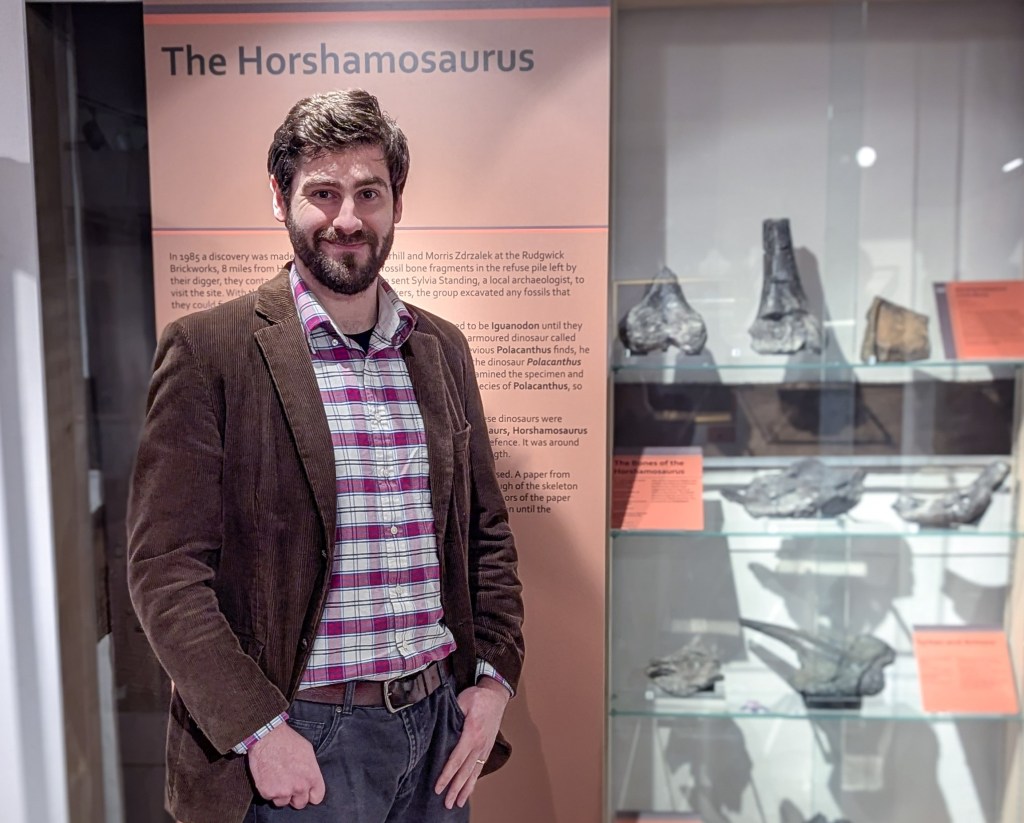
How far ahead do you plan for major exhibitions like this?
In this exhibition we have loans from the Natural History Museum and the Royal Society.
When securing loans from these large institutions they need to receive the request with a full year of notice, which means we need to have a pretty good idea of the objects we want to display and the themes of the exhibition more than a year in advance.
Starting the exhibition that early does mean that we’ve got a good amount of time to fully research all the topics before I start the writing, which I usually start at around the 6 months mark.
Are you a fan of dinosaurs?
Oh yes, visits to the Natural History Museum were very formative for me when I was young, and of course documentaries like ‘Walking with Dinosaurs’ and films like ‘Jurassic Park’ were a big part of my childhood, so both from an educational and entertainment point of view, I have always been interested in Dinosaurs.
What has been really nice about working on this exhibition is the focus on local discoveries.
The big famous dinosaurs like T-rex and Triceratops that you often see on television and in museums are all from North America and didn’t exist in England at all.
Dinosaurs like Iguanodon and Baryonyx aren’t as well known to the public but these are the dinosaurs that can be found beneath our feet here in Sussex, so working on them has been quite special to me.

Is it complicated asking for artefacts from other museums?
In most cases museums make borrowing objects really easy and accessible.
There is a good culture of being willing to share our collections, so the reactions you get for going to a museum, sharing your idea for an exhibition and asking for objects are always positive.
That said there are definitely hoops we have to jump through and criteria we need to meet so that lenders are confident that their objects will be safe while they are here.
On top of that there is the logistics of transporting objects etc. so the admin side of these loans does take a lot of time.
How do you plan what artefacts go where in an exhibition?
That’s actually a great question.
One of the big challenges that comes up when putting an exhibition together is that you have an idea in your head for a showcase with a certain group of objects in which all go really well together, and then you go ahead and measure everything to make sure it will fit and find out nothing will go where you envisioned and you have to go back to the drawing board!
Generally speaking we split the exhibition up into themes and group together objects for each theme. Then each theme gets its own display or showcase.
I’m sure all curators have their own methods for planning out a showcase. In my case I like to physically draw the showcase with paper and pencil and add in all the objects and labels.
Then I’ll meticulously measure everything to make sure it will fit where I want it to, and make sure the labels line up sensibly with their objects.
Usually there’s a few iterations of these sketches before I have the final version, but it does mean that when it comes to put the objects in the showcases I have a pretty good plan to follow, and if I’ve done my job well then the install goes pretty smoothly, which it did this time around.
What’s your favourite dinosaur?
I’m particularly fond of the Baryonyx. The type-specimen (the specimen from which the dinosaur was named) was discovered at the Smokejack brickworks in 1983, barely 5 miles outside of Horsham (but sadly just over the border into Surrey so we can’t lay claim to it!).
Baryonyx was a large predator, and the specimen actually had fish scales in its stomach when they dug it up, so we know that it ate fish, which is a pretty amazing discovery from 125 million years ago.
I’d be remiss if I didn’t give an honourable mention to the Horshamosaurus, which is not only named after our town but was a pretty cool animal itself.
If you imagine a spiky tortoise roughly the size of a car then you’re not far off the mark for what it looked like.
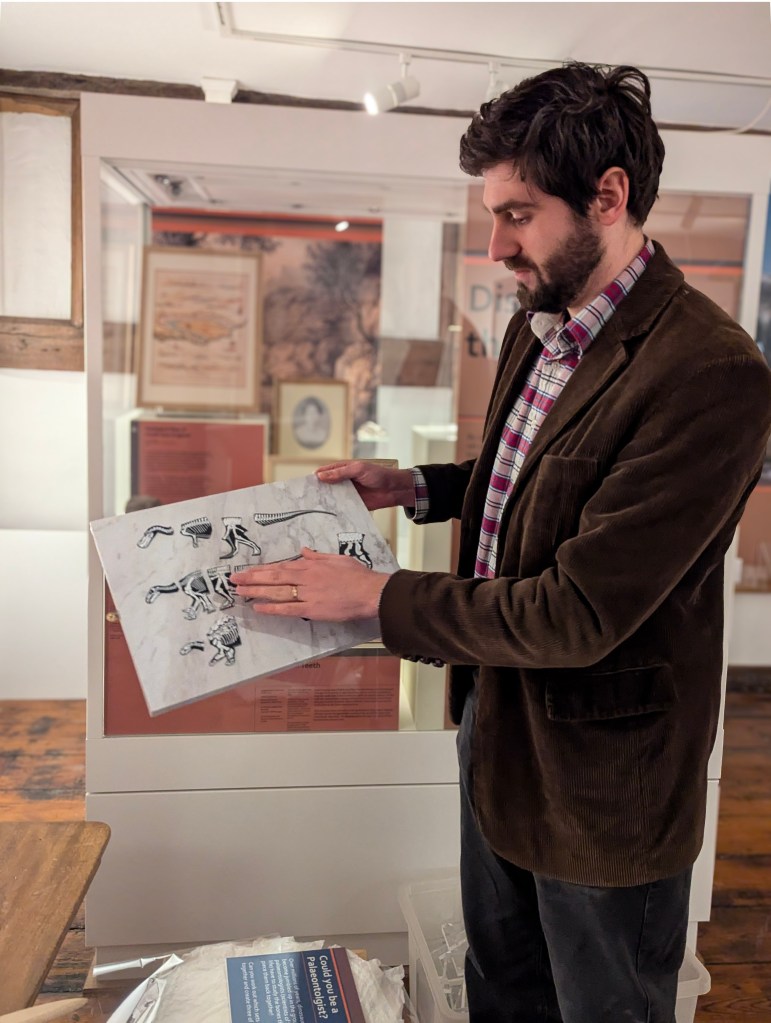
How much research did you have to do for this exhibition?
As I said, the exhibition planning started a good year in advance so I had plenty of time to do research.
There are two sides to the exhibition, the history of fossil hunters, which is quite well recorded in books about Gideon Mantell and Richard Owen, and even our local palaeontologist George Bax Holmes has a good historical publication about him, so I had plenty to work with.
The trick was boiling several books down to the much smaller word count of an exhibition.
The other side was researching the dinosaurs themselves, which was a little bit trickier as I wanted to publish the most modern information about these animals, which is mostly found in scientific journals.
These are extremely dense and because we are learning new things all the time they go out of date very quickly, so it was easy to spend a long time getting sucked into complex scientific debates that at the end of the day weren’t useful for the exhibition.
I think I struck a good balance in the end.
Which is your favourite artefact in the exhibition and why?
I’ve mentioned my fondness for the Horshamosaurus, the specimen of which is on display along with a pretty impressive scute (armoured spike) from a Polacanthus (a closely related species to Horshamosaurus).
Another favourite object is a book, “Fossils of the South Downs” by Gideon Mantell. It is quite a special copy on loan from lord Egremont of Petworth House.
This is considered to be the first book ever written to feature a large segment on dinosaurs, and our copy is the only one to have been hand coloured by Mantell himself, as a special gift to the Third Earl of Egremont, his primary sponsor at the time.
Discover more from Friends of Horsham Museum & Art Gallery
Subscribe to get the latest posts sent to your email.


That was so exciting to read — thank you for sharing!
LikeLike